SOCIAL MEDIA RESEARCH
ANNOTATED BIBLIOGRAPHY
Social media research
2
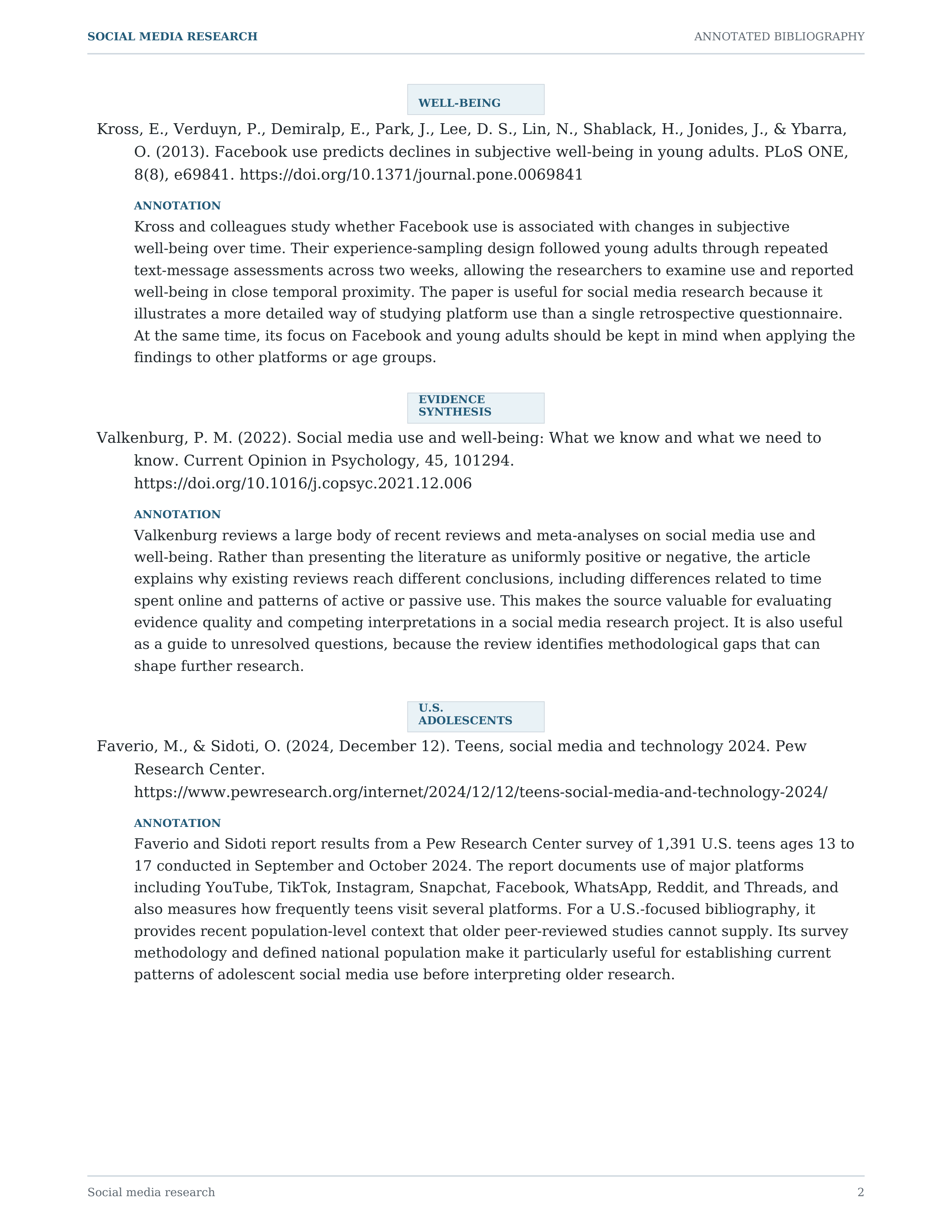
WELL-BEING
Kross, E., Verduyn, P., Demiralp, E., Park, J., Lee, D. S., Lin, N., Shablack, H., Jonides, J., & Ybarra,
O. (2013). Facebook use predicts declines in subjective well-being in young adults. PLoS ONE,
8(8), e69841. https://doi.org/10.1371/journal.pone.0069841
ANNOTATION
Kross and colleagues study whether Facebook use is associated with changes in subjective
well-being over time. Their experience-sampling design followed young adults through repeated
text-message assessments across two weeks, allowing the researchers to examine use and reported
well-being in close temporal proximity. The paper is useful for social media research because it
illustrates a more detailed way of studying platform use than a single retrospective questionnaire.
At the same time, its focus on Facebook and young adults should be kept in mind when applying the
findings to other platforms or age groups.
EVIDENCE
SYNTHESIS
Valkenburg, P. M. (2022). Social media use and well-being: What we know and what we need to
know. Current Opinion in Psychology, 45, 101294.
https://doi.org/10.1016/j.copsyc.2021.12.006
ANNOTATION
Valkenburg reviews a large body of recent reviews and meta-analyses on social media use and
well-being. Rather than presenting the literature as uniformly positive or negative, the article
explains why existing reviews reach different conclusions, including differences related to time
spent online and patterns of active or passive use. This makes the source valuable for evaluating
evidence quality and competing interpretations in a social media research project. It is also useful
as a guide to unresolved questions, because the review identifies methodological gaps that can
shape further research.
U.S.
ADOLESCENTS
Faverio, M., & Sidoti, O. (2024, December 12). Teens, social media and technology 2024. Pew
Research Center.
https://www.pewresearch.org/internet/2024/12/12/teens-social-media-and-technology-2024/
ANNOTATION
Faverio and Sidoti report results from a Pew Research Center survey of 1,391 U.S. teens ages 13 to
17 conducted in September and October 2024. The report documents use of major platforms
including YouTube, TikTok, Instagram, Snapchat, Facebook, WhatsApp, Reddit, and Threads, and
also measures how frequently teens visit several platforms. For a U.S.-focused bibliography, it
provides recent population-level context that older peer-reviewed studies cannot supply. Its survey
methodology and defined national population make it particularly useful for establishing current
patterns of adolescent social media use before interpreting older research.