CHILD DEVELOPMENT RESEARCH / EVIDENCE
PAGE 2
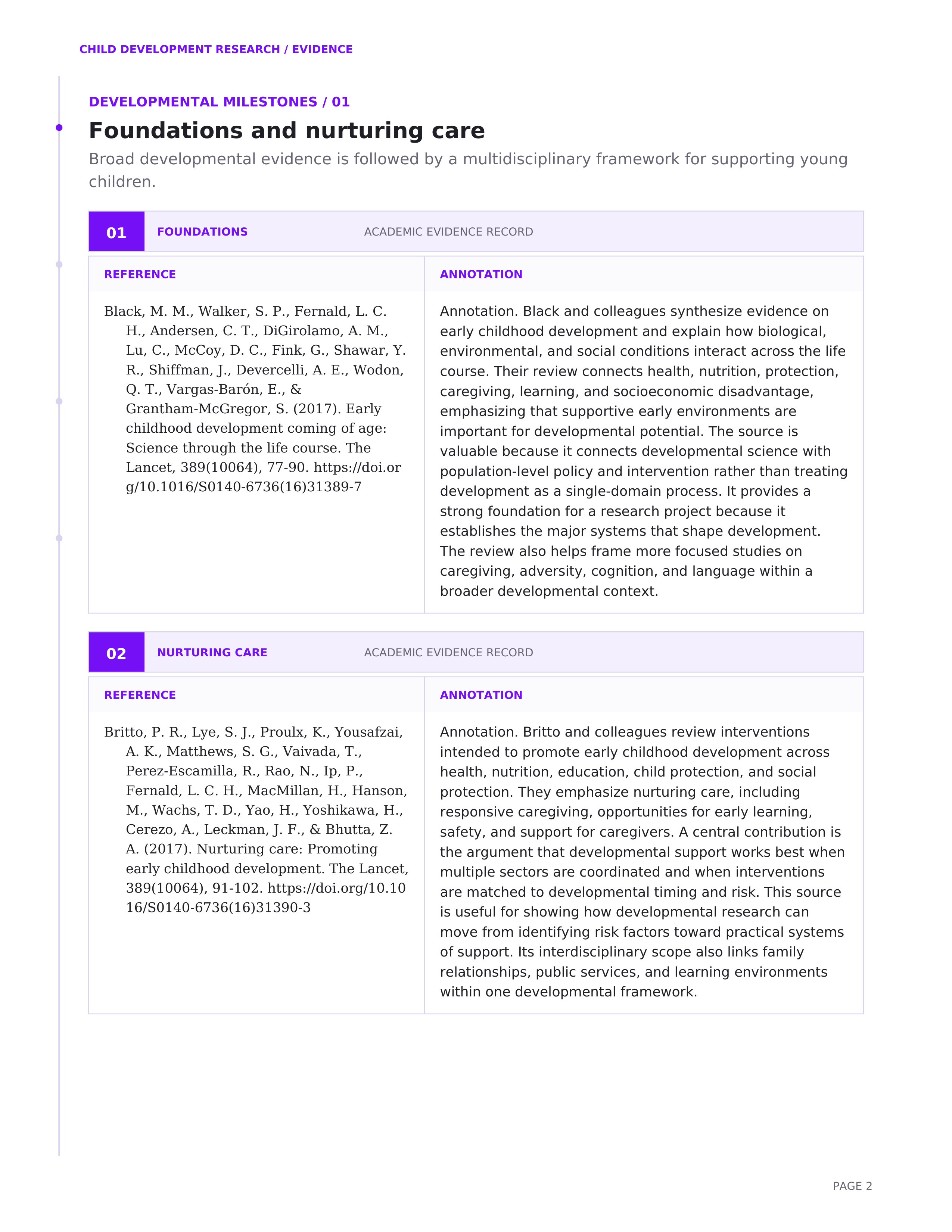
DEVELOPMENTAL MILESTONES / 01
Foundations and nurturing care
Broad developmental evidence is followed by a multidisciplinary framework for supporting young
children.
01
FOUNDATIONS
ACADEMIC EVIDENCE RECORD
REFERENCE
ANNOTATION
Black, M. M., Walker, S. P., Fernald, L. C.
H., Andersen, C. T., DiGirolamo, A. M.,
Lu, C., McCoy, D. C., Fink, G., Shawar, Y.
R., Shiffman, J., Devercelli, A. E., Wodon,
Q. T., Vargas-Barón, E., &
Grantham-McGregor, S. (2017). Early
childhood development coming of age:
Science through the life course. The
Lancet, 389(10064), 77-90. https://doi.or
g/10.1016/S0140-6736(16)31389-7
Annotation. Black and colleagues synthesize evidence on
early childhood development and explain how biological,
environmental, and social conditions interact across the life
course. Their review connects health, nutrition, protection,
caregiving, learning, and socioeconomic disadvantage,
emphasizing that supportive early environments are
important for developmental potential. The source is
valuable because it connects developmental science with
population-level policy and intervention rather than treating
development as a single-domain process. It provides a
strong foundation for a research project because it
establishes the major systems that shape development.
The review also helps frame more focused studies on
caregiving, adversity, cognition, and language within a
broader developmental context.
02
NURTURING CARE
ACADEMIC EVIDENCE RECORD
REFERENCE
ANNOTATION
Britto, P. R., Lye, S. J., Proulx, K., Yousafzai,
A. K., Matthews, S. G., Vaivada, T.,
Perez-Escamilla, R., Rao, N., Ip, P.,
Fernald, L. C. H., MacMillan, H., Hanson,
M., Wachs, T. D., Yao, H., Yoshikawa, H.,
Cerezo, A., Leckman, J. F., & Bhutta, Z.
A. (2017). Nurturing care: Promoting
early childhood development. The Lancet,
389(10064), 91-102. https://doi.org/10.10
16/S0140-6736(16)31390-3
Annotation. Britto and colleagues review interventions
intended to promote early childhood development across
health, nutrition, education, child protection, and social
protection. They emphasize nurturing care, including
responsive caregiving, opportunities for early learning,
safety, and support for caregivers. A central contribution is
the argument that developmental support works best when
multiple sectors are coordinated and when interventions
are matched to developmental timing and risk. This source
is useful for showing how developmental research can
move from identifying risk factors toward practical systems
of support. Its interdisciplinary scope also links family
relationships, public services, and learning environments
within one developmental framework.