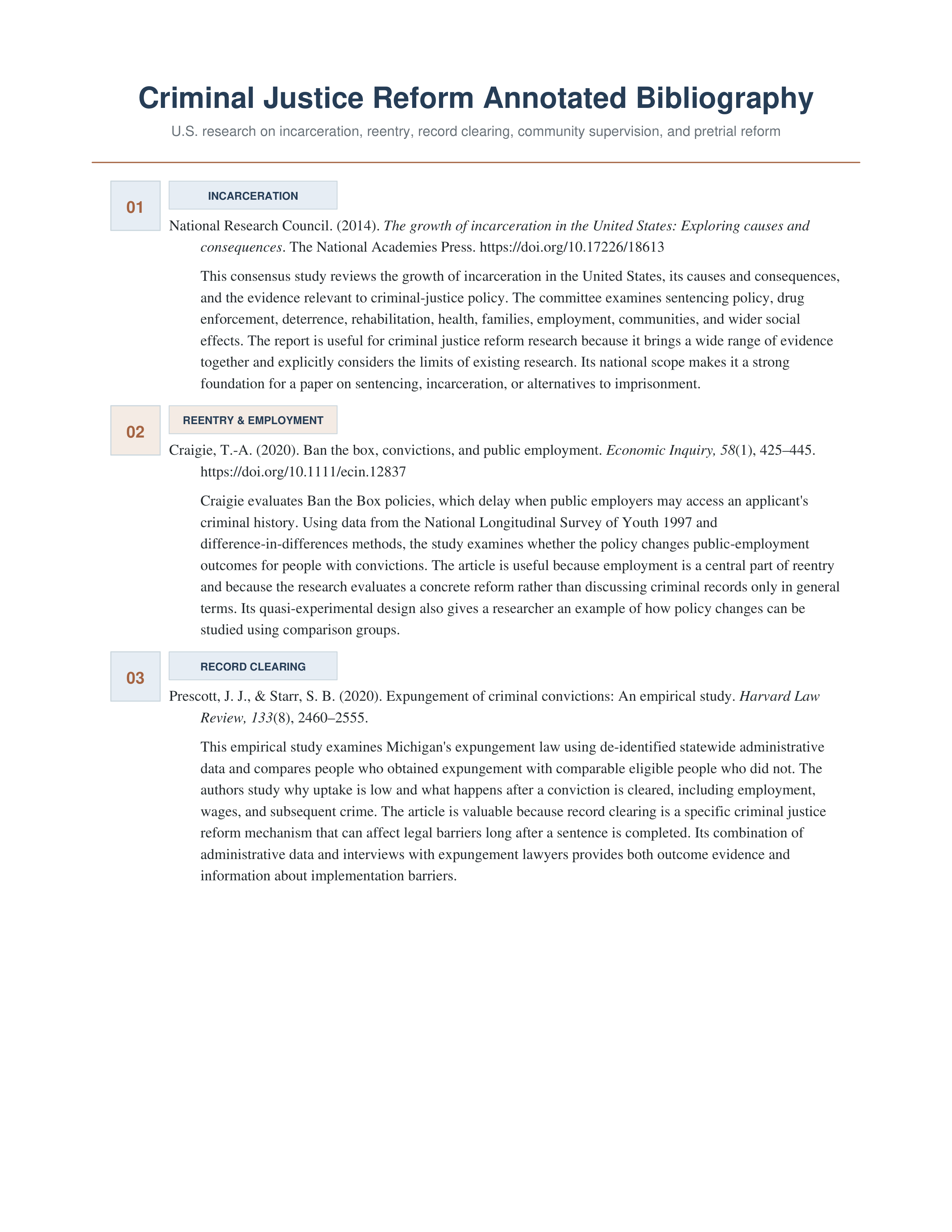
Criminal Justice Reform Annotated Bibliography
U.S. research on incarceration, reentry, record clearing, community supervision, and pretrial reform
01
INCARCERATION
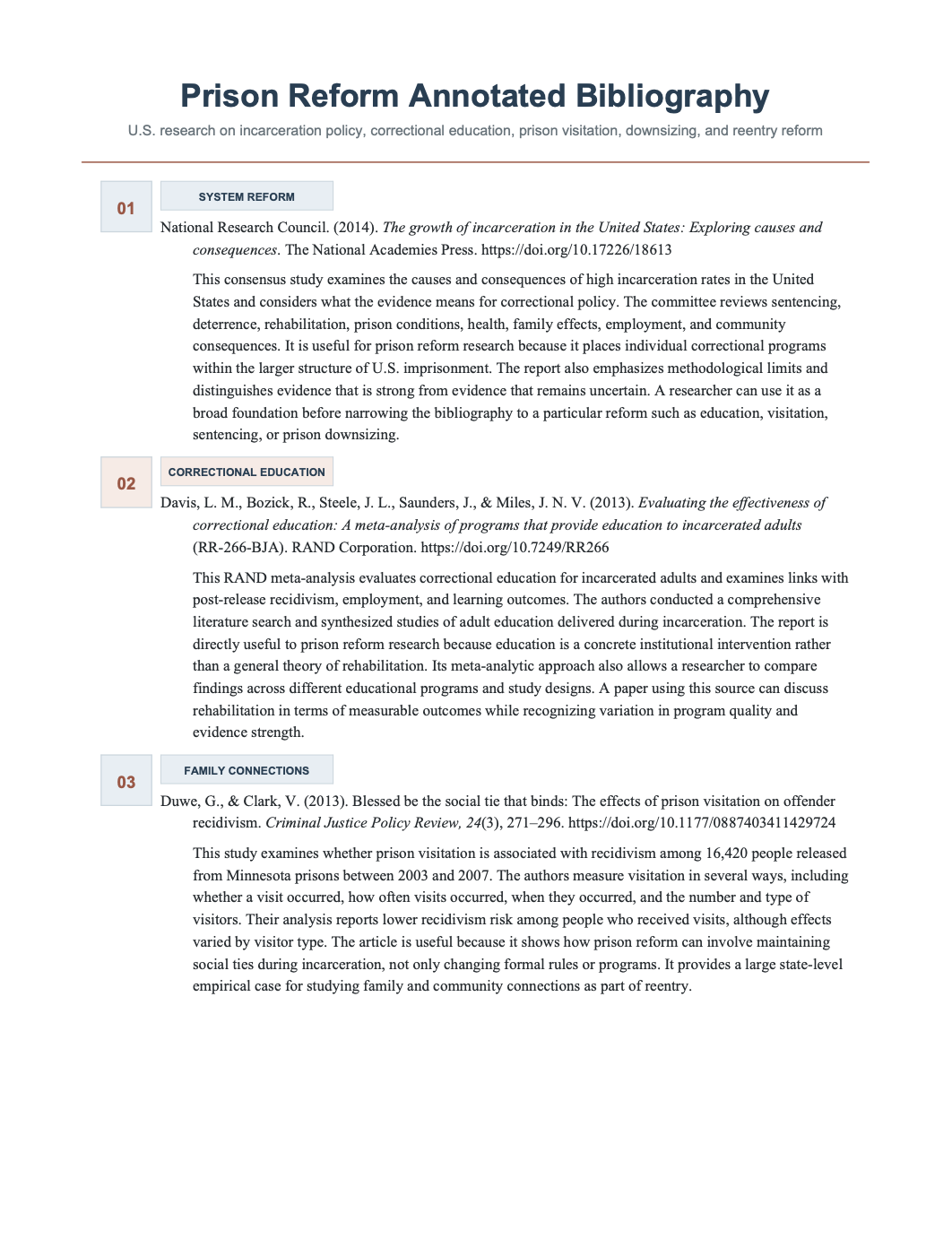
National Research Council. (2014).
The growth of incarceration in the United States: Exploring causes and
consequences
. The National Academies Press. https://doi.org/10.17226/18613
This consensus study reviews the growth of incarceration in the United States, its causes and consequences,
and the evidence relevant to criminal-justice policy. The committee examines sentencing policy, drug
enforcement, deterrence, rehabilitation, health, families, employment, communities, and wider social
effects. The report is useful for criminal justice reform research because it brings a wide range of evidence
together and explicitly considers the limits of existing research. Its national scope makes it a strong
foundation for a paper on sentencing, incarceration, or alternatives to imprisonment.
02
REENTRY & EMPLOYMENT
Craigie, T.-A. (2020). Ban the box, convictions, and public employment.
Economic Inquiry, 58
(1), 425–445.
https://doi.org/10.1111/ecin.12837
Craigie evaluates Ban the Box policies, which delay when public employers may access an applicant's
criminal history. Using data from the National Longitudinal Survey of Youth 1997 and
difference-in-differences methods, the study examines whether the policy changes public-employment
outcomes for people with convictions. The article is useful because employment is a central part of reentry
and because the research evaluates a concrete reform rather than discussing criminal records only in general
terms. Its quasi-experimental design also gives a researcher an example of how policy changes can be
studied using comparison groups.
03
RECORD CLEARING
Prescott, J. J., & Starr, S. B. (2020). Expungement of criminal convictions: An empirical study.
Harvard Law
Review, 133
(8), 2460–2555.
This empirical study examines Michigan's expungement law using de-identified statewide administrative
data and compares people who obtained expungement with comparable eligible people who did not. The
authors study why uptake is low and what happens after a conviction is cleared, including employment,
wages, and subsequent crime. The article is valuable because record clearing is a specific criminal justice
reform mechanism that can affect legal barriers long after a sentence is completed. Its combination of
administrative data and interviews with expungement lawyers provides both outcome evidence and
information about implementation barriers.