CHILDHOOD OBESITY RESEARCH / EVIDENCE
PAGE 2
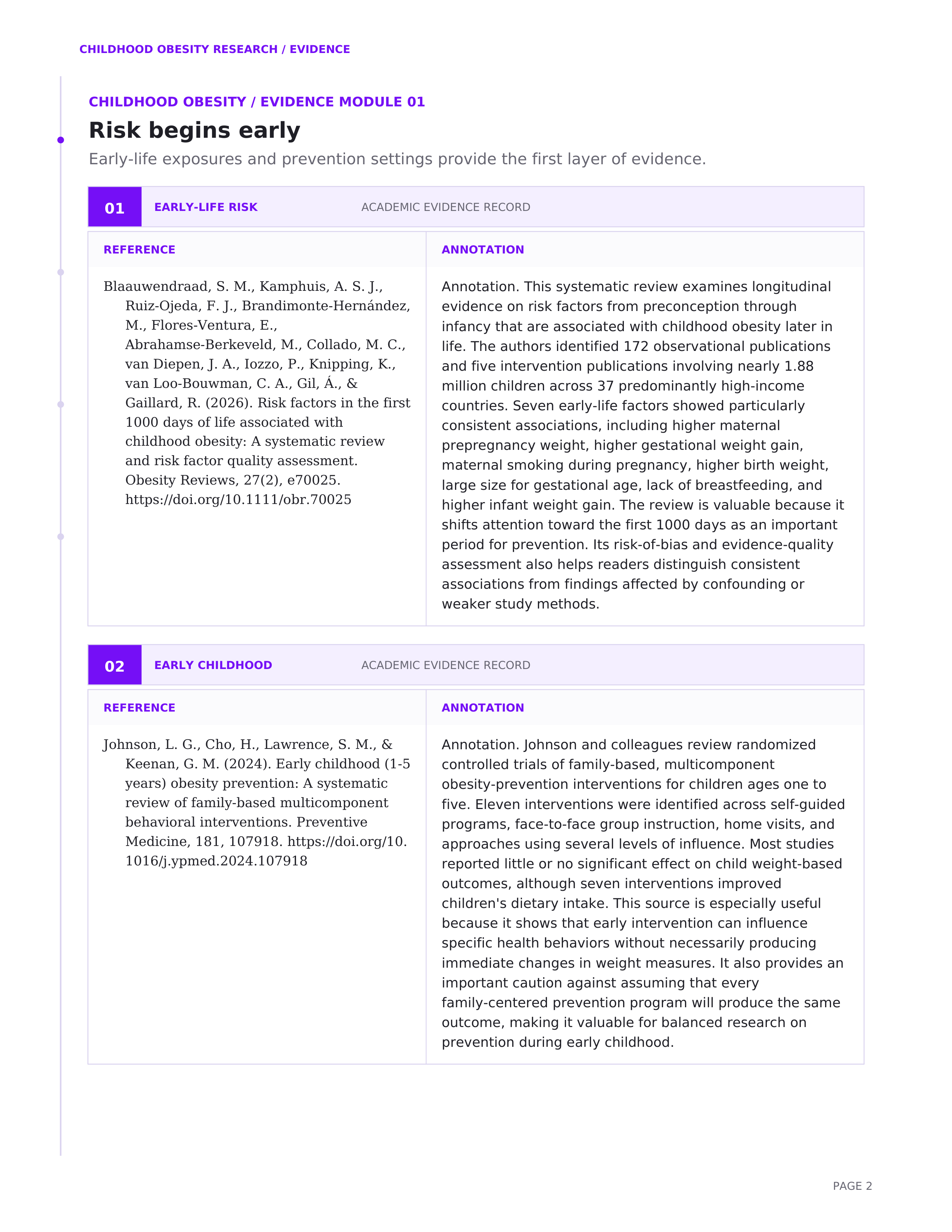
CHILDHOOD OBESITY / EVIDENCE MODULE 01
Risk begins early
Early-life exposures and prevention settings provide the first layer of evidence.
01
EARLY-LIFE RISK
ACADEMIC EVIDENCE RECORD
REFERENCE
ANNOTATION
Blaauwendraad, S. M., Kamphuis, A. S. J.,
Ruiz-Ojeda, F. J., Brandimonte-Hernández,
M., Flores-Ventura, E.,
Abrahamse-Berkeveld, M., Collado, M. C.,
van Diepen, J. A., Iozzo, P., Knipping, K.,
van Loo-Bouwman, C. A., Gil, Á., &
Gaillard, R. (2026). Risk factors in the first
1000 days of life associated with
childhood obesity: A systematic review
and risk factor quality assessment.
Obesity Reviews, 27(2), e70025.
https://doi.org/10.1111/obr.70025
Annotation. This systematic review examines longitudinal
evidence on risk factors from preconception through
infancy that are associated with childhood obesity later in
life. The authors identified 172 observational publications
and five intervention publications involving nearly 1.88
million children across 37 predominantly high-income
countries. Seven early-life factors showed particularly
consistent associations, including higher maternal
prepregnancy weight, higher gestational weight gain,
maternal smoking during pregnancy, higher birth weight,
large size for gestational age, lack of breastfeeding, and
higher infant weight gain. The review is valuable because it
shifts attention toward the first 1000 days as an important
period for prevention. Its risk-of-bias and evidence-quality
assessment also helps readers distinguish consistent
associations from findings affected by confounding or
weaker study methods.
02
EARLY CHILDHOOD
ACADEMIC EVIDENCE RECORD
REFERENCE
ANNOTATION
Johnson, L. G., Cho, H., Lawrence, S. M., &
Keenan, G. M. (2024). Early childhood (1-5
years) obesity prevention: A systematic
review of family-based multicomponent
behavioral interventions. Preventive
Medicine, 181, 107918. https://doi.org/10.
1016/j.ypmed.2024.107918
Annotation. Johnson and colleagues review randomized
controlled trials of family-based, multicomponent
obesity-prevention interventions for children ages one to
five. Eleven interventions were identified across self-guided
programs, face-to-face group instruction, home visits, and
approaches using several levels of influence. Most studies
reported little or no significant effect on child weight-based
outcomes, although seven interventions improved
children's dietary intake. This source is especially useful
because it shows that early intervention can influence
specific health behaviors without necessarily producing
immediate changes in weight measures. It also provides an
important caution against assuming that every
family-centered prevention program will produce the same
outcome, making it valuable for balanced research on
prevention during early childhood.