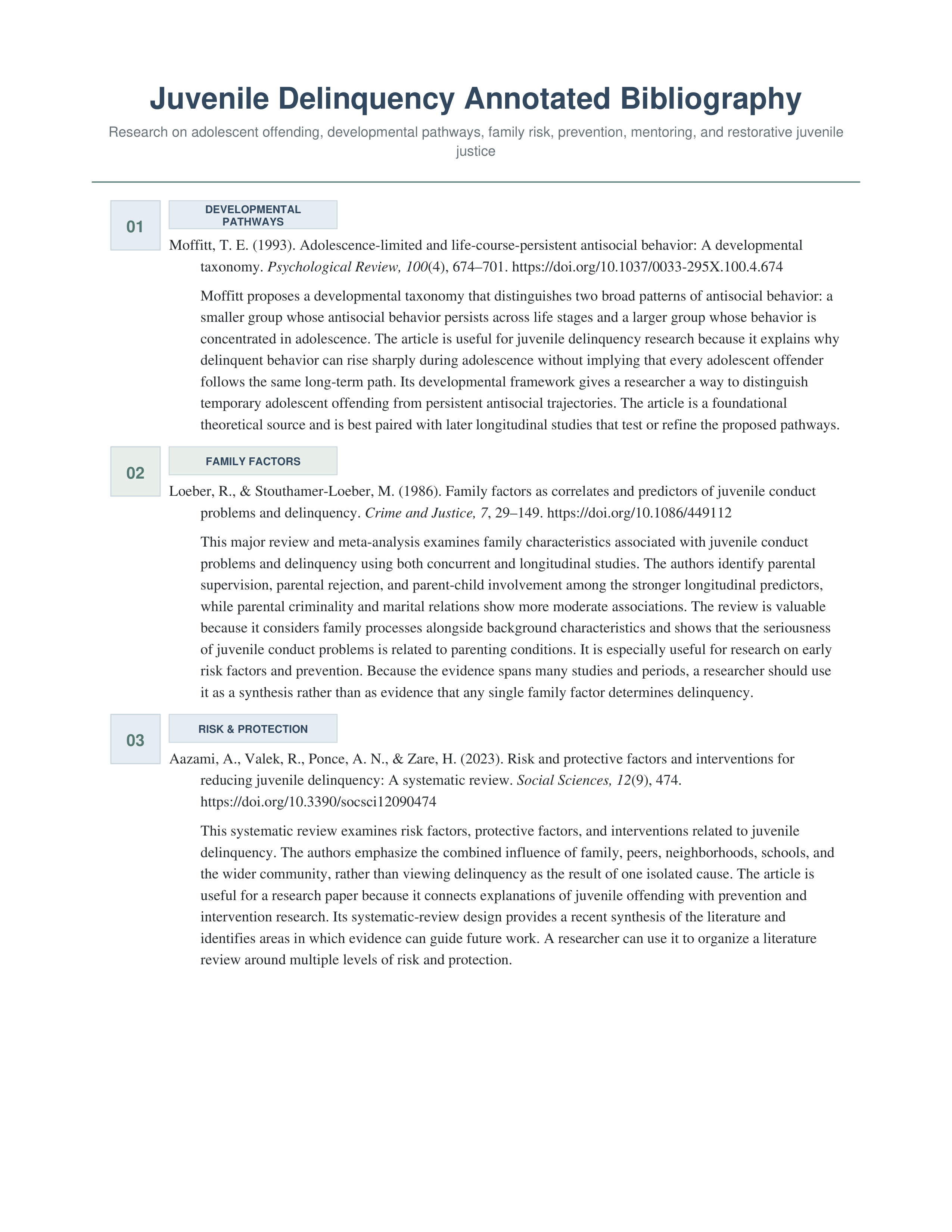
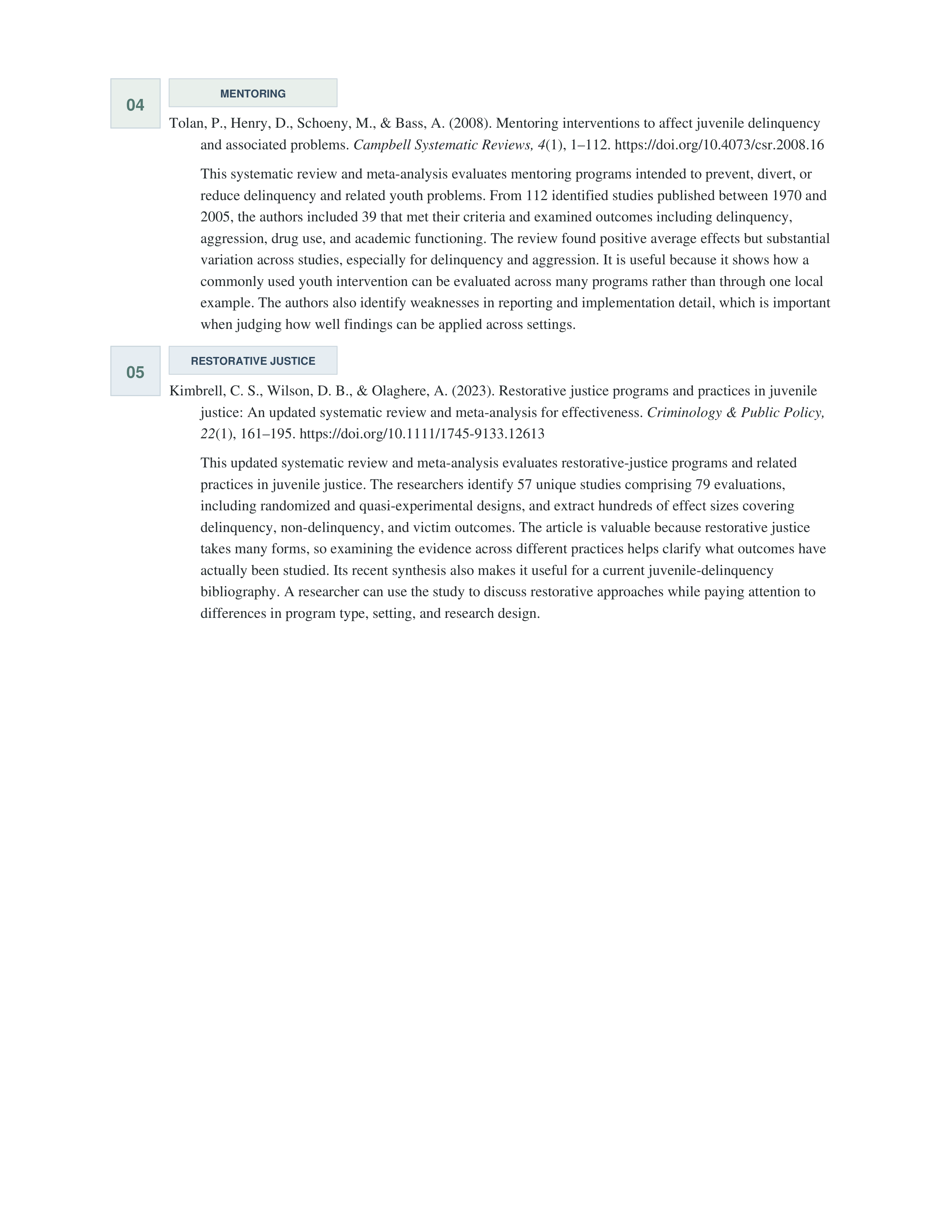
Juvenile Delinquency Annotated Bibliography
Research on adolescent offending, developmental pathways, family risk, prevention, mentoring, and restorative juvenile
justice
01
DEVELOPMENTAL
PATHWAYS
Moffitt, T. E. (1993). Adolescence-limited and life-course-persistent antisocial behavior: A developmental
taxonomy.
Psychological Review, 100
(4), 674–701. https://doi.org/10.1037/0033-295X.100.4.674
Moffitt proposes a developmental taxonomy that distinguishes two broad patterns of antisocial behavior: a
smaller group whose antisocial behavior persists across life stages and a larger group whose behavior is
concentrated in adolescence. The article is useful for juvenile delinquency research because it explains why
delinquent behavior can rise sharply during adolescence without implying that every adolescent offender
follows the same long-term path. Its developmental framework gives a researcher a way to distinguish
temporary adolescent offending from persistent antisocial trajectories. The article is a foundational
theoretical source and is best paired with later longitudinal studies that test or refine the proposed pathways.
02
FAMILY FACTORS
Loeber, R., & Stouthamer-Loeber, M. (1986). Family factors as correlates and predictors of juvenile conduct
problems and delinquency.
Crime and Justice, 7
, 29–149. https://doi.org/10.1086/449112
This major review and meta-analysis examines family characteristics associated with juvenile conduct
problems and delinquency using both concurrent and longitudinal studies. The authors identify parental
supervision, parental rejection, and parent-child involvement among the stronger longitudinal predictors,
while parental criminality and marital relations show more moderate associations. The review is valuable
because it considers family processes alongside background characteristics and shows that the seriousness
of juvenile conduct problems is related to parenting conditions. It is especially useful for research on early
risk factors and prevention. Because the evidence spans many studies and periods, a researcher should use
it as a synthesis rather than as evidence that any single family factor determines delinquency.
03
RISK & PROTECTION
Aazami, A., Valek, R., Ponce, A. N., & Zare, H. (2023). Risk and protective factors and interventions for
reducing juvenile delinquency: A systematic review.
Social Sciences, 12
(9), 474.
https://doi.org/10.3390/socsci12090474
This systematic review examines risk factors, protective factors, and interventions related to juvenile
delinquency. The authors emphasize the combined influence of family, peers, neighborhoods, schools, and
the wider community, rather than viewing delinquency as the result of one isolated cause. The article is
useful for a research paper because it connects explanations of juvenile offending with prevention and
intervention research. Its systematic-review design provides a recent synthesis of the literature and
identifies areas in which evidence can guide future work. A researcher can use it to organize a literature
review around multiple levels of risk and protection.