Student Debt Annotated Bibliography
U.S. research on borrowing for higher education, repayment burdens, college outcomes, housing, health, and financial
inequality
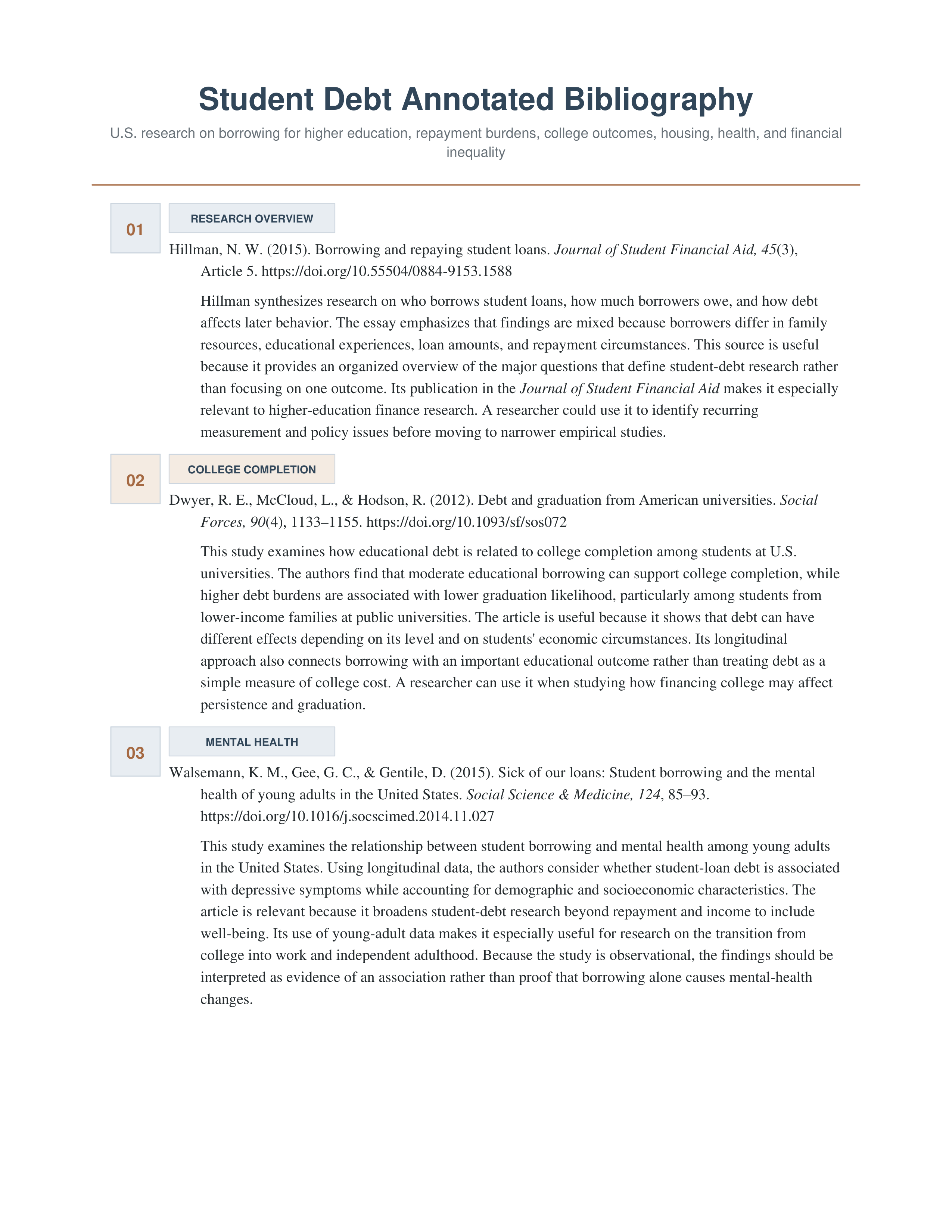
01
RESEARCH OVERVIEW
Hillman, N. W. (2015). Borrowing and repaying student loans.
Journal of Student Financial Aid, 45
(3),
Article 5. https://doi.org/10.55504/0884-9153.1588
Hillman synthesizes research on who borrows student loans, how much borrowers owe, and how debt
affects later behavior. The essay emphasizes that findings are mixed because borrowers differ in family
resources, educational experiences, loan amounts, and repayment circumstances. This source is useful
because it provides an organized overview of the major questions that define student-debt research rather
than focusing on one outcome. Its publication in the
Journal of Student Financial Aid
makes it especially
relevant to higher-education finance research. A researcher could use it to identify recurring
measurement and policy issues before moving to narrower empirical studies.
02
COLLEGE COMPLETION
Dwyer, R. E., McCloud, L., & Hodson, R. (2012). Debt and graduation from American universities.
Social
Forces, 90
(4), 1133–1155. https://doi.org/10.1093/sf/sos072
This study examines how educational debt is related to college completion among students at U.S.
universities. The authors find that moderate educational borrowing can support college completion, while
higher debt burdens are associated with lower graduation likelihood, particularly among students from
lower-income families at public universities. The article is useful because it shows that debt can have
different effects depending on its level and on students' economic circumstances. Its longitudinal
approach also connects borrowing with an important educational outcome rather than treating debt as a
simple measure of college cost. A researcher can use it when studying how financing college may affect
persistence and graduation.
03
MENTAL HEALTH
Walsemann, K. M., Gee, G. C., & Gentile, D. (2015). Sick of our loans: Student borrowing and the mental
health of young adults in the United States.
Social Science & Medicine, 124
, 85–93.
https://doi.org/10.1016/j.socscimed.2014.11.027
This study examines the relationship between student borrowing and mental health among young adults
in the United States. Using longitudinal data, the authors consider whether student-loan debt is associated
with depressive symptoms while accounting for demographic and socioeconomic characteristics. The
article is relevant because it broadens student-debt research beyond repayment and income to include
well-being. Its use of young-adult data makes it especially useful for research on the transition from
college into work and independent adulthood. Because the study is observational, the findings should be
interpreted as evidence of an association rather than proof that borrowing alone causes mental-health
changes.