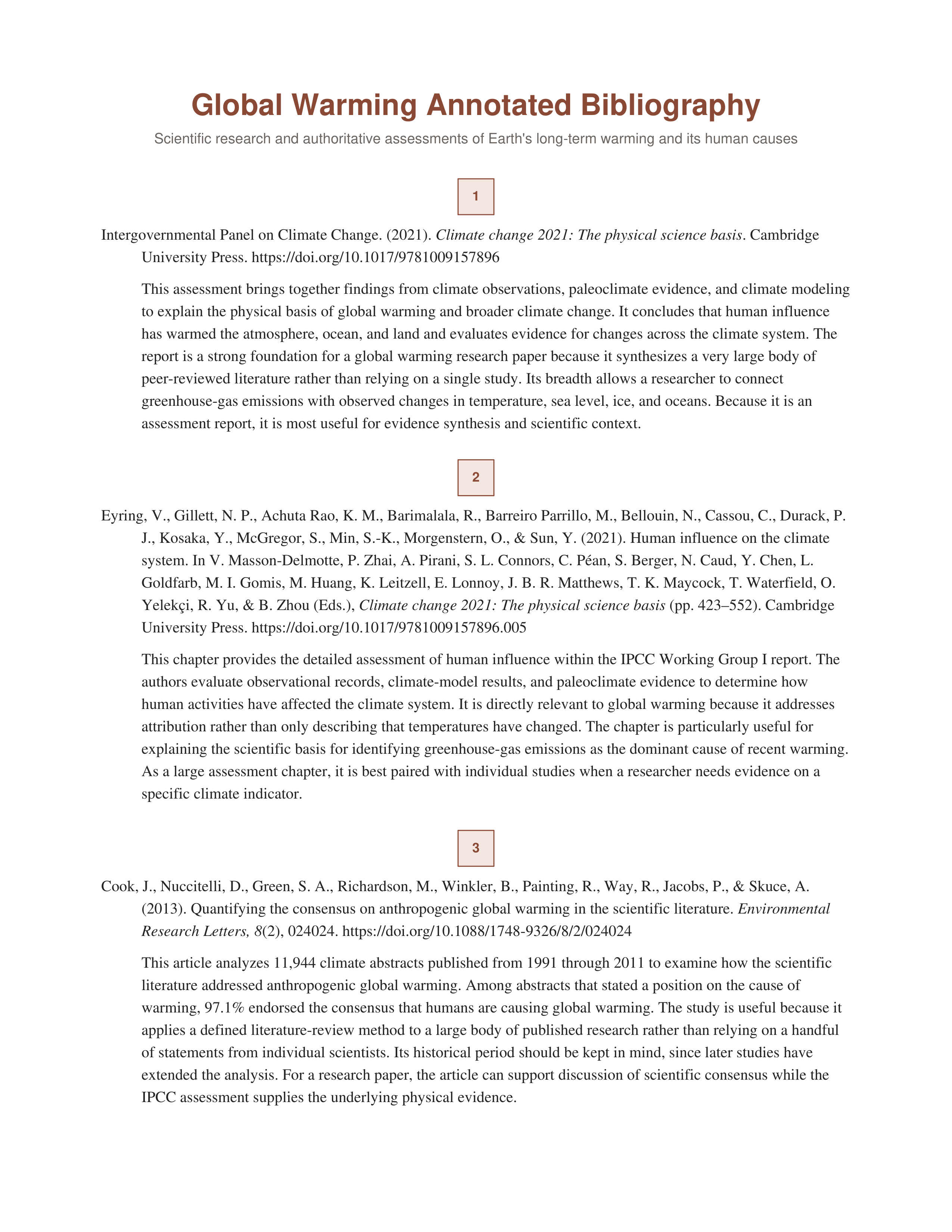
Global Warming Annotated Bibliography
Scientific research and authoritative assessments of Earth's long-term warming and its human causes
1
Intergovernmental Panel on Climate Change. (2021).
Climate change 2021: The physical science basis
. Cambridge
University Press. https://doi.org/10.1017/9781009157896
This assessment brings together findings from climate observations, paleoclimate evidence, and climate modeling
to explain the physical basis of global warming and broader climate change. It concludes that human influence
has warmed the atmosphere, ocean, and land and evaluates evidence for changes across the climate system. The
report is a strong foundation for a global warming research paper because it synthesizes a very large body of
peer-reviewed literature rather than relying on a single study. Its breadth allows a researcher to connect
greenhouse-gas emissions with observed changes in temperature, sea level, ice, and oceans. Because it is an
assessment report, it is most useful for evidence synthesis and scientific context.
2
Eyring, V., Gillett, N. P., Achuta Rao, K. M., Barimalala, R., Barreiro Parrillo, M., Bellouin, N., Cassou, C., Durack, P.
J., Kosaka, Y., McGregor, S., Min, S.-K., Morgenstern, O., & Sun, Y. (2021). Human influence on the climate
system. In V. Masson-Delmotte, P. Zhai, A. Pirani, S. L. Connors, C. Péan, S. Berger, N. Caud, Y. Chen, L.
Goldfarb, M. I. Gomis, M. Huang, K. Leitzell, E. Lonnoy, J. B. R. Matthews, T. K. Maycock, T. Waterfield, O.
Yelekçi, R. Yu, & B. Zhou (Eds.),
Climate change 2021: The physical science basis
(pp. 423–552). Cambridge
University Press. https://doi.org/10.1017/9781009157896.005
This chapter provides the detailed assessment of human influence within the IPCC Working Group I report. The
authors evaluate observational records, climate-model results, and paleoclimate evidence to determine how
human activities have affected the climate system. It is directly relevant to global warming because it addresses
attribution rather than only describing that temperatures have changed. The chapter is particularly useful for
explaining the scientific basis for identifying greenhouse-gas emissions as the dominant cause of recent warming.
As a large assessment chapter, it is best paired with individual studies when a researcher needs evidence on a
specific climate indicator.
3
Cook, J., Nuccitelli, D., Green, S. A., Richardson, M., Winkler, B., Painting, R., Way, R., Jacobs, P., & Skuce, A.
(2013). Quantifying the consensus on anthropogenic global warming in the scientific literature.
Environmental
Research Letters, 8
(2), 024024. https://doi.org/10.1088/1748-9326/8/2/024024
This article analyzes 11,944 climate abstracts published from 1991 through 2011 to examine how the scientific
literature addressed anthropogenic global warming. Among abstracts that stated a position on the cause of
warming, 97.1% endorsed the consensus that humans are causing global warming. The study is useful because it
applies a defined literature-review method to a large body of published research rather than relying on a handful
of statements from individual scientists. Its historical period should be kept in mind, since later studies have
extended the analysis. For a research paper, the article can support discussion of scientific consensus while the
IPCC assessment supplies the underlying physical evidence.