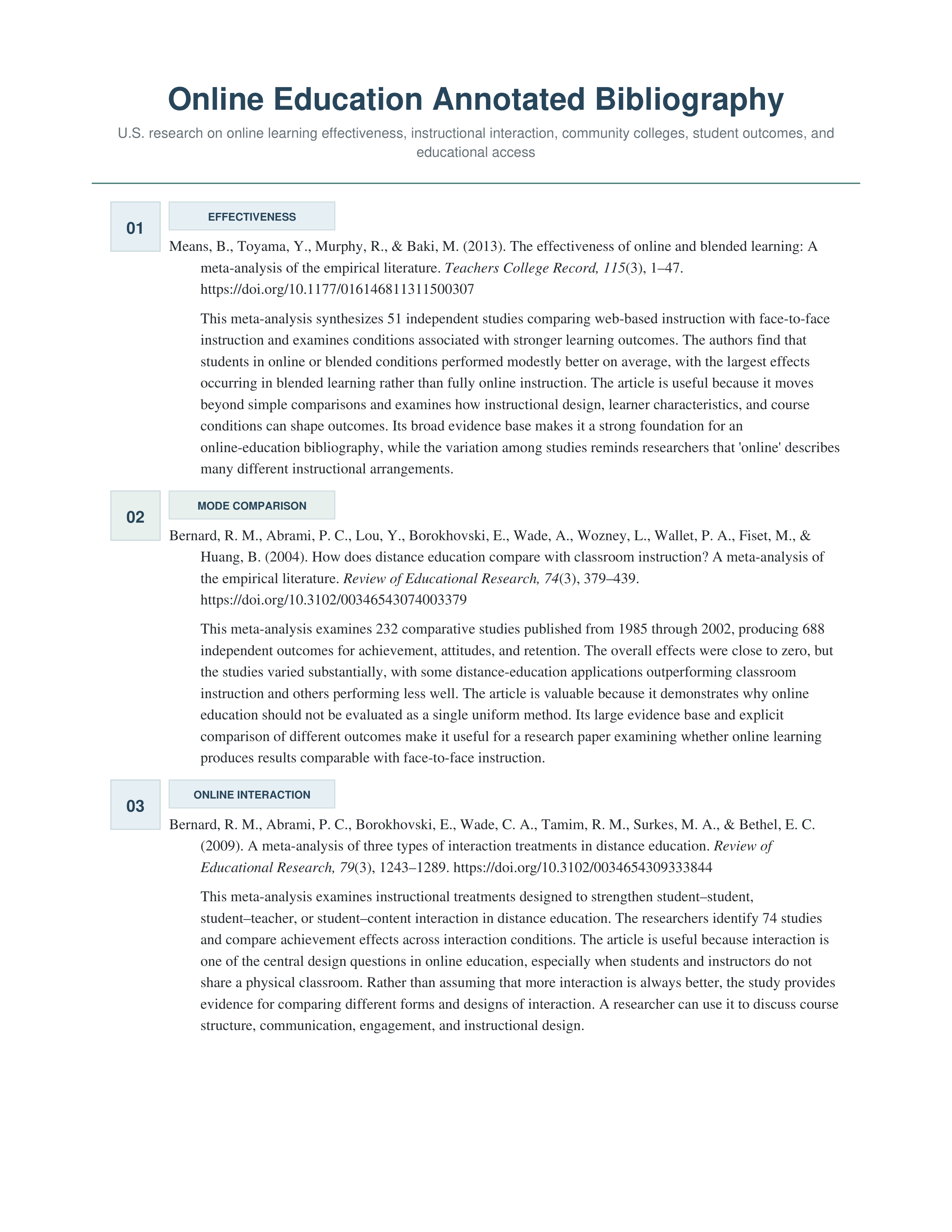
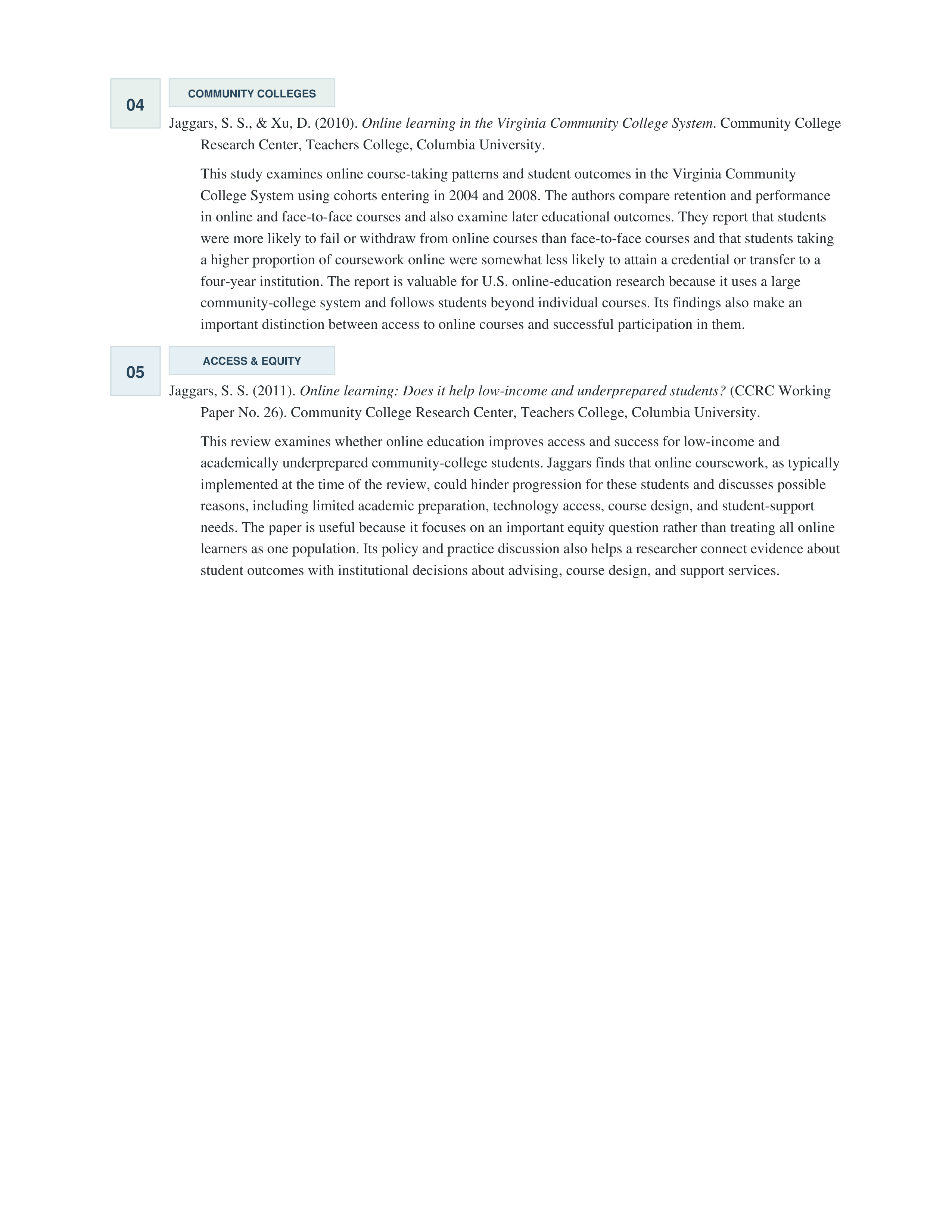
Online Education Annotated Bibliography
U.S. research on online learning effectiveness, instructional interaction, community colleges, student outcomes, and
educational access
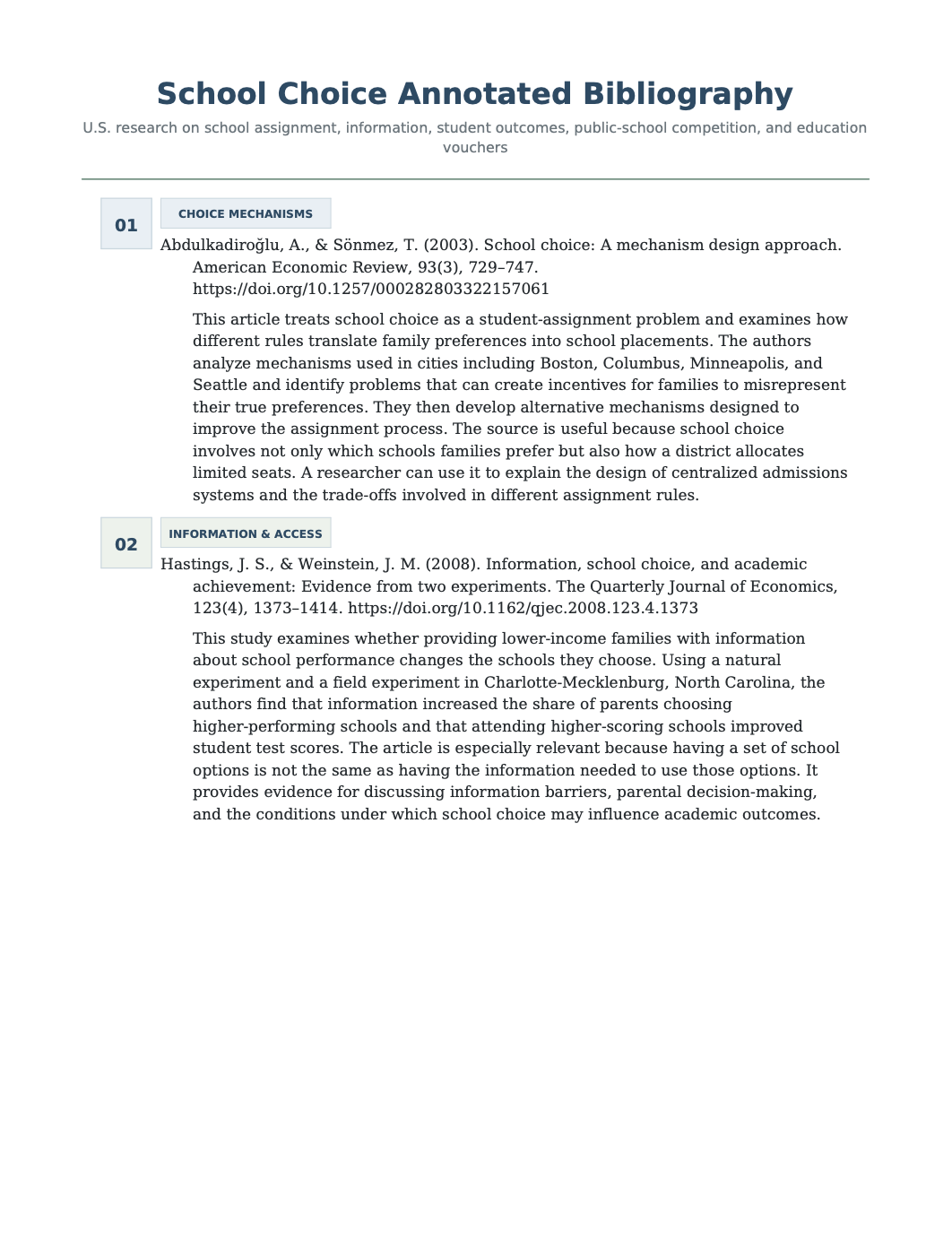
01
EFFECTIVENESS
Means, B., Toyama, Y., Murphy, R., & Baki, M. (2013). The effectiveness of online and blended learning: A
meta-analysis of the empirical literature.
Teachers College Record, 115
(3), 1–47.
https://doi.org/10.1177/016146811311500307
This meta-analysis synthesizes 51 independent studies comparing web-based instruction with face-to-face
instruction and examines conditions associated with stronger learning outcomes. The authors find that
students in online or blended conditions performed modestly better on average, with the largest effects
occurring in blended learning rather than fully online instruction. The article is useful because it moves
beyond simple comparisons and examines how instructional design, learner characteristics, and course
conditions can shape outcomes. Its broad evidence base makes it a strong foundation for an
online-education bibliography, while the variation among studies reminds researchers that 'online' describes
many different instructional arrangements.
02
MODE COMPARISON
Bernard, R. M., Abrami, P. C., Lou, Y., Borokhovski, E., Wade, A., Wozney, L., Wallet, P. A., Fiset, M., &
Huang, B. (2004). How does distance education compare with classroom instruction? A meta-analysis of
the empirical literature.
Review of Educational Research, 74
(3), 379–439.
https://doi.org/10.3102/00346543074003379
This meta-analysis examines 232 comparative studies published from 1985 through 2002, producing 688
independent outcomes for achievement, attitudes, and retention. The overall effects were close to zero, but
the studies varied substantially, with some distance-education applications outperforming classroom
instruction and others performing less well. The article is valuable because it demonstrates why online
education should not be evaluated as a single uniform method. Its large evidence base and explicit
comparison of different outcomes make it useful for a research paper examining whether online learning
produces results comparable with face-to-face instruction.
03
ONLINE INTERACTION
Bernard, R. M., Abrami, P. C., Borokhovski, E., Wade, C. A., Tamim, R. M., Surkes, M. A., & Bethel, E. C.
(2009). A meta-analysis of three types of interaction treatments in distance education.
Review of
Educational Research, 79
(3), 1243–1289. https://doi.org/10.3102/0034654309333844
This meta-analysis examines instructional treatments designed to strengthen student–student,
student–teacher, or student–content interaction in distance education. The researchers identify 74 studies
and compare achievement effects across interaction conditions. The article is useful because interaction is
one of the central design questions in online education, especially when students and instructors do not
share a physical classroom. Rather than assuming that more interaction is always better, the study provides
evidence for comparing different forms and designs of interaction. A researcher can use it to discuss course
structure, communication, engagement, and instructional design.