Prison Reform Annotated Bibliography
U.S. research on incarceration policy, correctional education, prison visitation, downsizing, and reentry reform
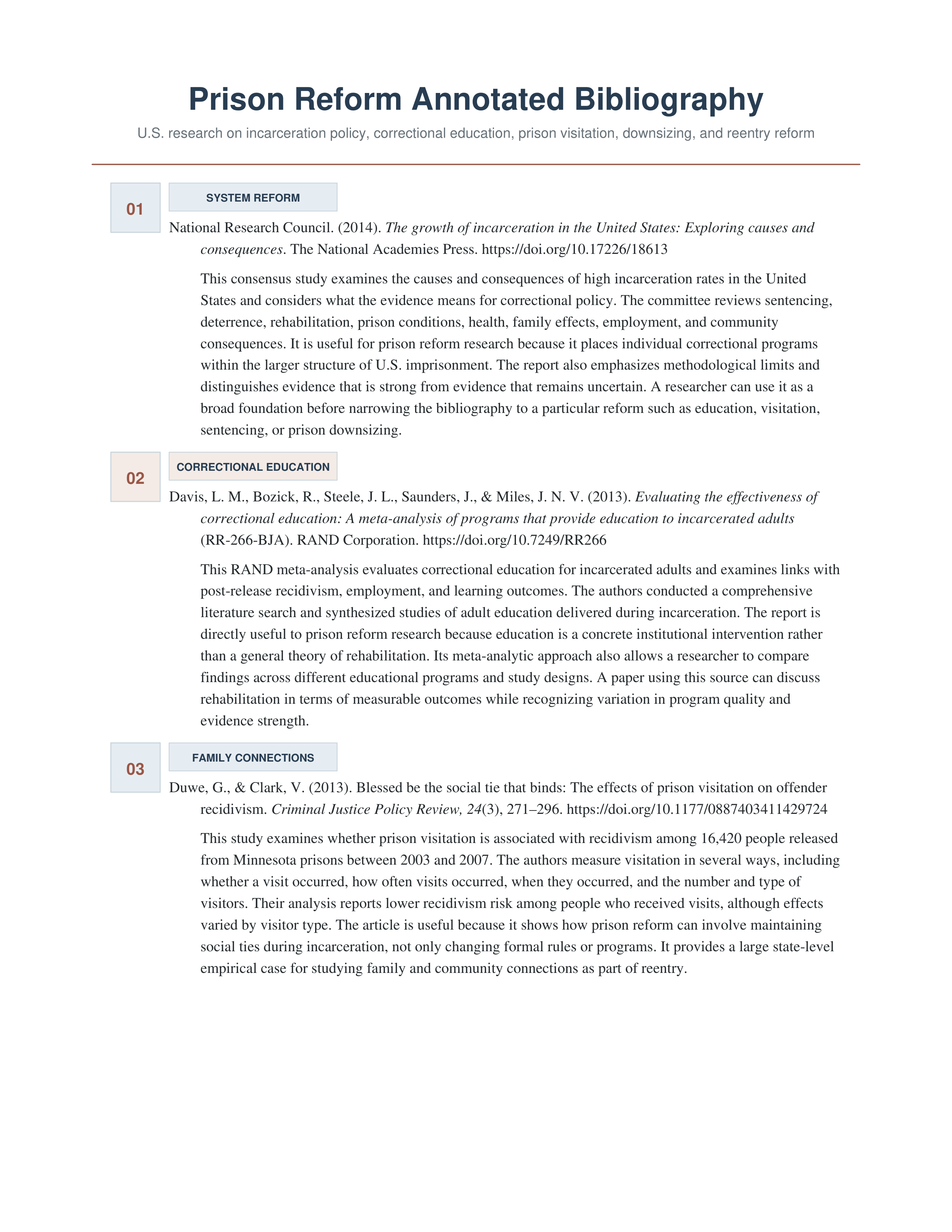
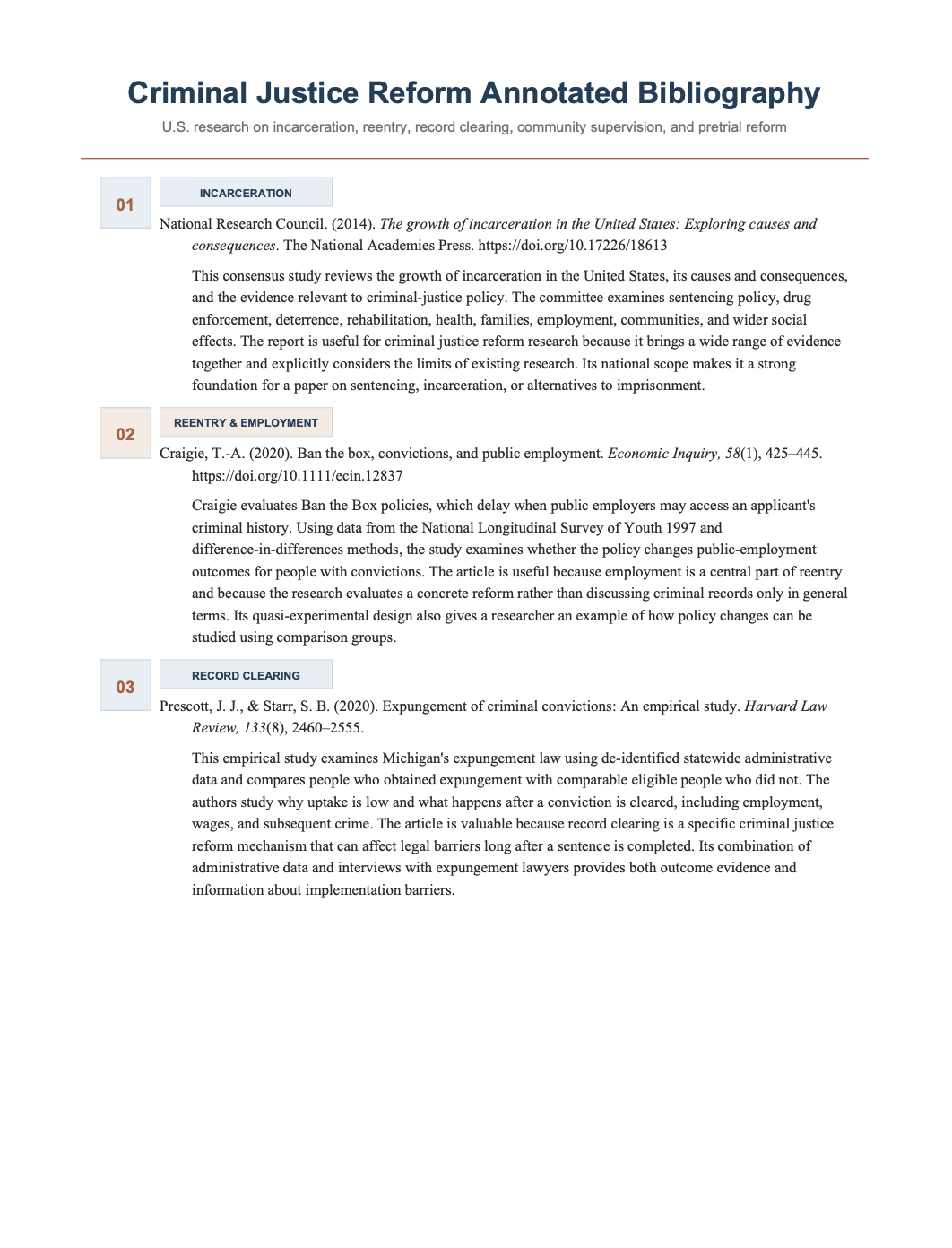
01
SYSTEM REFORM
National Research Council. (2014).
The growth of incarceration in the United States: Exploring causes and
consequences
. The National Academies Press. https://doi.org/10.17226/18613
This consensus study examines the causes and consequences of high incarceration rates in the United
States and considers what the evidence means for correctional policy. The committee reviews sentencing,
deterrence, rehabilitation, prison conditions, health, family effects, employment, and community
consequences. It is useful for prison reform research because it places individual correctional programs
within the larger structure of U.S. imprisonment. The report also emphasizes methodological limits and
distinguishes evidence that is strong from evidence that remains uncertain. A researcher can use it as a
broad foundation before narrowing the bibliography to a particular reform such as education, visitation,
sentencing, or prison downsizing.
02
CORRECTIONAL EDUCATION
Davis, L. M., Bozick, R., Steele, J. L., Saunders, J., & Miles, J. N. V. (2013).
Evaluating the effectiveness of
correctional education: A meta-analysis of programs that provide education to incarcerated adults
(RR-266-BJA). RAND Corporation. https://doi.org/10.7249/RR266
This RAND meta-analysis evaluates correctional education for incarcerated adults and examines links with
post-release recidivism, employment, and learning outcomes. The authors conducted a comprehensive
literature search and synthesized studies of adult education delivered during incarceration. The report is
directly useful to prison reform research because education is a concrete institutional intervention rather
than a general theory of rehabilitation. Its meta-analytic approach also allows a researcher to compare
findings across different educational programs and study designs. A paper using this source can discuss
rehabilitation in terms of measurable outcomes while recognizing variation in program quality and
evidence strength.
03
FAMILY CONNECTIONS
Duwe, G., & Clark, V. (2013). Blessed be the social tie that binds: The effects of prison visitation on offender
recidivism.
Criminal Justice Policy Review, 24
(3), 271–296. https://doi.org/10.1177/0887403411429724
This study examines whether prison visitation is associated with recidivism among 16,420 people released
from Minnesota prisons between 2003 and 2007. The authors measure visitation in several ways, including
whether a visit occurred, how often visits occurred, when they occurred, and the number and type of
visitors. Their analysis reports lower recidivism risk among people who received visits, although effects
varied by visitor type. The article is useful because it shows how prison reform can involve maintaining
social ties during incarceration, not only changing formal rules or programs. It provides a large state-level
empirical case for studying family and community connections as part of reentry.