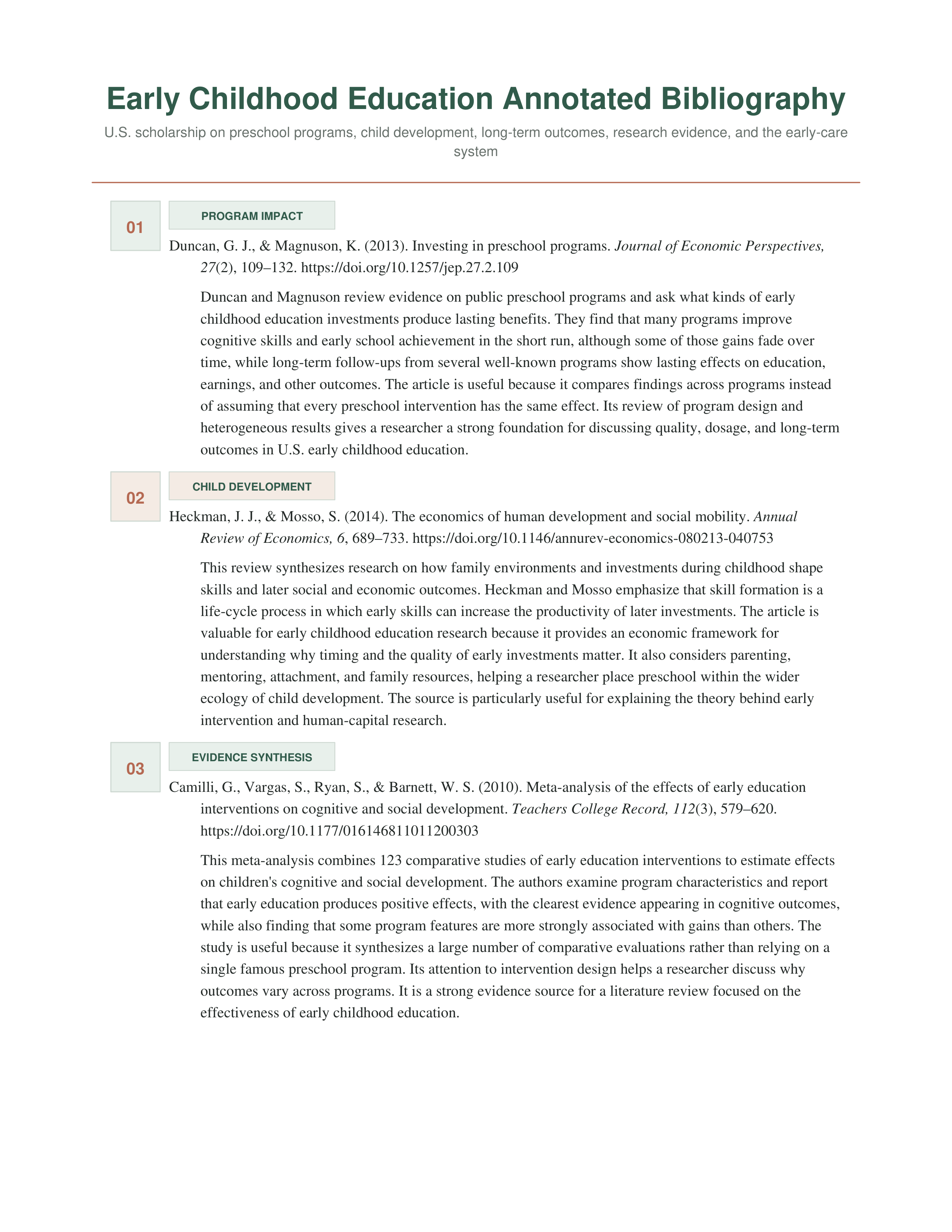
Early Childhood Education Annotated Bibliography
U.S. scholarship on preschool programs, child development, long-term outcomes, research evidence, and the early-care
system
01
PROGRAM IMPACT
Duncan, G. J., & Magnuson, K. (2013). Investing in preschool programs.
Journal of Economic Perspectives,
27
(2), 109–132. https://doi.org/10.1257/jep.27.2.109
Duncan and Magnuson review evidence on public preschool programs and ask what kinds of early
childhood education investments produce lasting benefits. They find that many programs improve
cognitive skills and early school achievement in the short run, although some of those gains fade over
time, while long-term follow-ups from several well-known programs show lasting effects on education,
earnings, and other outcomes. The article is useful because it compares findings across programs instead
of assuming that every preschool intervention has the same effect. Its review of program design and
heterogeneous results gives a researcher a strong foundation for discussing quality, dosage, and long-term
outcomes in U.S. early childhood education.
02
CHILD DEVELOPMENT
Heckman, J. J., & Mosso, S. (2014). The economics of human development and social mobility.
Annual
Review of Economics, 6
, 689–733. https://doi.org/10.1146/annurev-economics-080213-040753
This review synthesizes research on how family environments and investments during childhood shape
skills and later social and economic outcomes. Heckman and Mosso emphasize that skill formation is a
life-cycle process in which early skills can increase the productivity of later investments. The article is
valuable for early childhood education research because it provides an economic framework for
understanding why timing and the quality of early investments matter. It also considers parenting,
mentoring, attachment, and family resources, helping a researcher place preschool within the wider
ecology of child development. The source is particularly useful for explaining the theory behind early
intervention and human-capital research.
03
EVIDENCE SYNTHESIS
Camilli, G., Vargas, S., Ryan, S., & Barnett, W. S. (2010). Meta-analysis of the effects of early education
interventions on cognitive and social development.
Teachers College Record, 112
(3), 579–620.
https://doi.org/10.1177/016146811011200303
This meta-analysis combines 123 comparative studies of early education interventions to estimate effects
on children's cognitive and social development. The authors examine program characteristics and report
that early education produces positive effects, with the clearest evidence appearing in cognitive outcomes,
while also finding that some program features are more strongly associated with gains than others. The
study is useful because it synthesizes a large number of comparative evaluations rather than relying on a
single famous preschool program. Its attention to intervention design helps a researcher discuss why
outcomes vary across programs. It is a strong evidence source for a literature review focused on the
effectiveness of early childhood education.