White Collar Crime Annotated Bibliography
Criminological research on occupational and corporate offending, definitions, opportunity, and social control
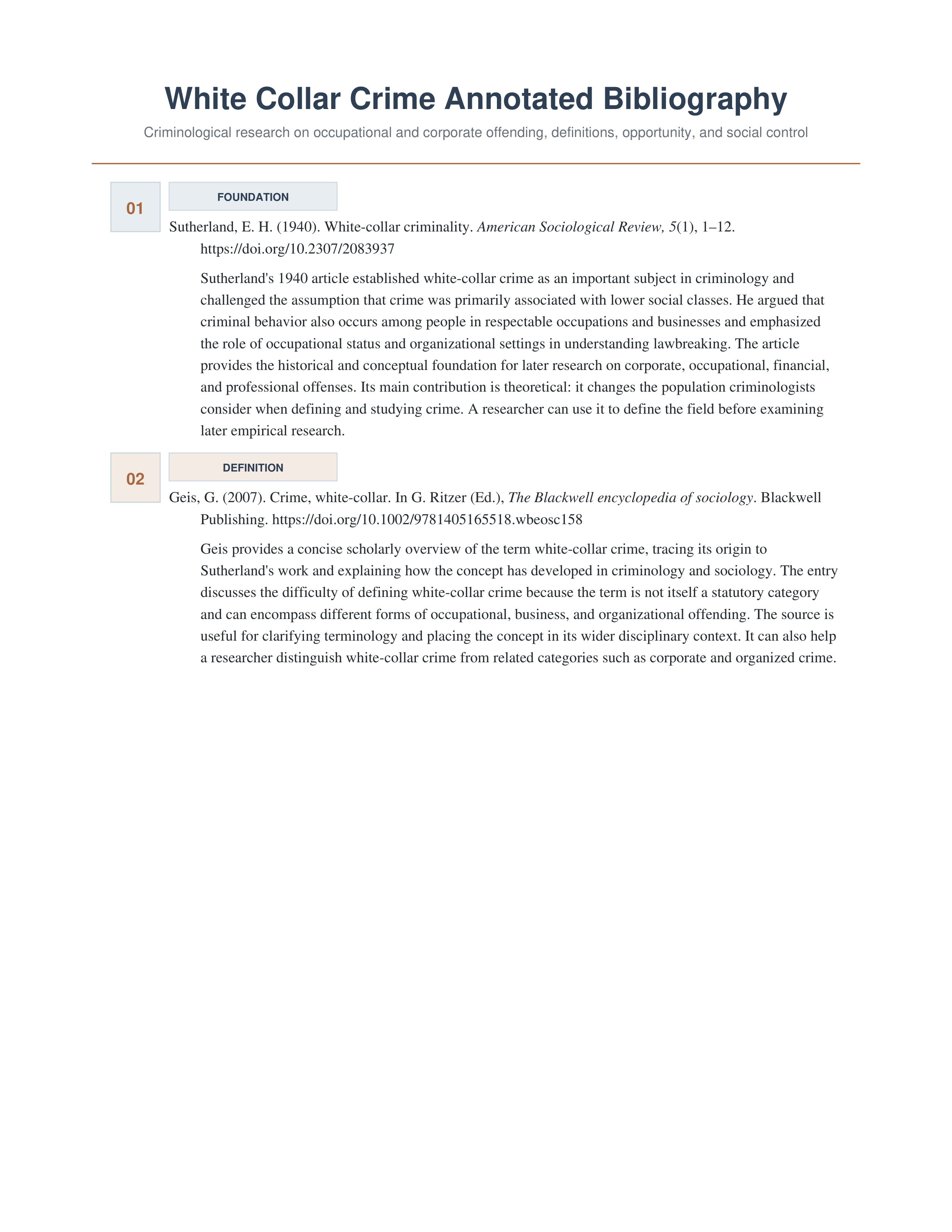
01
FOUNDATION
Sutherland, E. H. (1940). White-collar criminality.
American Sociological Review, 5
(1), 1–12.
https://doi.org/10.2307/2083937
Sutherland's 1940 article established white-collar crime as an important subject in criminology and
challenged the assumption that crime was primarily associated with lower social classes. He argued that
criminal behavior also occurs among people in respectable occupations and businesses and emphasized
the role of occupational status and organizational settings in understanding lawbreaking. The article
provides the historical and conceptual foundation for later research on corporate, occupational, financial,
and professional offenses. Its main contribution is theoretical: it changes the population criminologists
consider when defining and studying crime. A researcher can use it to define the field before examining
later empirical research.
02
DEFINITION
Geis, G. (2007). Crime, white-collar. In G. Ritzer (Ed.),
The Blackwell encyclopedia of sociology
. Blackwell
Publishing. https://doi.org/10.1002/9781405165518.wbeosc158
Geis provides a concise scholarly overview of the term white-collar crime, tracing its origin to
Sutherland's work and explaining how the concept has developed in criminology and sociology. The entry
discusses the difficulty of defining white-collar crime because the term is not itself a statutory category
and can encompass different forms of occupational, business, and organizational offending. The source is
useful for clarifying terminology and placing the concept in its wider disciplinary context. It can also help
a researcher distinguish white-collar crime from related categories such as corporate and organized crime.