ACADEMIC RESEARCH / ONLINE LEARNING
PAGE 4
0
5
INTERACTION
course dynamics
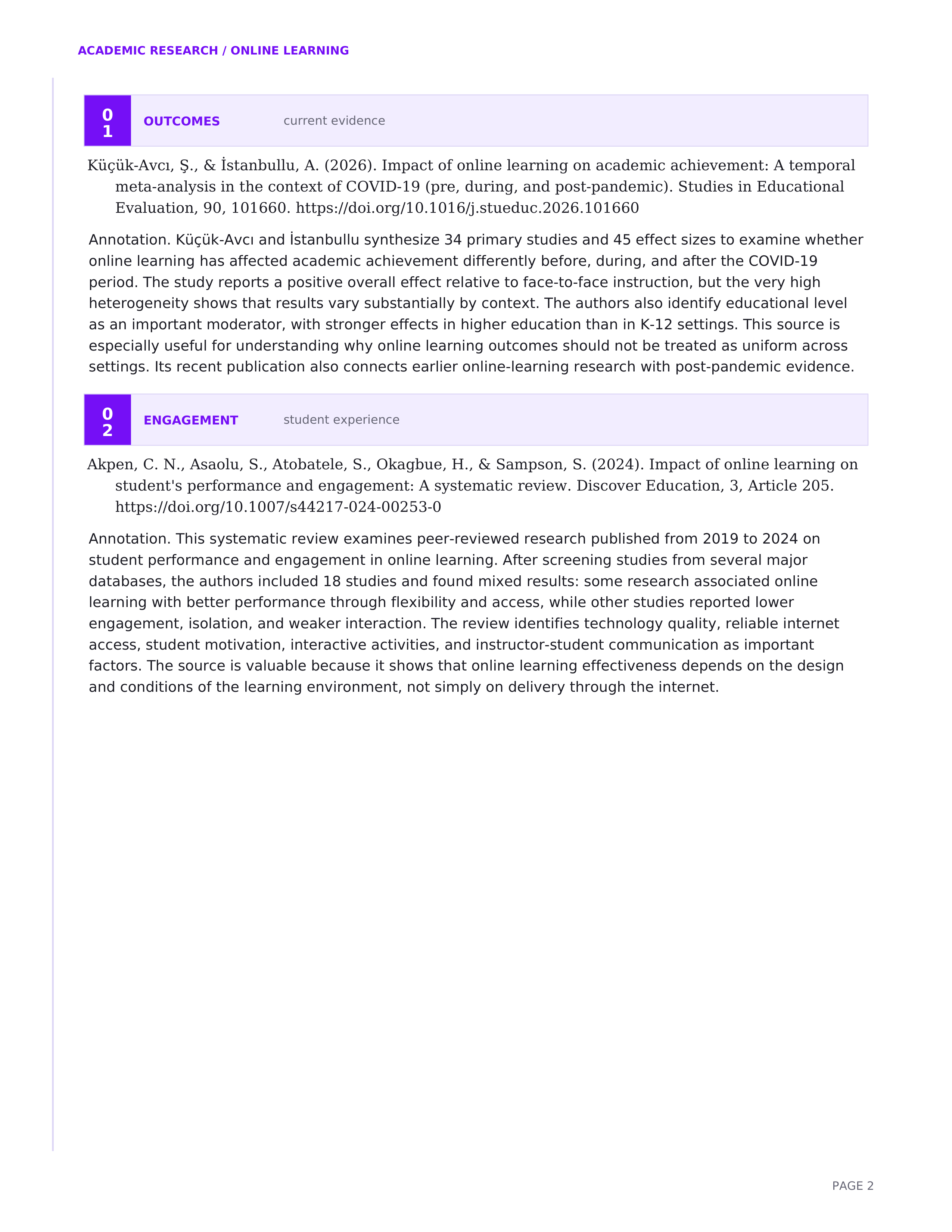
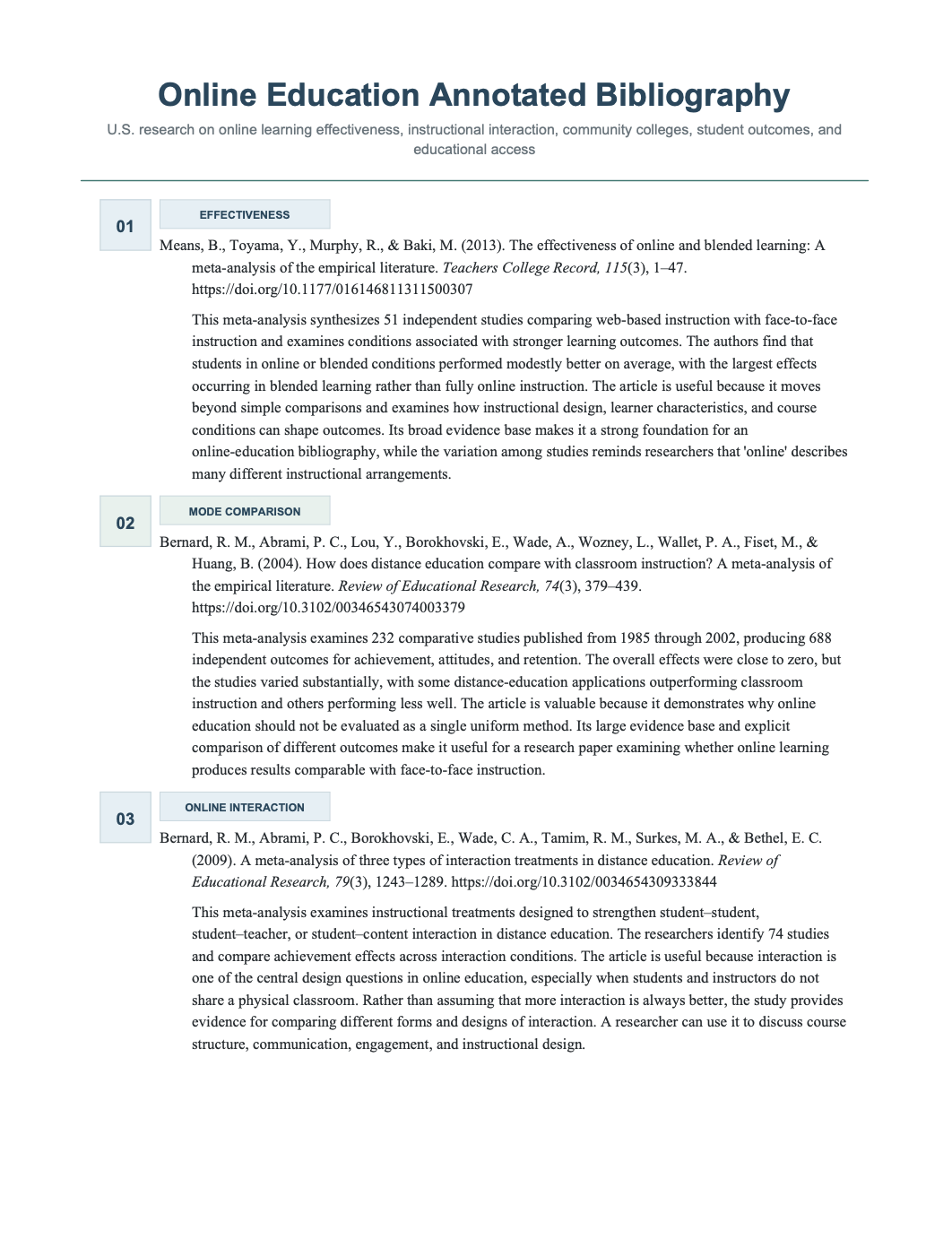
Bernard, R. M., Abrami, P. C., Borokhovski, E., Wade, C. A., Tamim, R. M., Surkes, M. A., & Bethel, E. C.
(2009). A meta-analysis of three types of interaction treatments in distance education. Review of
Educational Research, 79(3), 1243-1289. https://doi.org/10.3102/0034654309333844
Annotation. Bernard and colleagues focus on interaction as a central feature of distance education. Their
meta-analysis compares instructional treatments designed to strengthen student-student, student-teacher,
or student-content interaction, drawing on 74 studies that produced 74 achievement effects. The source is
important because it moves the discussion beyond whether online learning is effective in general and asks
which forms of interaction contribute to learning. Its comparative design makes it useful for research on
discussion forums, collaborative activities, instructor feedback, and structured engagement. Because the
evidence comes from multiple empirical studies, it provides a stronger basis for discussing interaction than
a single course evaluation.
0
6
QUALITY
program design
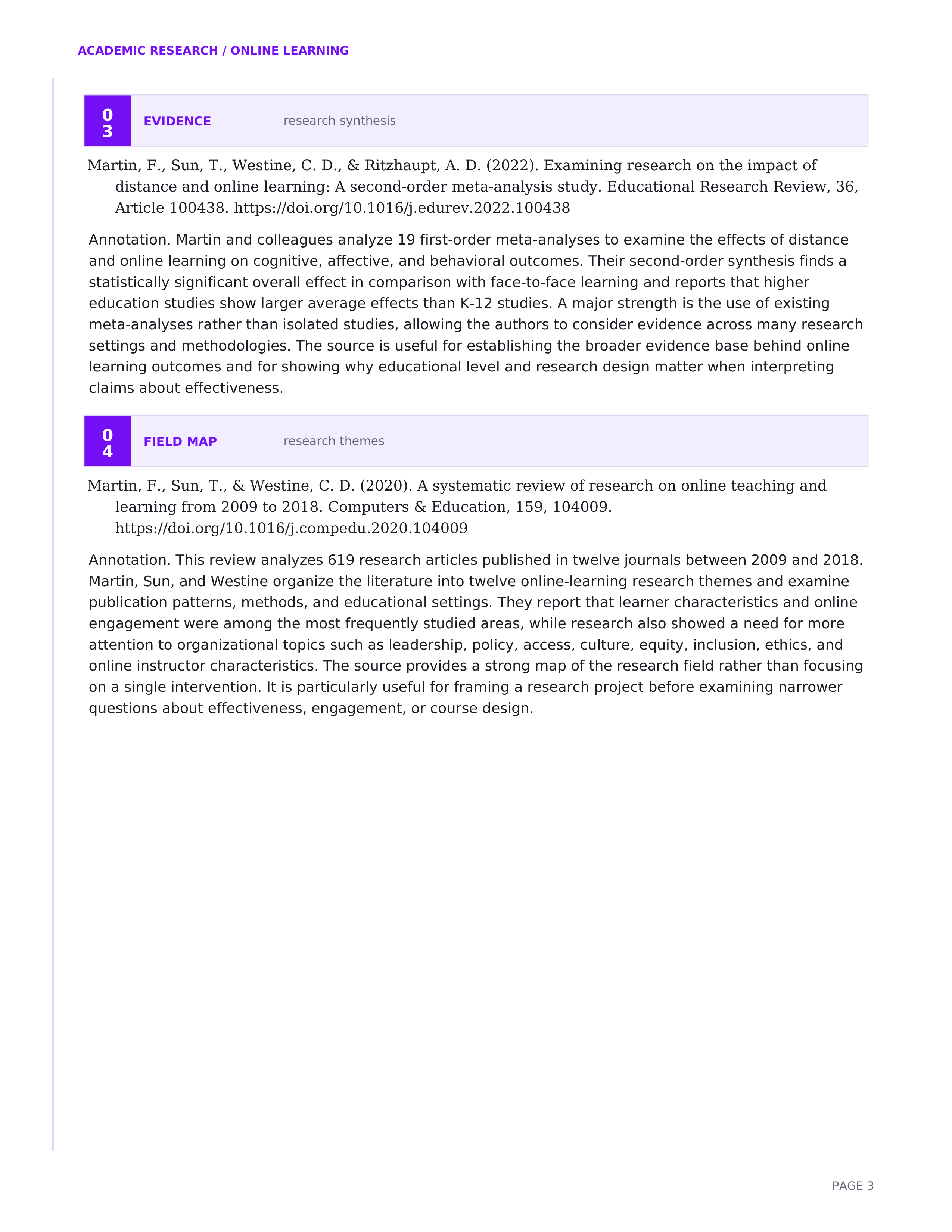
McGorry, S. Y. (2003). Measuring quality in online programs. The Internet and Higher Education, 6(2),
159-177. https://doi.org/10.1016/S1096-7516(03)00022-8
Annotation. McGorry addresses how institutions can evaluate the quality of online programs rather than
relying on a single measure such as grades or satisfaction. The study reviews prior distance-education and
information-technology research and proposes a model incorporating flexibility, responsiveness, interaction,
student learning, technical support, technology, and student satisfaction. The article is useful for defining
quality as a multidimensional concept: a course can be accessible yet still be weak in interaction or support,
for example. Although older than the other sources in this bibliography, its framework remains relevant for
interpreting later research because many questions about online course quality still involve instructional
design, support, interaction, and student experience.