EDUCATION RESEARCH / TECHNOLOGY
PAGE 4
TECHNOLOGY IN EDUCATION / EVIDENCE MODULES
Historical and subject-specific evidence
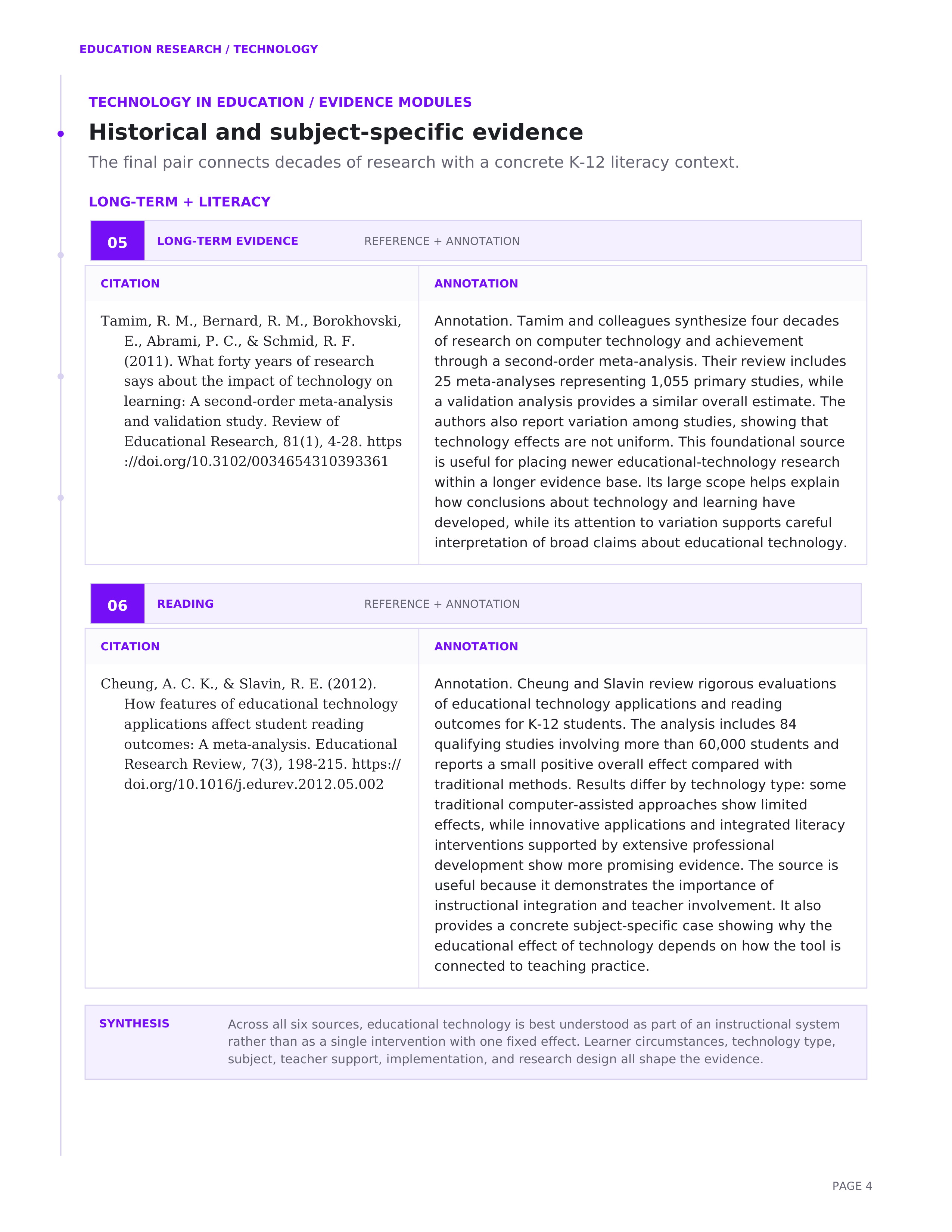
The final pair connects decades of research with a concrete K-12 literacy context.
LONG-TERM + LITERACY
05
LONG-TERM EVIDENCE
REFERENCE + ANNOTATION
CITATION
ANNOTATION
Tamim, R. M., Bernard, R. M., Borokhovski,
E., Abrami, P. C., & Schmid, R. F.
(2011). What forty years of research
says about the impact of technology on
learning: A second-order meta-analysis
and validation study. Review of
Educational Research, 81(1), 4-28. https
://doi.org/10.3102/0034654310393361
Annotation. Tamim and colleagues synthesize four decades
of research on computer technology and achievement
through a second-order meta-analysis. Their review includes
25 meta-analyses representing 1,055 primary studies, while
a validation analysis provides a similar overall estimate. The
authors also report variation among studies, showing that
technology effects are not uniform. This foundational source
is useful for placing newer educational-technology research
within a longer evidence base. Its large scope helps explain
how conclusions about technology and learning have
developed, while its attention to variation supports careful
interpretation of broad claims about educational technology.
06
READING
REFERENCE + ANNOTATION
CITATION
ANNOTATION
Cheung, A. C. K., & Slavin, R. E. (2012).
How features of educational technology
applications affect student reading
outcomes: A meta-analysis. Educational
Research Review, 7(3), 198-215. https://
doi.org/10.1016/j.edurev.2012.05.002
Annotation. Cheung and Slavin review rigorous evaluations
of educational technology applications and reading
outcomes for K-12 students. The analysis includes 84
qualifying studies involving more than 60,000 students and
reports a small positive overall effect compared with
traditional methods. Results differ by technology type: some
traditional computer-assisted approaches show limited
effects, while innovative applications and integrated literacy
interventions supported by extensive professional
development show more promising evidence. The source is
useful because it demonstrates the importance of
instructional integration and teacher involvement. It also
provides a concrete subject-specific case showing why the
educational effect of technology depends on how the tool is
connected to teaching practice.
SYNTHESIS
Across all six sources, educational technology is best understood as part of an instructional system
rather than as a single intervention with one fixed effect. Learner circumstances, technology type,
subject, teacher support, implementation, and research design all shape the evidence.