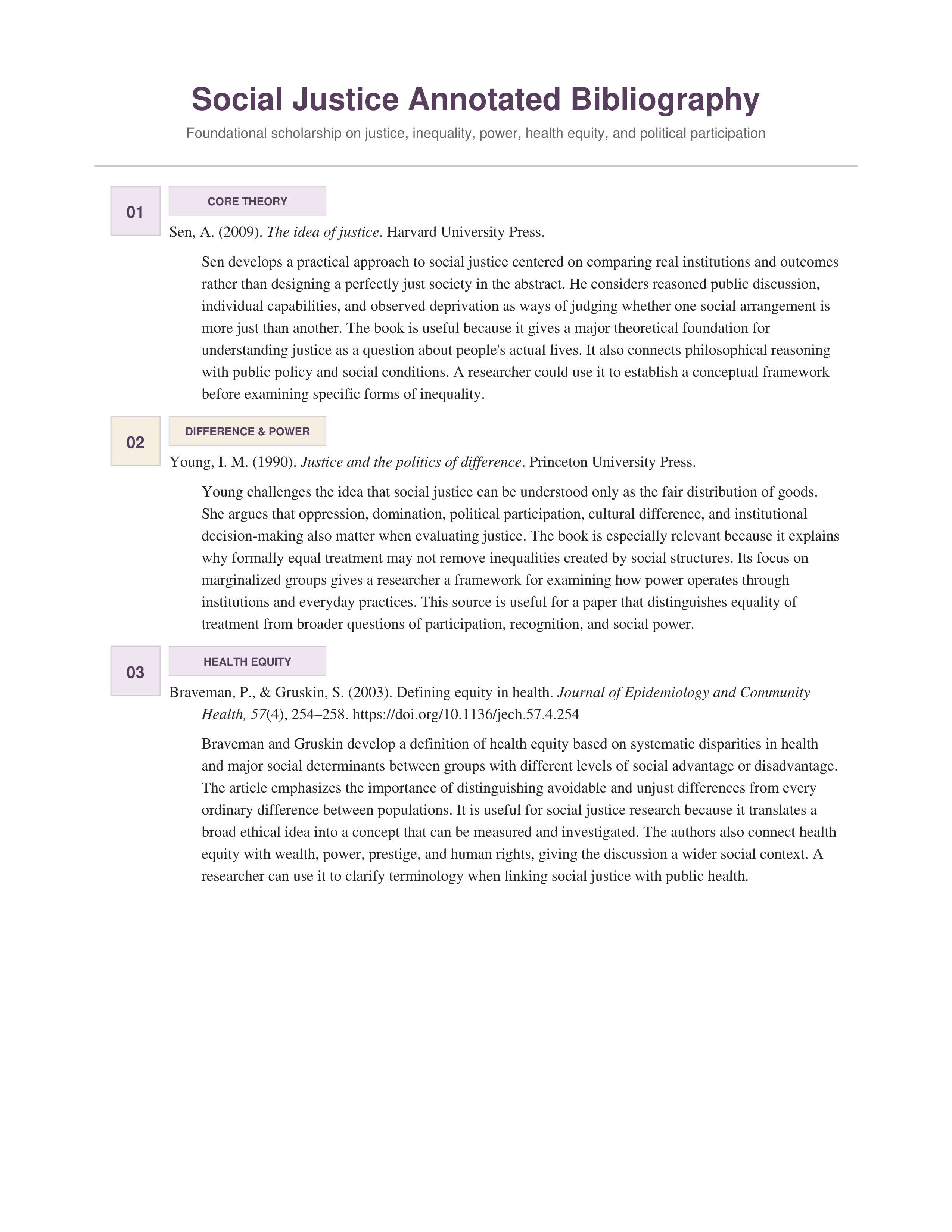
Social Justice Annotated Bibliography
Foundational scholarship on justice, inequality, power, health equity, and political participation
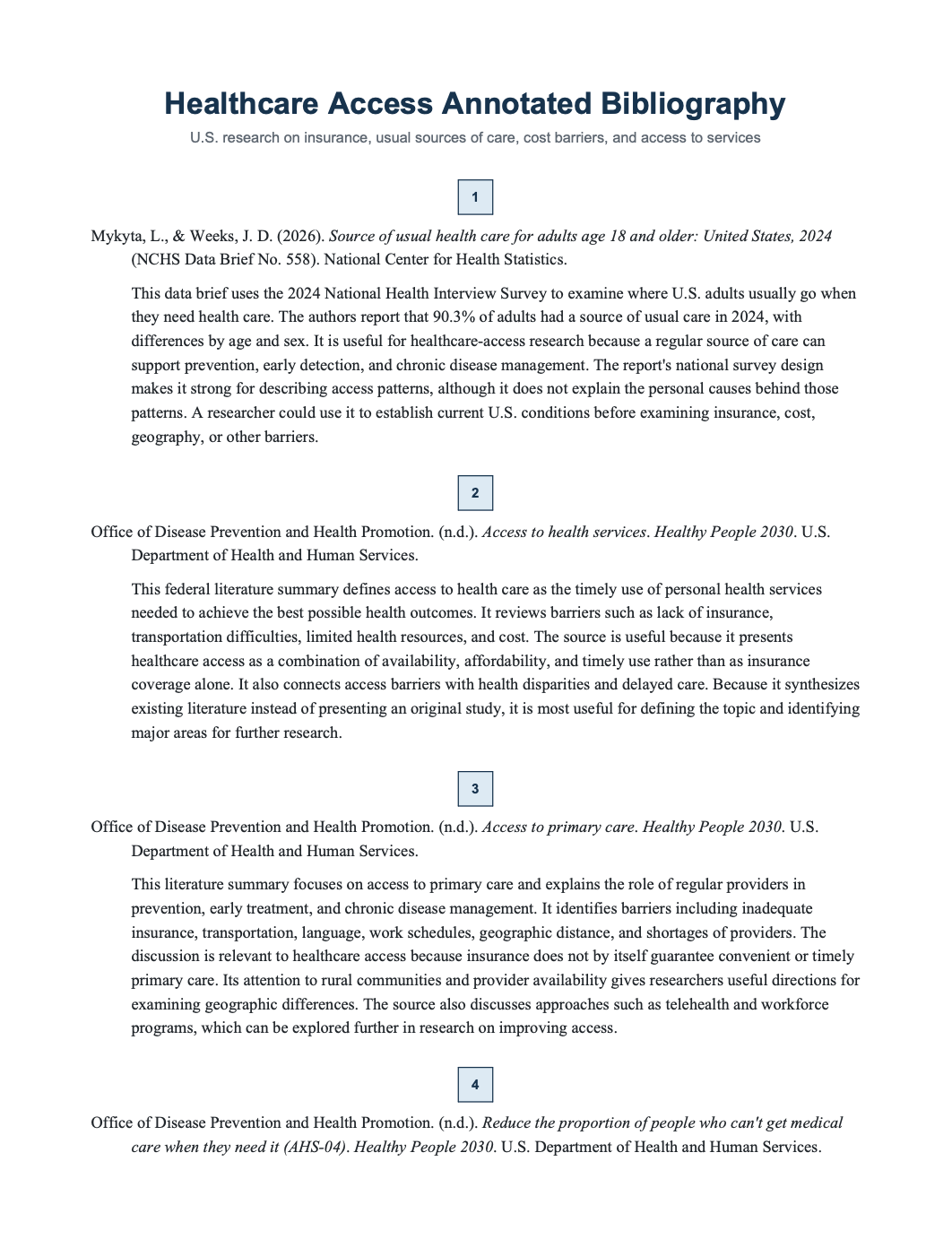
01
CORE THEORY
Sen, A. (2009).
The idea of justice
. Harvard University Press.
Sen develops a practical approach to social justice centered on comparing real institutions and outcomes
rather than designing a perfectly just society in the abstract. He considers reasoned public discussion,
individual capabilities, and observed deprivation as ways of judging whether one social arrangement is
more just than another. The book is useful because it gives a major theoretical foundation for
understanding justice as a question about people's actual lives. It also connects philosophical reasoning
with public policy and social conditions. A researcher could use it to establish a conceptual framework
before examining specific forms of inequality.
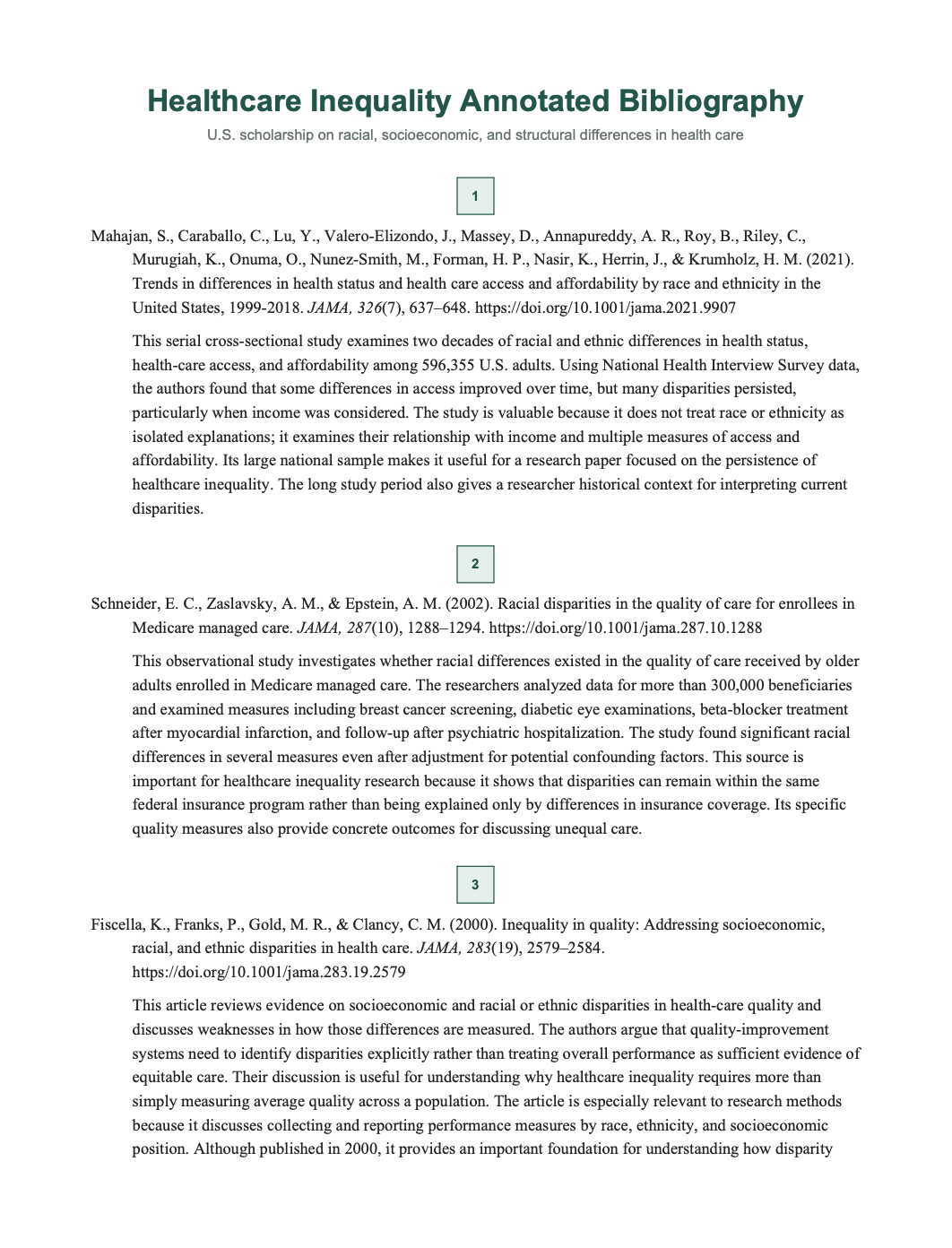
02
DIFFERENCE & POWER
Young, I. M. (1990).
Justice and the politics of difference
. Princeton University Press.
Young challenges the idea that social justice can be understood only as the fair distribution of goods.
She argues that oppression, domination, political participation, cultural difference, and institutional
decision-making also matter when evaluating justice. The book is especially relevant because it explains
why formally equal treatment may not remove inequalities created by social structures. Its focus on
marginalized groups gives a researcher a framework for examining how power operates through
institutions and everyday practices. This source is useful for a paper that distinguishes equality of
treatment from broader questions of participation, recognition, and social power.
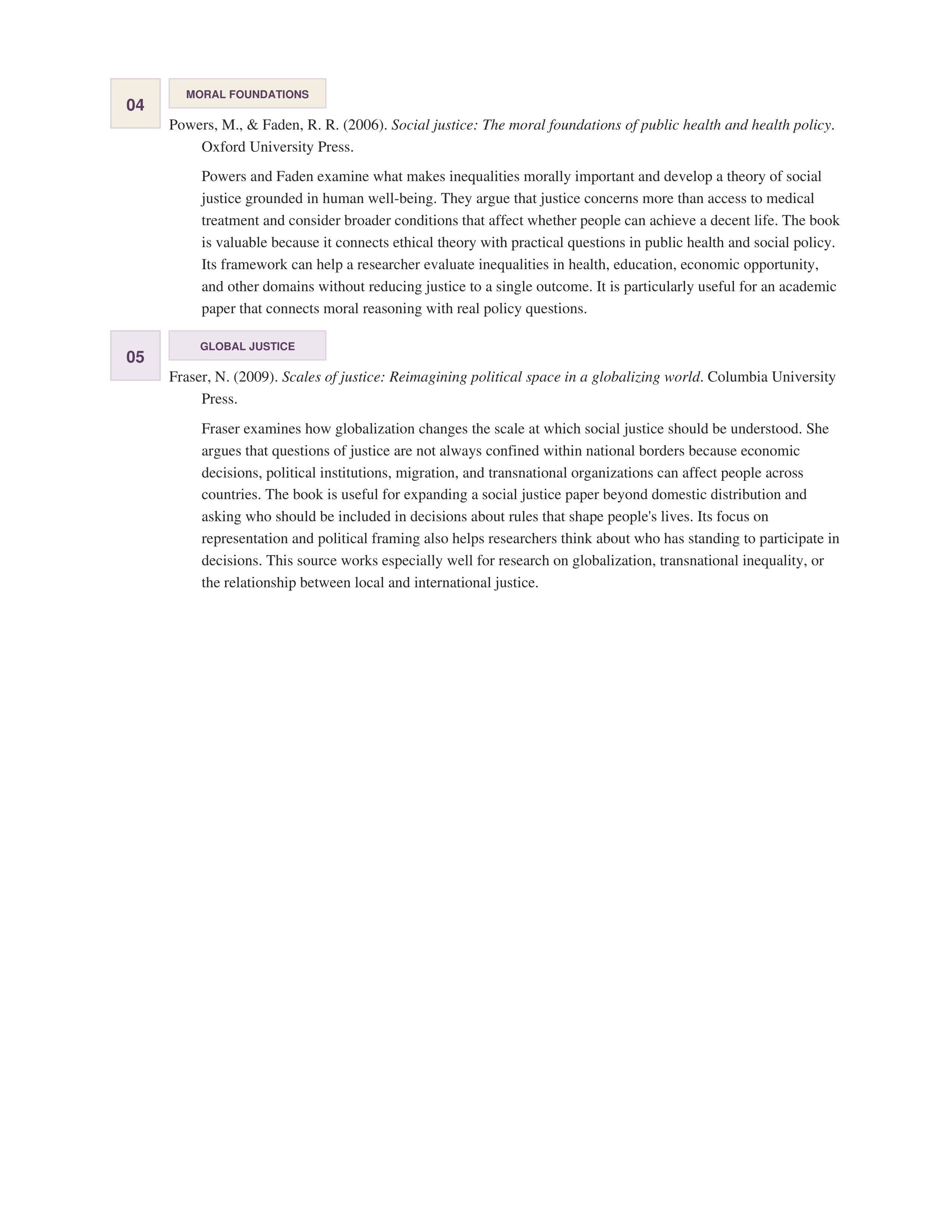
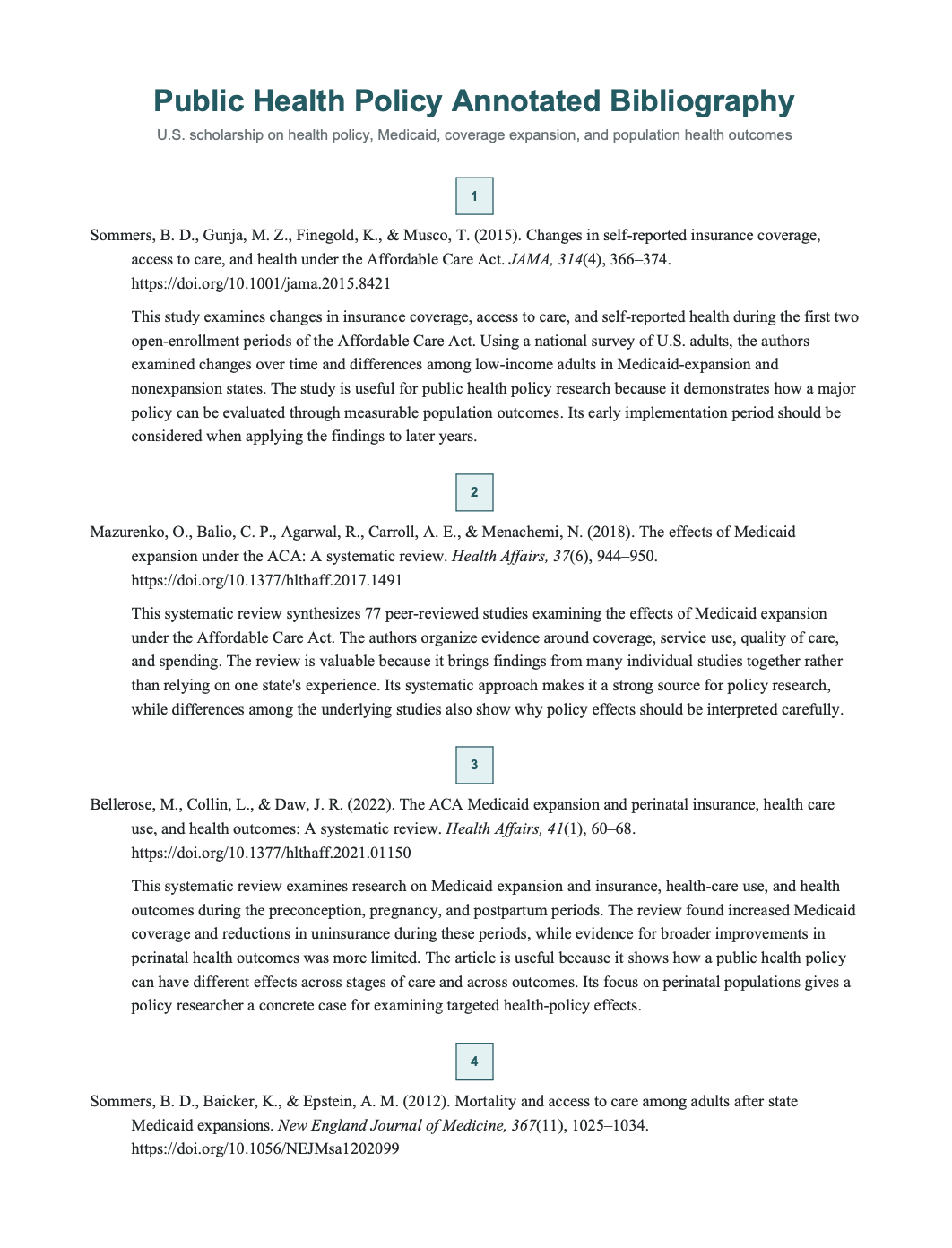
03
HEALTH EQUITY
Braveman, P., & Gruskin, S. (2003). Defining equity in health.
Journal of Epidemiology and Community
Health, 57
(4), 254–258. https://doi.org/10.1136/jech.57.4.254
Braveman and Gruskin develop a definition of health equity based on systematic disparities in health
and major social determinants between groups with different levels of social advantage or disadvantage.
The article emphasizes the importance of distinguishing avoidable and unjust differences from every
ordinary difference between populations. It is useful for social justice research because it translates a
broad ethical idea into a concept that can be measured and investigated. The authors also connect health
equity with wealth, power, prestige, and human rights, giving the discussion a wider social context. A
researcher can use it to clarify terminology when linking social justice with public health.