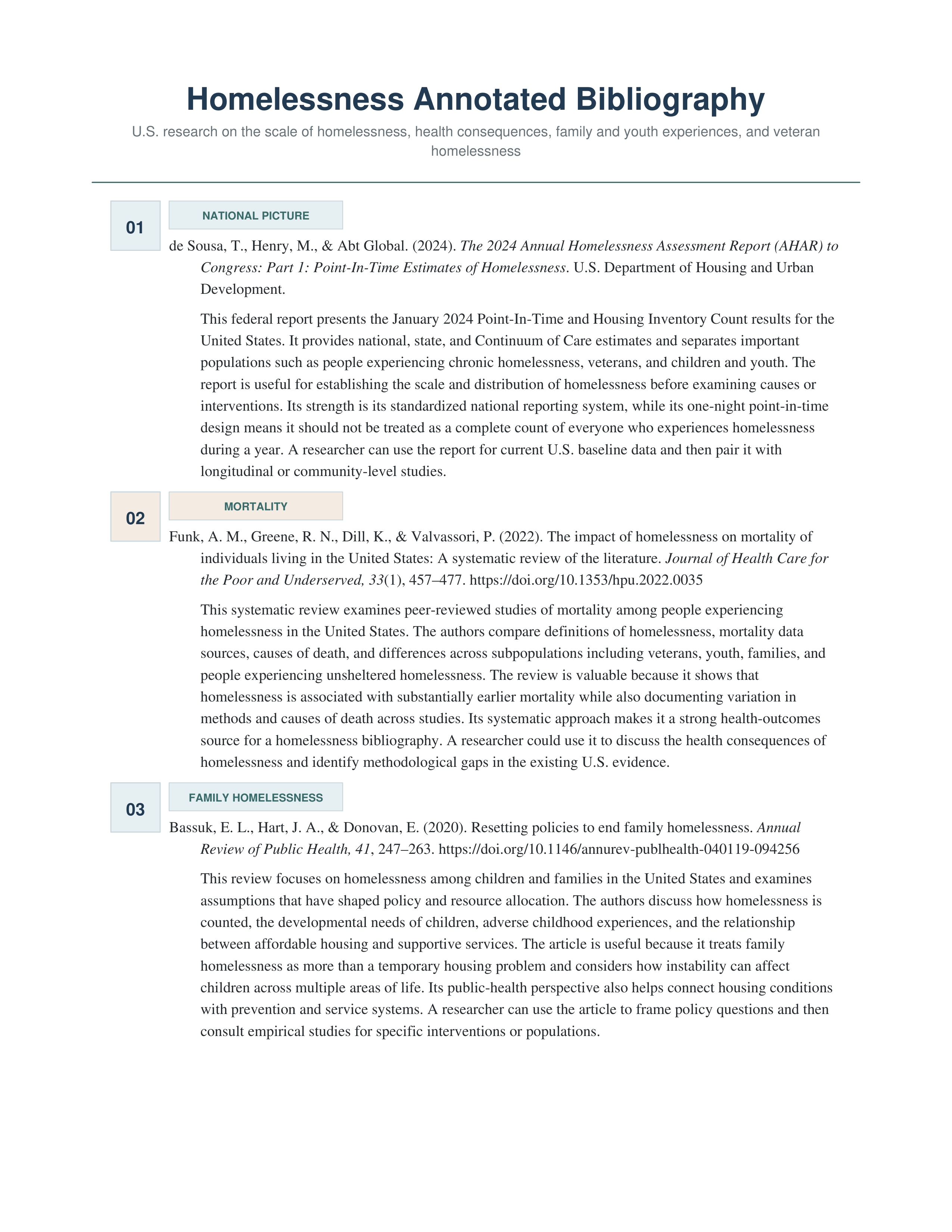
Homelessness Annotated Bibliography
U.S. research on the scale of homelessness, health consequences, family and youth experiences, and veteran
homelessness
01
NATIONAL PICTURE
de Sousa, T., Henry, M., & Abt Global. (2024).
The 2024 Annual Homelessness Assessment Report (AHAR) to
Congress: Part 1: Point-In-Time Estimates of Homelessness
. U.S. Department of Housing and Urban
Development.
This federal report presents the January 2024 Point-In-Time and Housing Inventory Count results for the
United States. It provides national, state, and Continuum of Care estimates and separates important
populations such as people experiencing chronic homelessness, veterans, and children and youth. The
report is useful for establishing the scale and distribution of homelessness before examining causes or
interventions. Its strength is its standardized national reporting system, while its one-night point-in-time
design means it should not be treated as a complete count of everyone who experiences homelessness
during a year. A researcher can use the report for current U.S. baseline data and then pair it with
longitudinal or community-level studies.
02
MORTALITY
Funk, A. M., Greene, R. N., Dill, K., & Valvassori, P. (2022). The impact of homelessness on mortality of
individuals living in the United States: A systematic review of the literature.
Journal of Health Care for
the Poor and Underserved, 33
(1), 457–477. https://doi.org/10.1353/hpu.2022.0035
This systematic review examines peer-reviewed studies of mortality among people experiencing
homelessness in the United States. The authors compare definitions of homelessness, mortality data
sources, causes of death, and differences across subpopulations including veterans, youth, families, and
people experiencing unsheltered homelessness. The review is valuable because it shows that
homelessness is associated with substantially earlier mortality while also documenting variation in
methods and causes of death across studies. Its systematic approach makes it a strong health-outcomes
source for a homelessness bibliography. A researcher could use it to discuss the health consequences of
homelessness and identify methodological gaps in the existing U.S. evidence.
03
FAMILY HOMELESSNESS
Bassuk, E. L., Hart, J. A., & Donovan, E. (2020). Resetting policies to end family homelessness.
Annual
Review of Public Health, 41
, 247–263. https://doi.org/10.1146/annurev-publhealth-040119-094256
This review focuses on homelessness among children and families in the United States and examines
assumptions that have shaped policy and resource allocation. The authors discuss how homelessness is
counted, the developmental needs of children, adverse childhood experiences, and the relationship
between affordable housing and supportive services. The article is useful because it treats family
homelessness as more than a temporary housing problem and considers how instability can affect
children across multiple areas of life. Its public-health perspective also helps connect housing conditions
with prevention and service systems. A researcher can use the article to frame policy questions and then
consult empirical studies for specific interventions or populations.