CHICAGO • NOTES AND BIBLIOGRAPHY
Annotated bibliography
1
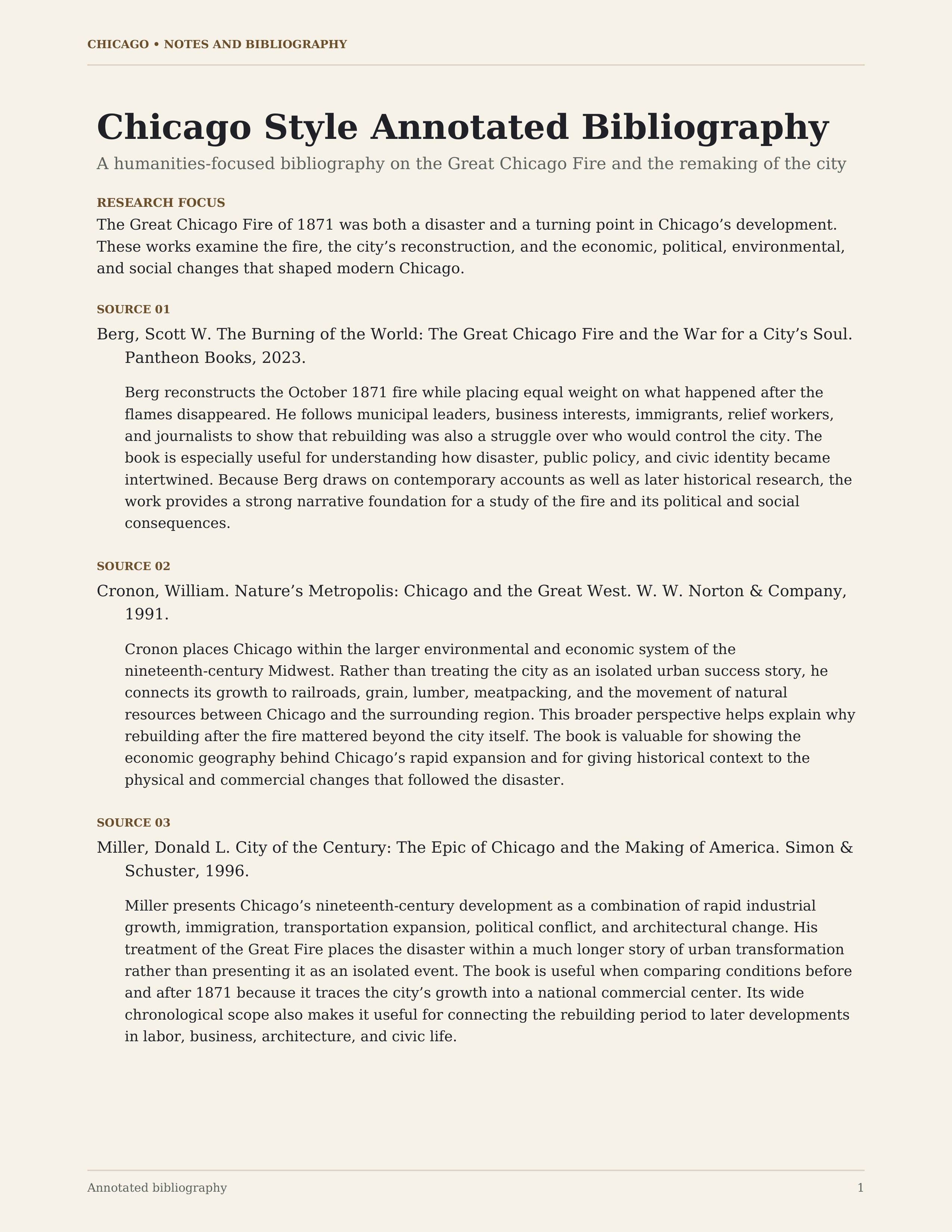
Chicago Style Annotated Bibliography
A humanities-focused bibliography on the Great Chicago Fire and the remaking of the city
RESEARCH FOCUS
The Great Chicago Fire of 1871 was both a disaster and a turning point in Chicago’s development.
These works examine the fire, the city’s reconstruction, and the economic, political, environmental,
and social changes that shaped modern Chicago.
SOURCE 01
Berg, Scott W. The Burning of the World: The Great Chicago Fire and the War for a City’s Soul.
Pantheon Books, 2023.
Berg reconstructs the October 1871 fire while placing equal weight on what happened after the
flames disappeared. He follows municipal leaders, business interests, immigrants, relief workers,
and journalists to show that rebuilding was also a struggle over who would control the city. The
book is especially useful for understanding how disaster, public policy, and civic identity became
intertwined. Because Berg draws on contemporary accounts as well as later historical research, the
work provides a strong narrative foundation for a study of the fire and its political and social
consequences.
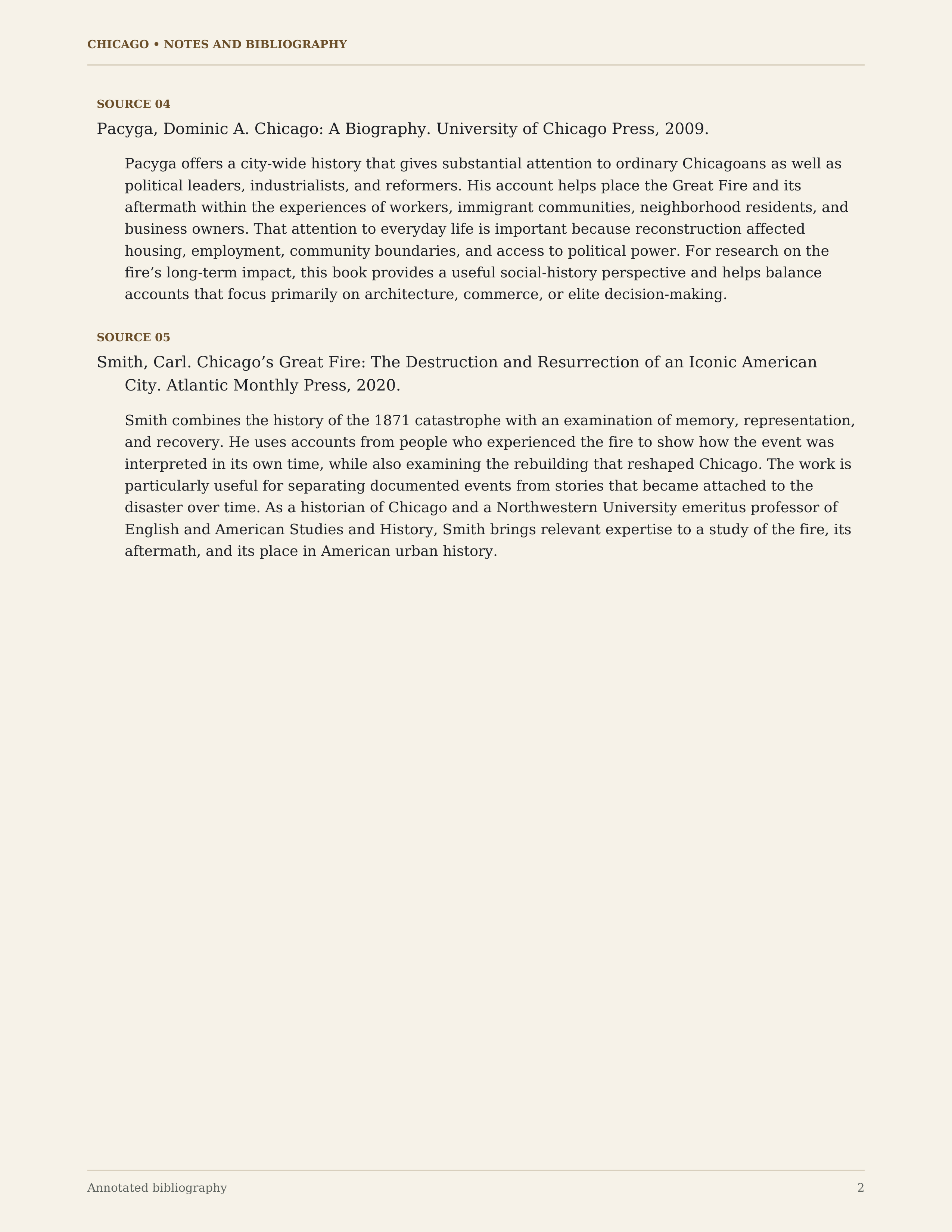
SOURCE 02
Cronon, William. Nature’s Metropolis: Chicago and the Great West. W. W. Norton & Company,
1991.
Cronon places Chicago within the larger environmental and economic system of the
nineteenth-century Midwest. Rather than treating the city as an isolated urban success story, he
connects its growth to railroads, grain, lumber, meatpacking, and the movement of natural
resources between Chicago and the surrounding region. This broader perspective helps explain why
rebuilding after the fire mattered beyond the city itself. The book is valuable for showing the
economic geography behind Chicago’s rapid expansion and for giving historical context to the
physical and commercial changes that followed the disaster.
SOURCE 03
Miller, Donald L. City of the Century: The Epic of Chicago and the Making of America. Simon &
Schuster, 1996.
Miller presents Chicago’s nineteenth-century development as a combination of rapid industrial
growth, immigration, transportation expansion, political conflict, and architectural change. His
treatment of the Great Fire places the disaster within a much longer story of urban transformation
rather than presenting it as an isolated event. The book is useful when comparing conditions before
and after 1871 because it traces the city’s growth into a national commercial center. Its wide
chronological scope also makes it useful for connecting the rebuilding period to later developments
in labor, business, architecture, and civic life.