03
STUDENT OUTCOMES
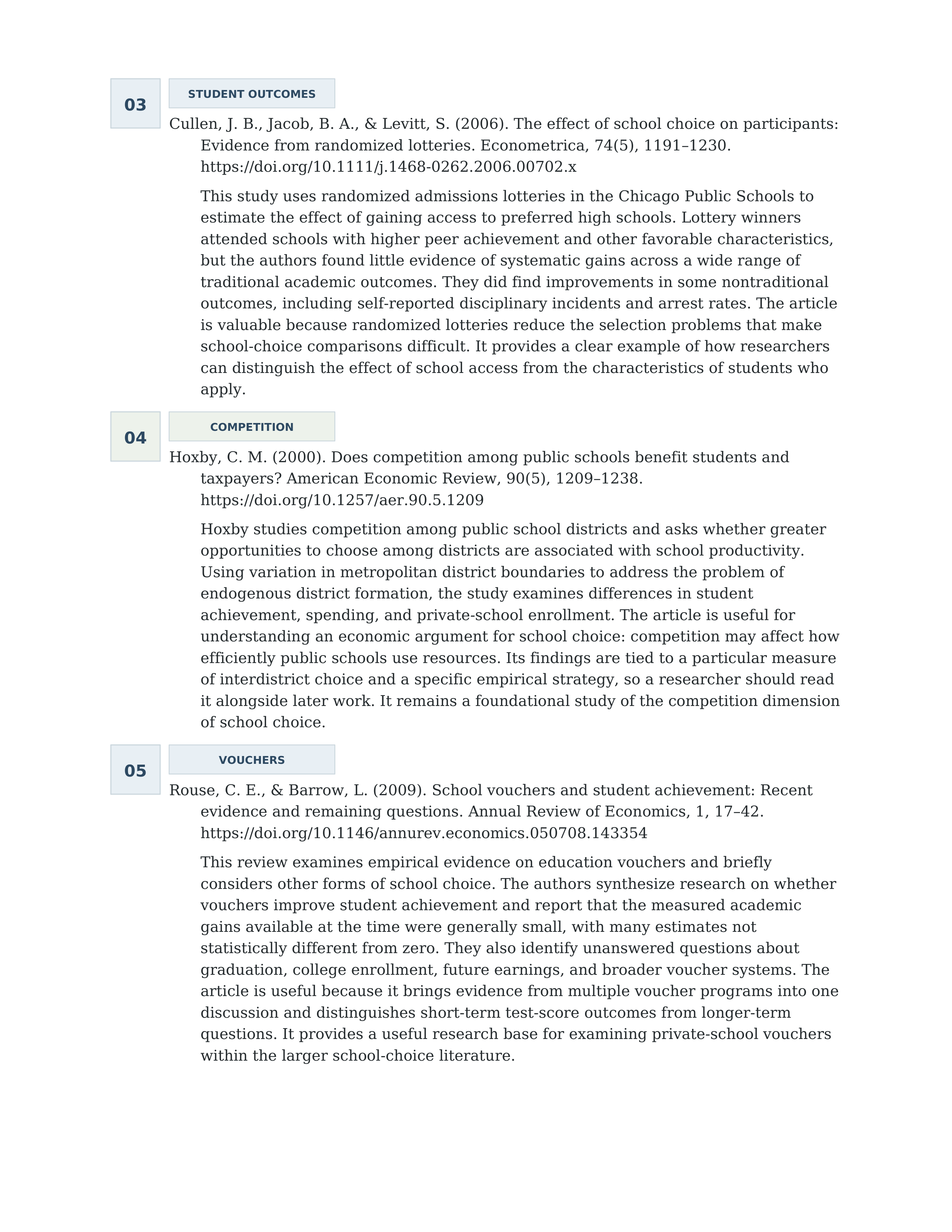
Cullen, J. B., Jacob, B. A., & Levitt, S. (2006). The effect of school choice on participants:
Evidence from randomized lotteries. Econometrica, 74(5), 1191–1230.
https://doi.org/10.1111/j.1468-0262.2006.00702.x
This study uses randomized admissions lotteries in the Chicago Public Schools to
estimate the effect of gaining access to preferred high schools. Lottery winners
attended schools with higher peer achievement and other favorable characteristics,
but the authors found little evidence of systematic gains across a wide range of
traditional academic outcomes. They did find improvements in some nontraditional
outcomes, including self-reported disciplinary incidents and arrest rates. The article
is valuable because randomized lotteries reduce the selection problems that make
school-choice comparisons difficult. It provides a clear example of how researchers
can distinguish the effect of school access from the characteristics of students who
apply.
04
COMPETITION
Hoxby, C. M. (2000). Does competition among public schools benefit students and
taxpayers? American Economic Review, 90(5), 1209–1238.
https://doi.org/10.1257/aer.90.5.1209
Hoxby studies competition among public school districts and asks whether greater
opportunities to choose among districts are associated with school productivity.
Using variation in metropolitan district boundaries to address the problem of
endogenous district formation, the study examines differences in student
achievement, spending, and private-school enrollment. The article is useful for
understanding an economic argument for school choice: competition may affect how
efficiently public schools use resources. Its findings are tied to a particular measure
of interdistrict choice and a specific empirical strategy, so a researcher should read
it alongside later work. It remains a foundational study of the competition dimension
of school choice.
05
VOUCHERS
Rouse, C. E., & Barrow, L. (2009). School vouchers and student achievement: Recent
evidence and remaining questions. Annual Review of Economics, 1, 17–42.
https://doi.org/10.1146/annurev.economics.050708.143354
This review examines empirical evidence on education vouchers and briefly
considers other forms of school choice. The authors synthesize research on whether
vouchers improve student achievement and report that the measured academic
gains available at the time were generally small, with many estimates not
statistically different from zero. They also identify unanswered questions about
graduation, college enrollment, future earnings, and broader voucher systems. The
article is useful because it brings evidence from multiple voucher programs into one
discussion and distinguishes short-term test-score outcomes from longer-term
questions. It provides a useful research base for examining private-school vouchers
within the larger school-choice literature.