CRIMINAL JUSTICE RESEARCH
ANNOTATED BIBLIOGRAPHY
U.S. criminal justice, incarceration, and collateral consequences
2
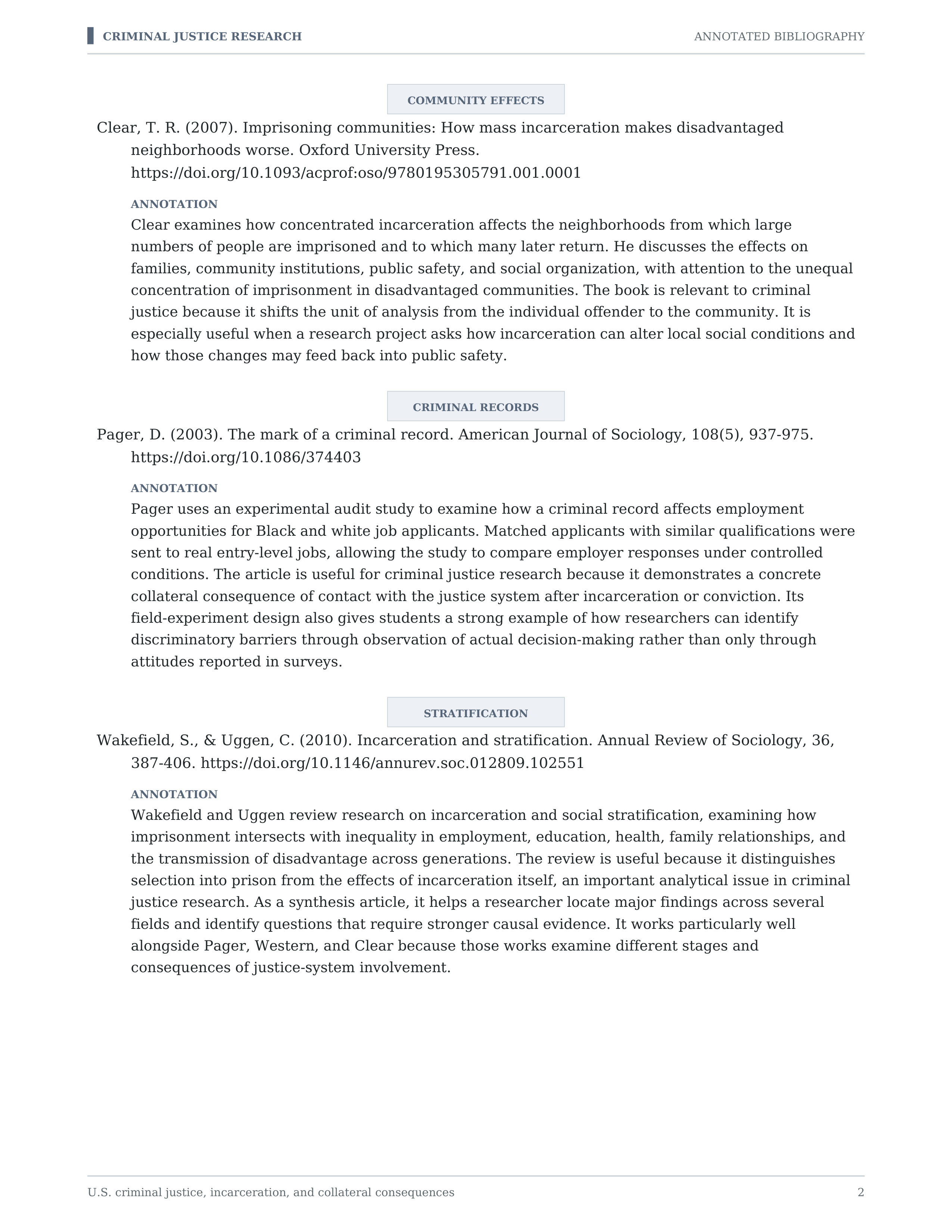
COMMUNITY EFFECTS
Clear, T. R. (2007). Imprisoning communities: How mass incarceration makes disadvantaged
neighborhoods worse. Oxford University Press.
https://doi.org/10.1093/acprof:oso/9780195305791.001.0001
ANNOTATION
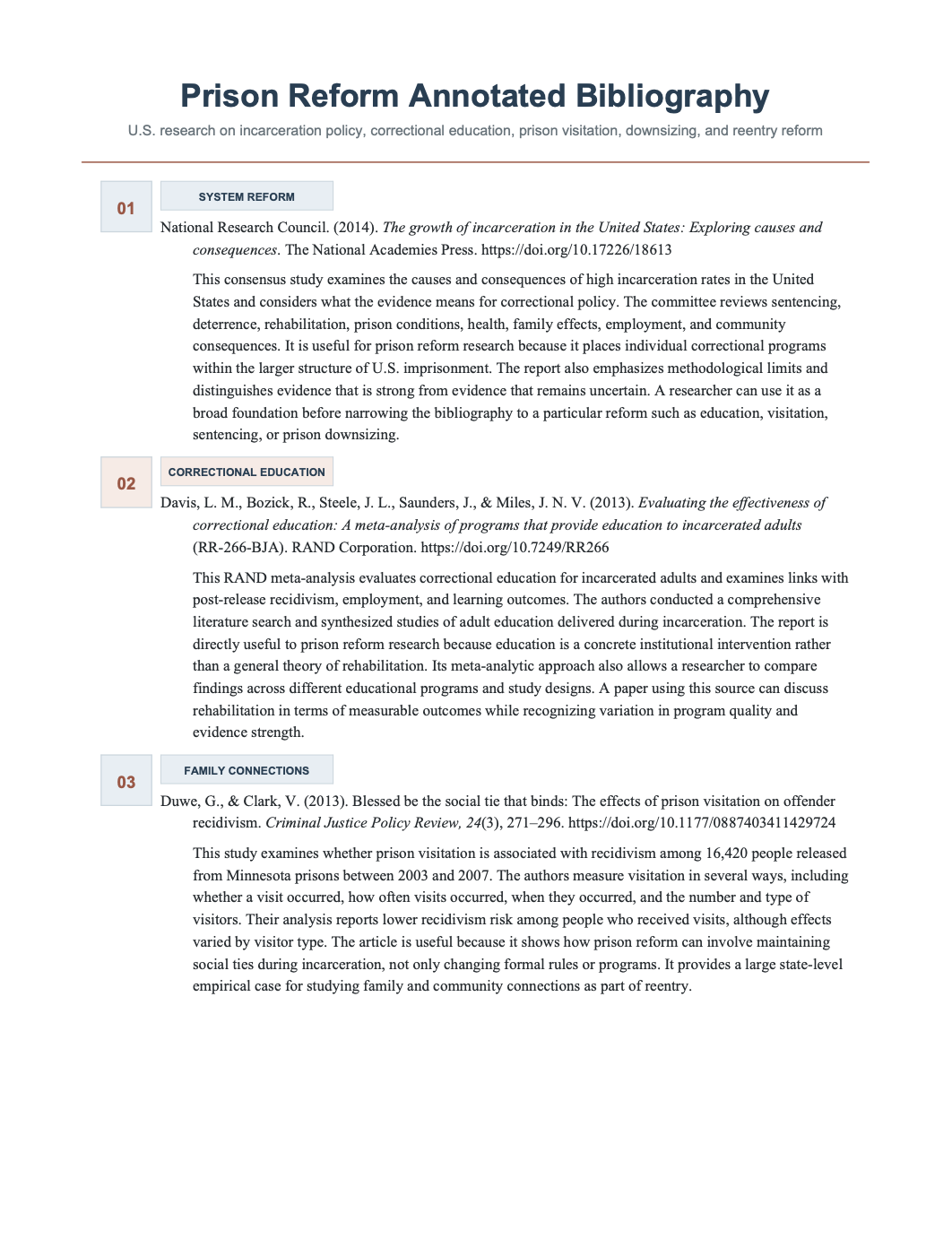
Clear examines how concentrated incarceration affects the neighborhoods from which large
numbers of people are imprisoned and to which many later return. He discusses the effects on
families, community institutions, public safety, and social organization, with attention to the unequal
concentration of imprisonment in disadvantaged communities. The book is relevant to criminal
justice because it shifts the unit of analysis from the individual offender to the community. It is
especially useful when a research project asks how incarceration can alter local social conditions and
how those changes may feed back into public safety.
CRIMINAL RECORDS
Pager, D. (2003). The mark of a criminal record. American Journal of Sociology, 108(5), 937-975.
https://doi.org/10.1086/374403
ANNOTATION
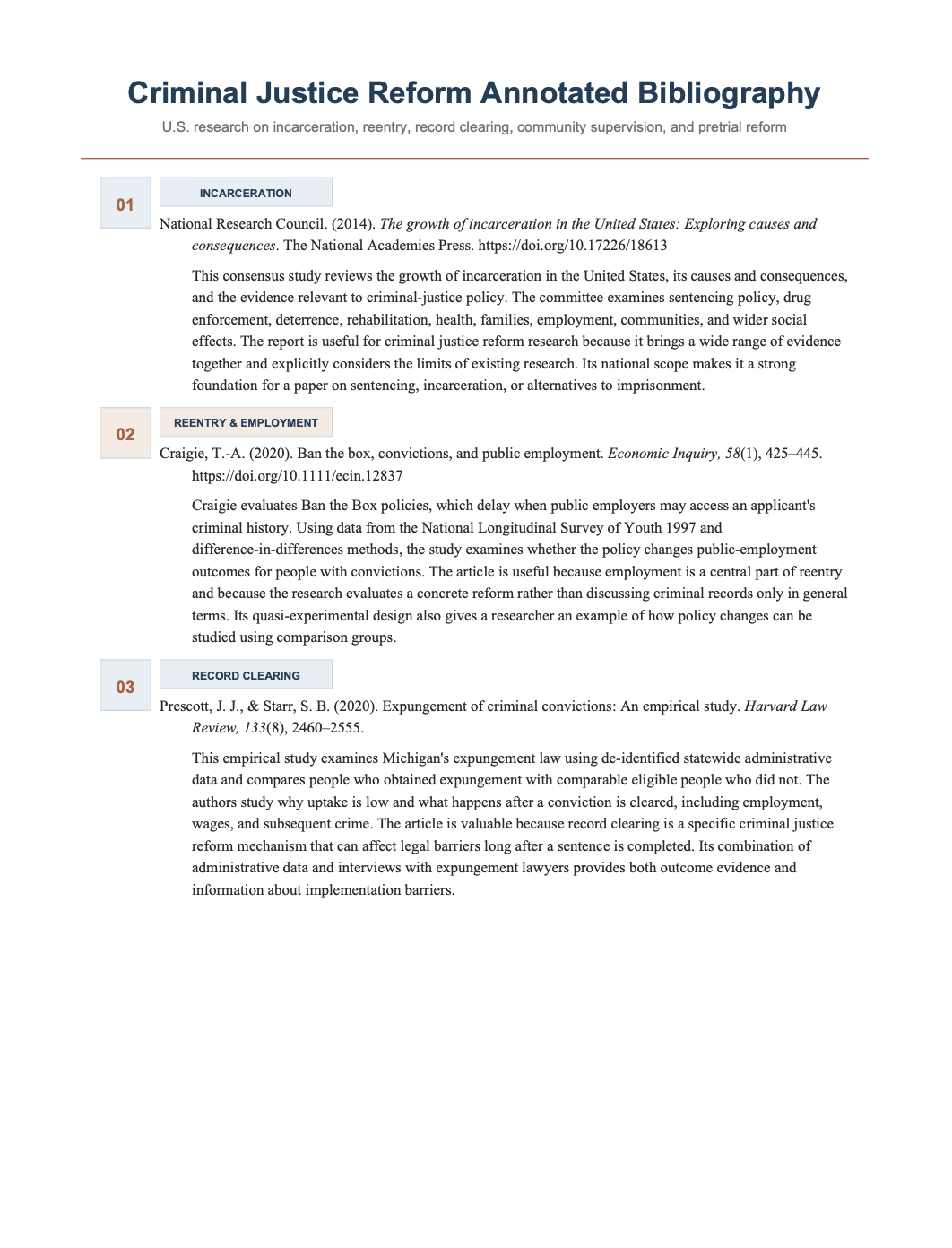
Pager uses an experimental audit study to examine how a criminal record affects employment
opportunities for Black and white job applicants. Matched applicants with similar qualifications were
sent to real entry-level jobs, allowing the study to compare employer responses under controlled
conditions. The article is useful for criminal justice research because it demonstrates a concrete
collateral consequence of contact with the justice system after incarceration or conviction. Its
field-experiment design also gives students a strong example of how researchers can identify
discriminatory barriers through observation of actual decision-making rather than only through
attitudes reported in surveys.
STRATIFICATION
Wakefield, S., & Uggen, C. (2010). Incarceration and stratification. Annual Review of Sociology, 36,
387-406. https://doi.org/10.1146/annurev.soc.012809.102551
ANNOTATION
Wakefield and Uggen review research on incarceration and social stratification, examining how
imprisonment intersects with inequality in employment, education, health, family relationships, and
the transmission of disadvantage across generations. The review is useful because it distinguishes
selection into prison from the effects of incarceration itself, an important analytical issue in criminal
justice research. As a synthesis article, it helps a researcher locate major findings across several
fields and identify questions that require stronger causal evidence. It works particularly well
alongside Pager, Western, and Clear because those works examine different stages and
consequences of justice-system involvement.