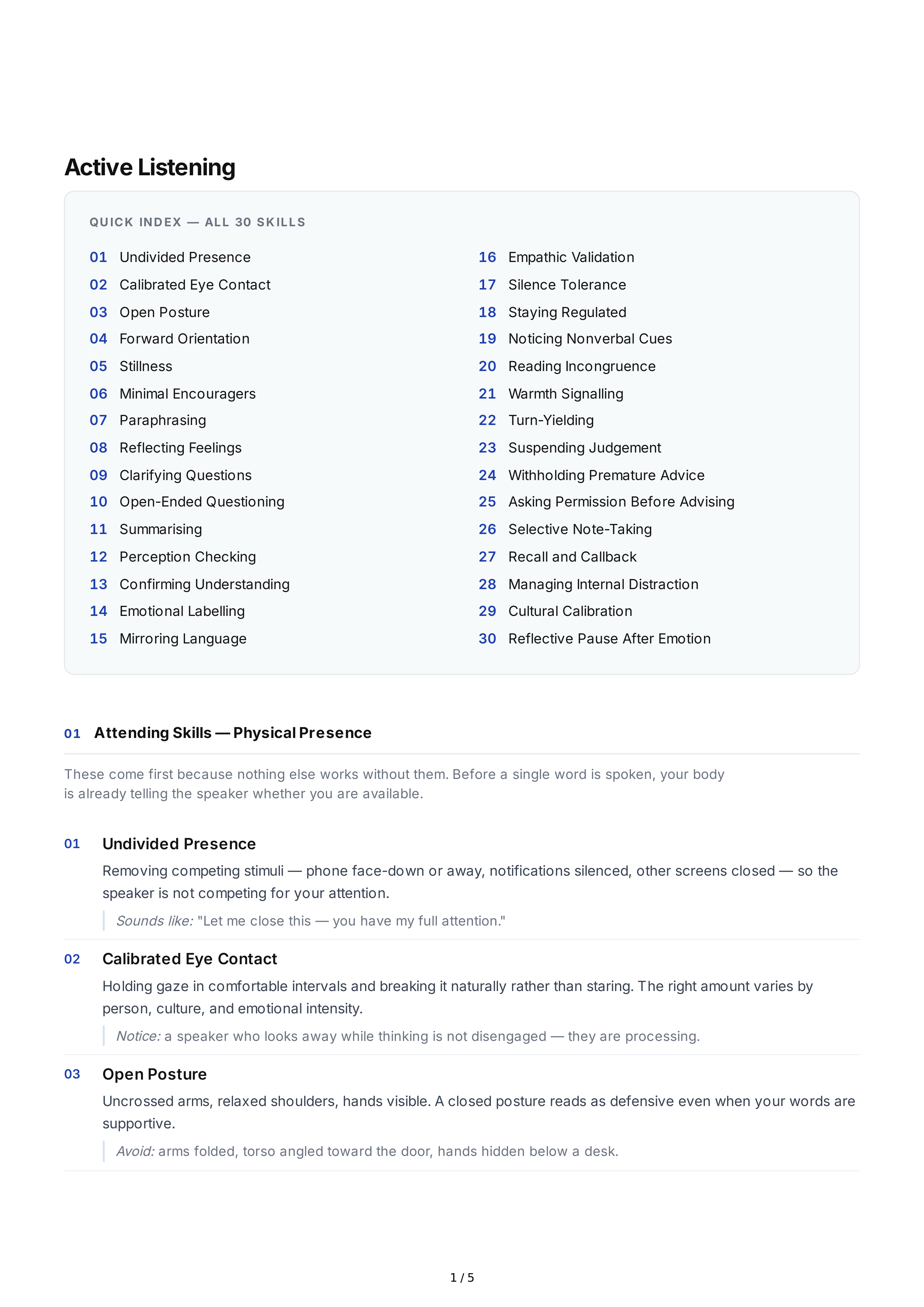
Active
Listening
QU ICK
IND EX
—
ALL
30
SK ILLS
01
Undivided
Presence
16
Empathic
Validation
02
Calibrated
Eye
Contact
17
Silence
Tolerance
03
Open
Posture
18
Staying
Regulated
04
Forward
Orientation
19
Noticing
Nonverbal
Cues
05
Stillness
20
Reading
Incongruence
06
Minimal
Encouragers
21
Warmth
Signalling
07
Paraphrasing
22
Turn
-
Yielding
08
Reflecting
Feelings
23
Suspending
Judgement
09
Clarifying
Questions
24
Withholding
Premature
Advice
10
Open
-
Ended
Questioning
25
Asking
Permission
Before
Advising
11
Summarising
26
Selective
Note
-
Taking
12
Perception
Checking
27
Recall
and
Callback
13
Confirming
Understanding
28
Managing
Internal
Distraction
14
Emotional
Labelling
29
Cultural
Calibration
15
Mirroring
Language
30
Reflective
Pause
After
Emotion
01
Attending
Skills
—
Physical
Presence
These
come
first
because
nothing
else
works
without
them
.
Before
a
single
word
is
spoken
,
your
body
is
already
telling
the
speaker
whether
you
are
available
.
01
Undivided
Presence
Removing
competing
stimuli
—
phone
face
-
down
or
away
,
notifications
silenced
,
other
screens
closed
—
so
the
speaker
is
not
competing
for
your
attention
.
Sounds
like
: "
Let
me
close
this
—
you
have
my
full
attention
."
02
Calibrated
Eye
Contact
Holding
gaze
in
comfortable
intervals
and
breaking
it
naturally
rather
than
staring
.
The
right
amount
varies
by
person
,
culture
,
and
emotional
intensity
.
Notice
:
a
speaker
who
looks
away
while
thinking
is
not
disengaged
—
they
are
processing
.
03
Open
Posture
Uncrossed
arms
,
relaxed
shoulders
,
hands
visible
.
A
closed
posture
reads
as
defensive
even
when
your
words
are
supportive
.
Avoid
:
arms
folded
,
torso
angled
toward
the
door
,
hands
hidden
below
a
desk
.
1 / 5
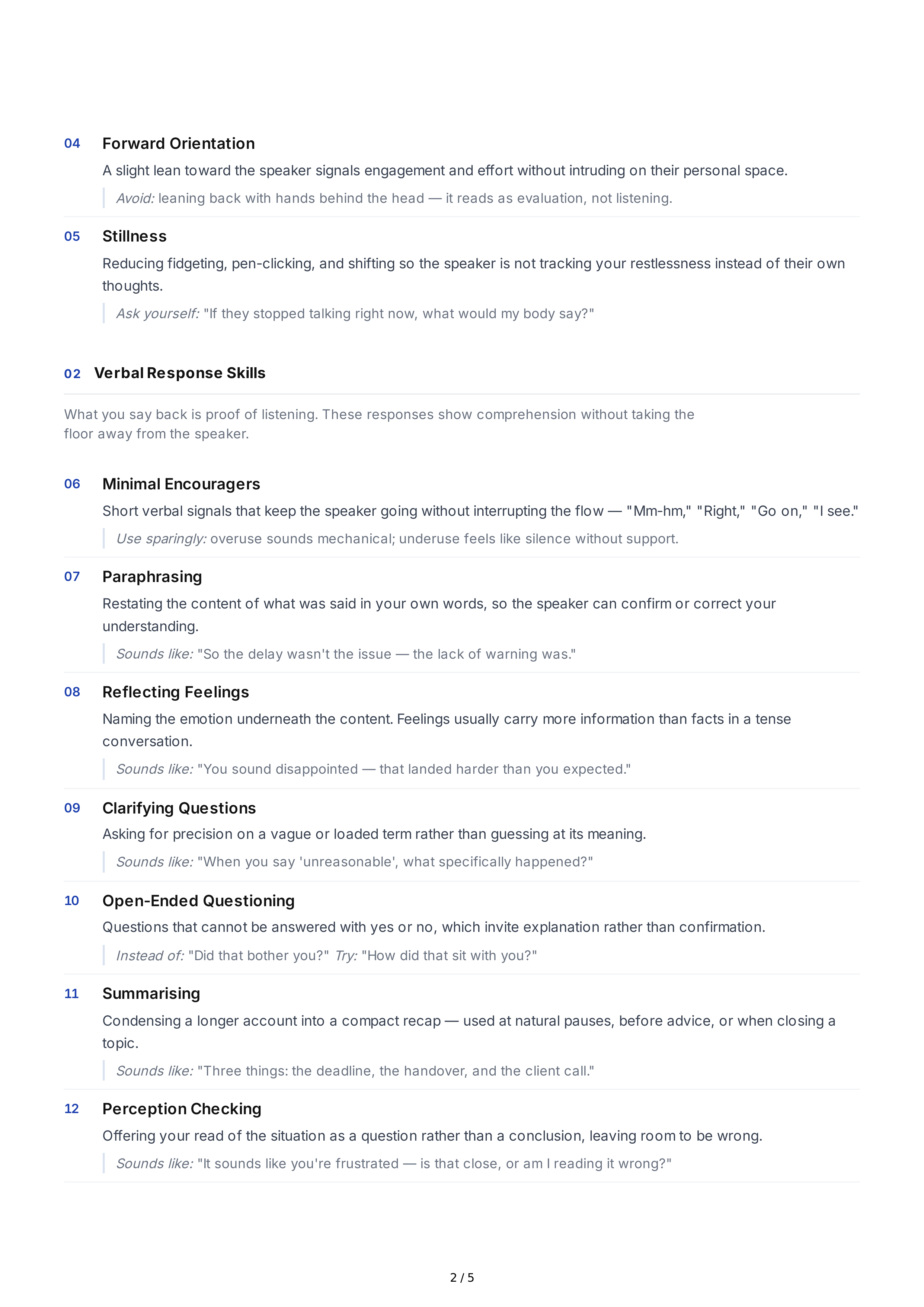
04
Forward
Orientation
A
slight
lean
toward
the
speaker
signals
engagement
and
effort
without
intruding
on
their
personal
space
.
Avoid
:
leaning
back
with
hands
behind
the
head
—
it
reads
as
evaluation
,
not
listening
.
05
Stillness
Reducing
fidgeting
,
pen
-
clicking
,
and
shifting
so
the
speaker
is
not
tracking
your
restlessness
instead
of
their
own
thoughts
.
Ask
yourself
: "
If
they
stopped
talking
right
now
,
what
would
my
body
say
?"
02
Verbal
Response
Skills
What
you
say
back
is
proof
of
listening
.
These
responses
show
comprehension
without
taking
the
floor
away
from
the
speaker
.
06
Minimal
Encouragers
Short
verbal
signals
that
keep
the
speaker
going
without
interrupting
the
flow
— "
Mm
-
hm
," "
Right
," "
Go
on
," "
I
see
."
Use
sparingly
:
overuse
sounds
mechanical
;
underuse
feels
like
silence
without
support
.
07
Paraphrasing
Restating
the
content
of
what
was
said
in
your
own
words
,
so
the
speaker
can
confirm
or
correct
your
understanding
.
Sounds
like
: "
So
the
delay
wasn
'
t
the
issue
—
the
lack
of
warning
was
."
08
Reflecting
Feelings
Naming
the
emotion
underneath
the
content
.
Feelings
usually
carry
more
information
than
facts
in
a
tense
conversation
.
Sounds
like
: "
You
sound
disappointed
—
that
landed
harder
than
you
expected
."
09
Clarifying
Questions
Asking
for
precision
on
a
vague
or
loaded
term
rather
than
guessing
at
its
meaning
.
Sounds
like
: "
When
you
say
'
unreasonable
',
what
specifically
happened
?"
10
Open
-
Ended
Questioning
Questions
that
cannot
be
answered
with
yes
or
no
,
which
invite
explanation
rather
than
confirmation
.
Instead
of
: "
Did
that
bother
you
?"
Try
: "
How
did
that
sit
with
you
?"
11
Summarising
Condensing
a
longer
account
into
a
compact
recap
—
used
at
natural
pauses
,
before
advice
,
or
when
closing
a
topic
.
Sounds
like
: "
Three
things
:
the
deadline
,
the
handover
,
and
the
client
call
."
12
Perception
Checking
Offering
your
read
of
the
situation
as
a
question
rather
than
a
conclusion
,
leaving
room
to
be
wrong
.
Sounds
like
: "
It
sounds
like
you
'
re
frustrated
—
is
that
close
,
or
am
I
reading
it
wrong
?"
2 / 5
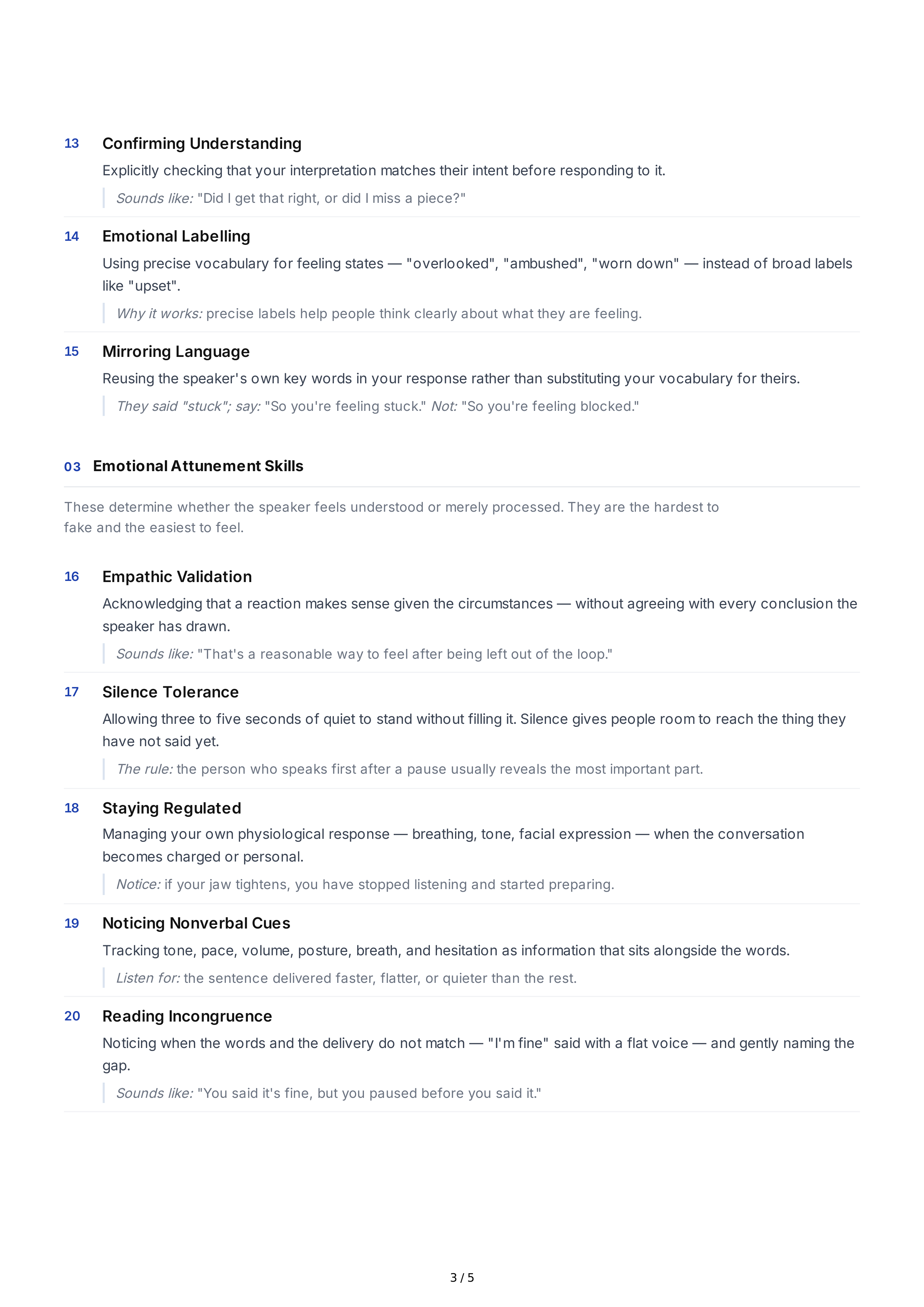
13
Confirming
Understanding
Explicitly
checking
that
your
interpretation
matches
their
intent
before
responding
to
it
.
Sounds
like
: "
Did
I
get
that
right
,
or
did
I
miss
a
piece
?"
14
Emotional
Labelling
Using
precise
vocabulary
for
feeling
states
— "
overlooked
", "
ambushed
", "
worn
down
" —
instead
of
broad
labels
like
"
upset
".
Why
it
works
:
precise
labels
help
people
think
clearly
about
what
they
are
feeling
.
15
Mirroring
Language
Reusing
the
speaker
'
s
own
key
words
in
your
response
rather
than
substituting
your
vocabulary
for
theirs
.
They
said
"
stuck
";
say
: "
So
you
'
re
feeling
stuck
."
Not
: "
So
you
'
re
feeling
blocked
."
03
Emotional
Attunement
Skills
These
determine
whether
the
speaker
feels
understood
or
merely
processed
.
They
are
the
hardest
to
fake
and
the
easiest
to
feel
.
16
Empathic
Validation
Acknowledging
that
a
reaction
makes
sense
given
the
circumstances
—
without
agreeing
with
every
conclusion
the
speaker
has
drawn
.
Sounds
like
: "
That
'
s
a
reasonable
way
to
feel
after
being
left
out
of
the
loop
."
17
Silence
Tolerance
Allowing
three
to
five
seconds
of
quiet
to
stand
without
filling
it
.
Silence
gives
people
room
to
reach
the
thing
they
have
not
said
yet
.
The
rule
:
the
person
who
speaks
first
after
a
pause
usually
reveals
the
most
important
part
.
18
Staying
Regulated
Managing
your
own
physiological
response
—
breathing
,
tone
,
facial
expression
—
when
the
conversation
becomes
charged
or
personal
.
Notice
:
if
your
jaw
tightens
,
you
have
stopped
listening
and
started
preparing
.
19
Noticing
Nonverbal
Cues
Tracking
tone
,
pace
,
volume
,
posture
,
breath
,
and
hesitation
as
information
that
sits
alongside
the
words
.
Listen
for
:
the
sentence
delivered
faster
,
flatter
,
or
quieter
than
the
rest
.
20
Reading
Incongruence
Noticing
when
the
words
and
the
delivery
do
not
match
— "
I
'
m
fine
"
said
with
a
flat
voice
—
and
gently
naming
the
gap
.
Sounds
like
: "
You
said
it
'
s
fine
,
but
you
paused
before
you
said
it
."
3 / 5
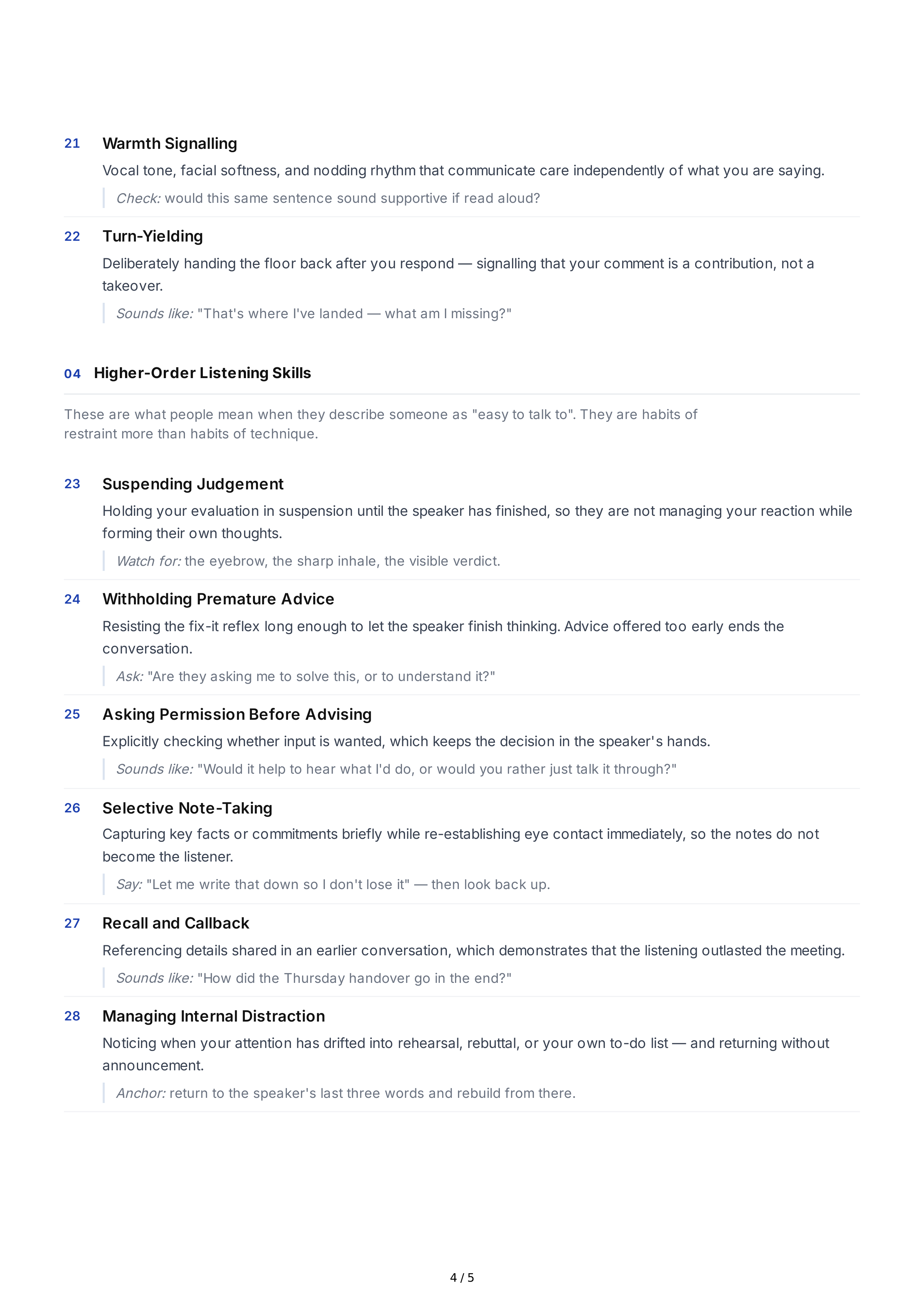
21
Warmth
Signalling
Vocal
tone
,
facial
softness
,
and
nodding
rhythm
that
communicate
care
independently
of
what
you
are
saying
.
Check
:
would
this
same
sentence
sound
supportive
if
read
aloud
?
22
Turn
-
Yielding
Deliberately
handing
the
floor
back
after
you
respond
—
signalling
that
your
comment
is
a
contribution
,
not
a
takeover
.
Sounds
like
: "
That
'
s
where
I
'
ve
landed
—
what
am
I
missing
?"
04
Higher
-
Order
Listening
Skills
These
are
what
people
mean
when
they
describe
someone
as
"
easy
to
talk
to
".
They
are
habits
of
restraint
more
than
habits
of
technique
.
23
Suspending
Judgement
Holding
your
evaluation
in
suspension
until
the
speaker
has
finished
,
so
they
are
not
managing
your
reaction
while
forming
their
own
thoughts
.
Watch
for
:
the
eyebrow
,
the
sharp
inhale
,
the
visible
verdict
.
24
Withholding
Premature
Advice
Resisting
the
fix
-
it
reflex
long
enough
to
let
the
speaker
finish
thinking
.
Advice
offered
too
early
ends
the
conversation
.
Ask
: "
Are
they
asking
me
to
solve
this
,
or
to
understand
it
?"
25
Asking
Permission
Before
Advising
Explicitly
checking
whether
input
is
wanted
,
which
keeps
the
decision
in
the
speaker
'
s
hands
.
Sounds
like
: "
Would
it
help
to
hear
what
I
'
d
do
,
or
would
you
rather
just
talk
it
through
?"
26
Selective
Note
-
Taking
Capturing
key
facts
or
commitments
briefly
while
re
-
establishing
eye
contact
immediately
,
so
the
notes
do
not
become
the
listener
.
Say
: "
Let
me
write
that
down
so
I
don
'
t
lose
it
" —
then
look
back
up
.
27
Recall
and
Callback
Referencing
details
shared
in
an
earlier
conversation
,
which
demonstrates
that
the
listening
outlasted
the
meeting
.
Sounds
like
: "
How
did
the
Thursday
handover
go
in
the
end
?"
28
Managing
Internal
Distraction
Noticing
when
your
attention
has
drifted
into
rehearsal
,
rebuttal
,
or
your
own
to
-
do
list
—
and
returning
without
announcement
.
Anchor
:
return
to
the
speaker
'
s
last
three
words
and
rebuild
from
there
.
4 / 5
29
Cultural
Calibration
Adjusting
eye
contact
,
directness
,
interruption
norms
,
and
acceptable
pause
length
to
the
person
and
context
in
front
of
you
.
Remember
:
in
some
contexts
,
sustained
eye
contact
signals
respect
;
in
others
,
it
signals
challenge
.
30
Reflective
Pause
After
Emotion
Letting
a
moment
of
weight
sit
before
you
respond
to
it
,
so
a
significant
disclosure
is
not
answered
with
the
first
thing
that
comes
to
mind
.
The
pause
says
: "
I
heard
that
,
and
I
'
m
taking
it
seriously
."
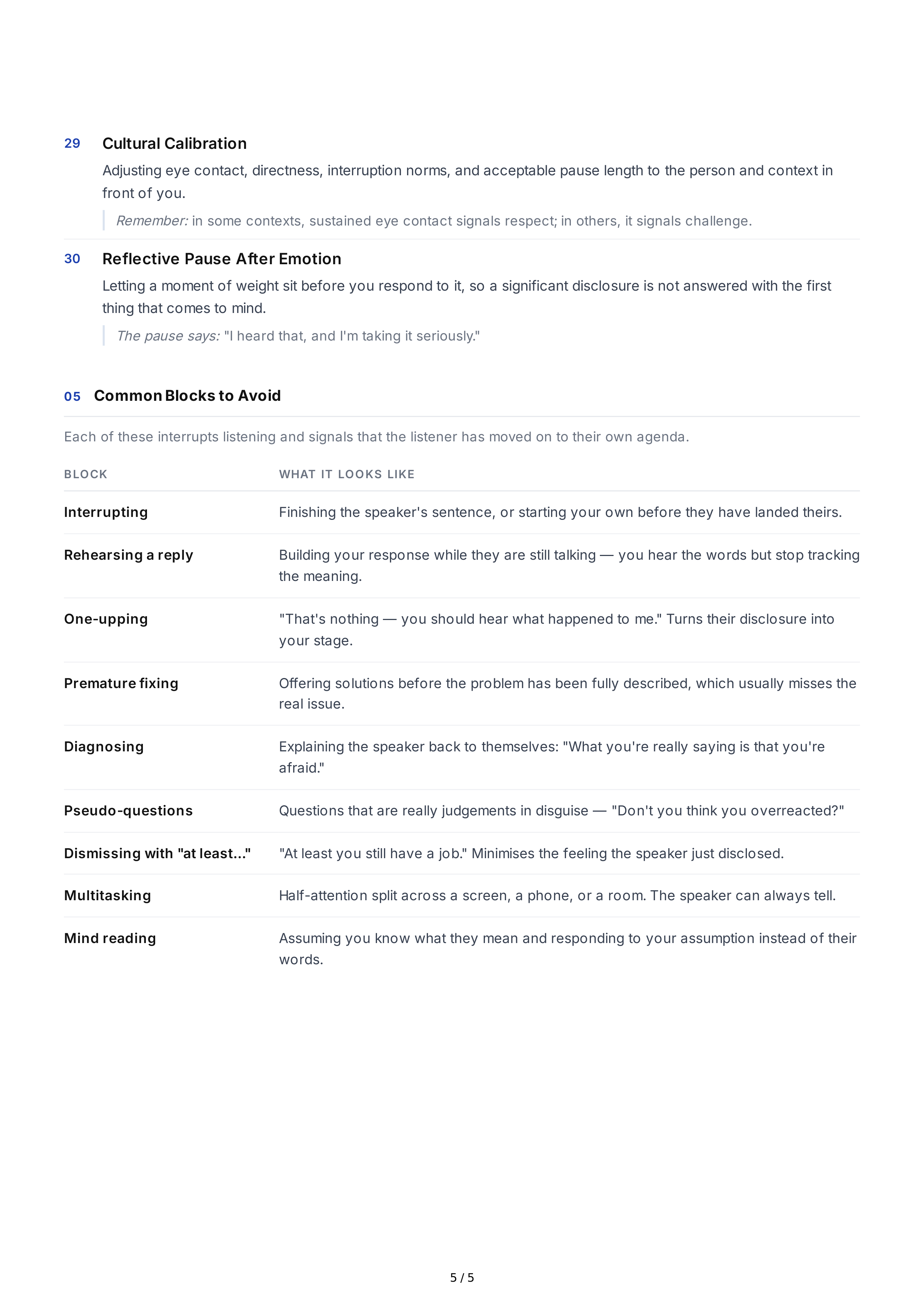
05
Common
Blocks
to
Avoid
Each
of
these
interrupts
listening
and
signals
that
the
listener
has
moved
on
to
their
own
agenda
.
BLOCK
WHAT
IT
LOOKS
LIKE
Interrupting
Finishing
the
speaker
'
s
sentence
,
or
starting
your
own
before
they
have
landed
theirs
.
Rehearsing
a
reply
Building
your
response
while
they
are
still
talking
—
you
hear
the
words
but
stop
tracking
the
meaning
.
One
-
upping
"
That
'
s
nothing
—
you
should
hear
what
happened
to
me
."
Turns
their
disclosure
into
your
stage
.
Premature
fixing
Offering
solutions
before
the
problem
has
been
fully
described
,
which
usually
misses
the
real
issue
.
Diagnosing
Explaining
the
speaker
back
to
themselves
: "
What
you
'
re
really
saying
is
that
you
'
re
afraid
."
Pseudo
-
questions
Questions
that
are
really
judgements
in
disguise
— "
Don
'
t
you
think
you
overreacted
?"
Dismissing
with
"
at
least
…"
"
At
least
you
still
have
a
job
."
Minimises
the
feeling
the
speaker
just
disclosed
.
Multitasking
Half
-
attention
split
across
a
screen
,
a
phone
,
or
a
room
.
The
speaker
can
always
tell
.
Mind
reading
Assuming
you
know
what
they
mean
and
responding
to
your
assumption
instead
of
their
words
.
5 / 5
