Consensus
Building
Interpersonal
Skills
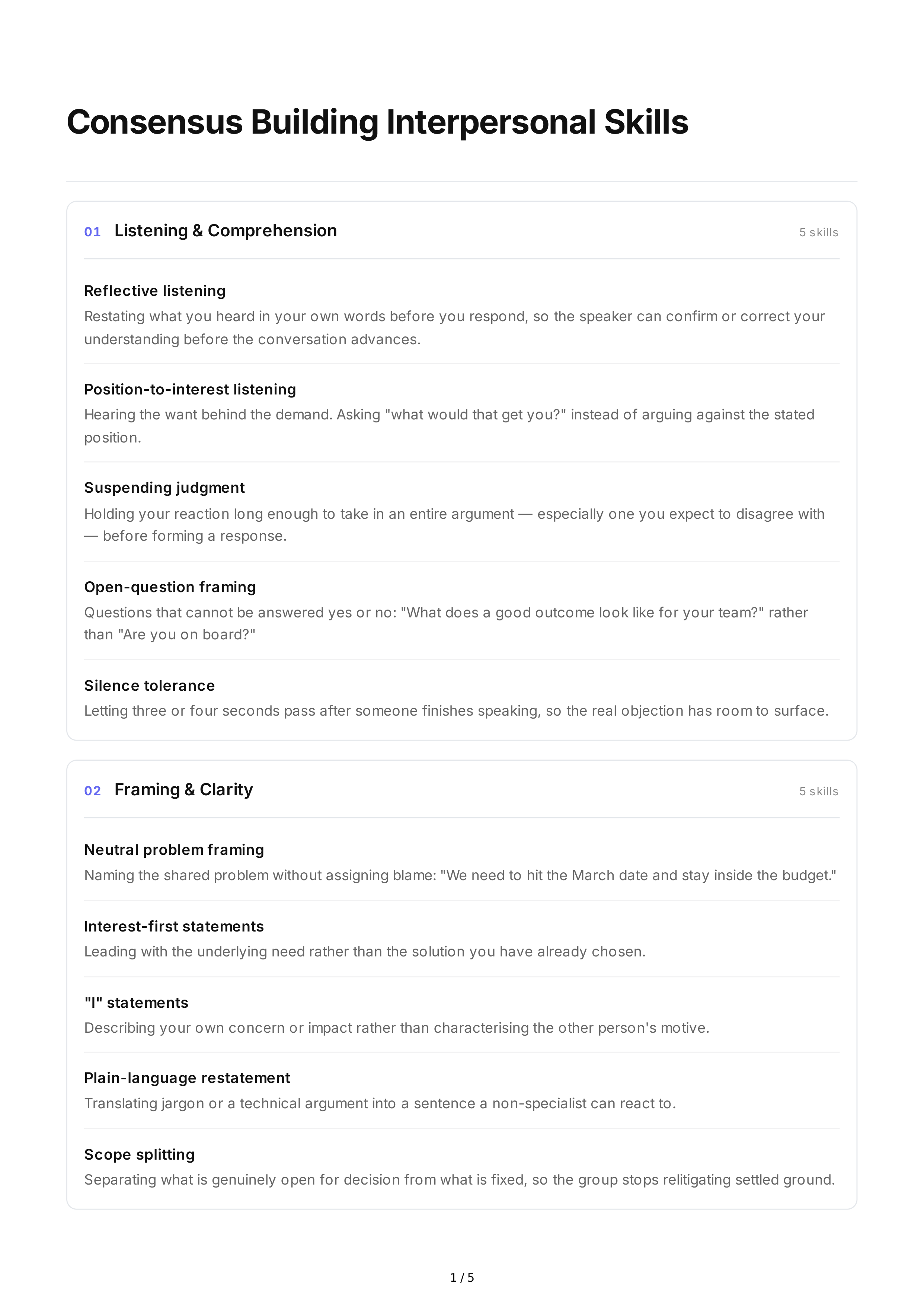
01
Listening
&
Comprehension
5
skills
Reflective
listening
Restating
what
you
heard
in
your
own
words
before
you
respond
,
so
the
speaker
can
confirm
or
correct
your
understanding
before
the
conversation
advances
.
Position
-
to
-
interest
listening
Hearing
the
want
behind
the
demand
.
Asking
"
what
would
that
get
you
?"
instead
of
arguing
against
the
stated
position
.
Suspending
judgment
Holding
your
reaction
long
enough
to
take
in
an
entire
argument
—
especially
one
you
expect
to
disagree
with
—
before
forming
a
response
.
Open
-
question
framing
Questions
that
cannot
be
answered
yes
or
no
: "
What
does
a
good
outcome
look
like
for
your
team
?"
rather
than
"
Are
you
on
board
?"
Silence
tolerance
Letting
three
or
four
seconds
pass
after
someone
finishes
speaking
,
so
the
real
objection
has
room
to
surface
.
02
Framing
&
Clarity
5
skills
Neutral
problem
framing
Naming
the
shared
problem
without
assigning
blame
: "
We
need
to
hit
the
March
date
and
stay
inside
the
budget
."
Interest
-
first
statements
Leading
with
the
underlying
need
rather
than
the
solution
you
have
already
chosen
.
"
I
"
statements
Describing
your
own
concern
or
impact
rather
than
characterising
the
other
person
'
s
motive
.
Plain
-
language
restatement
Translating
jargon
or
a
technical
argument
into
a
sentence
a
non
-
specialist
can
react
to
.
Scope
splitting
Separating
what
is
genuinely
open
for
decision
from
what
is
fixed
,
so
the
group
stops
relitigating
settled
ground
.
1 / 5
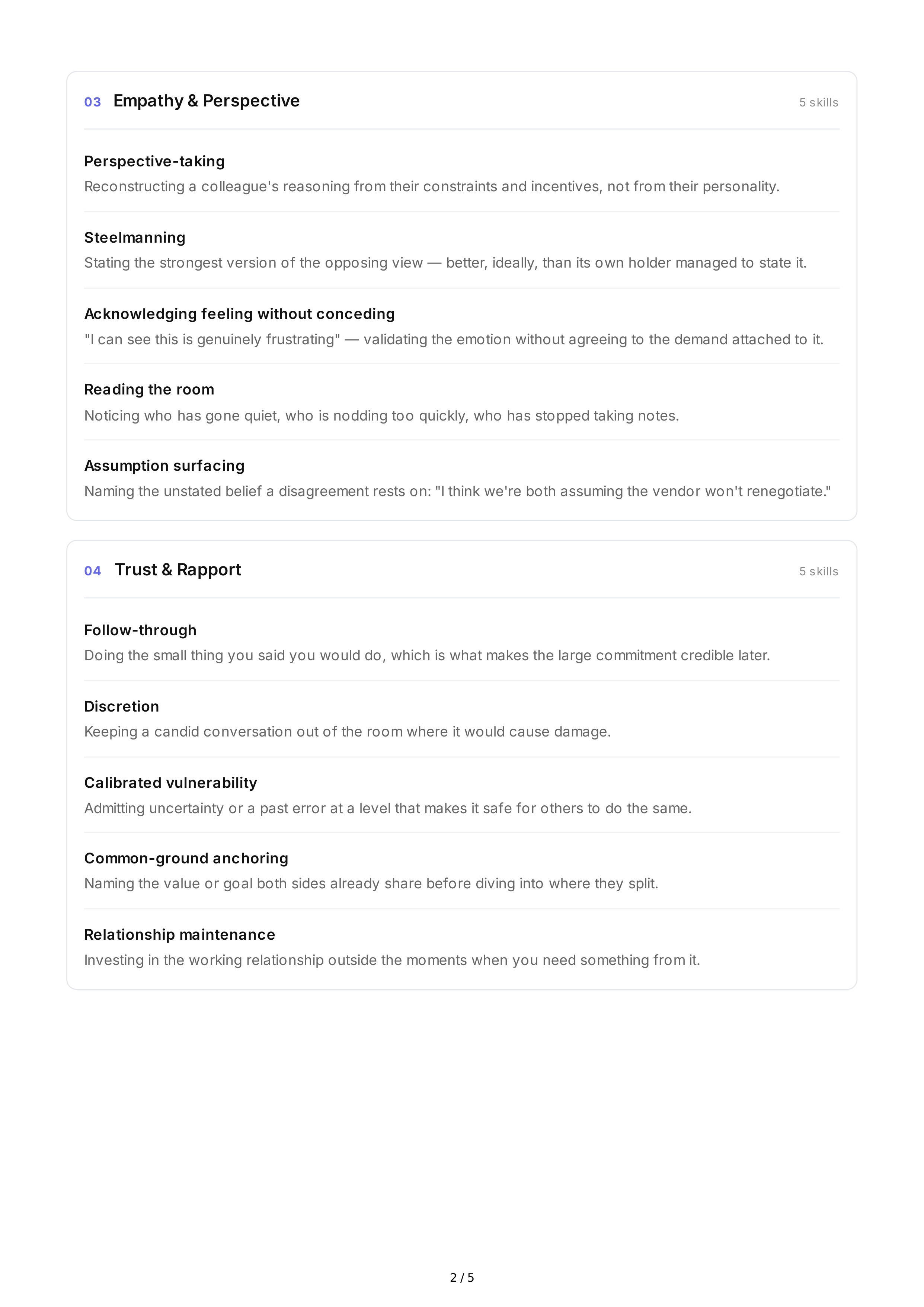
03
Empathy
&
Perspective
5
skills
Perspective
-
taking
Reconstructing
a
colleague
'
s
reasoning
from
their
constraints
and
incentives
,
not
from
their
personality
.
Steelmanning
Stating
the
strongest
version
of
the
opposing
view
—
better
,
ideally
,
than
its
own
holder
managed
to
state
it
.
Acknowledging
feeling
without
conceding
"
I
can
see
this
is
genuinely
frustrating
" —
validating
the
emotion
without
agreeing
to
the
demand
attached
to
it
.
Reading
the
room
Noticing
who
has
gone
quiet
,
who
is
nodding
too
quickly
,
who
has
stopped
taking
notes
.
Assumption
surfacing
Naming
the
unstated
belief
a
disagreement
rests
on
: "
I
think
we
'
re
both
assuming
the
vendor
won
'
t
renegotiate
."
04
Trust
&
Rapport
5
skills
Follow
-
through
Doing
the
small
thing
you
said
you
would
do
,
which
is
what
makes
the
large
commitment
credible
later
.
Discretion
Keeping
a
candid
conversation
out
of
the
room
where
it
would
cause
damage
.
Calibrated
vulnerability
Admitting
uncertainty
or
a
past
error
at
a
level
that
makes
it
safe
for
others
to
do
the
same
.
Common
-
ground
anchoring
Naming
the
value
or
goal
both
sides
already
share
before
diving
into
where
they
split
.
Relationship
maintenance
Investing
in
the
working
relationship
outside
the
moments
when
you
need
something
from
it
.
2 / 5
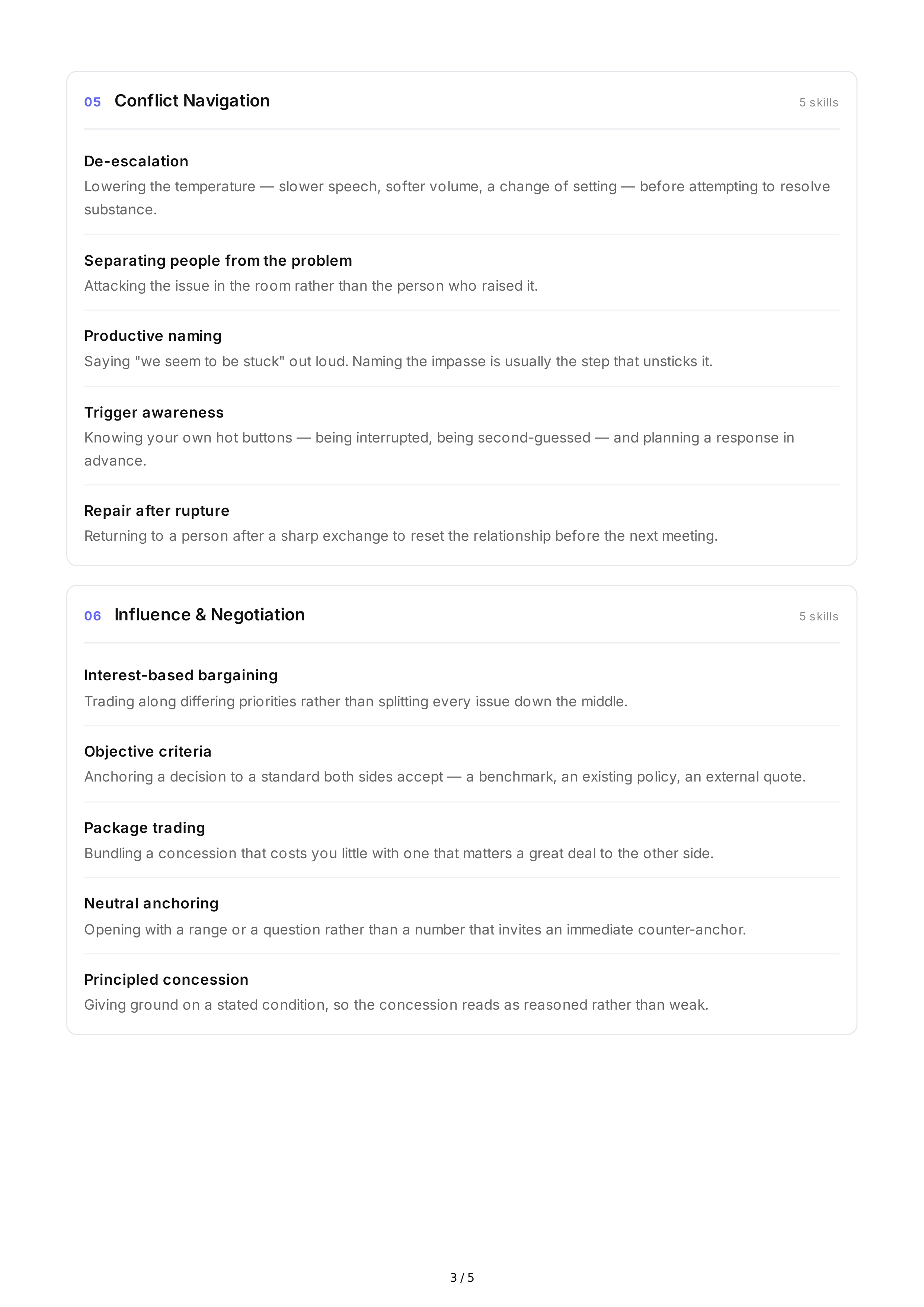
05
Conflict
Navigation
5
skills
De
-
escalation
Lowering
the
temperature
—
slower
speech
,
softer
volume
,
a
change
of
setting
—
before
attempting
to
resolve
substance
.
Separating
people
from
the
problem
Attacking
the
issue
in
the
room
rather
than
the
person
who
raised
it
.
Productive
naming
Saying
"
we
seem
to
be
stuck
"
out
loud
.
Naming
the
impasse
is
usually
the
step
that
unsticks
it
.
Trigger
awareness
Knowing
your
own
hot
buttons
—
being
interrupted
,
being
second
-
guessed
—
and
planning
a
response
in
advance
.
Repair
after
rupture
Returning
to
a
person
after
a
sharp
exchange
to
reset
the
relationship
before
the
next
meeting
.
06
Influence
&
Negotiation
5
skills
Interest
-
based
bargaining
Trading
along
differing
priorities
rather
than
splitting
every
issue
down
the
middle
.
Objective
criteria
Anchoring
a
decision
to
a
standard
both
sides
accept
—
a
benchmark
,
an
existing
policy
,
an
external
quote
.
Package
trading
Bundling
a
concession
that
costs
you
little
with
one
that
matters
a
great
deal
to
the
other
side
.
Neutral
anchoring
Opening
with
a
range
or
a
question
rather
than
a
number
that
invites
an
immediate
counter
-
anchor
.
Principled
concession
Giving
ground
on
a
stated
condition
,
so
the
concession
reads
as
reasoned
rather
than
weak
.
3 / 5
07
Facilitation
&
Group
Process
5
skills
Agenda
design
Sequencing
items
so
the
easiest
agreements
build
momentum
toward
the
hardest
one
.
Turn
-
taking
management
Structuring
input
so
the
most
senior
or
most
fluent
voice
does
not
automatically
speak
first
.
Parking
lot
Capturing
worthwhile
tangents
in
writing
so
people
can
let
go
of
them
for
the
duration
of
the
meeting
.
Temperature
checks
Testing
agreement
with
a
quick
visible
poll
before
assuming
the
room
is
aligned
.
Convergence
summary
Closing
with
a
written
statement
of
what
was
decided
,
by
whom
,
and
by
when
.
08
Self
-
Regulation
&
Commitment
5
skills
Impulse
control
Not
filling
a
pause
with
the
first
rebuttal
that
arrives
,
even
when
the
point
is
unfair
.
Emotional
labelling
Naming
your
own
state
accurately
— "
I
'
m
reacting
to
the
timing
,
not
the
proposal
" —
so
it
stops
driving
the
conversation
.
Decision
-
rights
clarity
Establishing
up
front
who
decides
,
who
is
consulted
,
and
who
simply
needs
to
be
told
.
Documenting
agreements
Recording
the
decision
and
any
reservation
in
writing
in
the
same
session
it
was
reached
.
Consensus
literacy
Knowing
the
difference
between
unanimous
agreement
,
consent
,
and
a
majority
vote
—
and
saying
which
one
is
being
asked
for
.
4 / 5
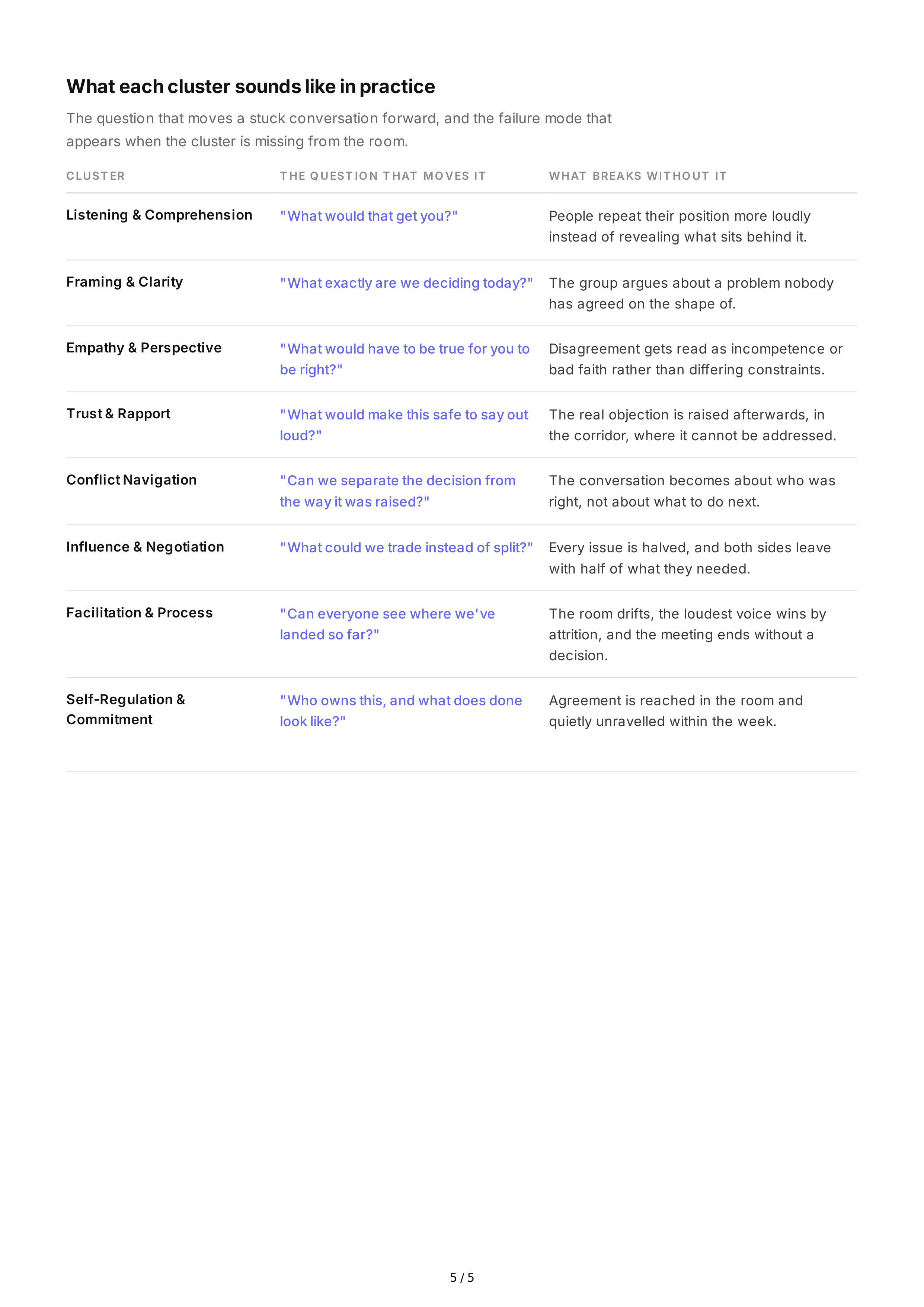
What
each
cluster
sounds
like
in
practice
The
question
that
moves
a
stuck
conversation
forward
,
and
the
failure
mode
that
appears
when
the
cluster
is
missing
from
the
room
.
CLUST ER
T HE
Q UEST IO N
T HAT
MO VES
IT
WHAT
BREAKS
WIT HO UT
IT
Listening
&
Comprehension
"
What
would
that
get
you
?"
People
repeat
their
position
more
loudly
instead
of
revealing
what
sits
behind
it
.
Framing
&
Clarity
"
What
exactly
are
we
deciding
today
?"
The
group
argues
about
a
problem
nobody
has
agreed
on
the
shape
of
.
Empathy
&
Perspective
"
What
would
have
to
be
true
for
you
to
be
right
?"
Disagreement
gets
read
as
incompetence
or
bad
faith
rather
than
differing
constraints
.
Trust
&
Rapport
"
What
would
make
this
safe
to
say
out
loud
?"
The
real
objection
is
raised
afterwards
,
in
the
corridor
,
where
it
cannot
be
addressed
.
Conflict
Navigation
"
Can
we
separate
the
decision
from
the
way
it
was
raised
?"
The
conversation
becomes
about
who
was
right
,
not
about
what
to
do
next
.
Influence
&
Negotiation
"
What
could
we
trade
instead
of
split
?"
Every
issue
is
halved
,
and
both
sides
leave
with
half
of
what
they
needed
.
Facilitation
&
Process
"
Can
everyone
see
where
we
'
ve
landed
so
far
?"
The
room
drifts
,
the
loudest
voice
wins
by
attrition
,
and
the
meeting
ends
without
a
decision
.
Self
-
Regulation
&
Commitment
"
Who
owns
this
,
and
what
does
done
look
like
?"
Agreement
is
reached
in
the
room
and
quietly
unravelled
within
the
week
.
5 / 5