Knowledge
Sharing
Interpersonal
Skills
1.
Master
List
— 25
Skills
at
a
Glance
The
complete
list
first
,
so
you
can
scan
it
in
one
pass
.
Detailed
descriptions
for
each
skill
follow
in
Section
2,
grouped
by
cluster
.
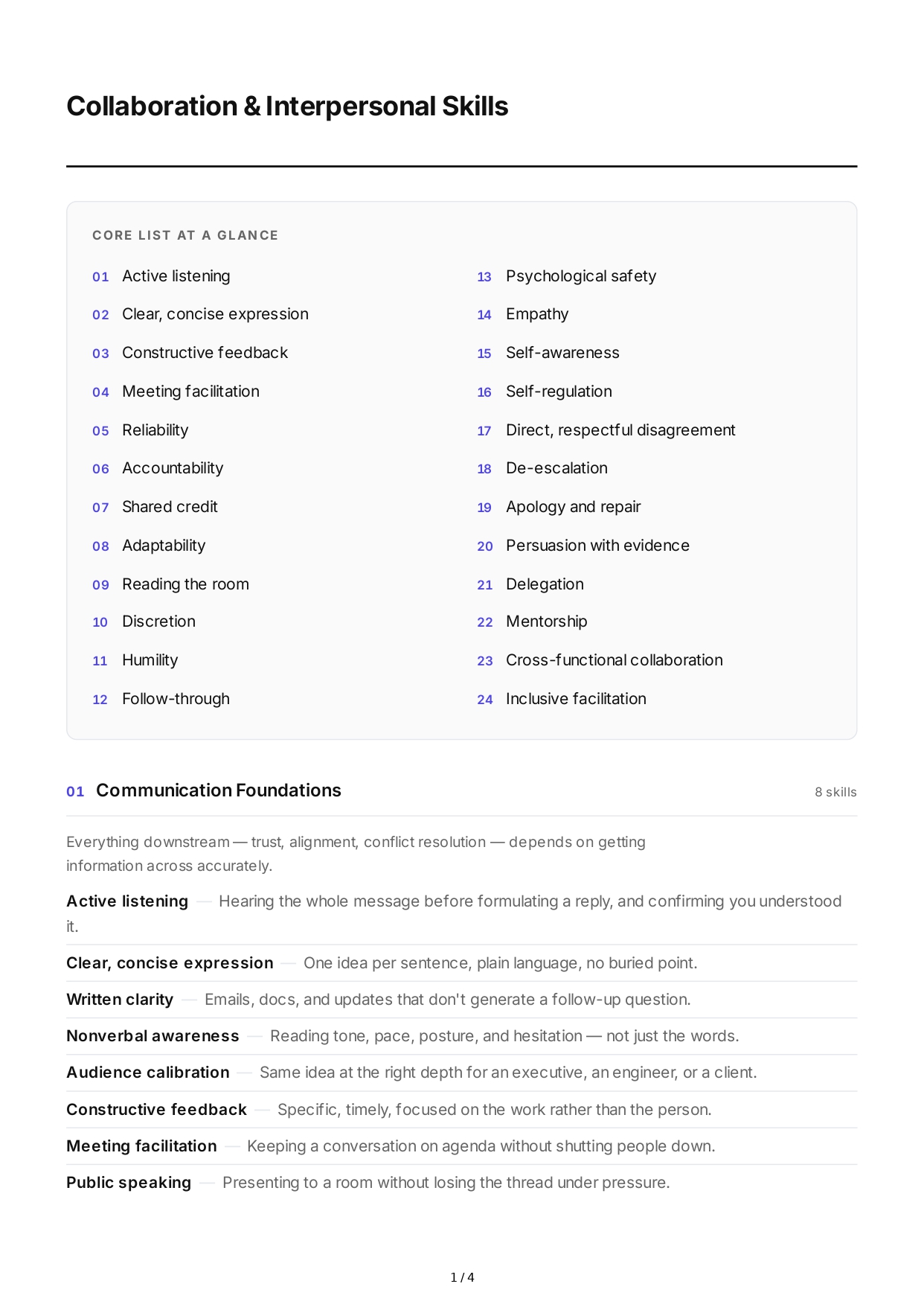
01
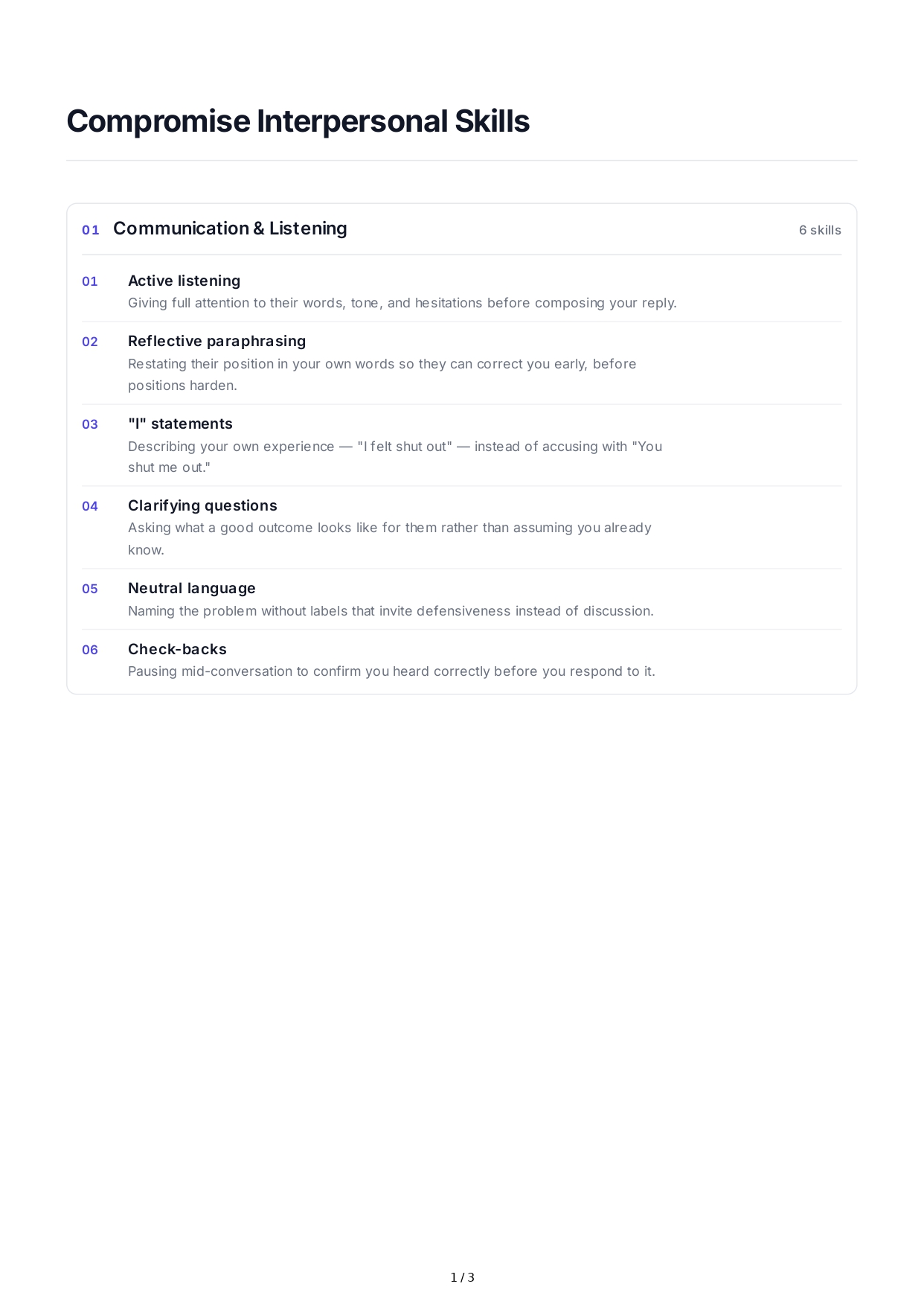
Active
listening
—
hearing
the
whole
message
,
not
just
the
words
02
Inquiry
through
open
questions
—
asking
to
understand
,
not
to
test
03
Empathetic
perspective
-
taking
—
seeing
the
problem
from
their
seat
04
Intellectual
curiosity
&
humility
— “
I
don
’
t
know
,
let
’
s
find
out
”
05
Plain
-
language
explanation
—
no
jargon
where
a
plain
word
works
06
Audience
calibration
—
matching
depth
to
who
is
in
the
room
07
Structured
storytelling
—
context
,
tension
,
resolution
08
Analogical
reasoning
—
anchoring
the
new
to
the
known
09
Visual
&
whiteboard
communication
—
drawing
the
idea
,
live
10
Technical
writing
—
docs
that
answer
on
the
first
screen
11
Asynchronous
communication
discipline
—
writing
for
the
reader
who
is
not
there
12
Note
-
taking
&
synthesis
—
turning
a
meeting
into
usable
knowledge
13
Knowledge
handover
&
continuity
—
leaving
the
work
legible
to
the
next
person
14
One
-
to
-
one
mentoring
—
growing
one
person
at
a
time
15
Live
demonstration
&
walkthrough
—
showing
the
thing
working
,
step
by
step
16
Constructive
feedback
delivery
—
specific
,
timely
,
actionable
17
Receiving
feedback
with
grace
—
separating
ego
from
the
signal
18
Meeting
facilitation
—
making
the
room
’
s
time
produce
something
19
Presentation
presence
—
holding
attention
while
teaching
20
Consensus
building
—
reaching
a
decision
people
will
back
21
Conflict
de
-
escalation
—
cooling
the
room
without
burying
the
issue
22
Psychological
safety
—
making
“
I
was
wrong
”
cheap
to
say
23
Cross
-
functional
translation
—
moving
an
idea
across
disciplines
24
Cultural
&
contextual
awareness
—
reading
norms
,
not
just
words
25
Boundaries
&
time
respect
—
protecting
focus
while
staying
reachable
How
to
use
this
list
:
pick
two
skills
,
not
twenty
.
Choose
one
from
the
listening
or
explaining
clusters
(
how
you
take
knowledge
in
and
hand
it
out
)
and
one
from
the
trust
or
facilitation
clusters
(
how
you
make
it
safe
and
useful
to
share
).
Work
on
those
for
a
quarter
,
then
revisit
the
list
.
1 / 4
2.
Listening
&
Inquiry
Nothing
gets
shared
well
until
the
other
person
’
s
actual
question
has
been
heard
.
These
skills
decide
whether
you
solve
the
problem
in
front
of
you
or
the
one
you
assumed
.
SKILL
0 1
Active
listening
Staying
with
a
speaker
until
the
thought
finishes
,
then
reflecting
it
back
in
your
own
words
before
responding
.
The
test
is
whether
they
say
“
yes
,
exactly
”
before
you
start
explaining
.
SKILL
0 2
Inquiry
through
open
questions
Leading
with
“
what
have
you
tried
so
far
?”
rather
than
“
did
you
try
X
?”
Open
questions
surface
the
context
that
a
yes
-
or
-
no
question
would
have
quietly
hidden
.
SKILL
0 3
Empathetic
perspective
-
taking
Reconstructing
the
other
person
’
s
constraints
,
deadlines
,
and
level
of
context
before
offering
a
solution
.
A
correct
answer
aimed
at
the
wrong
problem
still
reads
as
a
lecture
.
SKILL
0 4
Intellectual
curiosity
&
humility
Saying
“
I
don
’
t
know
—
let
’
s
find
out
”
out
loud
,
in
front
of
people
who
assume
you
do
.
Expertise
that
cannot
be
questioned
stops
being
shared
and
starts
being
obeyed
.
3.
Explaining
&
Framing
The
same
knowledge
lands
differently
depending
on
how
it
is
framed
.
These
skills
are
about
choosing
the
shape
of
the
explanation
before
choosing
the
words
.
SKILL
0 5
Plain
-
language
explanation
Choosing
the
shorter
,
older
word
and
cutting
the
acronyms
on
first
use
.
If
an
idea
only
survives
in
jargon
,
it
is
not
yet
understood
—
usually
by
the
person
explaining
it
.
SKILL
0 6
Audience
calibration
Adjusting
depth
,
vocabulary
,
and
pace
to
the
person
in
front
of
you
.
The
same
concept
needs
three
different
openings
for
a
new
graduate
,
a
peer
,
and
an
executive
.
SKILL
0 7
Structured
storytelling
Framing
knowledge
as
context
,
then
tension
,
then
resolution
.
People
retain
the
reasoning
behind
a
decision
far
longer
than
they
retain
the
decision
itself
.
SKILL
0 8
Analogical
reasoning
Anchoring
a
new
concept
to
something
the
listener
already
owns
.
Every
analogy
is
a
loan
against
their
existing
mental
model
,
so
check
that
the
mapping
actually
holds
.
SKILL
0 9
Visual
&
whiteboard
communication
Drawing
the
system
,
sketching
the
flow
,
labelling
the
boxes
while
you
talk
.
A
shared
diagram
removes
ambiguity
that
paragraphs
tend
to
reintroduce
.
2 / 4
4.
Writing
&
Documentation
Written
knowledge
outlives
the
conversation
that
produced
it
.
These
skills
determine
whether
it
is
still
findable
,
readable
,
and
correct
six
months
later
.
SKILL
10
Technical
writing
Documents
that
answer
“
how
do
I
do
this
?”
on
the
first
screen
,
written
for
someone
scanning
at
11
pm
during
an
incident
.
Structure
for
the
reader
,
not
for
the
author
’
s
narrative
.
SKILL
11
Asynchronous
communication
discipline
Writing
for
the
reader
who
was
not
in
the
room
and
will
not
be
online
for
another
eight
hours
.
Assume
no
shared
context
,
link
to
everything
,
and
state
the
ask
explicitly
.
SKILL
12
Note
-
taking
&
synthesis
Turning
a
sixty
-
minute
discussion
into
one
decision
,
three
open
questions
,
and
named
owners
.
Raw
transcripts
are
storage
;
synthesis
is
what
makes
them
knowledge
.
SKILL
13
Knowledge
handover
&
continuity
Leaving
work
legible
to
whoever
inherits
it
:
decisions
recorded
,
dead
ends
noted
,
next
steps
obvious
.
Reducing
the
bus
factor
on
purpose
rather
than
by
accident
.
5.
Teaching
&
Mentoring
Transfer
happens
one
person
and
one
session
at
a
time
.
These
skills
are
measured
by
what
the
other
person
can
do
afterwards
without
you
in
the
room
.
SKILL
14
One
-
to
-
one
mentoring
Growing
a
single
person
through
targeted
questions
,
paired
work
,
and
staged
responsibility
.
A
good
mentor
is
judged
by
what
their
mentee
can
do
alone
after
six
months
.
SKILL
15
Live
demonstration
&
walkthrough
Showing
the
thing
working
while
narrating
each
step
and
the
reasoning
behind
it
.
Watch
once
,
drive
once
,
teach
once
is
a
reliable
arc
for
durable
learning
.
SKILL
16
Constructive
feedback
delivery
Feedback
that
is
specific
,
timely
,
and
about
the
work
rather
than
the
person
. “
The
second
paragraph
buries
the
conclusion
”
is
usable
; “
good
effort
”
is
not
.
SKILL
17
Receiving
feedback
with
grace
Separating
your
ego
from
the
signal
and
asking
a
follow
-
up
question
instead
of
defending
.
How
you
receive
feedback
teaches
the
team
whether
it
is
safe
to
give
any
.
3 / 4
6.
Facilitation
&
Group
Work
Group
knowledge
sharing
fails
in
two
ways
:
nothing
gets
decided
,
or
everything
gets
decided
by
the
loudest
voice
.
These
skills
prevent
both
.
SKILL
18
Meeting
facilitation
Making
an
hour
of
collective
attention
produce
a
decision
,
a
plan
,
or
an
explicit
“
we
are
not
doing
this
.”
Agenda
,
timeboxes
,
and
a
written
outcome
at
the
end
.
SKILL
19
Presentation
presence
Holding
a
room
while
teaching
:
steady
pacing
,
real
eye
contact
,
and
a
deliberate
pause
after
the
important
sentence
.
Delivery
problems
frequently
hide
content
problems
.
SKILL
20
Consensus
building
Reaching
a
decision
the
group
will
actively
back
rather
than
merely
tolerate
.
Separating
consent
from
unanimous
agreement
saves
weeks
of
unnecessary
discussion
.
SKILL
21
Conflict
de
-
escalation
Cooling
the
temperature
without
burying
the
disagreement
.
Name
the
disagreement
in
neutral
terms
,
then
route
the
conversation
back
to
the
underlying
problem
.
7.
Trust
&
Relationship
Knowledge
flows
toward
people
and
rooms
where
questions
are
cheap
.
These
skills
build
the
conditions
that
make
every
other
skill
on
this
list
possible
.
SKILL
22
Psychological
safety
Making
“
I
was
wrong
”
and
“
I
don
’
t
understand
”
inexpensive
to
say
out
loud
.
Sharing
accelerates
where
asking
a
basic
question
carries
no
social
cost
.
SKILL
23
Cross
-
functional
translation
Carrying
an
idea
across
the
vocabulary
gap
between
engineering
,
design
,
sales
,
and
finance
.
The
same
concept
,
three
different
working
definitions
of
“
done
.”
SKILL
24
Cultural
&
contextual
awareness
Reading
norms
around
directness
,
silence
,
hierarchy
,
and
humour
across
regions
,
teams
,
and
levels
.
The
same
sentence
lands
differently
depending
on
who
is
in
the
room
.
SKILL
25
Boundaries
&
time
respect
Protecting
deep
work
while
staying
reliably
reachable
in
a
stated
way
. “
I
’
ll
reply
by
4
pm
”
beats
an
unanswered
ping
and
an
interrupted
afternoon
.
4 / 4