Cross
-
Cultural
Communication
:
Interpersonal
Skills
Reference
SK I LL
I N DE X
1.
Perception
&
Self
-
Awareness
Cultural
self
-
awareness
·
Perspective
-
taking
·
Suspending
judgment
·
Tolerance
for
ambiguity
·
Stereotype
vigilance
2.
Verbal
Communication
Plain
-
language
adaptation
·
Context
calibration
·
Active
listening
·
Silence
tolerance
·
Comprehension
looping
3.
Non
-
Verbal
&
Context
Reading
Non
-
verbal
literacy
·
Display
-
rule
awareness
·
Vocal
flexibility
·
Time
-
orientation
flexibility
·
Space
and
formality
reading
4.
Relational
&
Emotional
Empathy
across
difference
·
Respect
signalling
·
Face
-
saving
·
Relationship
-
first
pacing
·
Emotional
regulation
5.
Adaptive
&
Negotiation
Direct
/
indirect
feedback
fluency
·
Disagreement
framing
·
Decision
-
rule
reading
·
Negotiation
-
style
flexibility
·
Agreement
orientation
6.
Team
,
Collaboration
&
Inclusion
Inclusive
facilitation
·
Language
equity
·
Asynchronous
clarity
·
Conflict
-
style
mapping
·
Multicultural
team
norms
1 / 7
1
Perception
&
Self
-
Awareness
Every
cross
-
cultural
skill
begins
here
.
You
cannot
read
another
person
'
s
frame
accurately
until
you
can
see
your
own
as
one
option
among
many
.
1.1
Cultural
self
-
awareness
Naming
your
own
communication
defaults
—
directness
,
punctuality
,
formality
,
eye
contact
—
as
learned
preferences
rather
than
universal
standards
of
professionalism
.
IN
P R AC T IC E
Write
down
three
norms
you
treat
as
"
just
normal
at
work
."
Then
ask
which
of
them
a
colleague
from
another
background
might
read
differently
.
1.2
Perspective
-
taking
Deliberately
reconstructing
an
interaction
from
the
other
person
'
s
cultural
frame
before
responding
to
it
.
IN
P R AC T IC E
Before
replying
to
a
message
that
reads
as
abrupt
or
evasive
,
ask
: "
What
would
this
same
message
mean
if
it
were
written
by
someone
with
different
norms
?"
1.3
Suspending
judgment
Holding
interpretation
open
while
evidence
is
incomplete
,
instead
of
resolving
ambiguity
with
an
assumption
about
intent
.
IN
P R AC T IC E
Separate
the
two
sentences
in
your
head
: "
Here
is
what
I
observed
"
and
"
Here
is
what
I
think
it
means
."
Only
the
first
belongs
in
the
meeting
.
1.4
Tolerance
for
ambiguity
Staying
functional
and
productive
when
the
social
rules
of
a
situation
are
unfamiliar
,
unwritten
,
or
shifting
.
IN
P R AC T IC E
Keep
a
short
running
list
of
open
questions
rather
than
forcing
a
resolution
in
the
moment
.
Ambiguity
held
for
a
day
usually
resolves
;
ambiguity
resolved
too
fast
usually
doesn
'
t
.
1.5
Stereotype
vigilance
Treating
cultural
patterns
as
hypotheses
about
groups
and
never
as
facts
about
the
individual
in
front
of
you
.
IN
P R AC T IC E
Turn
each
generalization
into
a
question
. "
This
team
may
prefer
indirect
feedback
—
how
do
you
prefer
to
receive
it
?"
2 / 7
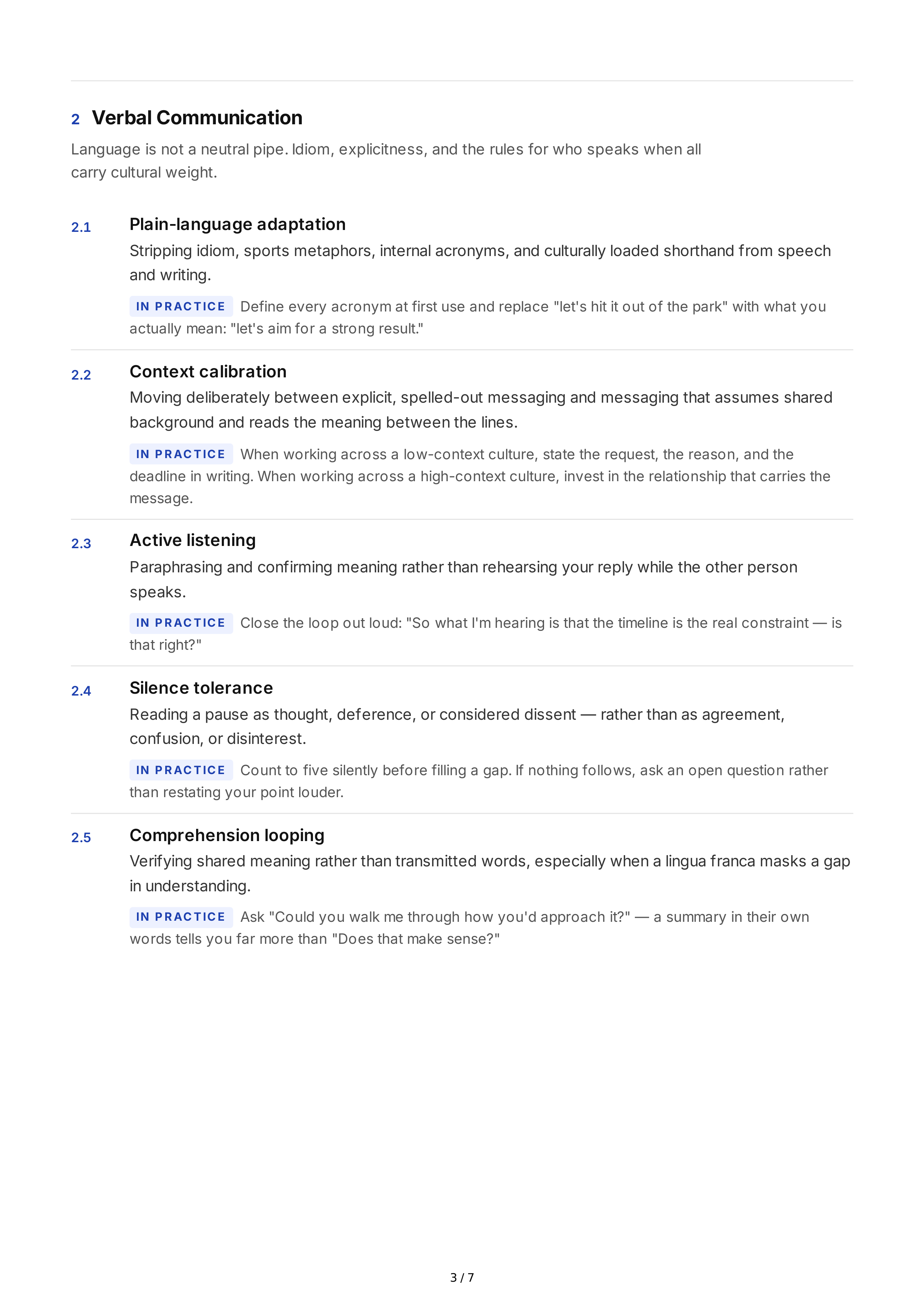
2
Verbal
Communication
Language
is
not
a
neutral
pipe
.
Idiom
,
explicitness
,
and
the
rules
for
who
speaks
when
all
carry
cultural
weight
.
2.1
Plain
-
language
adaptation
Stripping
idiom
,
sports
metaphors
,
internal
acronyms
,
and
culturally
loaded
shorthand
from
speech
and
writing
.
IN
P R AC T IC E
Define
every
acronym
at
first
use
and
replace
"
let
'
s
hit
it
out
of
the
park
"
with
what
you
actually
mean
: "
let
'
s
aim
for
a
strong
result
."
2.2
Context
calibration
Moving
deliberately
between
explicit
,
spelled
-
out
messaging
and
messaging
that
assumes
shared
background
and
reads
the
meaning
between
the
lines
.
IN
P R AC T IC E
When
working
across
a
low
-
context
culture
,
state
the
request
,
the
reason
,
and
the
deadline
in
writing
.
When
working
across
a
high
-
context
culture
,
invest
in
the
relationship
that
carries
the
message
.
2.3
Active
listening
Paraphrasing
and
confirming
meaning
rather
than
rehearsing
your
reply
while
the
other
person
speaks
.
IN
P R AC T IC E
Close
the
loop
out
loud
: "
So
what
I
'
m
hearing
is
that
the
timeline
is
the
real
constraint
—
is
that
right
?"
2.4
Silence
tolerance
Reading
a
pause
as
thought
,
deference
,
or
considered
dissent
—
rather
than
as
agreement
,
confusion
,
or
disinterest
.
IN
P R AC T IC E
Count
to
five
silently
before
filling
a
gap
.
If
nothing
follows
,
ask
an
open
question
rather
than
restating
your
point
louder
.
2.5
Comprehension
looping
Verifying
shared
meaning
rather
than
transmitted
words
,
especially
when
a
lingua
franca
masks
a
gap
in
understanding
.
IN
P R AC T IC E
Ask
"
Could
you
walk
me
through
how
you
'
d
approach
it
?" —
a
summary
in
their
own
words
tells
you
far
more
than
"
Does
that
make
sense
?"
3 / 7
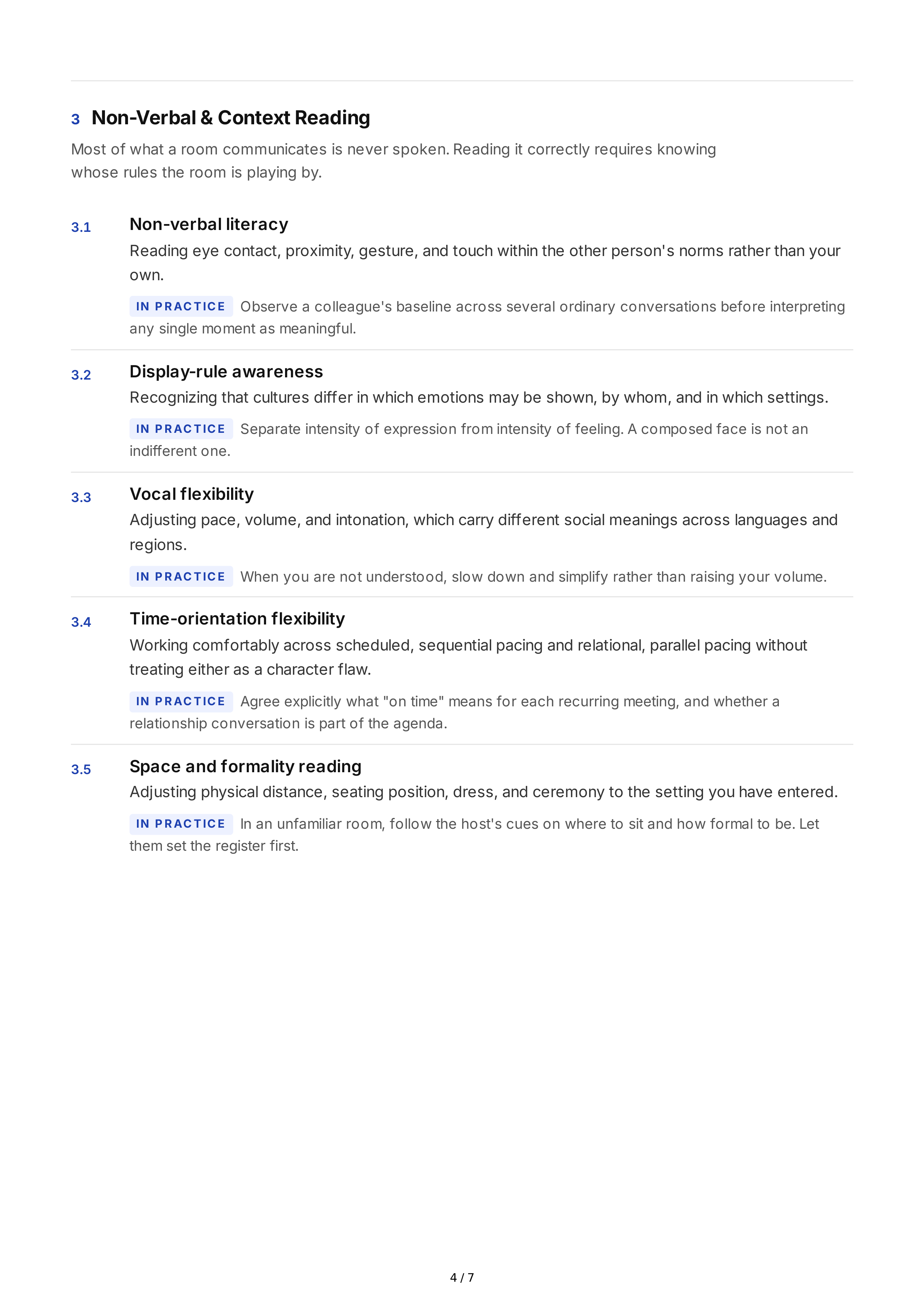
3
Non
-
Verbal
&
Context
Reading
Most
of
what
a
room
communicates
is
never
spoken
.
Reading
it
correctly
requires
knowing
whose
rules
the
room
is
playing
by
.
3.1
Non
-
verbal
literacy
Reading
eye
contact
,
proximity
,
gesture
,
and
touch
within
the
other
person
'
s
norms
rather
than
your
own
.
IN
P R AC T IC E
Observe
a
colleague
'
s
baseline
across
several
ordinary
conversations
before
interpreting
any
single
moment
as
meaningful
.
3.2
Display
-
rule
awareness
Recognizing
that
cultures
differ
in
which
emotions
may
be
shown
,
by
whom
,
and
in
which
settings
.
IN
P R AC T IC E
Separate
intensity
of
expression
from
intensity
of
feeling
.
A
composed
face
is
not
an
indifferent
one
.
3.3
Vocal
flexibility
Adjusting
pace
,
volume
,
and
intonation
,
which
carry
different
social
meanings
across
languages
and
regions
.
IN
P R AC T IC E
When
you
are
not
understood
,
slow
down
and
simplify
rather
than
raising
your
volume
.
3.4
Time
-
orientation
flexibility
Working
comfortably
across
scheduled
,
sequential
pacing
and
relational
,
parallel
pacing
without
treating
either
as
a
character
flaw
.
IN
P R AC T IC E
Agree
explicitly
what
"
on
time
"
means
for
each
recurring
meeting
,
and
whether
a
relationship
conversation
is
part
of
the
agenda
.
3.5
Space
and
formality
reading
Adjusting
physical
distance
,
seating
position
,
dress
,
and
ceremony
to
the
setting
you
have
entered
.
IN
P R AC T IC E
In
an
unfamiliar
room
,
follow
the
host
'
s
cues
on
where
to
sit
and
how
formal
to
be
.
Let
them
set
the
register
first
.
4 / 7
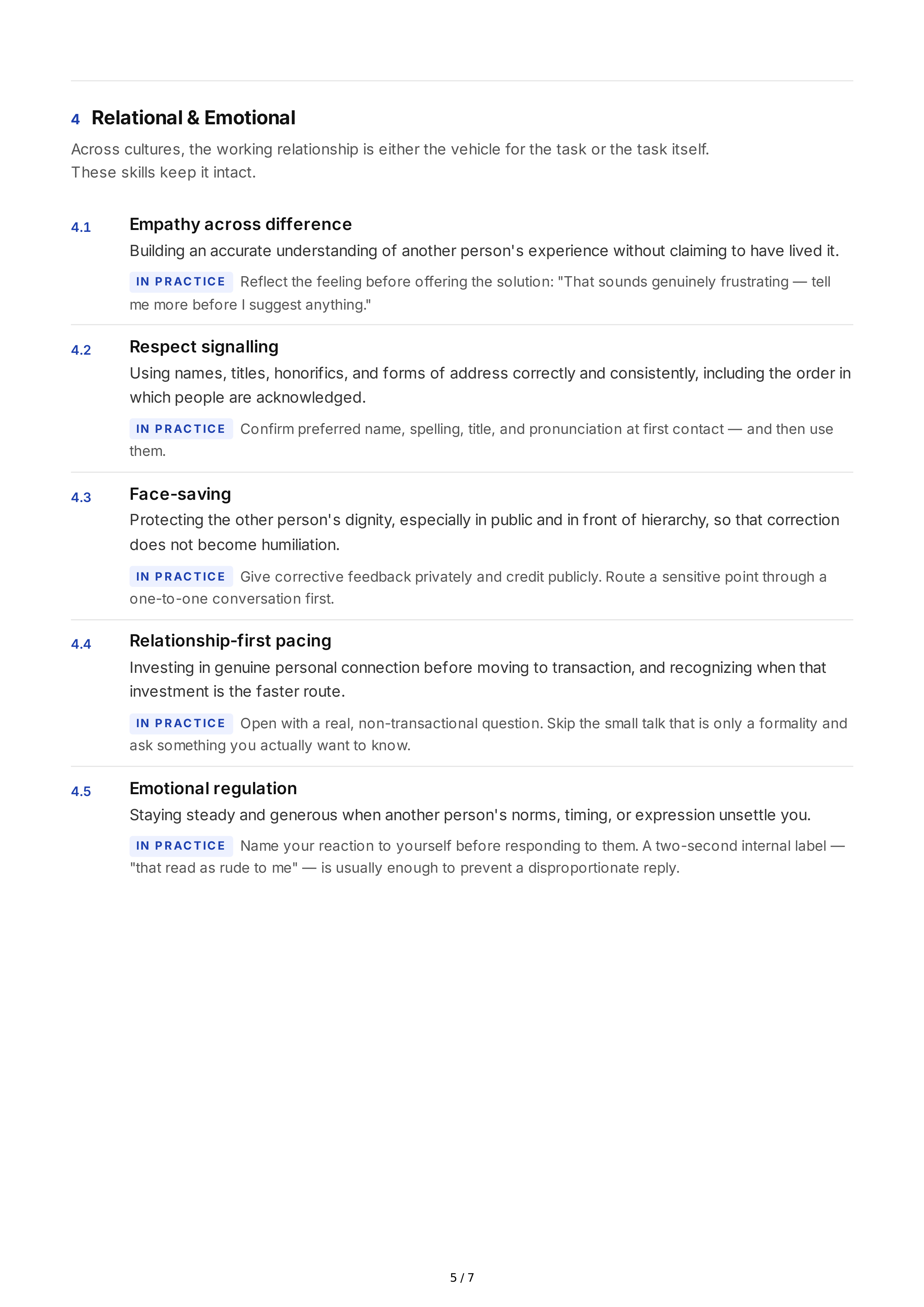
4
Relational
&
Emotional
Across
cultures
,
the
working
relationship
is
either
the
vehicle
for
the
task
or
the
task
itself
.
These
skills
keep
it
intact
.
4.1
Empathy
across
difference
Building
an
accurate
understanding
of
another
person
'
s
experience
without
claiming
to
have
lived
it
.
IN
P R AC T IC E
Reflect
the
feeling
before
offering
the
solution
: "
That
sounds
genuinely
frustrating
—
tell
me
more
before
I
suggest
anything
."
4.2
Respect
signalling
Using
names
,
titles
,
honorifics
,
and
forms
of
address
correctly
and
consistently
,
including
the
order
in
which
people
are
acknowledged
.
IN
P R AC T IC E
Confirm
preferred
name
,
spelling
,
title
,
and
pronunciation
at
first
contact
—
and
then
use
them
.
4.3
Face
-
saving
Protecting
the
other
person
'
s
dignity
,
especially
in
public
and
in
front
of
hierarchy
,
so
that
correction
does
not
become
humiliation
.
IN
P R AC T IC E
Give
corrective
feedback
privately
and
credit
publicly
.
Route
a
sensitive
point
through
a
one
-
to
-
one
conversation
first
.
4.4
Relationship
-
first
pacing
Investing
in
genuine
personal
connection
before
moving
to
transaction
,
and
recognizing
when
that
investment
is
the
faster
route
.
IN
P R AC T IC E
Open
with
a
real
,
non
-
transactional
question
.
Skip
the
small
talk
that
is
only
a
formality
and
ask
something
you
actually
want
to
know
.
4.5
Emotional
regulation
Staying
steady
and
generous
when
another
person
'
s
norms
,
timing
,
or
expression
unsettle
you
.
IN
P R AC T IC E
Name
your
reaction
to
yourself
before
responding
to
them
.
A
two
-
second
internal
label
—
"
that
read
as
rude
to
me
" —
is
usually
enough
to
prevent
a
disproportionate
reply
.
5 / 7
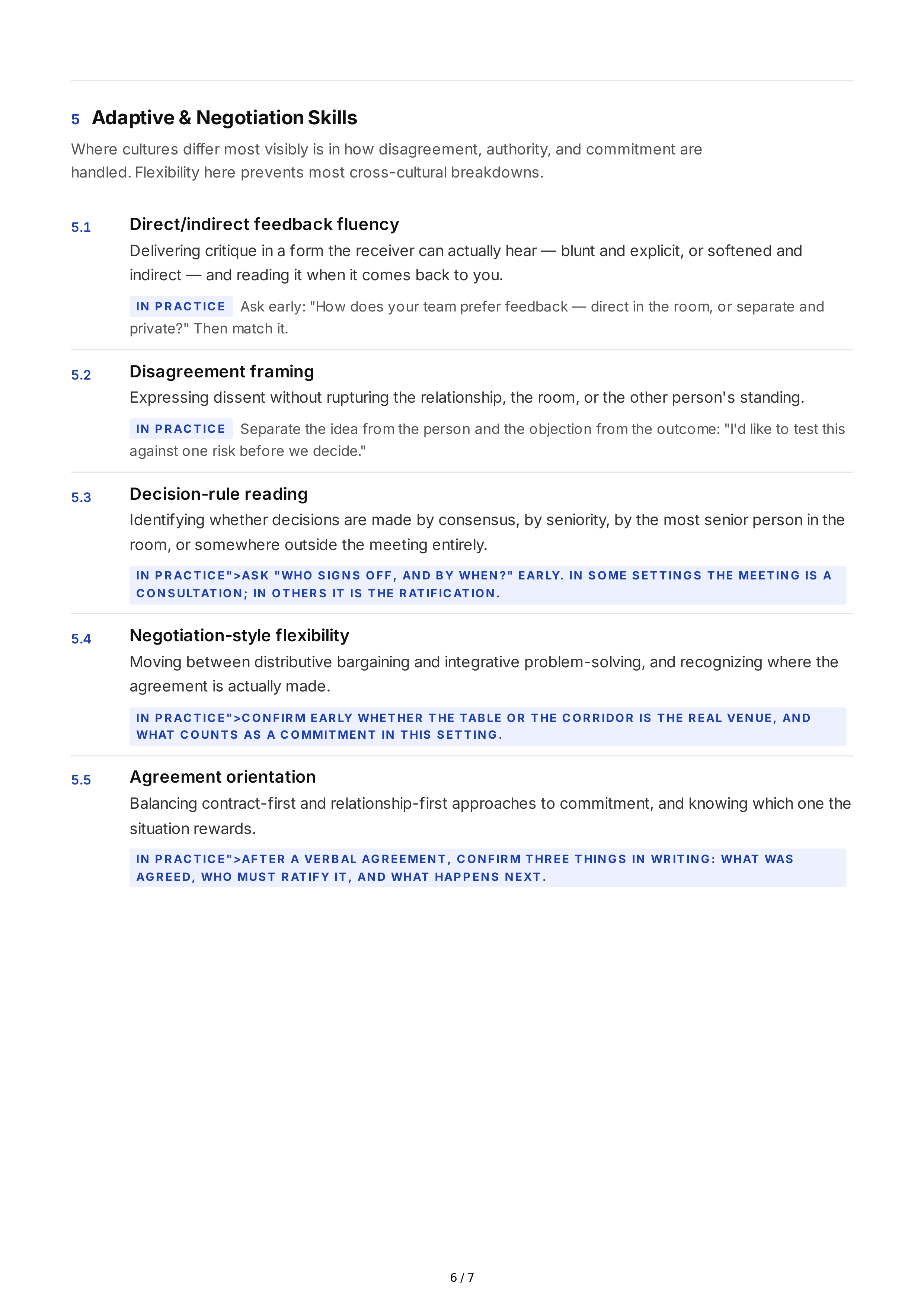
5
Adaptive
&
Negotiation
Skills
Where
cultures
differ
most
visibly
is
in
how
disagreement
,
authority
,
and
commitment
are
handled
.
Flexibility
here
prevents
most
cross
-
cultural
breakdowns
.
5.1
Direct
/
indirect
feedback
fluency
Delivering
critique
in
a
form
the
receiver
can
actually
hear
—
blunt
and
explicit
,
or
softened
and
indirect
—
and
reading
it
when
it
comes
back
to
you
.
IN
P R AC T IC E
Ask
early
: "
How
does
your
team
prefer
feedback
—
direct
in
the
room
,
or
separate
and
private
?"
Then
match
it
.
5.2
Disagreement
framing
Expressing
dissent
without
rupturing
the
relationship
,
the
room
,
or
the
other
person
'
s
standing
.
IN
P R AC T IC E
Separate
the
idea
from
the
person
and
the
objection
from
the
outcome
: "
I
'
d
like
to
test
this
against
one
risk
before
we
decide
."
5.3
Decision
-
rule
reading
Identifying
whether
decisions
are
made
by
consensus
,
by
seniority
,
by
the
most
senior
person
in
the
room
,
or
somewhere
outside
the
meeting
entirely
.
IN
P R AC T IC E
">
AS K
"
WHO
S IG N S
OFF
,
AN D
B Y
WHEN
?"
EAR LY
.
IN
S OME
S ET T IN G S
T HE
MEET IN G
IS
A
C ON S ULTAT ION
;
IN
OT HER S
IT
IS
T HE
R AT IFIC AT ION
.
5.4
Negotiation
-
style
flexibility
Moving
between
distributive
bargaining
and
integrative
problem
-
solving
,
and
recognizing
where
the
agreement
is
actually
made
.
IN
P R AC T IC E
">
C ON FIR M
EAR LY
WHET HER
T HE
TAB LE
OR
T HE
C OR R IDOR
IS
T HE
R EAL
VEN UE
,
AN D
WHAT
C OUN T S
AS
A
C OMMIT MEN T
IN
T HIS
S ET T IN G
.
5.5
Agreement
orientation
Balancing
contract
-
first
and
relationship
-
first
approaches
to
commitment
,
and
knowing
which
one
the
situation
rewards
.
IN
P R AC T IC E
">
AFT ER
A
VER B AL
AG R EEMEN T
,
C ON FIR M
T HR EE
T HIN G S
IN
WR IT IN G
:
WHAT
WAS
AG R EED
,
WHO
MUS T
R AT IFY
IT
,
AN D
WHAT
HAP P EN S
N EXT
.
6 / 7
6
Team
,
Collaboration
&
Inclusion
These
skills
are
structural
rather
than
personal
.
They
design
the
conditions
in
which
the
other
twenty
-
five
can
actually
operate
.
6.1
Inclusive
facilitation
Designing
airtime
so
that
quieter
,
junior
,
remote
,
or
non
-
native
-
speaking
participants
can
contribute
on
equal
footing
.
IN
P R AC T IC E
">
C OLLEC T
WR IT T EN
IN P UT
B EFOR E
T HE
OP EN
DIS C US S ION
,
T HEN
R UN
A
R OUN D
-
R OB IN
S O
T HE
FAS T ES T
S P EAKER
DOES
N OT
S ET
T HE
EN T IR E
AG EN DA
.
6.2
Language
equity
Running
meetings
so
that
fluency
is
never
mistaken
for
competence
and
hesitation
is
never
mistaken
for
ignorance
.
IN
P R AC T IC E
">
C IR C ULAT E
MAT ER IALS
AT
LEAS T
24
HOUR S
AHEAD
,
PAUS E
AFT ER
EAC H
P OIN T
,
AN D
R ES IS T
T HE
UR G E
T O
FIN IS H
AN OT HER
P ER S ON
'
S
S EN T EN C E
.
6.3
Asynchronous
clarity
Writing
across
time
zones
and
languages
so
that
the
context
survives
without
you
in
the
room
to
supply
it
.
IN
P R AC T IC E
">
LEAD
EVER Y
WR IT T EN
MES S AG E
WIT H
T HE
AS K
,
T HE
DEADLIN E
,
AN D
T HE
DEC IS ION
R EQUIR ED
.
P UT
B AC KG R OUN D
B ELOW
,
C LEAR LY
MAR KED
AS
B AC KG R OUN D
.
6.4
Conflict
-
style
mapping
Reading
avoidance
,
accommodation
,
competition
,
compromise
,
and
collaboration
as
culturally
shaped
strategies
rather
than
as
maturity
levels
.
IN
P R AC T IC E
">
N AME
T HE
S T YLE
YOU
AR E
S EEIN G
IN
T HE
R OOM
B EFOR E
N EG OT IAT IN G
T HE
P R OC ES S
: "
IT
S OUN DS
LIKE
WE
'
R E
B OT H
AVOIDIN G
T HE
DIS AG R EEMEN T
—
C AN
WE
P UT
IT
ON
T HE
TAB LE
?"
6.5
Multicultural
team
norms
Co
-
authoring
explicit
team
agreements
on
meetings
,
feedback
,
decisions
,
and
escalation
so
that
no
one
has
to
guess
whose
culture
is
the
default
.
IN
P R AC T IC E
">
WR IT E
T HE
AG R EEMEN T
DOWN
,
R EVIS IT
IT
QUAR T ER LY
,
AN D
LET
T HE
N EWES T
T EAM
MEMB ER
R EVIEW
IT
FIR S T
—
T HEY
S EE
T HE
UN WR IT T EN
R ULES
MOS T
C LEAR LY
.
7 / 7