Diplomacy
&
Interpersonal
Skills
01 ·
Communication
&
Dialogue
8
SKILLS
01
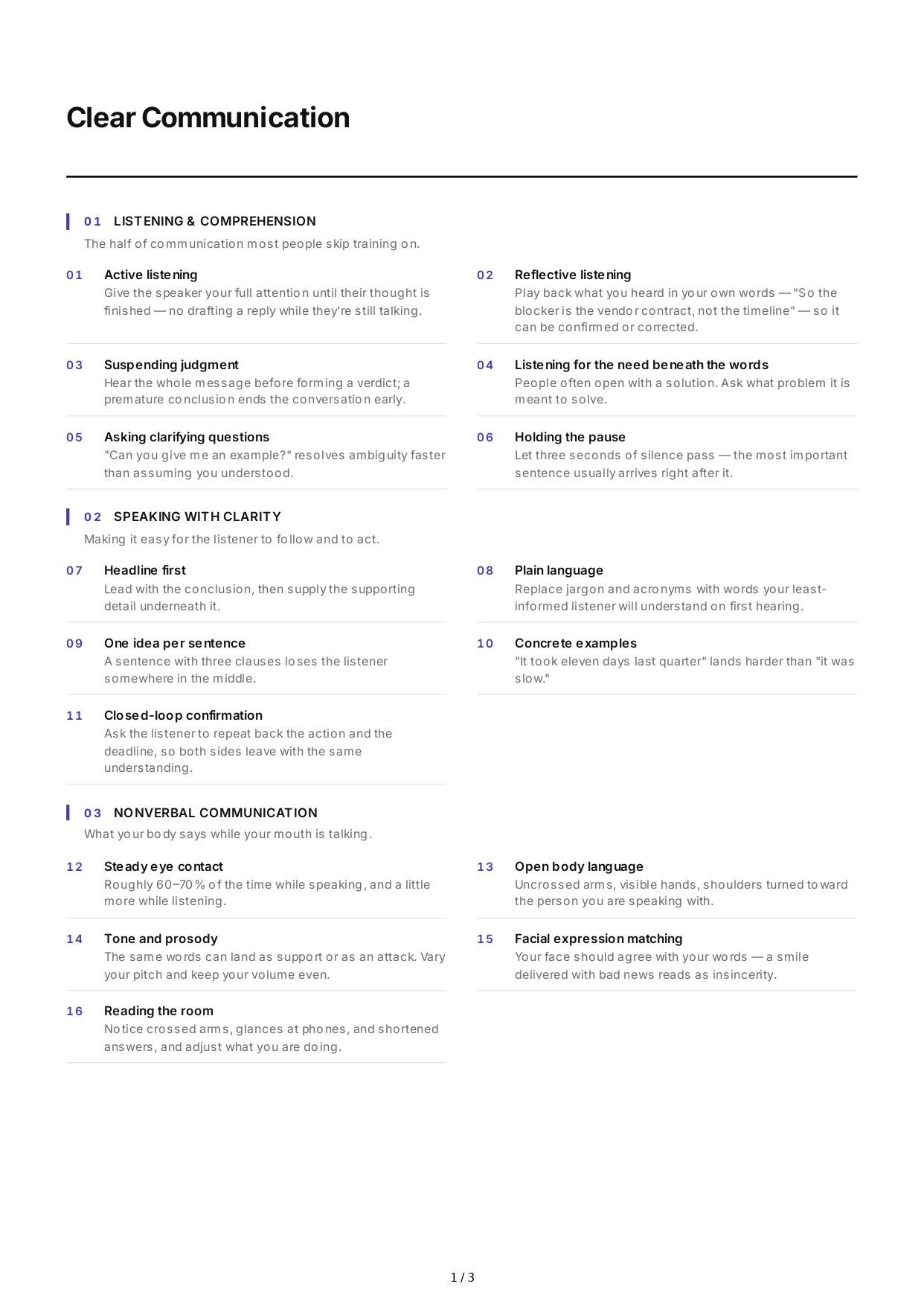
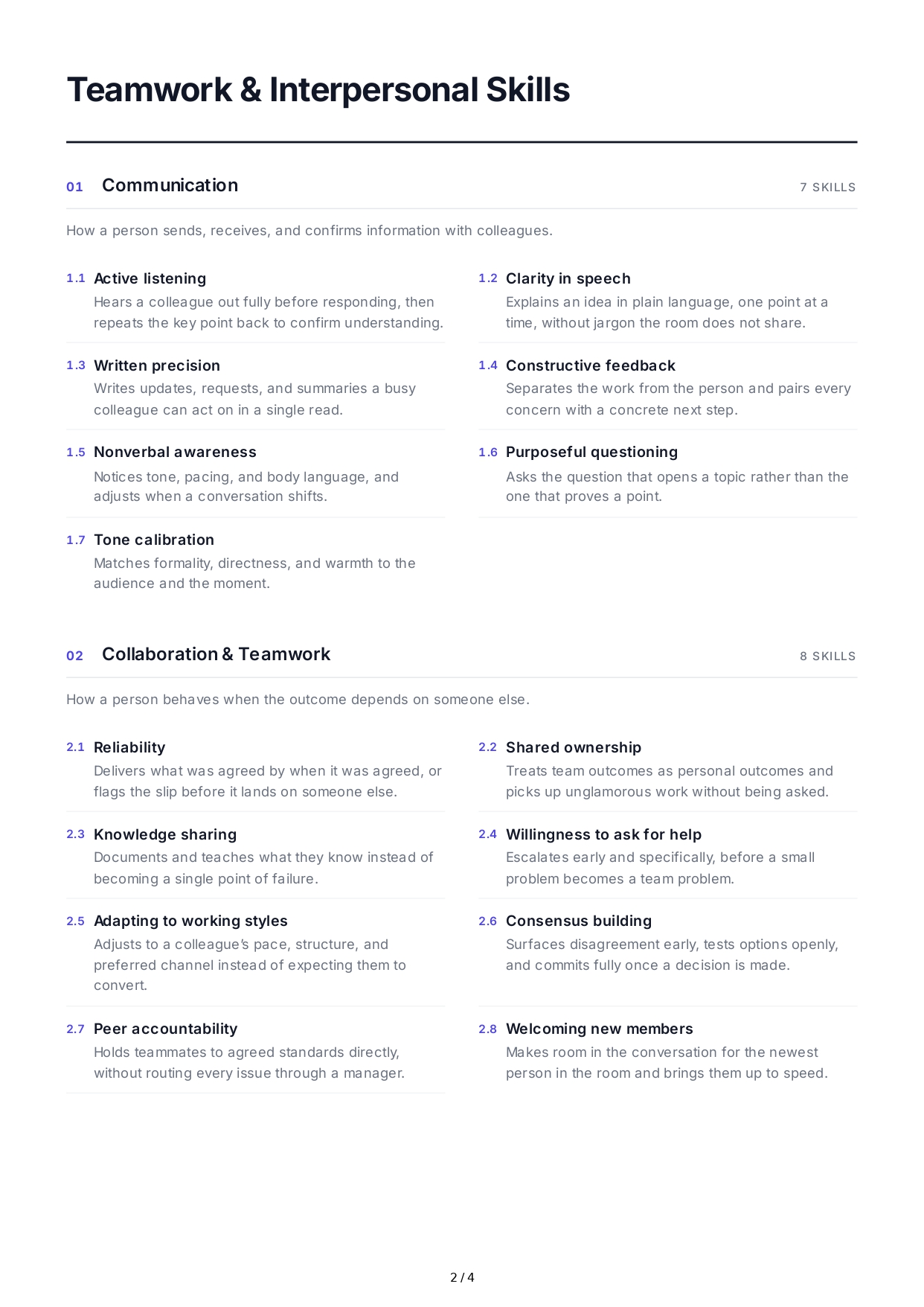
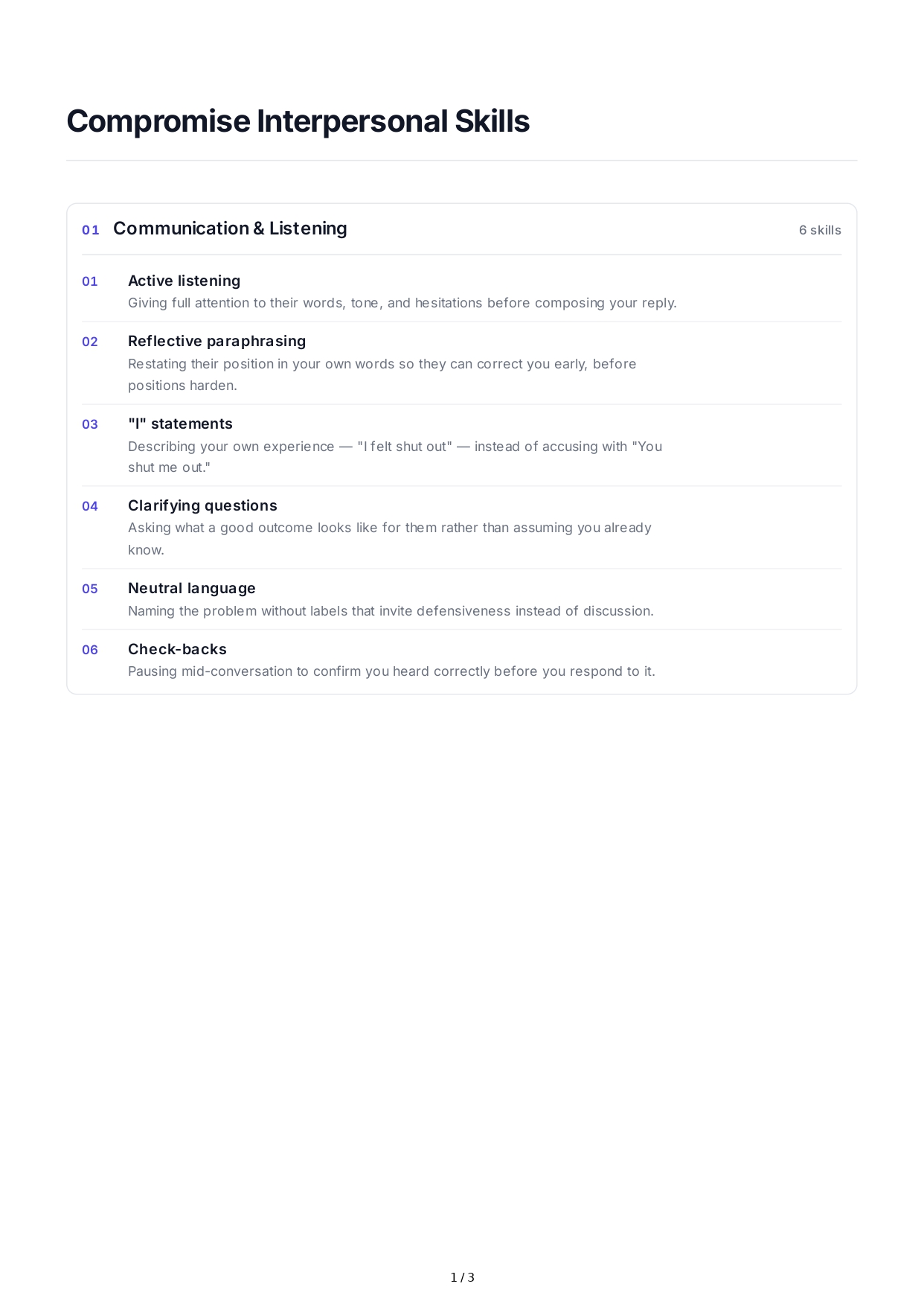
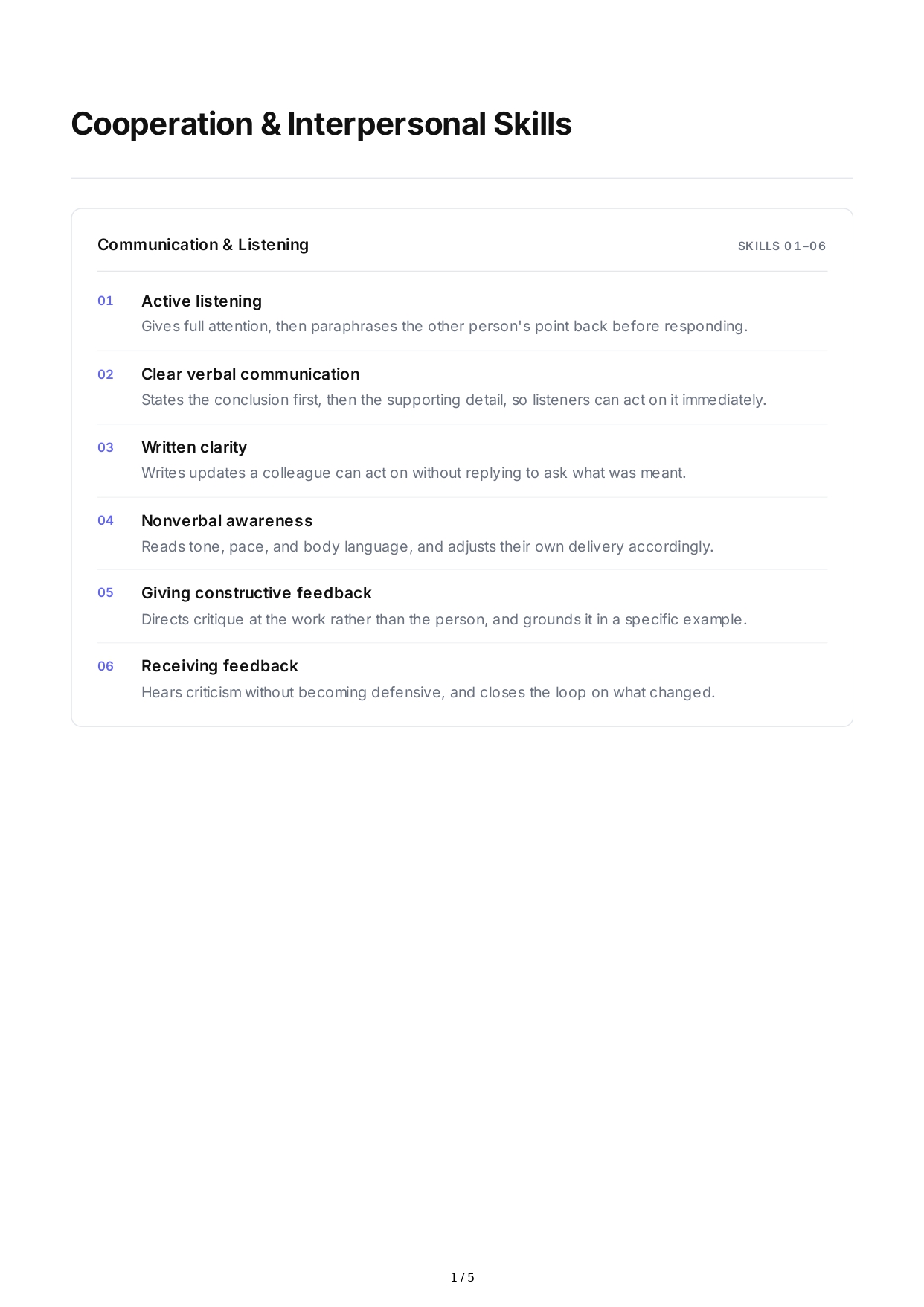
Active
Listening
—
Giving
full
attention
to
the
speaker
'
s
words
,
tone
,
and
unstated
concerns
before
formulating
a
reply
.
02
Precision
of
Language
—
Choosing
words
that
convey
intent
exactly
while
still
leaving
room
for
the
other
party
'
s
interpretation
.
03
Nonverbal
Attunement
—
Reading
posture
,
pacing
,
and
micro
-
expression
to
detect
hesitation
,
agreement
,
or
a
position
quietly
shifting
.
04
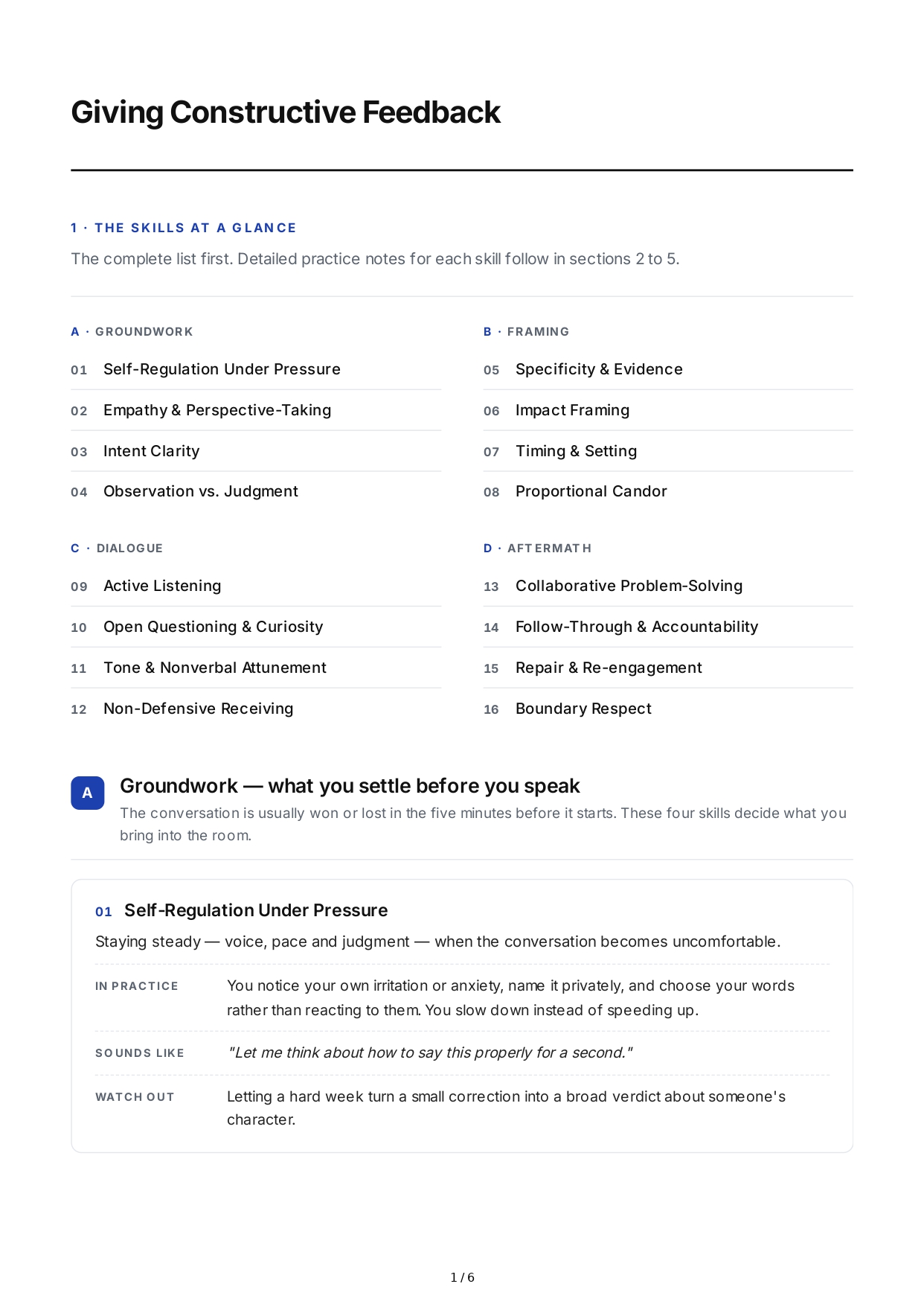
Constructive
Framing
—
Delivering
difficult
information
in
terms
that
preserve
the
other
party
'
s
dignity
.
05
Question
Crafting
—
Using
open
and
calibrated
questions
to
surface
interests
rather
than
force
stated
positions
.
06
Diplomatic
Silence
—
Using
deliberate
pauses
to
let
the
other
side
fill
the
space
with
information
they
did
not
intend
to
give
.
07
Tone
Modulation
—
Adjusting
formality
,
warmth
,
and
directness
to
match
the
setting
and
the
audience
.
08
Multilingual
Sensitivity
—
Navigating
meaning
,
idiom
,
and
register
across
languages
without
flattening
nuance
.
02 ·
Emotional
Intelligence
&
Self
-
Regulation
8
SKILLS
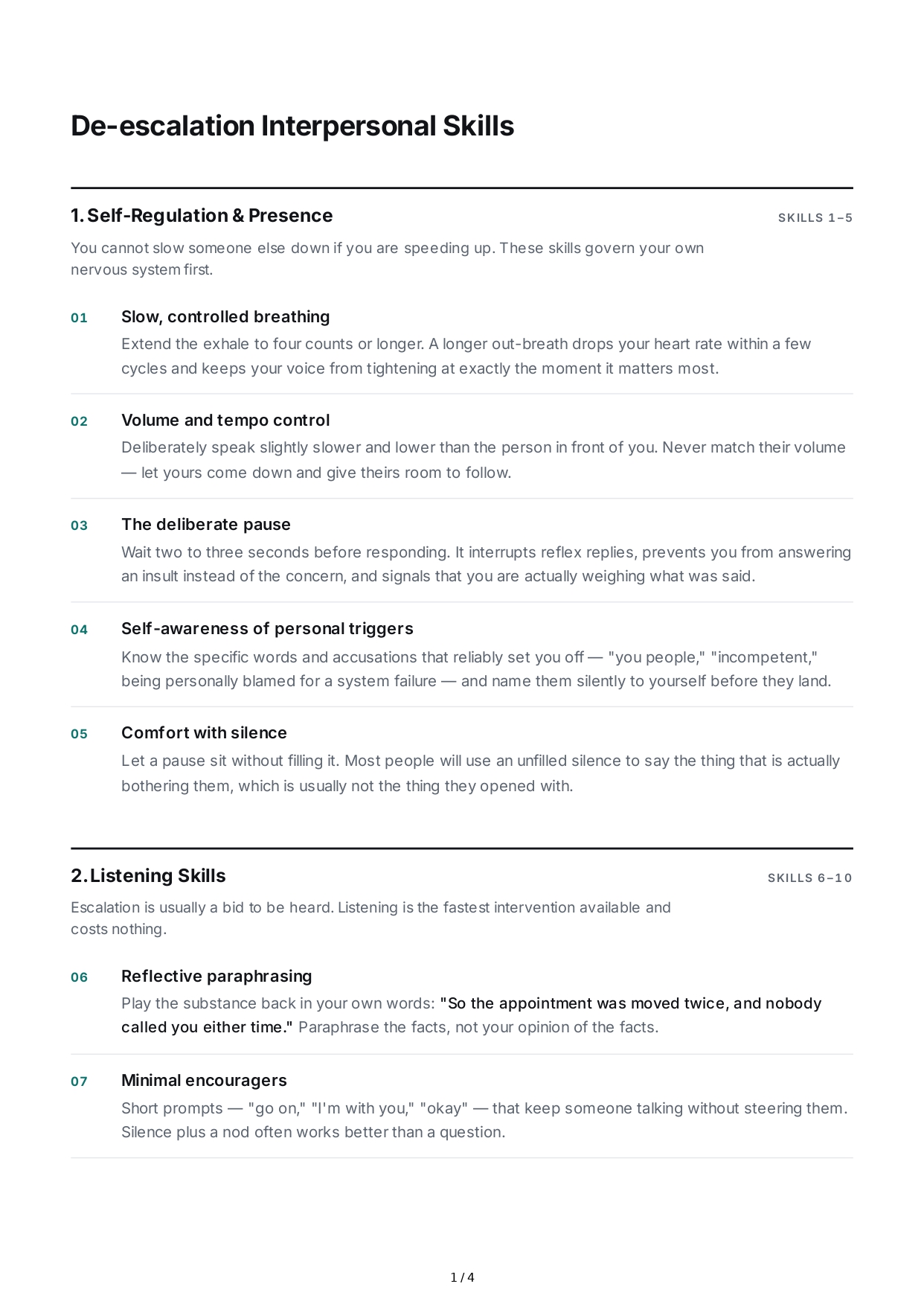
09
Emotional
Self
-
Awareness
—
Recognizing
one
'
s
own
triggers
in
real
time
,
before
they
shape
a
reaction
.
10
Composure
Under
Pressure
—
Maintaining
steady
delivery
and
clear
judgment
when
challenged
publicly
.
11
Empathy
Without
Absorption
—
Understanding
another
'
s
position
deeply
without
adopting
it
as
one
'
s
own
.
12
Patience
with
Process
—
Accepting
that
trust
and
agreement
build
more
slowly
than
deadlines
demand
.
13
Impulse
Restraint
—
Withholding
the
immediate
retort
in
favour
of
the
strategically
timed
response
.
14
Resilience
to
Rejection
—
Absorbing
a
refusal
without
treating
it
as
a
verdict
on
one
'
s
judgment
or
worth
.
15
Humility
in
Expertise
—
Acknowledging
the
limits
of
one
'
s
own
knowledge
without
surrendering
authority
.
1 / 4
16
Discretion
—
Knowing
what
must
not
be
repeated
,
and
precisely
to
whom
it
must
not
be
repeated
.
03 ·
Cross
-
Cultural
&
Contextual
Awareness
7
SKILLS
17
Cultural
Literacy
—
Understanding
how
hierarchy
,
time
,
and
directness
are
read
differently
across
cultures
.
18
Context
Calibration
—
Adjusting
approach
by
venue
:
formal
negotiation
,
informal
corridor
conversation
,
public
forum
.
19
Protocol
Awareness
—
Honouring
titles
,
seating
,
precedence
,
and
ceremony
wherever
they
still
carry
weight
.
20
Power
Mapping
—
Identifying
who
actually
decides
,
who
influences
the
decider
,
and
who
can
quietly
block
progress
.
21
Historical
Sensitivity
—
Recognizing
how
past
grievances
continue
to
shape
present
-
day
positions
.
22
Perspective
-
Taking
—
Reconstructing
a
counterpart
'
s
incentives
from
their
vantage
point
rather
than
one
'
s
own
.
23
Situational
Judgment
—
Knowing
when
to
press
,
when
to
yield
,
and
when
simply
to
wait
.
04 ·
Negotiation
&
Consensus
Building
8
SKILLS
24
Interest
-
Based
Bargaining
—
Negotiating
around
underlying
needs
rather
than
around
stated
positions
.
25
Option
Generation
—
Widening
the
set
of
possible
outcomes
before
narrowing
toward
a
single
agreement
.
26
Concession
Sequencing
—
Trading
concessions
in
an
order
that
preserves
value
and
signals
intent
clearly
.
27
Red
-
Line
Clarity
—
Knowing
in
advance
what
cannot
be
given
away
,
and
stating
so
without
hostility
.
28
Consensus
Facilitation
—
Shaping
agreement
that
every
party
can
defend
to
its
own
constituents
.
29
Incremental
Agreement
—
Locking
in
partial
wins
to
build
momentum
toward
a
larger
settlement
.
30
BATNA
Discipline
—
Evaluating
one
'
s
alternatives
honestly
and
soberly
before
entering
the
room
.
31
Face
-
Saving
Exits
—
Designing
outcomes
that
let
every
side
claim
a
defensible
result
.
05 ·
Relationship
&
Trust
Building
8
SKILLS
32
Reliability
—
Doing
what
was
promised
,
on
the
timeline
promised
,
without
requiring
a
reminder
.
33
Rapport
Development
—
Establishing
genuine
human
connection
before
the
agenda
is
formally
opened
.
2 / 4
34
Reciprocal
Disclosure
—
Sharing
appropriately
in
order
to
lower
the
cost
of
candour
for
the
other
party
.
35
Network
Cultivation
—
Maintaining
relationships
across
institutions
long
before
they
are
needed
.
36
Follow
-
Through
—
Closing
the
loop
on
every
commitment
made
,
including
the
small
ones
.
37
Boundary
Setting
—
Protecting
one
'
s
own
capacity
and
integrity
without
damaging
the
relationship
.
38
Loyalty
Signalling
—
Demonstrating
that
confidence
placed
in
you
will
not
be
traded
away
.
39
Long
-
Horizon
Patience
—
Investing
in
relationships
that
will
not
pay
off
for
years
,
and
knowing
why
that
matters
.
06 ·
Conflict
Resolution
&
De
-
escalation
8
SKILLS
40
De
-
escalation
—
Lowering
the
emotional
temperature
of
a
confrontation
before
addressing
substance
.
41
Neutral
Reframing
—
Restating
a
hostile
claim
in
terms
both
parties
can
actually
work
with
.
42
Mediation
—
Standing
between
parties
without
quietly
becoming
a
party
to
the
dispute
.
43
Apology
Craft
—
Offering
an
acknowledgment
that
repairs
the
relationship
rather
than
reopening
the
injury
.
44
Cooling
-
Off
Design
—
Structuring
deliberate
pauses
that
let
positions
soften
without
losing
ground
.
45
Third
-
Party
Leverage
—
Bringing
in
outside
actors
at
the
precise
moment
they
can
move
a
deadlock
.
46
Reframing
Blame
—
Moving
a
conversation
from
the
question
of
fault
to
the
question
of
forward
remedy
.
47
Disagreeing
Without
Rupture
—
Registering
firm
opposition
while
preserving
the
working
relationship
.
07 ·
Representation
&
Protocol
5
SKILLS
48
Institutional
Voice
—
Speaking
on
behalf
of
an
organisation
while
keeping
personal
opinions
in
reserve
.
49
Message
Discipline
—
Holding
one
consistent
line
across
multiple
audiences
,
formats
,
and
occasions
.
50
Confidentiality
Management
—
Handling
sensitive
information
across
different
levels
,
teams
,
and
jurisdictions
.
51
Ceremonial
Grace
—
Carrying
formal
occasions
with
appropriate
dignity
,
ease
,
and
attention
to
custom
.
52
Public
Composure
—
Staying
measured
under
scrutiny
from
press
,
public
,
or
opposition
.
3 / 4
08 ·
Strategic
Influence
&
Persuasion
7
SKILLS
53
Persuasion
Through
Evidence
—
Advancing
a
position
with
data
the
other
side
cannot
easily
dismiss
.
54
Coalition
Building
—
Assembling
support
well
before
the
decision
point
,
not
during
it
.
55
Agenda
Shaping
—
Influencing
what
gets
discussed
,
in
what
order
,
and
against
what
framing
.
56
Timing
Sense
—
Choosing
the
moment
when
a
proposal
will
be
heard
rather
than
resisted
.
57
Reciprocity
Management
—
Tracking
favours
given
and
owed
without
ever
making
the
ledger
visible
.
58
Narrative
Framing
—
Shaping
the
story
that
makes
a
position
feel
like
the
natural
conclusion
.
59
Soft
Power
—
Achieving
outcomes
through
credibility
and
attraction
rather
than
pressure
.
09 ·
Leadership
&
Team
Diplomacy
8
SKILLS
60
Fairness
Signalling
—
Making
decisions
that
are
seen
to
be
even
-
handed
,
not
merely
defensible
.
61
Public
Credit
,
Private
Correction
—
Giving
recognition
openly
and
criticism
where
it
costs
no
dignity
.
62
Coalition
Maintenance
—
Keeping
diverse
internal
factions
aligned
on
shared
goals
over
time
.
63
Upward
Diplomacy
—
Managing
senior
stakeholders
without
flattery
and
without
confrontation
.
64
Delegation
Clarity
—
Assigning
responsibility
in
terms
that
leave
no
room
for
later
dispute
.
65
Inclusive
Facilitation
—
Drawing
out
quieter
voices
without
embarrassing
the
more
dominant
ones
.
66
Crisis
Communication
—
Delivering
clarity
and
calm
when
the
information
available
is
still
incomplete
.
67
Integrity
Under
Pressure
—
Choosing
the
defensible
course
of
action
when
the
expedient
one
is
easier
.
4 / 4