Emotional
Awareness
Interpersonal
Skills
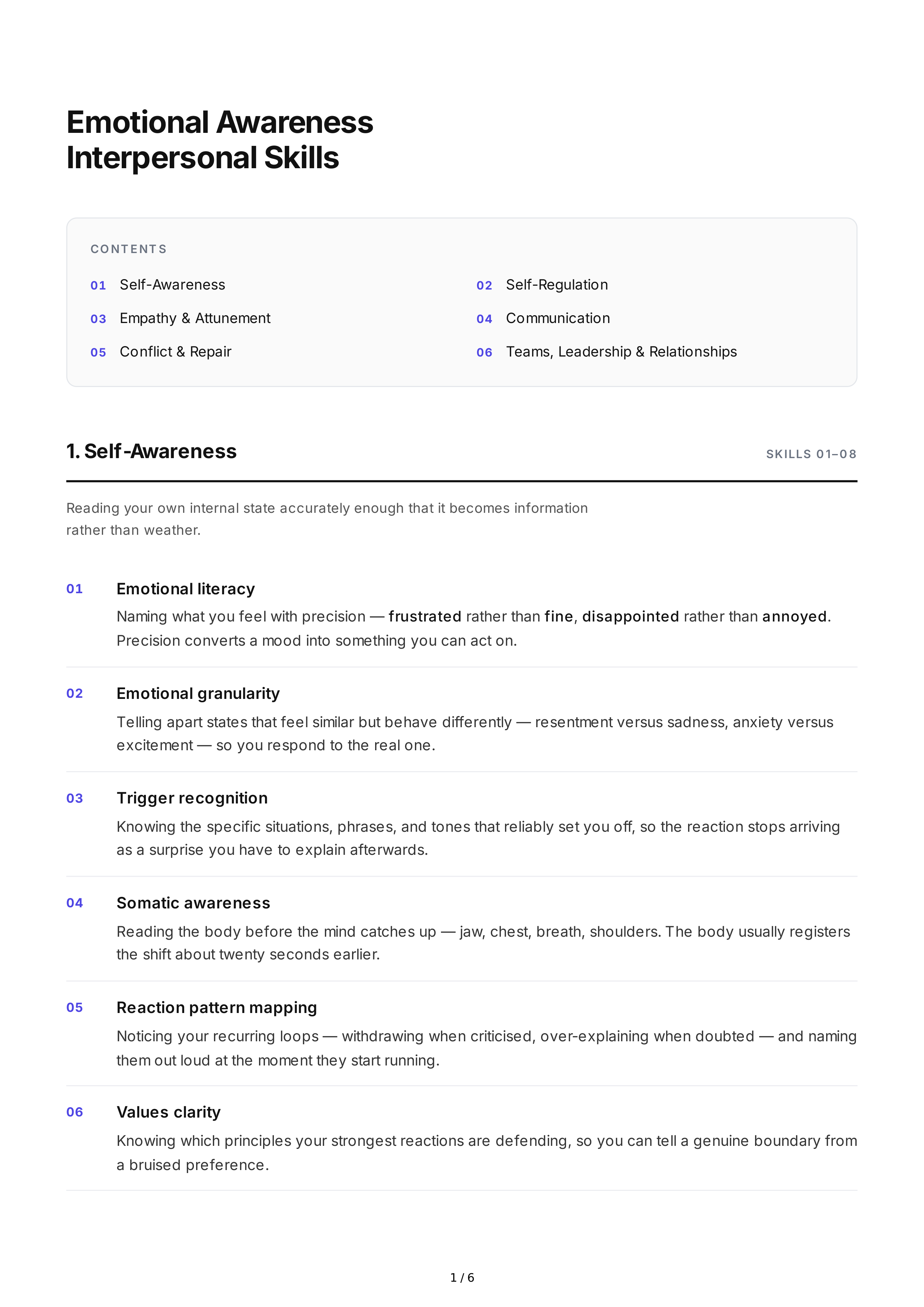
CO NT E NT S
01
Self
-
Awareness
02
Self
-
Regulation
03
Empathy
&
Attunement
04
Communication
05
Conflict
&
Repair
06
Teams
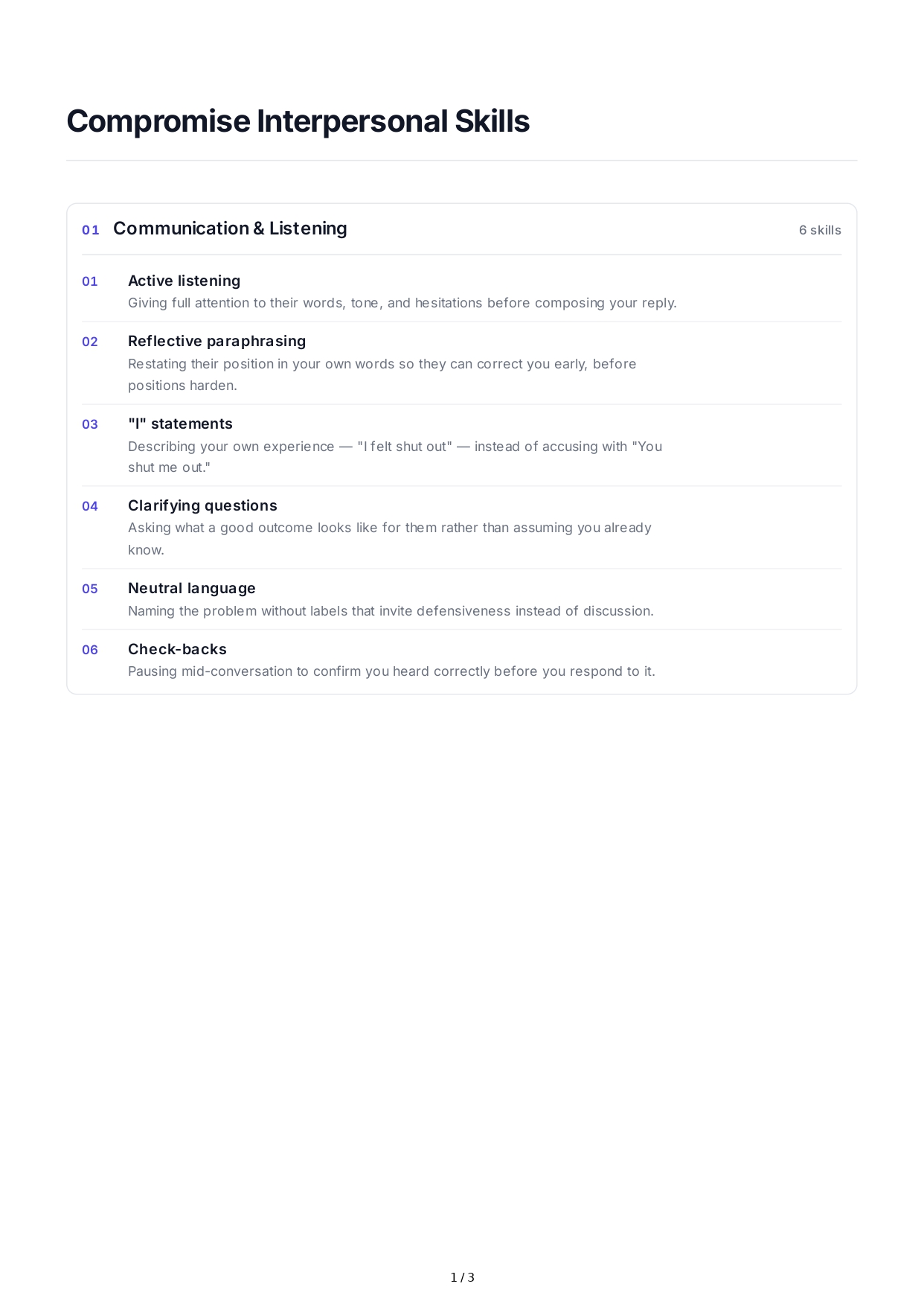
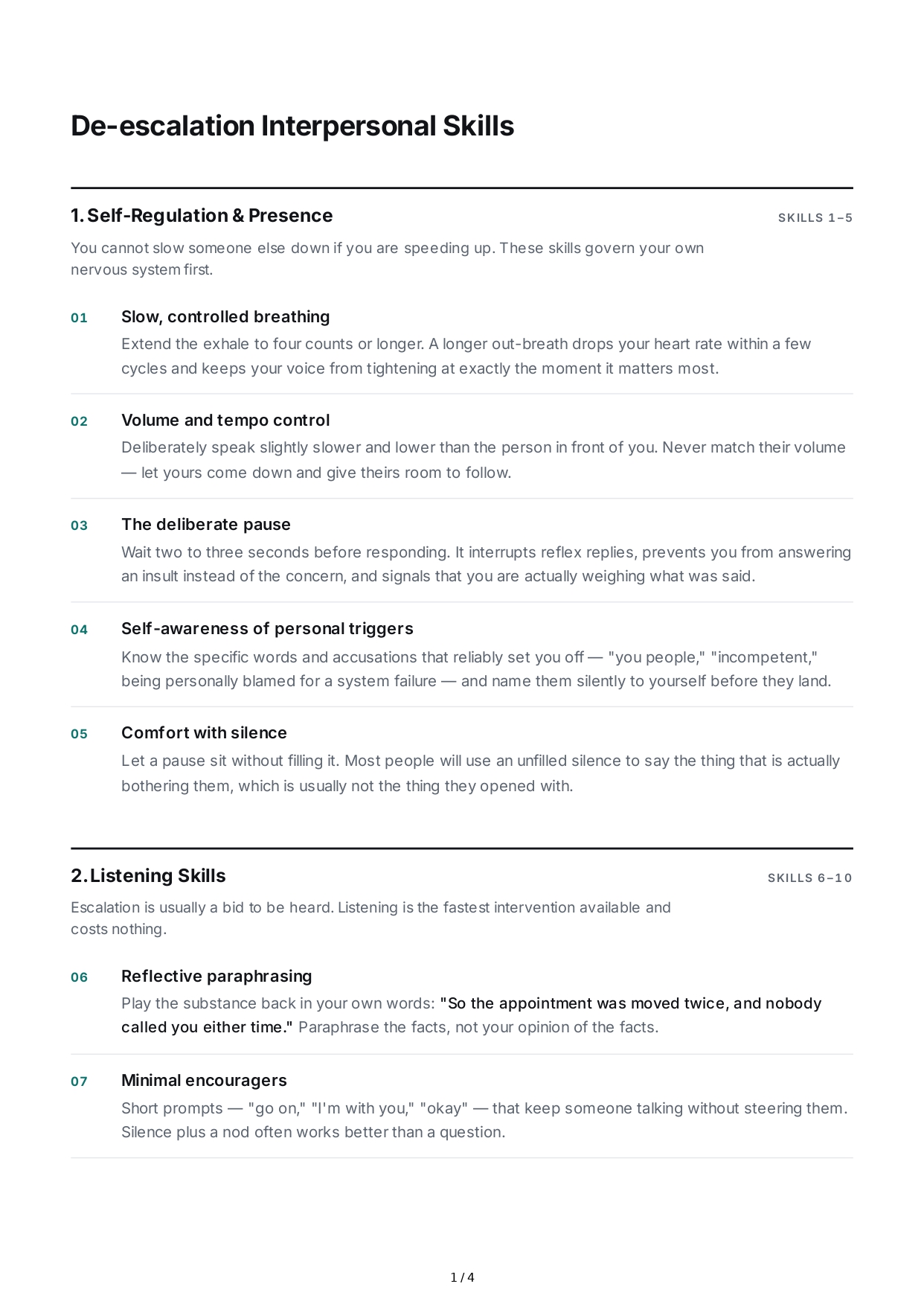
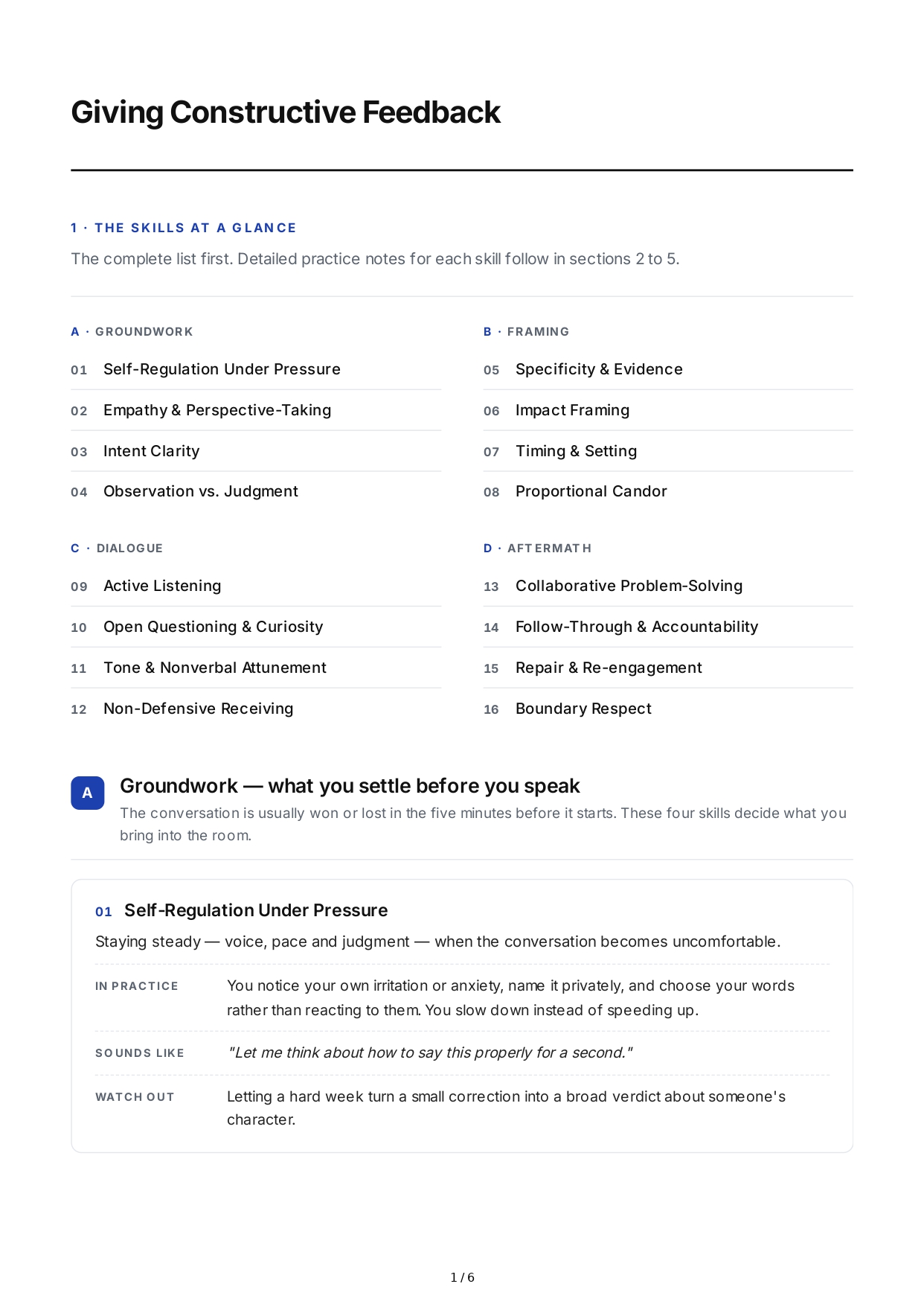
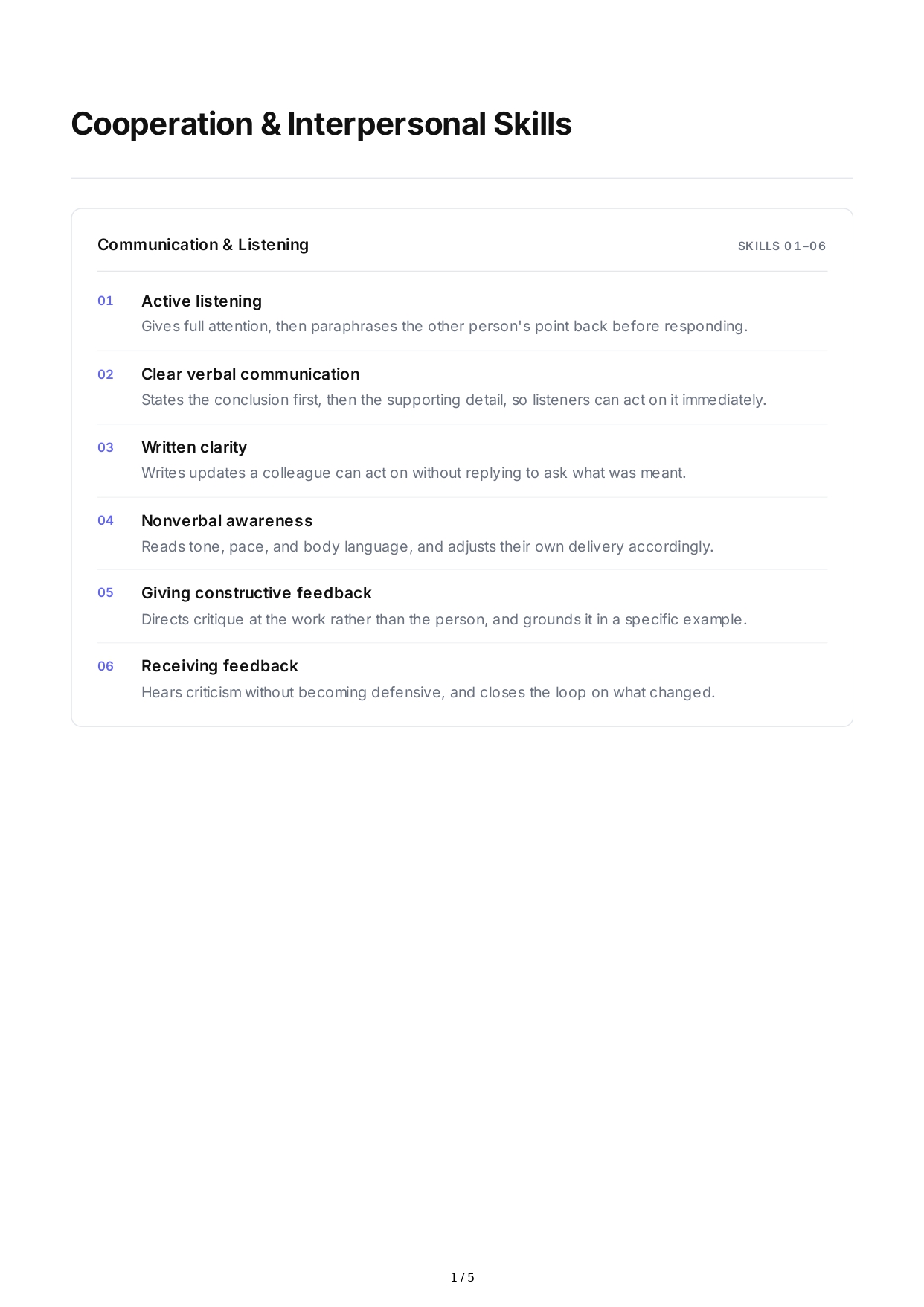
,
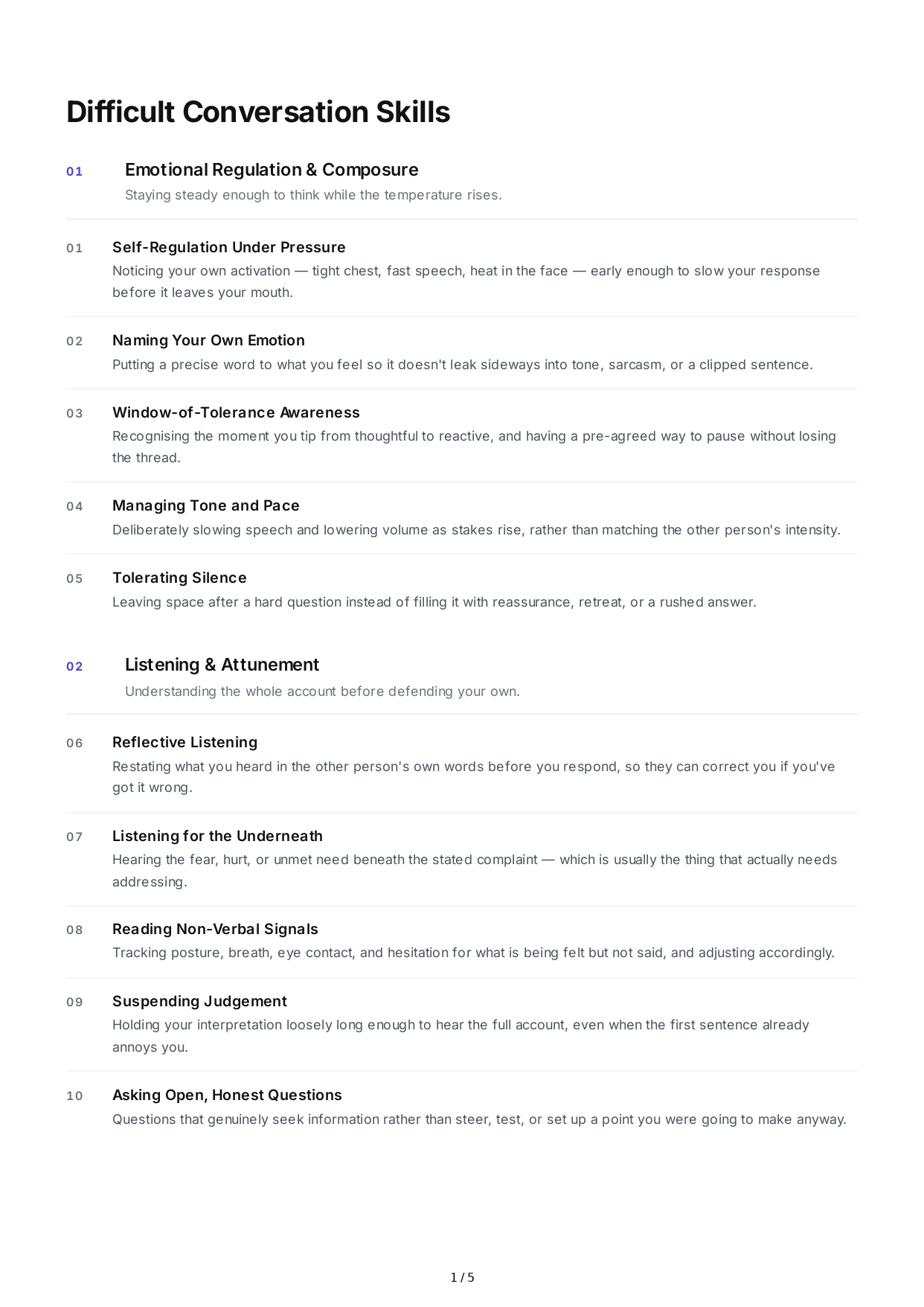
Leadership
&
Relationships
1.
Self
-
Awareness
SKILLS
0 1–0 8
Reading
your
own
internal
state
accurately
enough
that
it
becomes
information
rather
than
weather
.
01
Emotional
literacy
Naming
what
you
feel
with
precision
—
frustrated
rather
than
fine
,
disappointed
rather
than
annoyed
.
Precision
converts
a
mood
into
something
you
can
act
on
.
02
Emotional
granularity
Telling
apart
states
that
feel
similar
but
behave
differently
—
resentment
versus
sadness
,
anxiety
versus
excitement
—
so
you
respond
to
the
real
one
.
03
Trigger
recognition
Knowing
the
specific
situations
,
phrases
,
and
tones
that
reliably
set
you
off
,
so
the
reaction
stops
arriving
as
a
surprise
you
have
to
explain
afterwards
.
04
Somatic
awareness
Reading
the
body
before
the
mind
catches
up
—
jaw
,
chest
,
breath
,
shoulders
.
The
body
usually
registers
the
shift
about
twenty
seconds
earlier
.
05
Reaction
pattern
mapping
Noticing
your
recurring
loops
—
withdrawing
when
criticised
,
over
-
explaining
when
doubted
—
and
naming
them
out
loud
at
the
moment
they
start
running
.
06
Values
clarity
Knowing
which
principles
your
strongest
reactions
are
defending
,
so
you
can
tell
a
genuine
boundary
from
a
bruised
preference
.
1 / 6
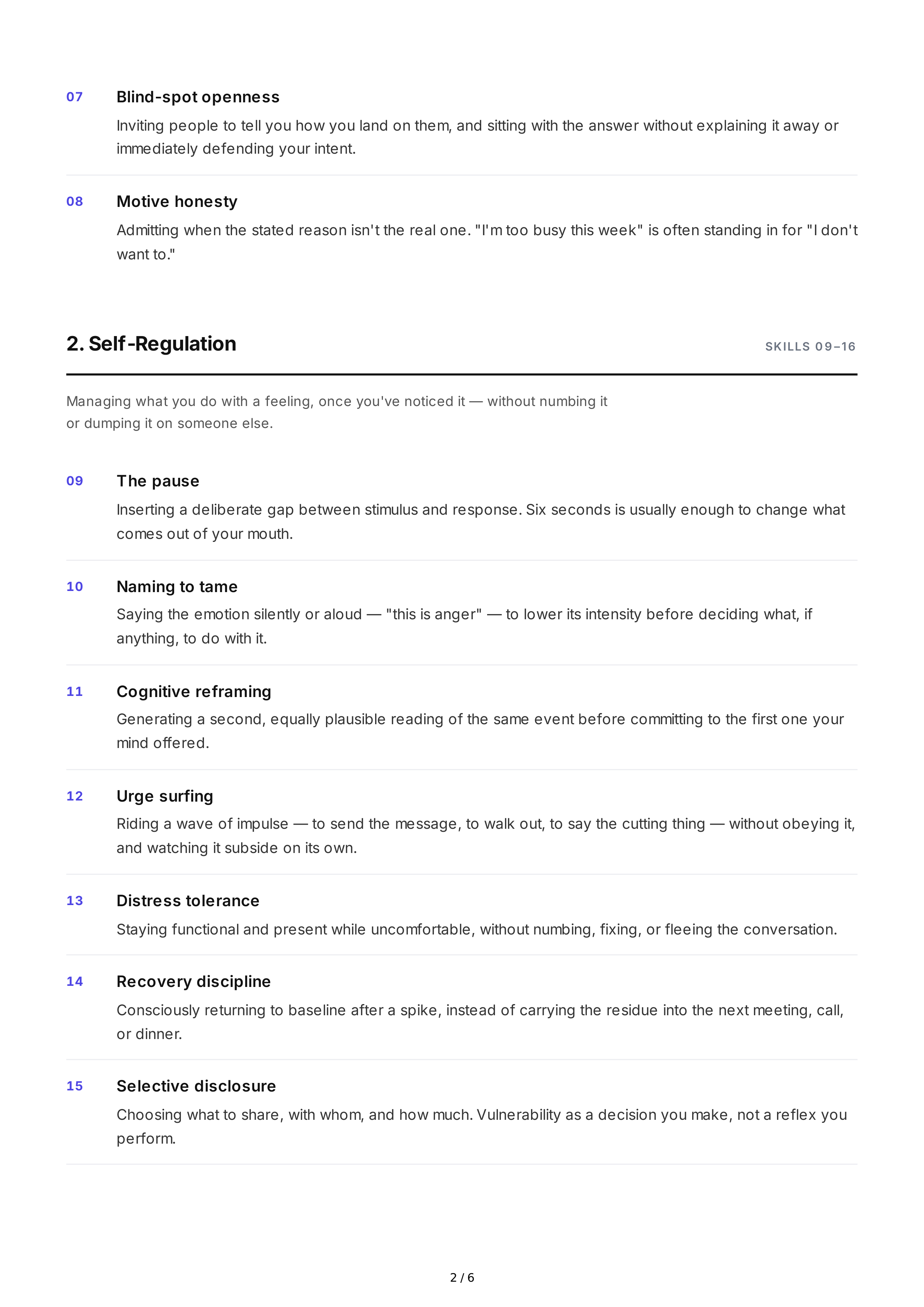
07
Blind
-
spot
openness
Inviting
people
to
tell
you
how
you
land
on
them
,
and
sitting
with
the
answer
without
explaining
it
away
or
immediately
defending
your
intent
.
08
Motive
honesty
Admitting
when
the
stated
reason
isn
'
t
the
real
one
. "
I
'
m
too
busy
this
week
"
is
often
standing
in
for
"
I
don
'
t
want
to
."
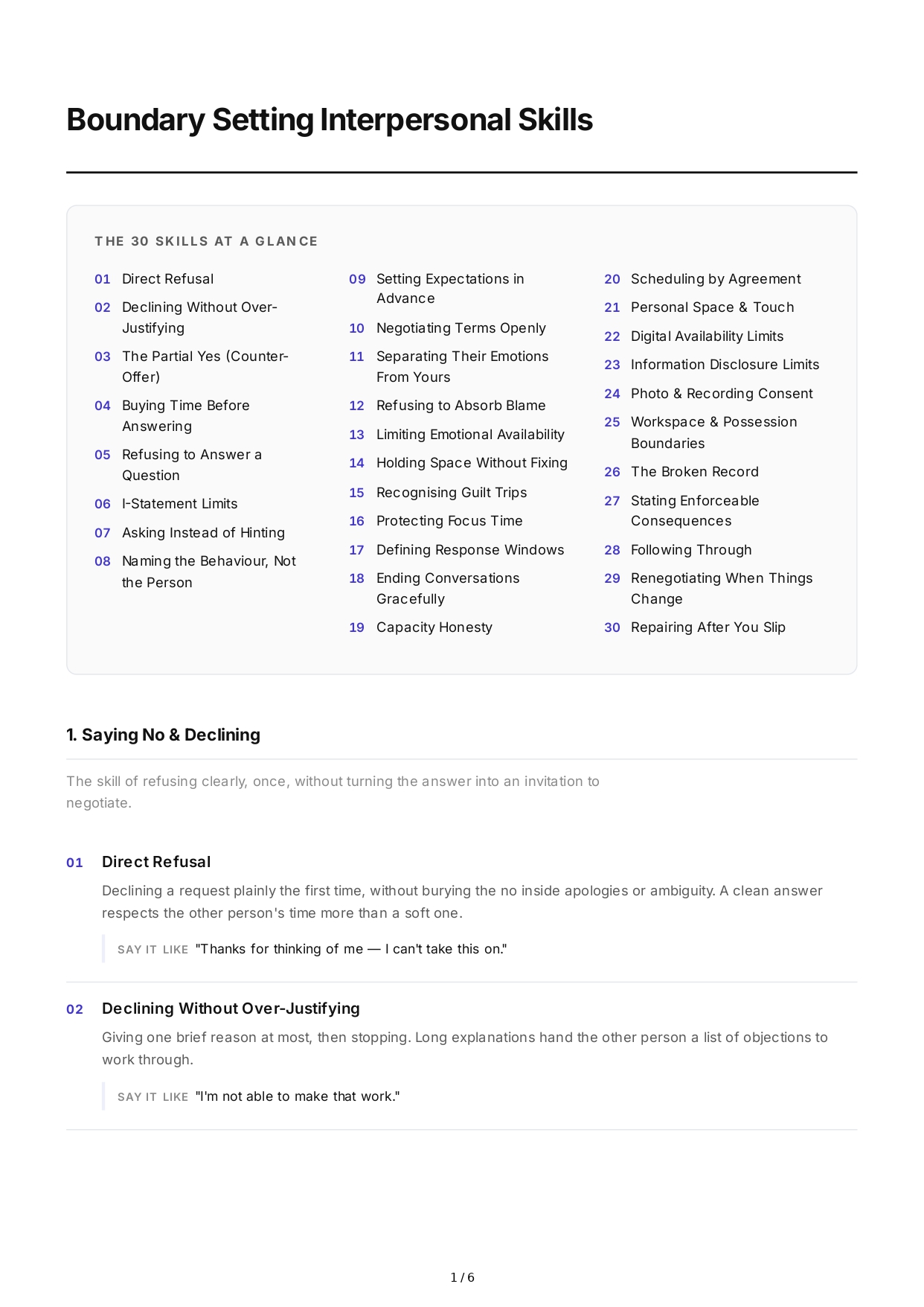
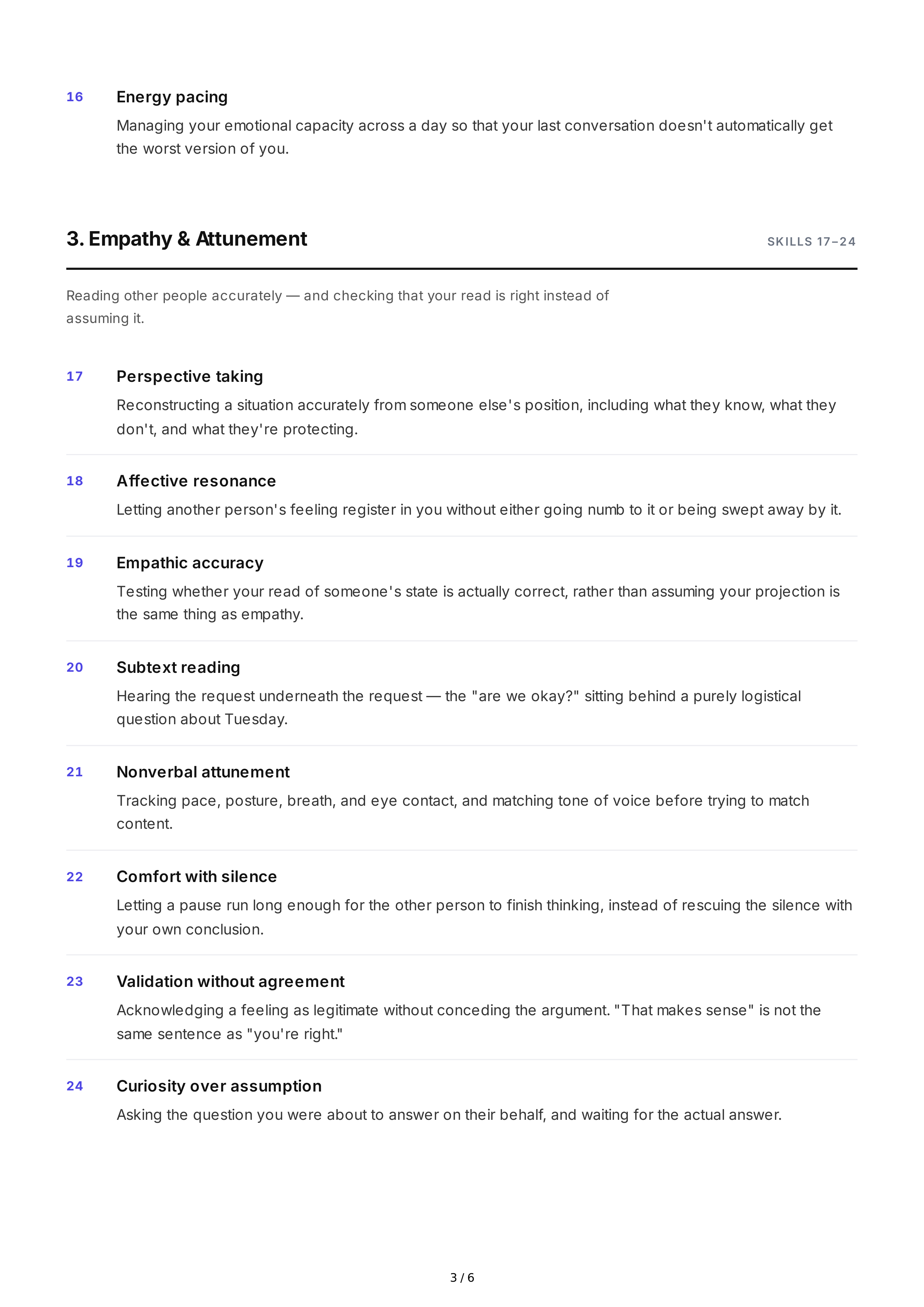
2.
Self
-
Regulation
SKILLS
0 9 –16
Managing
what
you
do
with
a
feeling
,
once
you
'
ve
noticed
it
—
without
numbing
it
or
dumping
it
on
someone
else
.
09
The
pause
Inserting
a
deliberate
gap
between
stimulus
and
response
.
Six
seconds
is
usually
enough
to
change
what
comes
out
of
your
mouth
.
10
Naming
to
tame
Saying
the
emotion
silently
or
aloud
— "
this
is
anger
" —
to
lower
its
intensity
before
deciding
what
,
if
anything
,
to
do
with
it
.
11
Cognitive
reframing
Generating
a
second
,
equally
plausible
reading
of
the
same
event
before
committing
to
the
first
one
your
mind
offered
.
12
Urge
surfing
Riding
a
wave
of
impulse
—
to
send
the
message
,
to
walk
out
,
to
say
the
cutting
thing
—
without
obeying
it
,
and
watching
it
subside
on
its
own
.
13
Distress
tolerance
Staying
functional
and
present
while
uncomfortable
,
without
numbing
,
fixing
,
or
fleeing
the
conversation
.
14
Recovery
discipline
Consciously
returning
to
baseline
after
a
spike
,
instead
of
carrying
the
residue
into
the
next
meeting
,
call
,
or
dinner
.
15
Selective
disclosure
Choosing
what
to
share
,
with
whom
,
and
how
much
.
Vulnerability
as
a
decision
you
make
,
not
a
reflex
you
perform
.
2 / 6
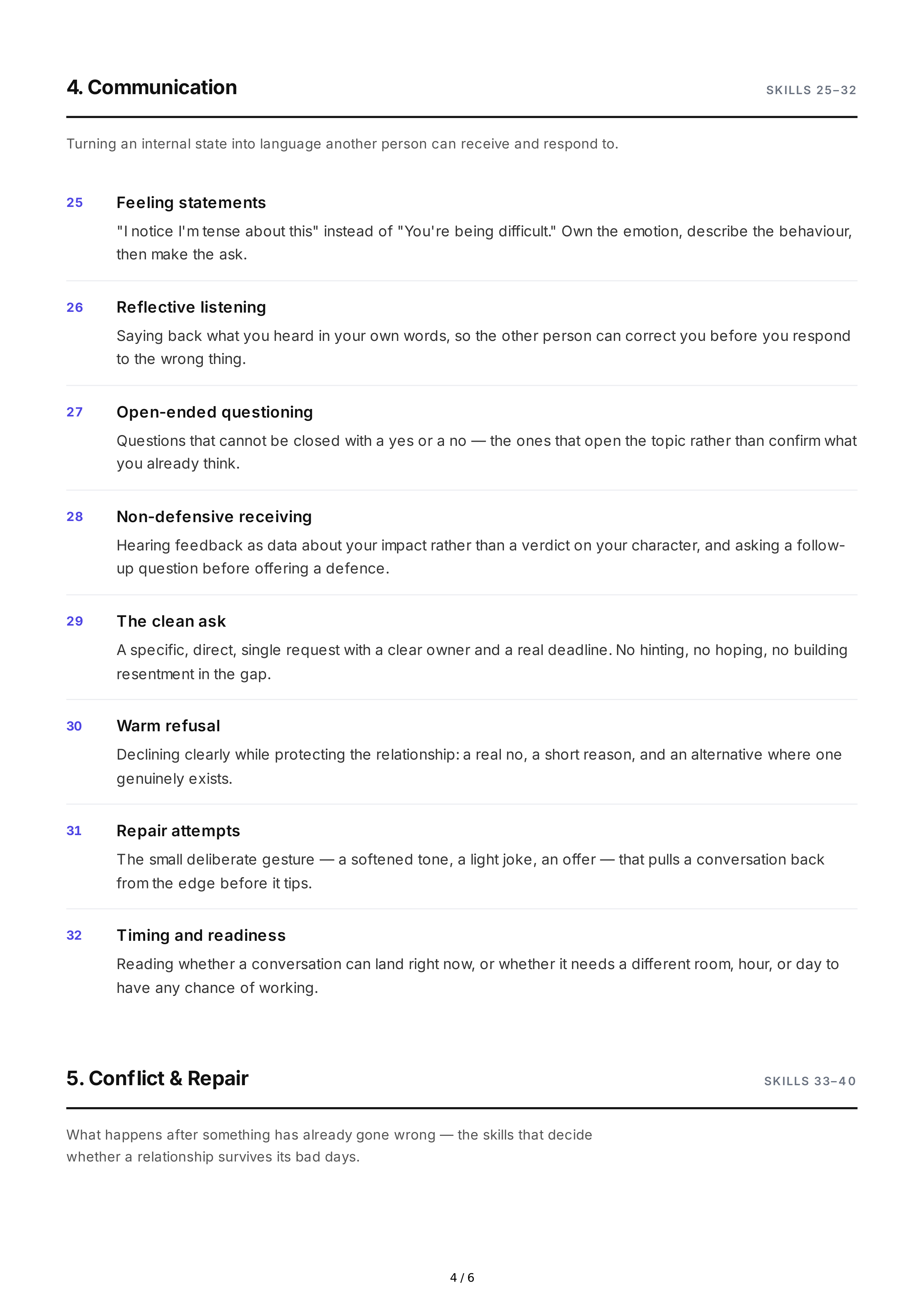
16
Energy
pacing
Managing
your
emotional
capacity
across
a
day
so
that
your
last
conversation
doesn
'
t
automatically
get
the
worst
version
of
you
.
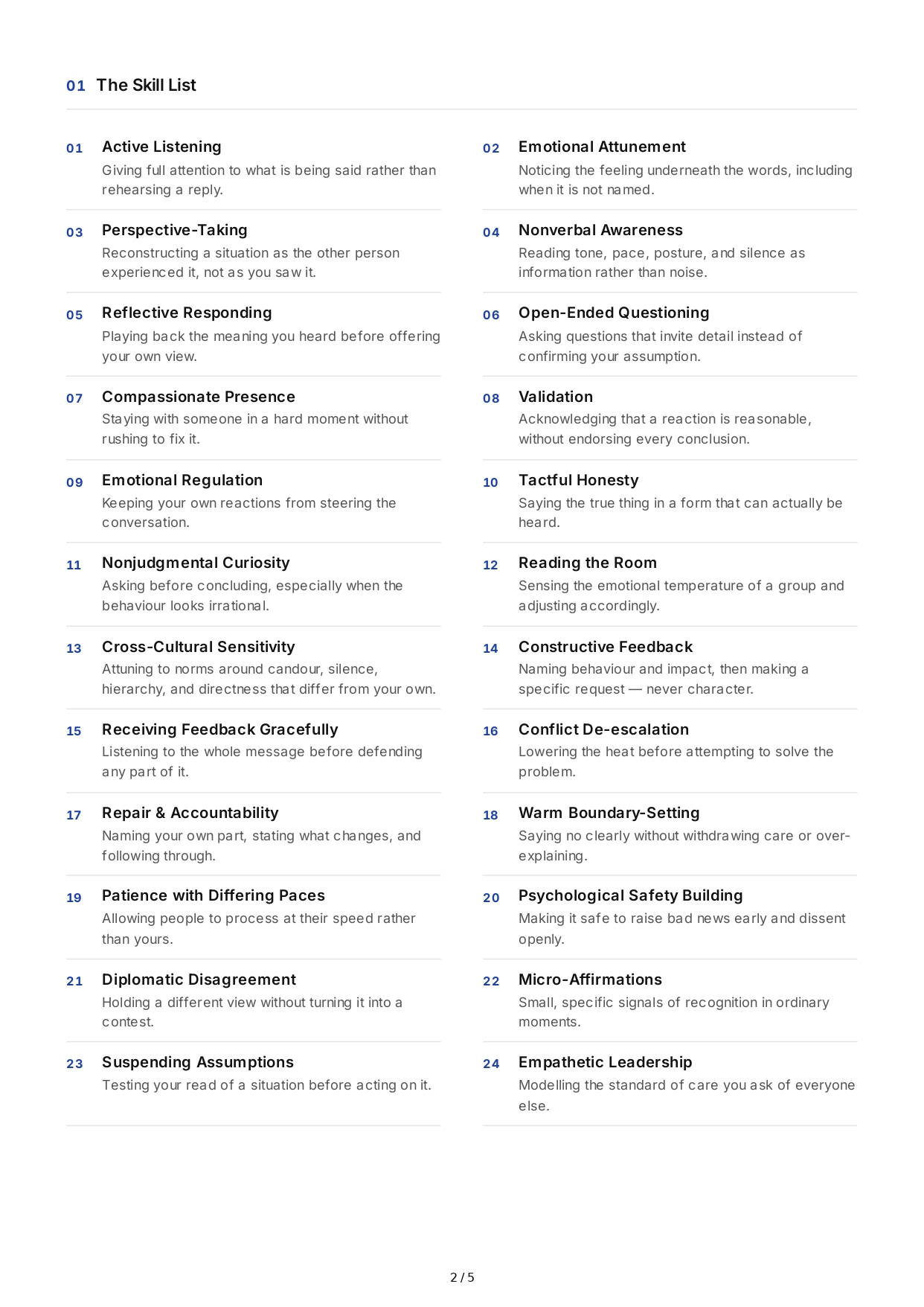
3.
Empathy
&
Attunement
SKILLS
17 –24
Reading
other
people
accurately
—
and
checking
that
your
read
is
right
instead
of
assuming
it
.
17
Perspective
taking
Reconstructing
a
situation
accurately
from
someone
else
'
s
position
,
including
what
they
know
,
what
they
don
'
t
,
and
what
they
'
re
protecting
.
18
Affective
resonance
Letting
another
person
'
s
feeling
register
in
you
without
either
going
numb
to
it
or
being
swept
away
by
it
.
19
Empathic
accuracy
Testing
whether
your
read
of
someone
'
s
state
is
actually
correct
,
rather
than
assuming
your
projection
is
the
same
thing
as
empathy
.
20
Subtext
reading
Hearing
the
request
underneath
the
request
—
the
"
are
we
okay
?"
sitting
behind
a
purely
logistical
question
about
Tuesday
.
21
Nonverbal
attunement
Tracking
pace
,
posture
,
breath
,
and
eye
contact
,
and
matching
tone
of
voice
before
trying
to
match
content
.
22
Comfort
with
silence
Letting
a
pause
run
long
enough
for
the
other
person
to
finish
thinking
,
instead
of
rescuing
the
silence
with
your
own
conclusion
.
23
Validation
without
agreement
Acknowledging
a
feeling
as
legitimate
without
conceding
the
argument
. "
That
makes
sense
"
is
not
the
same
sentence
as
"
you
'
re
right
."
24
Curiosity
over
assumption
Asking
the
question
you
were
about
to
answer
on
their
behalf
,
and
waiting
for
the
actual
answer
.
3 / 6
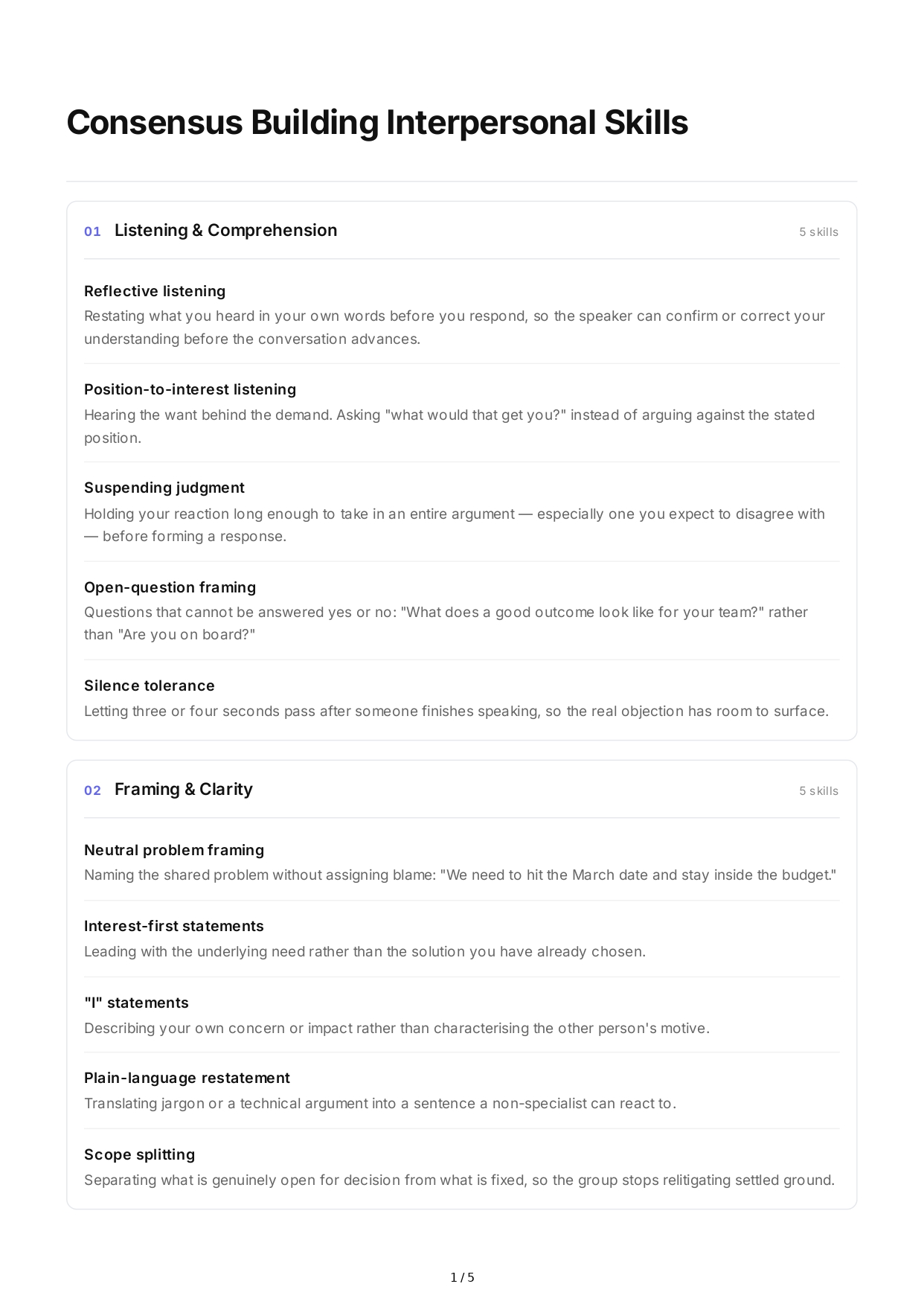
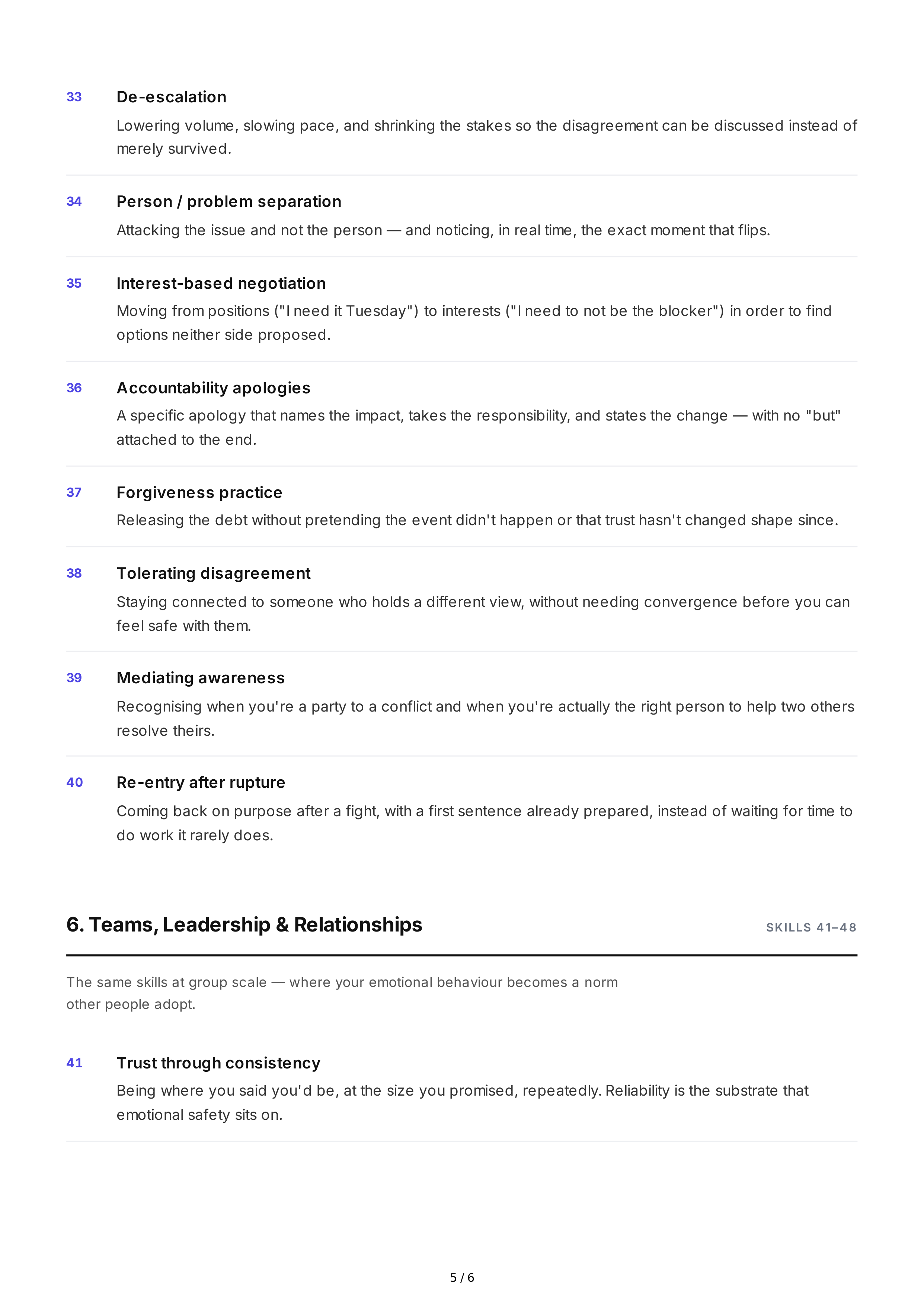
4.
Communication
SKILLS
25–32
Turning
an
internal
state
into
language
another
person
can
receive
and
respond
to
.
25
Feeling
statements
"
I
notice
I
'
m
tense
about
this
"
instead
of
"
You
'
re
being
difficult
."
Own
the
emotion
,
describe
the
behaviour
,
then
make
the
ask
.
26
Reflective
listening
Saying
back
what
you
heard
in
your
own
words
,
so
the
other
person
can
correct
you
before
you
respond
to
the
wrong
thing
.
27
Open
-
ended
questioning
Questions
that
cannot
be
closed
with
a
yes
or
a
no
—
the
ones
that
open
the
topic
rather
than
confirm
what
you
already
think
.
28
Non
-
defensive
receiving
Hearing
feedback
as
data
about
your
impact
rather
than
a
verdict
on
your
character
,
and
asking
a
follow
-
up
question
before
offering
a
defence
.
29
The
clean
ask
A
specific
,
direct
,
single
request
with
a
clear
owner
and
a
real
deadline
.
No
hinting
,
no
hoping
,
no
building
resentment
in
the
gap
.
30
Warm
refusal
Declining
clearly
while
protecting
the
relationship
:
a
real
no
,
a
short
reason
,
and
an
alternative
where
one
genuinely
exists
.
31
Repair
attempts
The
small
deliberate
gesture
—
a
softened
tone
,
a
light
joke
,
an
offer
—
that
pulls
a
conversation
back
from
the
edge
before
it
tips
.
32
Timing
and
readiness
Reading
whether
a
conversation
can
land
right
now
,
or
whether
it
needs
a
different
room
,
hour
,
or
day
to
have
any
chance
of
working
.
5.
Conflict
&
Repair
SKILLS
33–4 0
What
happens
after
something
has
already
gone
wrong
—
the
skills
that
decide
whether
a
relationship
survives
its
bad
days
.
4 / 6
33
De
-
escalation
Lowering
volume
,
slowing
pace
,
and
shrinking
the
stakes
so
the
disagreement
can
be
discussed
instead
of
merely
survived
.
34
Person
/
problem
separation
Attacking
the
issue
and
not
the
person
—
and
noticing
,
in
real
time
,
the
exact
moment
that
flips
.
35
Interest
-
based
negotiation
Moving
from
positions
("
I
need
it
Tuesday
")
to
interests
("
I
need
to
not
be
the
blocker
")
in
order
to
find
options
neither
side
proposed
.
36
Accountability
apologies
A
specific
apology
that
names
the
impact
,
takes
the
responsibility
,
and
states
the
change
—
with
no
"
but
"
attached
to
the
end
.
37
Forgiveness
practice
Releasing
the
debt
without
pretending
the
event
didn
'
t
happen
or
that
trust
hasn
'
t
changed
shape
since
.
38
Tolerating
disagreement
Staying
connected
to
someone
who
holds
a
different
view
,
without
needing
convergence
before
you
can
feel
safe
with
them
.
39
Mediating
awareness
Recognising
when
you
'
re
a
party
to
a
conflict
and
when
you
'
re
actually
the
right
person
to
help
two
others
resolve
theirs
.
40
Re
-
entry
after
rupture
Coming
back
on
purpose
after
a
fight
,
with
a
first
sentence
already
prepared
,
instead
of
waiting
for
time
to
do
work
it
rarely
does
.
6.
Teams
,
Leadership
&
Relationships
SKILLS
4 1–4 8
The
same
skills
at
group
scale
—
where
your
emotional
behaviour
becomes
a
norm
other
people
adopt
.
41
Trust
through
consistency
Being
where
you
said
you
'
d
be
,
at
the
size
you
promised
,
repeatedly
.
Reliability
is
the
substrate
that
emotional
safety
sits
on
.
5 / 6
42
Psychological
safety
Making
it
normal
to
say
"
I
don
'
t
know
," "
I
was
wrong
,"
and
"
I
need
help
" —
by
saying
those
things
first
,
unprompted
.
43
Group
mood
reading
Noticing
the
temperature
of
a
room
—
who
'
s
disengaged
,
what
just
shifted
—
and
naming
it
lightly
enough
that
it
can
be
addressed
.
44
Inclusion
noticing
Tracking
who
hasn
'
t
spoken
,
who
keeps
getting
interrupted
,
and
who
was
left
off
the
invite
—
then
correcting
it
without
ceremony
.
45
Recognition
specificity
Acknowledging
people
for
the
exact
thing
they
did
,
close
to
the
moment
they
did
it
,
rather
than
in
a
generic
quarterly
sweep
.
46
Register
adaptation
Calibrating
directness
,
humour
,
and
formality
to
the
person
and
the
setting
,
without
becoming
a
different
person
to
do
it
.
47
Emotional
labour
awareness
Seeing
the
invisible
work
of
soothing
,
translating
,
and
holding
space
—
and
distributing
it
deliberately
instead
of
assuming
it
'
s
covered
.
48
Boundaries
with
care
Holding
a
limit
without
withdrawing
warmth
,
so
that
"
no
"
and
"
I
value
you
"
can
be
true
in
the
same
sentence
.
6 / 6