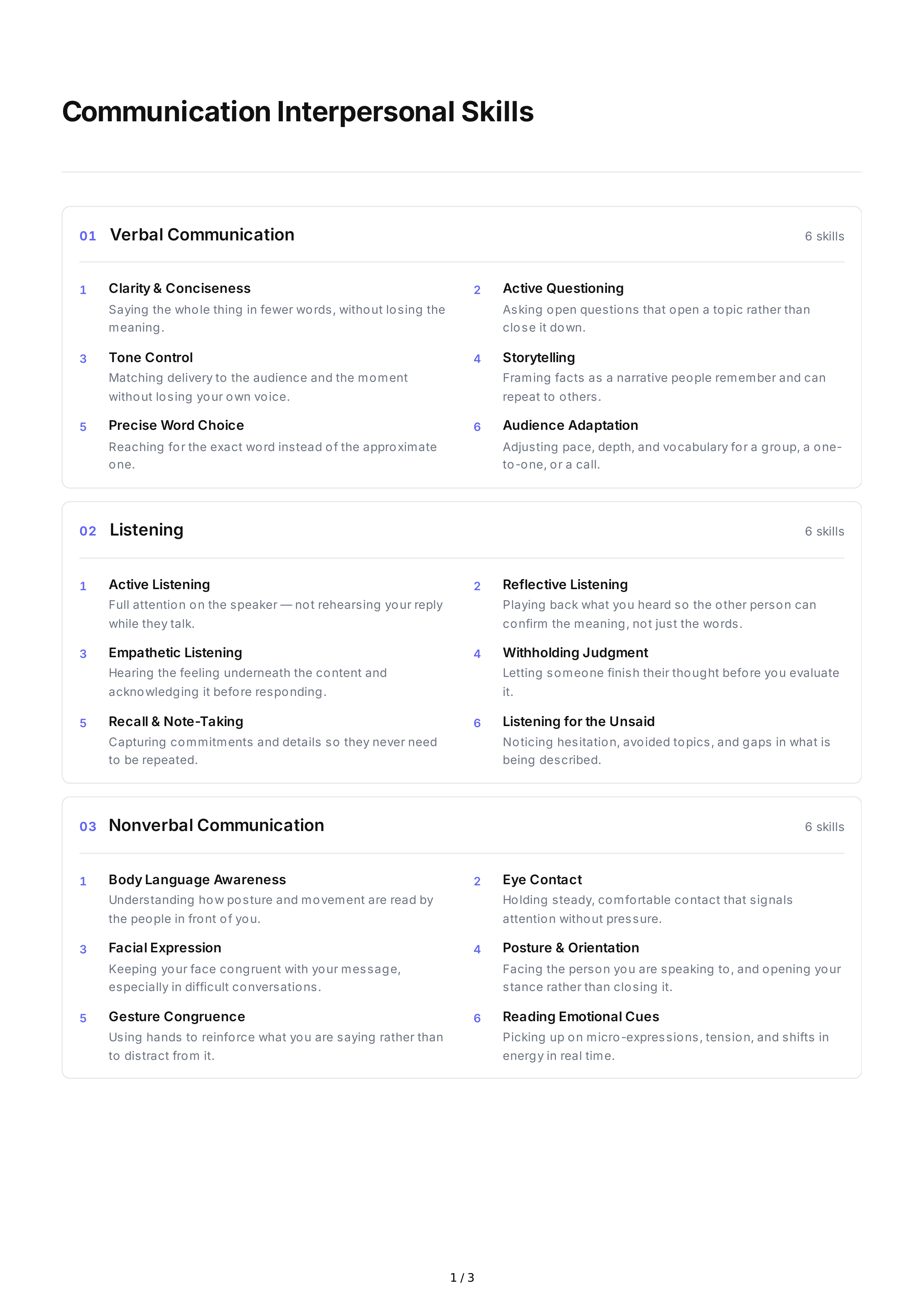
Communication
Interpersonal
Skills
01
Verbal
Communication
6
skills
1
Clarity
&
Conciseness
Saying
the
whole
thing
in
fewer
words
,
without
losing
the
meaning
.
2
Active
Questioning
Asking
open
questions
that
open
a
topic
rather
than
close
it
down
.
3
Tone
Control
Matching
delivery
to
the
audience
and
the
moment
without
losing
your
own
voice
.
4
Storytelling
Framing
facts
as
a
narrative
people
remember
and
can
repeat
to
others
.
5
Precise
Word
Choice
Reaching
for
the
exact
word
instead
of
the
approximate
one
.
6
Audience
Adaptation
Adjusting
pace
,
depth
,
and
vocabulary
for
a
group
,
a
one
-
to
-
one
,
or
a
call
.
02
Listening
6
skills
1
Active
Listening
Full
attention
on
the
speaker
—
not
rehearsing
your
reply
while
they
talk
.
2
Reflective
Listening
Playing
back
what
you
heard
so
the
other
person
can
confirm
the
meaning
,
not
just
the
words
.
3
Empathetic
Listening
Hearing
the
feeling
underneath
the
content
and
acknowledging
it
before
responding
.
4
Withholding
Judgment
Letting
someone
finish
their
thought
before
you
evaluate
it
.
5
Recall
&
Note
-
Taking
Capturing
commitments
and
details
so
they
never
need
to
be
repeated
.
6
Listening
for
the
Unsaid
Noticing
hesitation
,
avoided
topics
,
and
gaps
in
what
is
being
described
.
03
Nonverbal
Communication
6
skills
1
Body
Language
Awareness
Understanding
how
posture
and
movement
are
read
by
the
people
in
front
of
you
.
2
Eye
Contact
Holding
steady
,
comfortable
contact
that
signals
attention
without
pressure
.
3
Facial
Expression
Keeping
your
face
congruent
with
your
message
,
especially
in
difficult
conversations
.
4
Posture
&
Orientation
Facing
the
person
you
are
speaking
to
,
and
opening
your
stance
rather
than
closing
it
.
5
Gesture
Congruence
Using
hands
to
reinforce
what
you
are
saying
rather
than
to
distract
from
it
.
6
Reading
Emotional
Cues
Picking
up
on
micro
-
expressions
,
tension
,
and
shifts
in
energy
in
real
time
.
1 / 3
04
Written
Communication
6
skills
1
Structure
&
Signposting
Leading
with
the
point
,
then
supporting
it
in
an
order
a
reader
can
follow
.
2
Audience
Calibration
Writing
for
the
reader
'
s
context
—
an
executive
,
a
new
hire
,
a
customer
.
3
Brevity
in
Email
Getting
to
the
ask
in
the
first
few
lines
and
keeping
the
thread
readable
.
4
Documentation
Writing
down
decisions
,
meeting
notes
,
and
processes
so
they
survive
the
people
who
made
them
.
5
Written
Tone
Controlling
how
a
message
lands
in
text
,
where
there
is
no
voice
or
face
to
soften
it
.
6
Editing
&
Proofreading
Cutting
what
does
not
earn
its
place
and
catching
what
would
undermine
the
message
.
05
Emotional
Intelligence
6
skills
1
Self
-
Awareness
Recognizing
your
own
mood
,
bias
,
and
triggers
while
they
are
happening
.
2
Self
-
Regulation
Choosing
your
response
instead
of
discharging
the
first
reaction
you
feel
.
3
Empathy
Accurately
imagining
another
person
'
s
position
without
needing
to
agree
with
it
.
4
Social
Awareness
Reading
the
room
—
who
has
influence
,
who
is
unheard
,
what
is
not
being
said
.
5
Resilience
Under
Pressure
Staying
steady
and
clear
when
a
conversation
becomes
tense
or
high
-
stakes
.
6
Receiving
Feedback
Taking
criticism
as
information
rather
than
as
a
verdict
on
you
.
06
Collaboration
&
Teamwork
6
skills
1
Building
Rapport
Establishing
enough
ease
that
difficult
conversations
become
possible
later
.
2
Trust
-
Building
Being
consistent
,
credible
,
and
honest
about
what
you
do
and
do
not
know
.
3
Giving
Feedback
Making
a
point
specific
,
timely
,
and
about
the
work
rather
than
the
person
.
4
Delegation
&
Handoff
Transferring
work
with
enough
context
that
it
does
not
come
back
half
-
done
.
5
Cross
-
Functional
Partnering
Working
effectively
with
people
whose
goals
and
vocabulary
differ
from
yours
.
6
Shared
Accountability
Owning
outcomes
jointly
instead
of
defending
your
own
piece
of
the
work
.
2 / 3
07
Conflict
Resolution
&
Negotiation
6
skills
1
Staying
Curious
in
Disagreement
Asking
what
the
other
person
sees
that
you
do
not
,
before
arguing
your
case
.
2
Separating
Position
from
Interest
Getting
past
what
someone
is
asking
for
to
why
they
need
it
.
3
De
-
escalation
Lowering
the
temperature
of
a
conversation
without
conceding
the
point
.
4
Mediation
Helping
two
other
parties
find
terms
they
can
both
accept
.
5
Assertiveness
Without
Aggression
Holding
a
position
firmly
while
keeping
the
relationship
intact
.
6
Building
Workable
Agreements
Finding
a
third
option
that
neither
party
walked
in
with
.
08
Influence
,
Leadership
&
Facilitation
6
skills
1
Persuasion
&
Framing
Presenting
the
same
facts
in
the
frame
that
moves
the
decision
.
2
Meeting
Facilitation
Keeping
a
discussion
on
track
,
on
time
,
and
ending
with
clear
owners
.
3
Public
Speaking
Holding
a
room
,
managing
nerves
,
and
landing
a
point
with
a
group
.
4
Coaching
Conversations
Helping
someone
reach
their
own
answer
instead
of
handing
them
yours
.
5
Motivating
&
Recognizing
Others
Naming
good
work
specifically
and
in
a
way
that
lands
for
the
person
receiving
it
.
6
Executive
Presence
Communicating
with
enough
composure
and
brevity
to
be
trusted
with
bigger
rooms
.
09
Cultural
&
Interpersonal
Awareness
6
skills
1
Cultural
Sensitivity
Understanding
how
directness
,
hierarchy
,
and
silence
are
read
differently
across
cultures
.
2
Adapting
to
Communication
Styles
Matching
how
someone
prefers
to
receive
information
—
written
,
verbal
,
fast
,
or
considered
.
3
Inclusive
Language
Choosing
words
that
do
not
exclude
or
assume
,
without
becoming
stilted
.
4
Building
Bridges
Across
Difference
Working
well
with
people
whose
background
,
seniority
,
or
views
differ
sharply
from
yours
.
5
Remote
&
Asynchronous
Etiquette
Writing
for
people
in
other
time
zones
and
contexts
,
and
knowing
when
a
call
is
required
.
6
Networking
&
Relationship
Maintenance
Keeping
contact
useful
and
warm
over
years
,
not
just
when
you
need
something
.
3 / 3