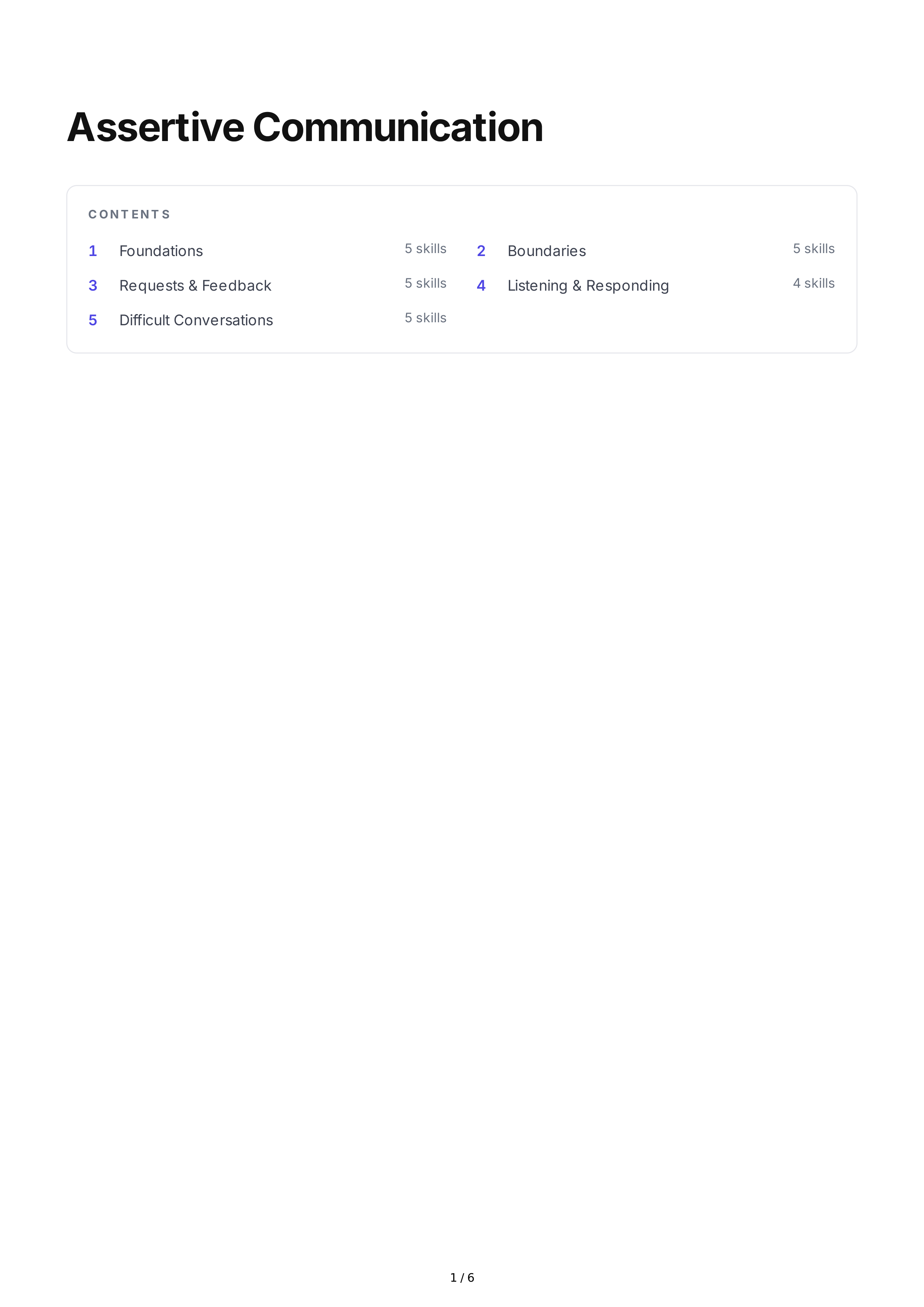
Assertive
Communication
C O N T EN T S
1
Foundations
5
skills
2
Boundaries
5
skills
3
Requests
&
Feedback
5
skills
4
Listening
&
Responding
4
skills
5
Difficult
Conversations
5
skills
1 / 6
01
Foundations
5
SKILLS
01
Clear
“
I
”
statements
Speak
from
your
own
position
instead
of
opening
with
an
accusation
. “
I
”
statements
describe
what
you
noticed
,
what
you
need
,
and
why
it
matters
—
which
keeps
the
other
person
listening
rather
than
defending
.
S O UND S
LIK E
“
I
need
the
draft
by
Thursday
so
I
have
time
to
review
it
before
the
client
call
.”
02
Direct
,
specific
requests
Ask
for
the
thing
you
actually
want
,
with
a
name
and
a
date
attached
.
Vague
requests
get
vague
answers
,
and
then
you
have
to
have
the
same
conversation
twice
.
S O UND S
LIK E
“
Priya
,
can
you
get
me
the
final
numbers
by
Wednesday
at
noon
?”
03
Steady
,
even
tone
Keep
your
volume
and
pace
level
,
especially
when
the
other
person
raises
theirs
.
A
calm
tone
signals
that
the
conversation
isn
’
t
a
contest
,
without
softening
the
content
of
what
you
’
re
saying
.
S O UND S
LIK E
“
I
hear
that
you
’
re
frustrated
.
I
still
can
’
t
approve
this
today
.”
04
Open
,
grounded
body
language
Relaxed
shoulders
,
hands
visible
,
steady
but
not
staring
eye
contact
.
Your
body
either
backs
up
your
words
or
quietly
contradicts
them
,
and
people
read
the
body
first
.
LO O K S
LIK E
Sitting
square
to
the
table
,
hands
resting
open
,
breathing
slower
than
feels
natural
.
05
Confident
pacing
and
pauses
Say
your
sentence
,
then
stop
.
Silence
after
a
clear
point
gives
it
weight
and
hands
the
turn
back
—
most
people
rush
to
fill
the
gap
and
weaken
their
own
case
in
the
process
.
S O UND S
LIK E
“
That
doesn
’
t
work
for
me
.” —
then
wait
,
without
adding
anything
.
2 / 6
02
Boundaries
5
SKILLS
06
Saying
no
without
over
-
apologizing
One
short
no
,
one
honest
reason
,
no
five
-
sentence
buildup
.
Apologizing
three
times
in
a
row
turns
a
boundary
into
a
request
for
permission
.
S O UND S
LIK E
“
I
can
’
t
take
that
on
this
quarter
—
my
capacity
is
already
committed
to
the
migration
.”
07
Limiting
scope
instead
of
refusing
outright
Separate
what
you
can
do
from
what
you
can
’
t
.
Partial
agreement
protects
the
deadline
and
the
relationship
at
the
same
time
,
and
it
gives
the
other
person
something
to
work
with
.
S O UND S
LIK E
“
I
can
get
you
the
first
two
sections
by
Friday
.
The
rest
would
need
to
move
to
next
week
.”
08
Naming
your
limits
before
they
’
re
tested
State
your
working
boundaries
in
advance
—
hours
,
channels
,
turnaround
times
—
so
nobody
has
to
guess
and
you
never
end
up
negotiating
from
a
deficit
later
.
S O UND S
LIK E
“
I
don
’
t
check
email
after
7
pm
.
If
something
is
genuinely
urgent
,
call
my
phone
.”
09
Holding
a
boundary
once
it
’
s
set
Repeat
the
same
limit
in
the
same
words
,
calmly
,
instead
of
re
-
arguing
the
reasons
.
Consistency
ends
the
negotiation
;
fresh
explanations
reopen
it
.
S O UND S
LIK E
“
I
understand
.
The
answer
is
still
no
for
this
week
.”
10
Closing
a
conversation
that
stopped
being
productive
End
the
exchange
on
your
own
terms
when
it
’
s
looping
,
rather
than
enduring
it
until
you
’
re
worn
down
.
Offer
a
specific
next
step
and
a
specific
time
.
S O UND S
LIK E
“
I
don
’
t
think
we
’
ll
settle
this
today
.
Let
’
s
pick
it
up
Thursday
at
10,
once
we
’
ve
both
looked
at
the
numbers
.”
3 / 6
03
Requests
&
Feedback
5
SKILLS
11
Giving
feedback
without
blame
Describe
the
behavior
,
its
impact
,
and
the
change
you
’
re
asking
for
.
Feedback
aimed
at
someone
’
s
character
gets
a
defense
;
feedback
aimed
at
the
work
gets
a
revision
.
S O UND S
LIK E
“
The
report
landed
after
the
client
call
,
so
we
lost
the
chance
to
correct
the
figures
.
Next
time
,
can
it
reach
me
the
day
before
?”
12
Receiving
criticism
without
defending
Ask
a
question
before
you
answer
.
Getting
curious
first
buys
you
time
and
usually
turns
a
vague
complaint
into
something
concrete
you
can
actually
act
on
.
S O UND S
LIK E
“
That
’
s
fair
—
can
you
point
me
to
the
part
that
landed
badly
?”
13
Disagreeing
out
loud
,
respectfully
Say
that
you
see
it
differently
while
the
decision
is
still
open
.
Silent
disagreement
turns
into
passive
resistance
that
nobody
can
diagnose
or
fix
.
S O UND S
LIK E
“
I
see
it
differently
,
and
I
’
d
like
ten
minutes
to
make
the
case
before
we
decide
.”
14
Naming
the
problem
,
not
the
person
Keep
the
subject
on
the
process
,
the
timeline
,
or
the
deliverable
.
People
can
change
a
system
;
they
can
’
t
easily
change
being
called
careless
.
S O UND S
LIK E
“
Two
handoffs
were
missed
last
week
.
What
would
make
the
handoff
harder
to
miss
?”
15
Pairing
every
concern
with
a
proposal
Raise
the
problem
and
bring
at
least
one
path
forward
in
the
same
breath
.
It
moves
the
conversation
out
of
complaint
and
into
a
decision
.
S O UND S
LIK E
“
The
current
review
cycle
adds
four
days
.
Could
we
review
Tuesdays
only
and
cut
it
to
one
?”
4 / 6
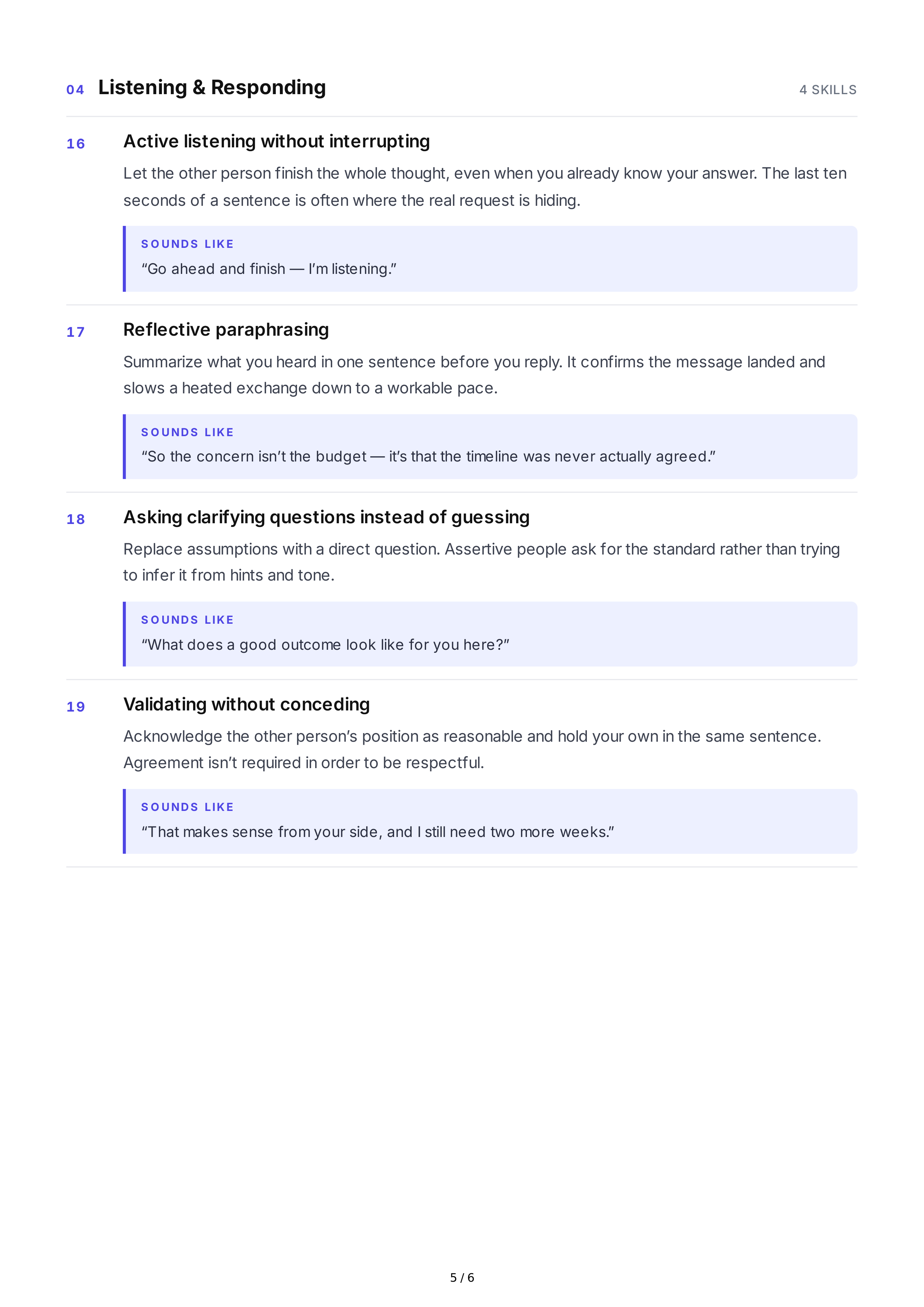
04
Listening
&
Responding
4
SKILLS
16
Active
listening
without
interrupting
Let
the
other
person
finish
the
whole
thought
,
even
when
you
already
know
your
answer
.
The
last
ten
seconds
of
a
sentence
is
often
where
the
real
request
is
hiding
.
S O UND S
LIK E
“
Go
ahead
and
finish
—
I
’
m
listening
.”
17
Reflective
paraphrasing
Summarize
what
you
heard
in
one
sentence
before
you
reply
.
It
confirms
the
message
landed
and
slows
a
heated
exchange
down
to
a
workable
pace
.
S O UND S
LIK E
“
So
the
concern
isn
’
t
the
budget
—
it
’
s
that
the
timeline
was
never
actually
agreed
.”
18
Asking
clarifying
questions
instead
of
guessing
Replace
assumptions
with
a
direct
question
.
Assertive
people
ask
for
the
standard
rather
than
trying
to
infer
it
from
hints
and
tone
.
S O UND S
LIK E
“
What
does
a
good
outcome
look
like
for
you
here
?”
19
Validating
without
conceding
Acknowledge
the
other
person
’
s
position
as
reasonable
and
hold
your
own
in
the
same
sentence
.
Agreement
isn
’
t
required
in
order
to
be
respectful
.
S O UND S
LIK E
“
That
makes
sense
from
your
side
,
and
I
still
need
two
more
weeks
.”
5 / 6
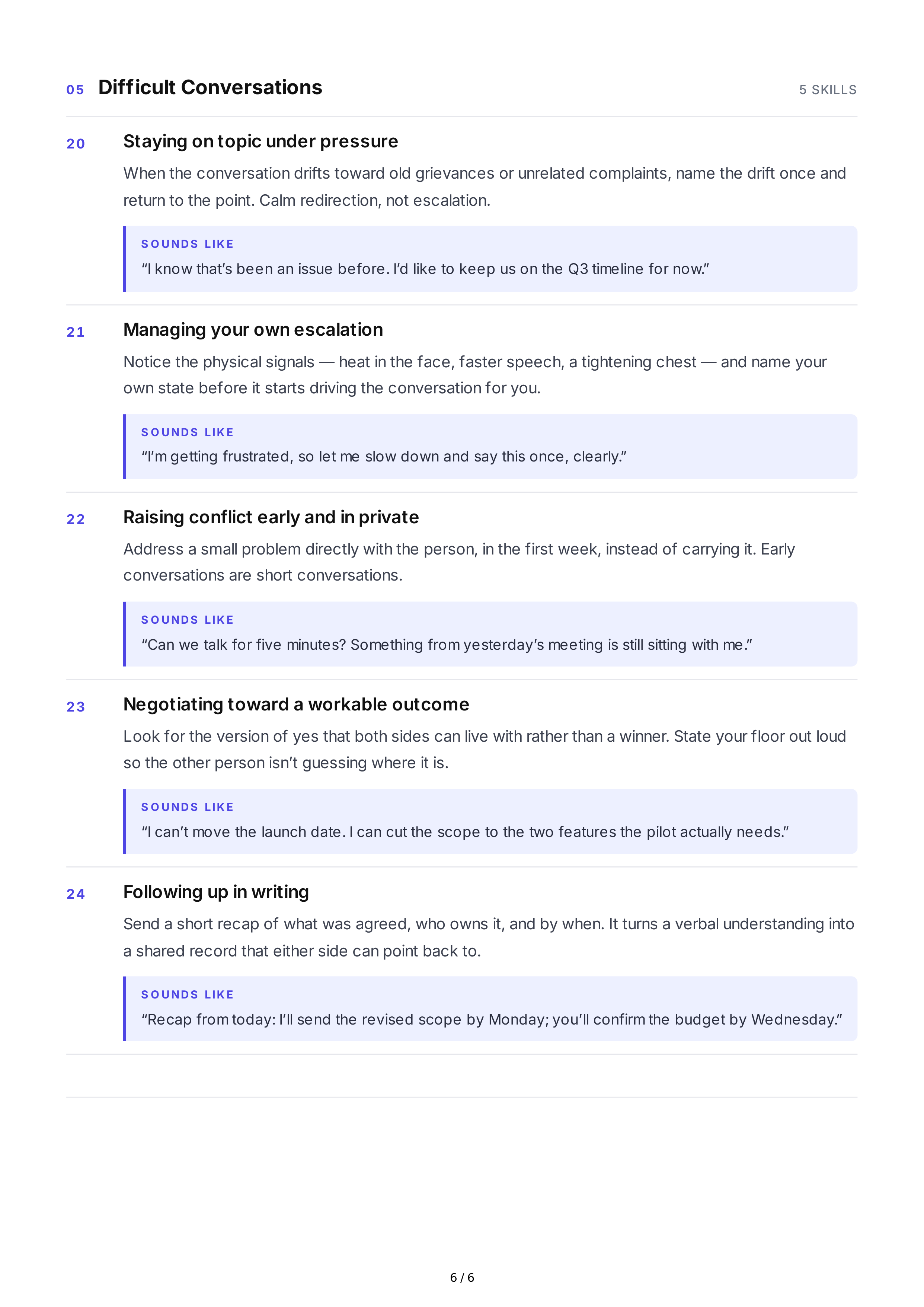
05
Difficult
Conversations
5
SKILLS
20
Staying
on
topic
under
pressure
When
the
conversation
drifts
toward
old
grievances
or
unrelated
complaints
,
name
the
drift
once
and
return
to
the
point
.
Calm
redirection
,
not
escalation
.
S O UND S
LIK E
“
I
know
that
’
s
been
an
issue
before
.
I
’
d
like
to
keep
us
on
the
Q
3
timeline
for
now
.”
21
Managing
your
own
escalation
Notice
the
physical
signals
—
heat
in
the
face
,
faster
speech
,
a
tightening
chest
—
and
name
your
own
state
before
it
starts
driving
the
conversation
for
you
.
S O UND S
LIK E
“
I
’
m
getting
frustrated
,
so
let
me
slow
down
and
say
this
once
,
clearly
.”
22
Raising
conflict
early
and
in
private
Address
a
small
problem
directly
with
the
person
,
in
the
first
week
,
instead
of
carrying
it
.
Early
conversations
are
short
conversations
.
S O UND S
LIK E
“
Can
we
talk
for
five
minutes
?
Something
from
yesterday
’
s
meeting
is
still
sitting
with
me
.”
23
Negotiating
toward
a
workable
outcome
Look
for
the
version
of
yes
that
both
sides
can
live
with
rather
than
a
winner
.
State
your
floor
out
loud
so
the
other
person
isn
’
t
guessing
where
it
is
.
S O UND S
LIK E
“
I
can
’
t
move
the
launch
date
.
I
can
cut
the
scope
to
the
two
features
the
pilot
actually
needs
.”
24
Following
up
in
writing
Send
a
short
recap
of
what
was
agreed
,
who
owns
it
,
and
by
when
.
It
turns
a
verbal
understanding
into
a
shared
record
that
either
side
can
point
back
to
.
S O UND S
LIK E
“
Recap
from
today
:
I
’
ll
send
the
revised
scope
by
Monday
;
you
’
ll
confirm
the
budget
by
Wednesday
.”
6 / 6
