Networking
Interpersonal
Skills
01
The
complete
list
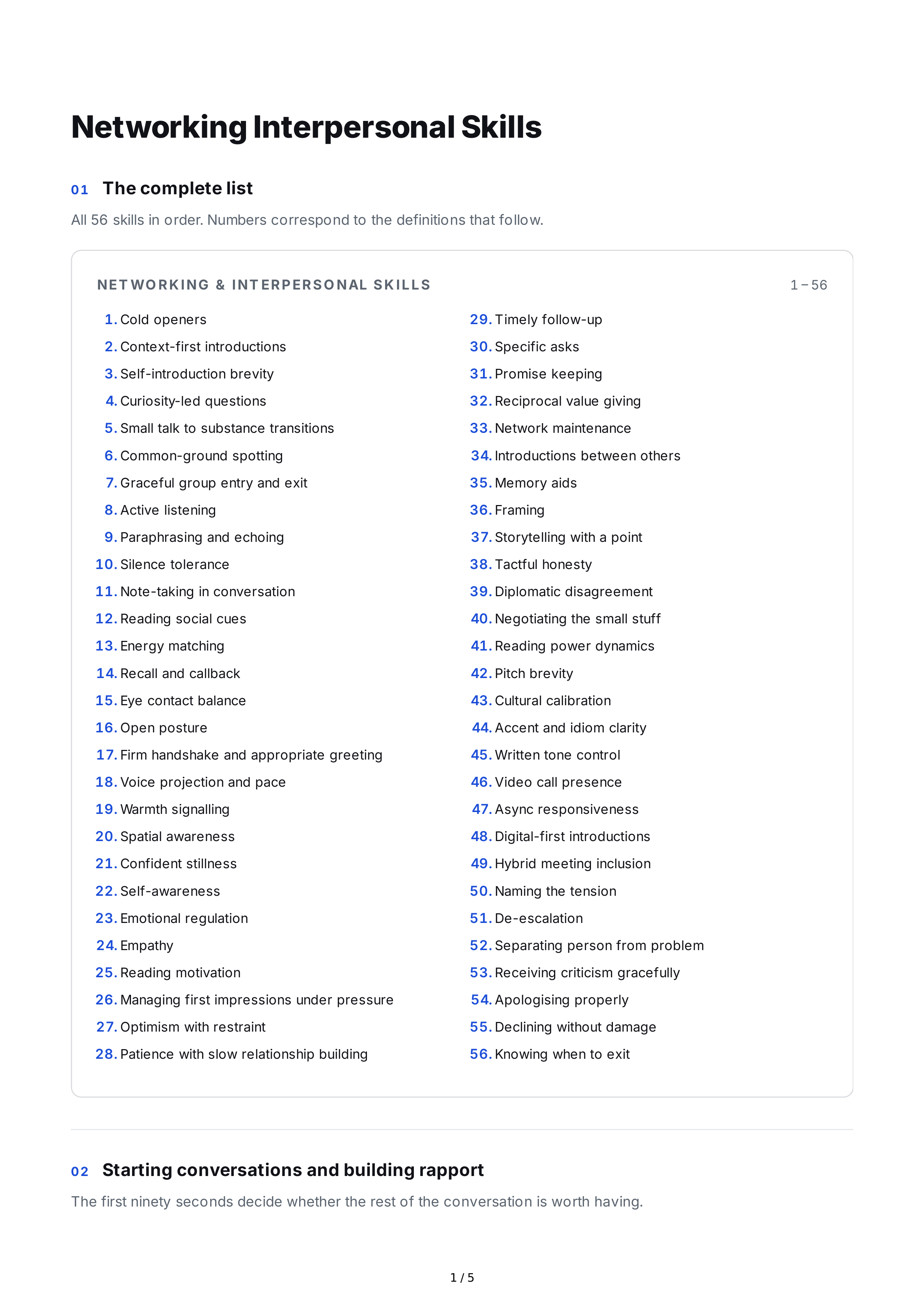
All
56
skills
in
order
.
Numbers
correspond
to
the
definitions
that
follow
.
NET WO RK ING
&
INT ERPERSO NAL
SK IL L S
1 – 56
1.
Cold
openers
2.
Context
-
first
introductions
3.
Self
-
introduction
brevity
4.
Curiosity
-
led
questions
5.
Small
talk
to
substance
transitions
6.
Common
-
ground
spotting
7.
Graceful
group
entry
and
exit
8.
Active
listening
9.
Paraphrasing
and
echoing
10.
Silence
tolerance
11.
Note
-
taking
in
conversation
12.
Reading
social
cues
13.
Energy
matching
14.
Recall
and
callback
15.
Eye
contact
balance
16.
Open
posture
17.
Firm
handshake
and
appropriate
greeting
18.
Voice
projection
and
pace
19.
Warmth
signalling
20.
Spatial
awareness
21.
Confident
stillness
22.
Self
-
awareness
23.
Emotional
regulation
24.
Empathy
25.
Reading
motivation
26.
Managing
first
impressions
under
pressure
27.
Optimism
with
restraint
28.
Patience
with
slow
relationship
building
29.
Timely
follow
-
up
30.
Specific
asks
31.
Promise
keeping
32.
Reciprocal
value
giving
33.
Network
maintenance
34.
Introductions
between
others
35.
Memory
aids
36.
Framing
37.
Storytelling
with
a
point
38.
Tactful
honesty
39.
Diplomatic
disagreement
40.
Negotiating
the
small
stuff
41.
Reading
power
dynamics
42.
Pitch
brevity
43.
Cultural
calibration
44.
Accent
and
idiom
clarity
45.
Written
tone
control
46.
Video
call
presence
47.
Async
responsiveness
48.
Digital
-
first
introductions
49.
Hybrid
meeting
inclusion
50.
Naming
the
tension
51.
De
-
escalation
52.
Separating
person
from
problem
53.
Receiving
criticism
gracefully
54.
Apologising
properly
55.
Declining
without
damage
56.
Knowing
when
to
exit
02
Starting
conversations
and
building
rapport
The
first
ninety
seconds
decide
whether
the
rest
of
the
conversation
is
worth
having
.
1 / 5
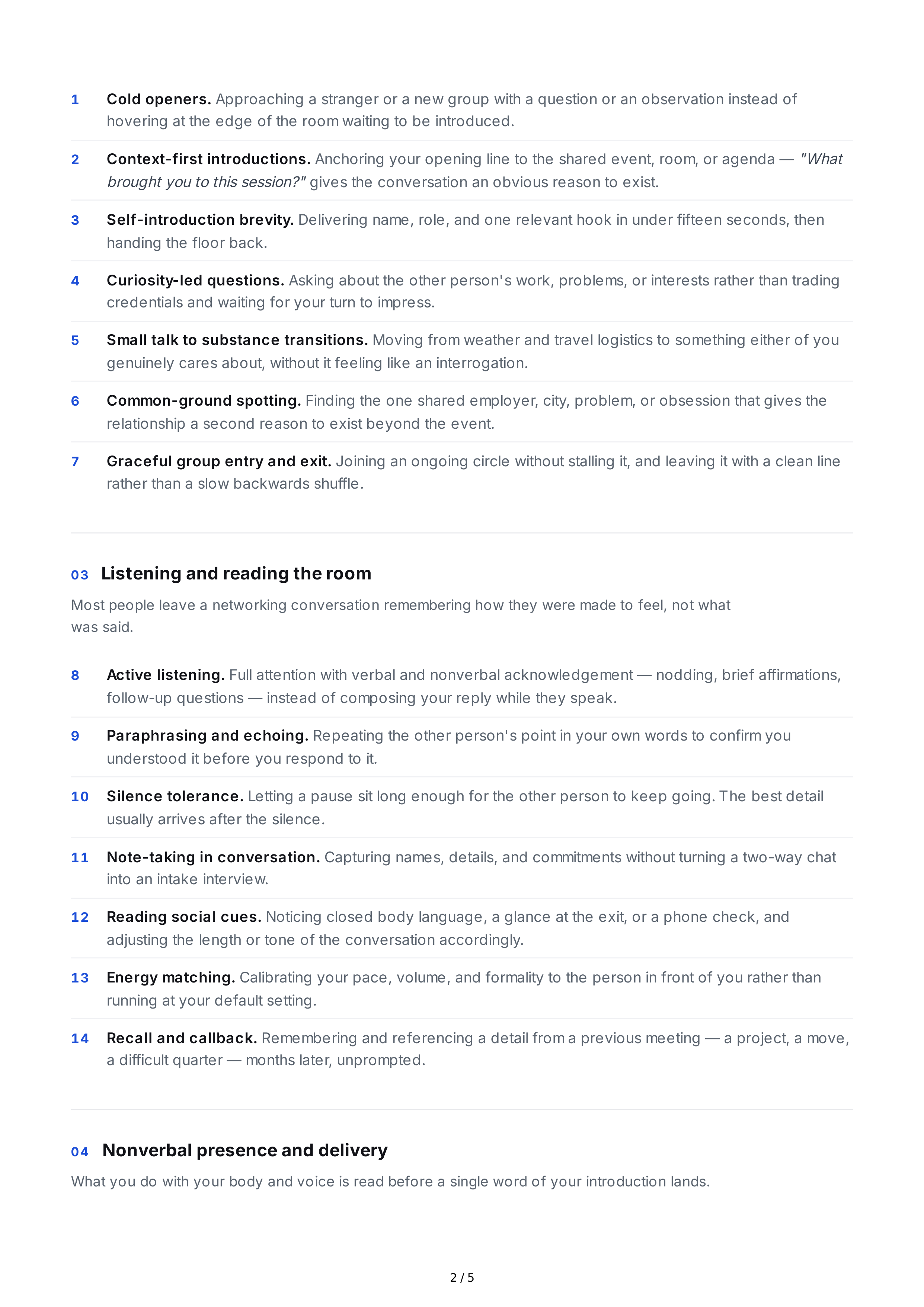
1
Cold
openers
.
Approaching
a
stranger
or
a
new
group
with
a
question
or
an
observation
instead
of
hovering
at
the
edge
of
the
room
waiting
to
be
introduced
.
2
Context
-
first
introductions
.
Anchoring
your
opening
line
to
the
shared
event
,
room
,
or
agenda
—
"
What
brought
you
to
this
session
?"
gives
the
conversation
an
obvious
reason
to
exist
.
3
Self
-
introduction
brevity
.
Delivering
name
,
role
,
and
one
relevant
hook
in
under
fifteen
seconds
,
then
handing
the
floor
back
.
4
Curiosity
-
led
questions
.
Asking
about
the
other
person
'
s
work
,
problems
,
or
interests
rather
than
trading
credentials
and
waiting
for
your
turn
to
impress
.
5
Small
talk
to
substance
transitions
.
Moving
from
weather
and
travel
logistics
to
something
either
of
you
genuinely
cares
about
,
without
it
feeling
like
an
interrogation
.
6
Common
-
ground
spotting
.
Finding
the
one
shared
employer
,
city
,
problem
,
or
obsession
that
gives
the
relationship
a
second
reason
to
exist
beyond
the
event
.
7
Graceful
group
entry
and
exit
.
Joining
an
ongoing
circle
without
stalling
it
,
and
leaving
it
with
a
clean
line
rather
than
a
slow
backwards
shuffle
.
03
Listening
and
reading
the
room
Most
people
leave
a
networking
conversation
remembering
how
they
were
made
to
feel
,
not
what
was
said
.
8
Active
listening
.
Full
attention
with
verbal
and
nonverbal
acknowledgement
—
nodding
,
brief
affirmations
,
follow
-
up
questions
—
instead
of
composing
your
reply
while
they
speak
.
9
Paraphrasing
and
echoing
.
Repeating
the
other
person
'
s
point
in
your
own
words
to
confirm
you
understood
it
before
you
respond
to
it
.
10
Silence
tolerance
.
Letting
a
pause
sit
long
enough
for
the
other
person
to
keep
going
.
The
best
detail
usually
arrives
after
the
silence
.
11
Note
-
taking
in
conversation
.
Capturing
names
,
details
,
and
commitments
without
turning
a
two
-
way
chat
into
an
intake
interview
.
12
Reading
social
cues
.
Noticing
closed
body
language
,
a
glance
at
the
exit
,
or
a
phone
check
,
and
adjusting
the
length
or
tone
of
the
conversation
accordingly
.
13
Energy
matching
.
Calibrating
your
pace
,
volume
,
and
formality
to
the
person
in
front
of
you
rather
than
running
at
your
default
setting
.
14
Recall
and
callback
.
Remembering
and
referencing
a
detail
from
a
previous
meeting
—
a
project
,
a
move
,
a
difficult
quarter
—
months
later
,
unprompted
.
04
Nonverbal
presence
and
delivery
What
you
do
with
your
body
and
voice
is
read
before
a
single
word
of
your
introduction
lands
.
2 / 5
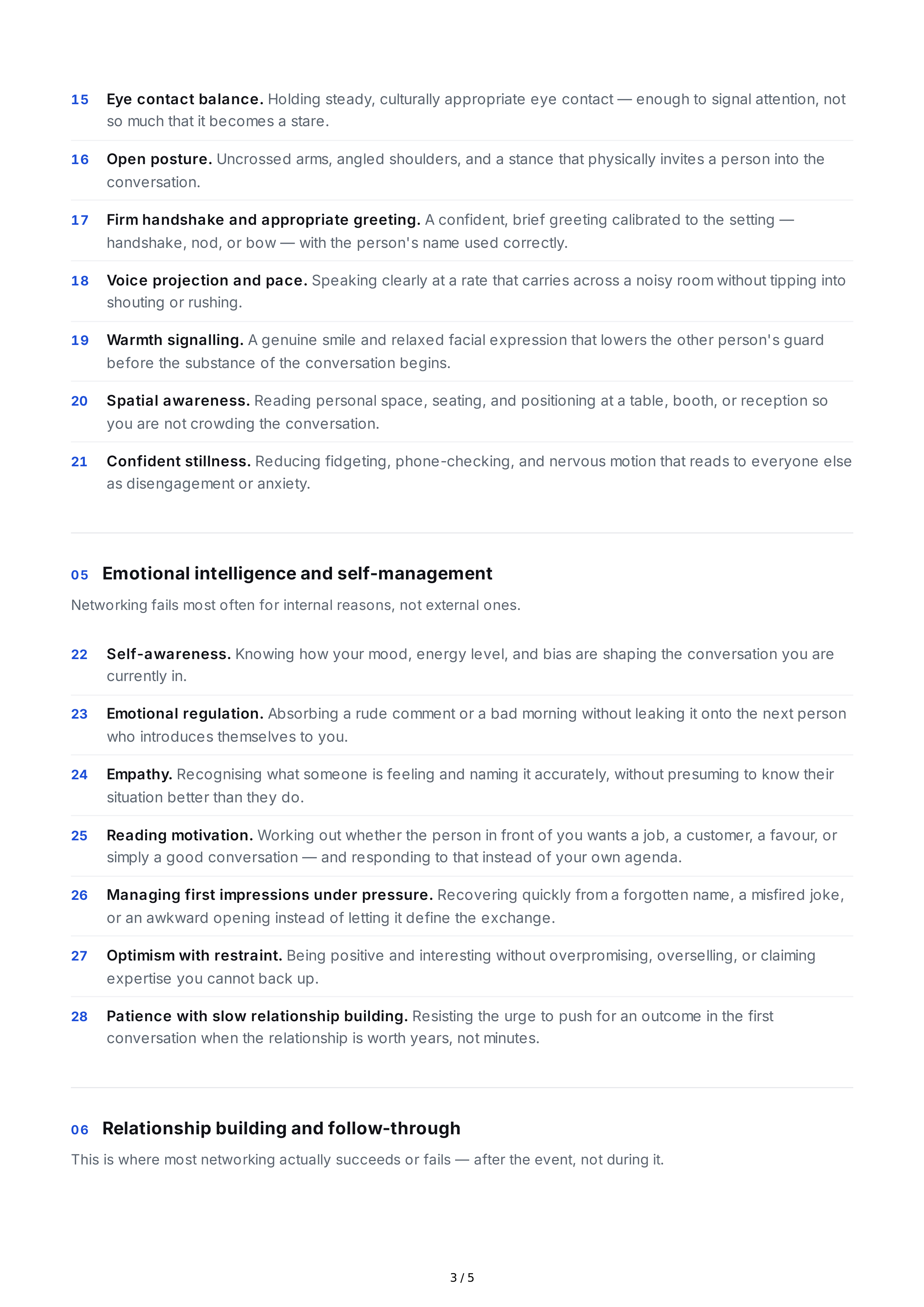
15
Eye
contact
balance
.
Holding
steady
,
culturally
appropriate
eye
contact
—
enough
to
signal
attention
,
not
so
much
that
it
becomes
a
stare
.
16
Open
posture
.
Uncrossed
arms
,
angled
shoulders
,
and
a
stance
that
physically
invites
a
person
into
the
conversation
.
17
Firm
handshake
and
appropriate
greeting
.
A
confident
,
brief
greeting
calibrated
to
the
setting
—
handshake
,
nod
,
or
bow
—
with
the
person
'
s
name
used
correctly
.
18
Voice
projection
and
pace
.
Speaking
clearly
at
a
rate
that
carries
across
a
noisy
room
without
tipping
into
shouting
or
rushing
.
19
Warmth
signalling
.
A
genuine
smile
and
relaxed
facial
expression
that
lowers
the
other
person
'
s
guard
before
the
substance
of
the
conversation
begins
.
20
Spatial
awareness
.
Reading
personal
space
,
seating
,
and
positioning
at
a
table
,
booth
,
or
reception
so
you
are
not
crowding
the
conversation
.
21
Confident
stillness
.
Reducing
fidgeting
,
phone
-
checking
,
and
nervous
motion
that
reads
to
everyone
else
as
disengagement
or
anxiety
.
05
Emotional
intelligence
and
self
-
management
Networking
fails
most
often
for
internal
reasons
,
not
external
ones
.
22
Self
-
awareness
.
Knowing
how
your
mood
,
energy
level
,
and
bias
are
shaping
the
conversation
you
are
currently
in
.
23
Emotional
regulation
.
Absorbing
a
rude
comment
or
a
bad
morning
without
leaking
it
onto
the
next
person
who
introduces
themselves
to
you
.
24
Empathy
.
Recognising
what
someone
is
feeling
and
naming
it
accurately
,
without
presuming
to
know
their
situation
better
than
they
do
.
25
Reading
motivation
.
Working
out
whether
the
person
in
front
of
you
wants
a
job
,
a
customer
,
a
favour
,
or
simply
a
good
conversation
—
and
responding
to
that
instead
of
your
own
agenda
.
26
Managing
first
impressions
under
pressure
.
Recovering
quickly
from
a
forgotten
name
,
a
misfired
joke
,
or
an
awkward
opening
instead
of
letting
it
define
the
exchange
.
27
Optimism
with
restraint
.
Being
positive
and
interesting
without
overpromising
,
overselling
,
or
claiming
expertise
you
cannot
back
up
.
28
Patience
with
slow
relationship
building
.
Resisting
the
urge
to
push
for
an
outcome
in
the
first
conversation
when
the
relationship
is
worth
years
,
not
minutes
.
06
Relationship
building
and
follow
-
through
This
is
where
most
networking
actually
succeeds
or
fails
—
after
the
event
,
not
during
it
.
3 / 5
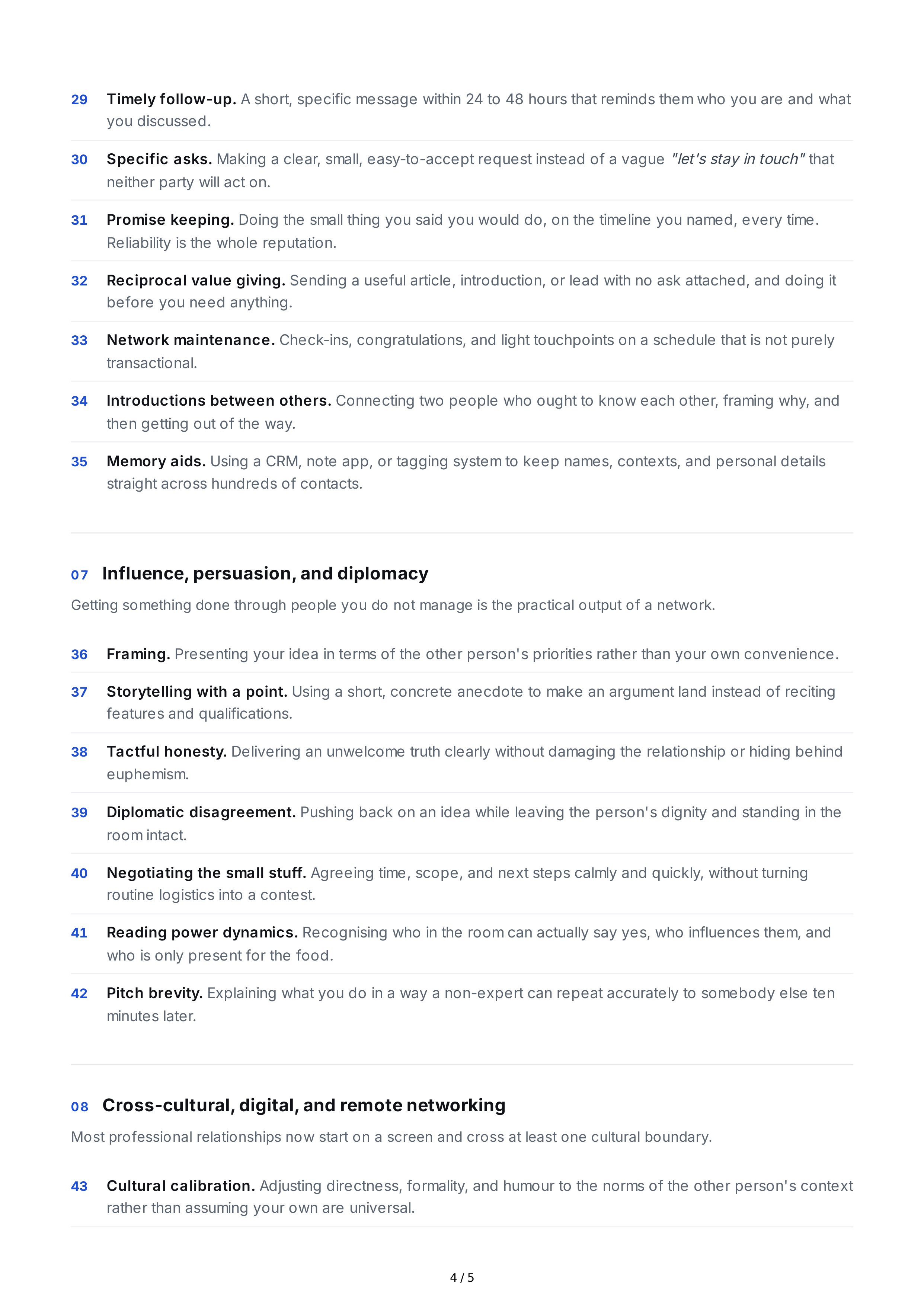
29
Timely
follow
-
up
.
A
short
,
specific
message
within
24
to
48
hours
that
reminds
them
who
you
are
and
what
you
discussed
.
30
Specific
asks
.
Making
a
clear
,
small
,
easy
-
to
-
accept
request
instead
of
a
vague
"
let
'
s
stay
in
touch
"
that
neither
party
will
act
on
.
31
Promise
keeping
.
Doing
the
small
thing
you
said
you
would
do
,
on
the
timeline
you
named
,
every
time
.
Reliability
is
the
whole
reputation
.
32
Reciprocal
value
giving
.
Sending
a
useful
article
,
introduction
,
or
lead
with
no
ask
attached
,
and
doing
it
before
you
need
anything
.
33
Network
maintenance
.
Check
-
ins
,
congratulations
,
and
light
touchpoints
on
a
schedule
that
is
not
purely
transactional
.
34
Introductions
between
others
.
Connecting
two
people
who
ought
to
know
each
other
,
framing
why
,
and
then
getting
out
of
the
way
.
35
Memory
aids
.
Using
a
CRM
,
note
app
,
or
tagging
system
to
keep
names
,
contexts
,
and
personal
details
straight
across
hundreds
of
contacts
.
07
Influence
,
persuasion
,
and
diplomacy
Getting
something
done
through
people
you
do
not
manage
is
the
practical
output
of
a
network
.
36
Framing
.
Presenting
your
idea
in
terms
of
the
other
person
'
s
priorities
rather
than
your
own
convenience
.
37
Storytelling
with
a
point
.
Using
a
short
,
concrete
anecdote
to
make
an
argument
land
instead
of
reciting
features
and
qualifications
.
38
Tactful
honesty
.
Delivering
an
unwelcome
truth
clearly
without
damaging
the
relationship
or
hiding
behind
euphemism
.
39
Diplomatic
disagreement
.
Pushing
back
on
an
idea
while
leaving
the
person
'
s
dignity
and
standing
in
the
room
intact
.
40
Negotiating
the
small
stuff
.
Agreeing
time
,
scope
,
and
next
steps
calmly
and
quickly
,
without
turning
routine
logistics
into
a
contest
.
41
Reading
power
dynamics
.
Recognising
who
in
the
room
can
actually
say
yes
,
who
influences
them
,
and
who
is
only
present
for
the
food
.
42
Pitch
brevity
.
Explaining
what
you
do
in
a
way
a
non
-
expert
can
repeat
accurately
to
somebody
else
ten
minutes
later
.
08
Cross
-
cultural
,
digital
,
and
remote
networking
Most
professional
relationships
now
start
on
a
screen
and
cross
at
least
one
cultural
boundary
.
43
Cultural
calibration
.
Adjusting
directness
,
formality
,
and
humour
to
the
norms
of
the
other
person
'
s
context
rather
than
assuming
your
own
are
universal
.
4 / 5
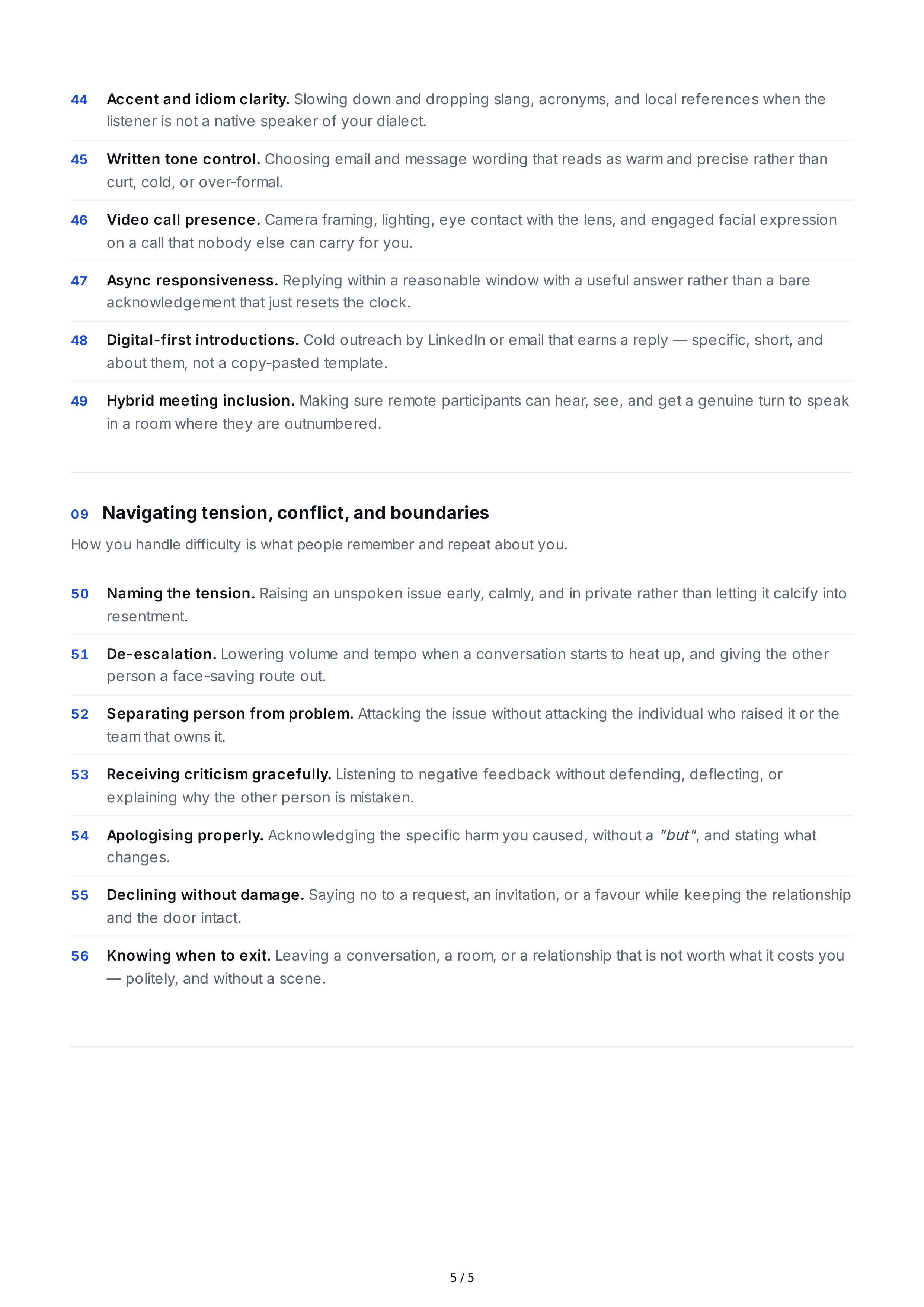
44
Accent
and
idiom
clarity
.
Slowing
down
and
dropping
slang
,
acronyms
,
and
local
references
when
the
listener
is
not
a
native
speaker
of
your
dialect
.
45
Written
tone
control
.
Choosing
email
and
message
wording
that
reads
as
warm
and
precise
rather
than
curt
,
cold
,
or
over
-
formal
.
46
Video
call
presence
.
Camera
framing
,
lighting
,
eye
contact
with
the
lens
,
and
engaged
facial
expression
on
a
call
that
nobody
else
can
carry
for
you
.
47
Async
responsiveness
.
Replying
within
a
reasonable
window
with
a
useful
answer
rather
than
a
bare
acknowledgement
that
just
resets
the
clock
.
48
Digital
-
first
introductions
.
Cold
outreach
by
LinkedIn
or
email
that
earns
a
reply
—
specific
,
short
,
and
about
them
,
not
a
copy
-
pasted
template
.
49
Hybrid
meeting
inclusion
.
Making
sure
remote
participants
can
hear
,
see
,
and
get
a
genuine
turn
to
speak
in
a
room
where
they
are
outnumbered
.
09
Navigating
tension
,
conflict
,
and
boundaries
How
you
handle
difficulty
is
what
people
remember
and
repeat
about
you
.
50
Naming
the
tension
.
Raising
an
unspoken
issue
early
,
calmly
,
and
in
private
rather
than
letting
it
calcify
into
resentment
.
51
De
-
escalation
.
Lowering
volume
and
tempo
when
a
conversation
starts
to
heat
up
,
and
giving
the
other
person
a
face
-
saving
route
out
.
52
Separating
person
from
problem
.
Attacking
the
issue
without
attacking
the
individual
who
raised
it
or
the
team
that
owns
it
.
53
Receiving
criticism
gracefully
.
Listening
to
negative
feedback
without
defending
,
deflecting
,
or
explaining
why
the
other
person
is
mistaken
.
54
Apologising
properly
.
Acknowledging
the
specific
harm
you
caused
,
without
a
"
but
"
,
and
stating
what
changes
.
55
Declining
without
damage
.
Saying
no
to
a
request
,
an
invitation
,
or
a
favour
while
keeping
the
relationship
and
the
door
intact
.
56
Knowing
when
to
exit
.
Leaving
a
conversation
,
a
room
,
or
a
relationship
that
is
not
worth
what
it
costs
you
—
politely
,
and
without
a
scene
.
5 / 5