Empathetic
Listening
01
Presence
&
Attending
The
foundation
.
Nothing
further
down
this
list
works
until
the
other
person
believes
they
have
your
full
attention
.
1.1
Undivided
Attention
Removing
the
phone
from
the
table
,
closing
the
laptop
lid
,
and
letting
the
person
in
front
of
you
become
the
only
thing
in
the
room
.
Attention
is
the
first
act
of
respect
,
and
it
is
noticed
within
seconds
.
IN
PRACT ICE
“
Let
me
put
this
down
—
I
'
m
listening
.”
1.2
Cultivated
Silence
Holding
the
pause
after
someone
finishes
a
difficult
sentence
instead
of
filling
it
.
Most
people
say
their
real
point
three
seconds
after
their
first
point
—
but
only
if
nobody
rescues
them
from
the
silence
.
IN
PRACT ICE
Do
not
answer
immediately
.
Count
to
three
.
Let
them
keep
going
.
1.3
Open
Body
Orientation
Squaring
your
shoulders
toward
the
speaker
,
uncrossing
your
arms
,
keeping
your
hands
visible
and
still
.
Posture
communicates
availability
before
a
single
word
is
exchanged
.
IN
PRACT ICE
Angle
your
chair
toward
the
person
,
not
the
monitor
.
1.4
Steady
,
Comfortable
Eye
Contact
Contact
that
is
consistent
but
unhurried
—
more
while
the
other
person
is
speaking
,
less
while
you
are
.
Enough
to
signal
engagement
;
never
so
much
that
it
becomes
a
stare
.
IN
PRACT ICE
Look
at
the
person
,
not
through
them
.
Break
contact
naturally
when
you
think
.
1.5
Patience
with
Pace
Letting
the
speaker
arrive
at
the
point
in
their
own
time
,
including
the
restarts
and
apparent
tangents
.
Interrupting
to
speed
things
up
usually
costs
more
than
it
saves
.
IN
PRACT ICE
Resist
finishing
their
sentence
—
the
version
they
finish
themselves
is
more
accurate
.
1 / 9
1.6
Physical
Attunement
A
subtle
forward
lean
,
an
unhurried
nod
,
a
matching
energy
level
.
Small
embodied
signals
that
say
“
I
'
m
here
”
without
taking
the
floor
.
IN
PRACT ICE
Match
a
quiet
voice
with
a
quiet
voice
;
a
fast
one
with
a
faster
nod
.
02
Reading
the
Unspoken
Skills
for
perceiving
what
is
carried
in
tone
,
face
and
posture
rather
than
in
words
.
2.1
Reading
Facial
Expression
Noticing
the
micro
-
flashes
that
pass
across
a
face
in
under
a
second
—
a
tightening
around
the
eyes
,
a
brief
lip
compression
,
a
swallow
—
before
the
person
composes
themselves
.
IN
PRACT ICE
Notice
the
flash
,
then
wait
.
Do
not
narrate
it
back
yet
.
2.2
Tracking
Vocal
Tone
Listening
for
pitch
,
pace
and
volume
shifts
,
not
just
vocabulary
. “
I
'
m
fine
”
delivered
flat
and
slow
is
a
different
sentence
than
“
I
'
m
fine
”
delivered
bright
and
quick
.
IN
PRACT ICE
“
You
said
you
'
re
fine
,
but
that
sounded
heavy
.
What
'
s
underneath
?”
2.3
Noticing
Posture
and
Gesture
Shoulders
that
drop
,
hands
that
fidget
,
a
body
that
turns
slightly
away
.
The
body
often
reports
the
emotional
cost
of
a
situation
before
the
person
is
willing
to
name
it
.
IN
PRACT ICE
Register
the
shift
;
do
not
diagnose
it
out
loud
.
2.4
Detecting
Incongruence
Hearing
the
gap
between
what
is
said
and
what
is
shown
.
When
words
and
body
disagree
,
the
body
is
usually
closer
to
the
truth
—
but
it
must
be
raised
gently
,
as
an
invitation
.
IN
PRACT ICE
“
Part
of
you
says
it
'
s
fine
and
part
of
you
looks
exhausted
.
Which
part
should
we
listen
to
?”
2.5
Attuned
Mirroring
Subtly
matching
pace
,
volume
and
posture
so
the
other
person
'
s
nervous
system
reads
you
as
safe
.
This
is
not
mimicry
—
it
is
calibration
,
and
it
should
never
be
visible
as
technique
.
IN
PRACT ICE
Slow
your
speech
by
ten
percent
when
the
other
person
is
struggling
to
speak
.
03
Reflective
Listening
Turning
attention
into
evidence
.
These
are
the
skills
that
prove
you
heard
the
message
accurately
.
2 / 9
3.1
Paraphrasing
Restating
the
content
of
what
was
said
in
your
own
words
,
without
adding
interpretation
.
If
your
paraphrase
is
wrong
,
the
correction
itself
is
useful
information
.
IN
PRACT ICE
“
So
the
deadline
moved
up
two
weeks
and
nobody
told
your
team
.”
3.2
Reflecting
Feeling
Naming
the
emotion
you
hear
rather
than
only
the
facts
.
Feelings
that
are
named
tend
to
loosen
;
feelings
that
are
ignored
tend
to
escalate
.
IN
PRACT ICE
“
That
sounds
exhausting
—
not
just
frustrating
.”
3.3
Summarizing
Gathering
several
threads
into
one
statement
after
a
long
or
winding
stretch
.
A
good
summary
gives
the
speaker
a
chance
to
correct
the
record
before
the
conversation
moves
on
.
IN
PRACT ICE
“
Let
me
pull
this
together
:
three
things
are
on
you
right
now
,
and
only
one
of
them
is
yours
to
fix
.”
3.4
Minimal
Encouragers
Short
,
low
-
weight
vocal
signals
— “
mm
-
hmm
,” “
go
on
,” “
I
see
” —
that
keep
the
floor
with
the
speaker
without
inserting
your
own
content
.
IN
PRACT ICE
Use
them
in
the
gaps
.
Never
over
a
word
the
other
person
is
still
finishing
.
3.5
Verbal
Tracking
Staying
on
the
topic
the
speaker
chose
rather
than
steering
toward
the
topic
you
find
more
interesting
.
If
they
mention
a
sick
parent
and
then
pivot
to
work
,
the
sick
parent
is
usually
the
live
wire
.
IN
PRACT ICE
“
Before
we
get
to
the
project
—
you
mentioned
your
dad
.
How
is
he
?”
3.6
Clarifying
Asking
for
the
specific
detail
that
would
make
the
picture
accurate
,
rather
than
assuming
you
already
understand
.
Good
clarifying
questions
are
short
and
neutral
.
IN
PRACT ICE
“
When
you
say
‘
they
,'
do
you
mean
the
client
or
your
manager
?”
04
Questioning
Questions
that
open
a
conversation
rather
than
steer
it
toward
the
answer
you
were
hoping
for
.
3 / 9
4.1
Open
-
Ended
Questioning
Questions
that
require
more
than
yes
or
no
,
and
that
leave
the
speaker
free
to
choose
the
direction
.
Closed
questions
confirm
;
open
questions
reveal
.
IN
PRACT ICE
“
What
was
that
like
?”
rather
than
“
Were
you
upset
?”
4.2
Gentle
Probing
Going
one
layer
deeper
on
what
was
just
said
,
at
a
pace
the
speaker
can
refuse
.
Probing
becomes
interrogation
the
moment
it
stops
being
optional
.
IN
PRACT ICE
“
You
said
‘
frustrating
.'
What
'
s
the
part
that
'
s
actually
frustrating
?”
4.3
Checking
Understanding
Verifying
that
what
you
took
away
is
what
was
meant
,
before
you
act
on
it
.
This
is
especially
important
when
the
stakes
are
high
or
the
story
is
still
unfolding
.
IN
PRACT ICE
“
Let
me
make
sure
I
'
ve
got
this
right
before
I
say
anything
else
.”
4.4
Asking
Permission
Before
Advising
Establishing
whether
the
person
wants
ideas
or
wants
to
be
heard
,
before
offering
either
.
Advice
given
uninvited
is
heard
as
a
verdict
,
not
a
gift
.
IN
PRACT ICE
“
Do
you
want
ideas
,
or
do
you
want
me
to
just
hear
this
for
a
while
?”
4.5
Avoiding
Leading
Questions
Recognizing
questions
that
contain
their
own
answer
— “
Don
'
t
you
think
you
should
have
escalated
?”
Leading
questions
train
people
to
agree
with
you
rather
than
to
tell
you
the
truth
.
IN
PRACT ICE
“
What
made
that
the
right
call
at
the
time
?”
05
Emotional
Attunement
Working
with
feeling
itself
—
naming
it
,
honoring
it
,
and
staying
in
the
room
with
it
.
5.1
Perspective
-
Taking
Reconstructing
the
situation
from
inside
the
other
person
'
s
constraints
,
history
and
knowledge
—
not
from
where
you
would
have
stood
in
the
same
room
.
IN
PRACT ICE
“
Given
what
you
were
told
at
the
start
,
that
reaction
makes
sense
.”
4 / 9
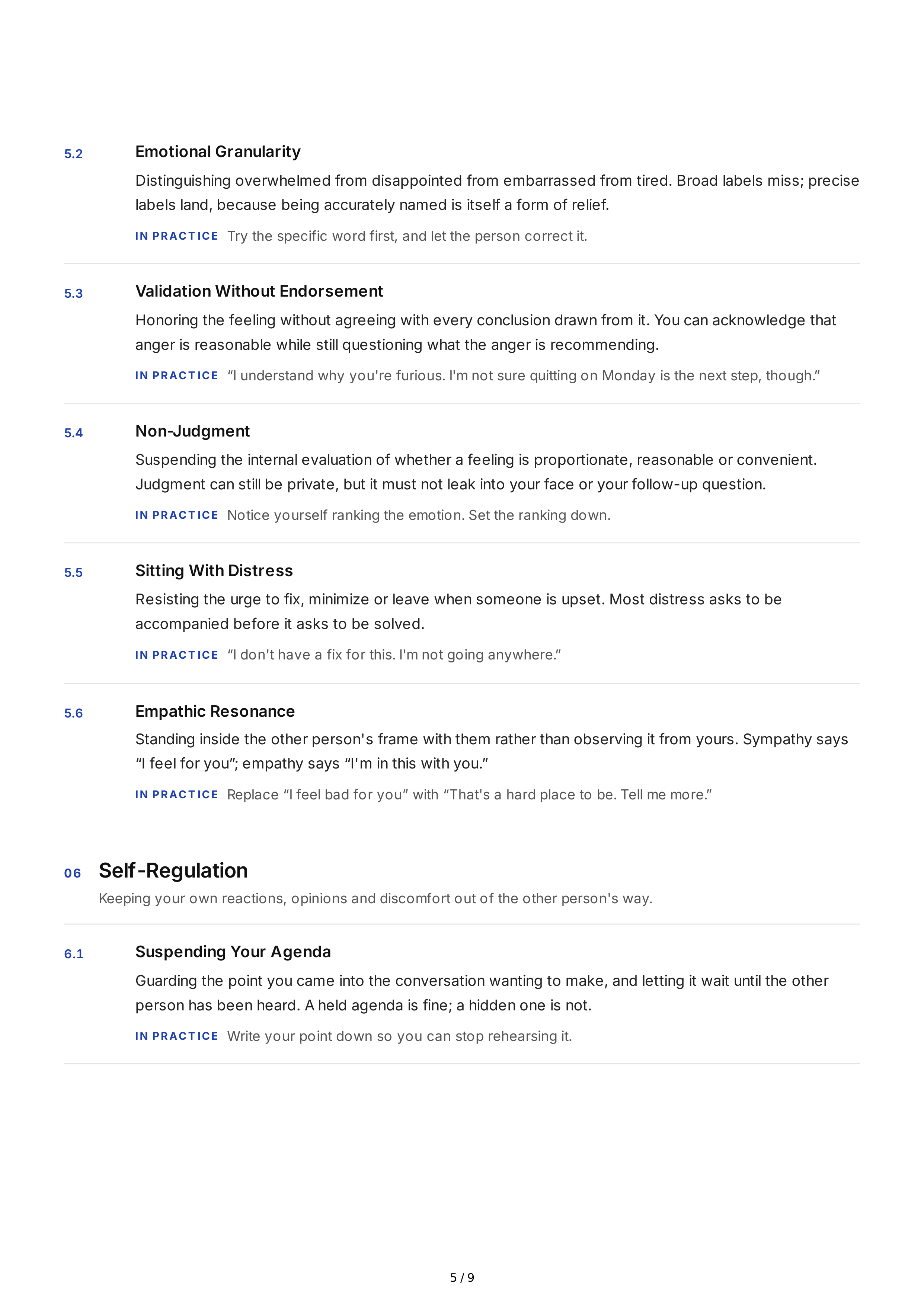
5.2
Emotional
Granularity
Distinguishing
overwhelmed
from
disappointed
from
embarrassed
from
tired
.
Broad
labels
miss
;
precise
labels
land
,
because
being
accurately
named
is
itself
a
form
of
relief
.
IN
PRACT ICE
Try
the
specific
word
first
,
and
let
the
person
correct
it
.
5.3
Validation
Without
Endorsement
Honoring
the
feeling
without
agreeing
with
every
conclusion
drawn
from
it
.
You
can
acknowledge
that
anger
is
reasonable
while
still
questioning
what
the
anger
is
recommending
.
IN
PRACT ICE
“
I
understand
why
you
'
re
furious
.
I
'
m
not
sure
quitting
on
Monday
is
the
next
step
,
though
.”
5.4
Non
-
Judgment
Suspending
the
internal
evaluation
of
whether
a
feeling
is
proportionate
,
reasonable
or
convenient
.
Judgment
can
still
be
private
,
but
it
must
not
leak
into
your
face
or
your
follow
-
up
question
.
IN
PRACT ICE
Notice
yourself
ranking
the
emotion
.
Set
the
ranking
down
.
5.5
Sitting
With
Distress
Resisting
the
urge
to
fix
,
minimize
or
leave
when
someone
is
upset
.
Most
distress
asks
to
be
accompanied
before
it
asks
to
be
solved
.
IN
PRACT ICE
“
I
don
'
t
have
a
fix
for
this
.
I
'
m
not
going
anywhere
.”
5.6
Empathic
Resonance
Standing
inside
the
other
person
'
s
frame
with
them
rather
than
observing
it
from
yours
.
Sympathy
says
“
I
feel
for
you
”;
empathy
says
“
I
'
m
in
this
with
you
.”
IN
PRACT ICE
Replace
“
I
feel
bad
for
you
”
with
“
That
'
s
a
hard
place
to
be
.
Tell
me
more
.”
06
Self
-
Regulation
Keeping
your
own
reactions
,
opinions
and
discomfort
out
of
the
other
person
'
s
way
.
6.1
Suspending
Your
Agenda
Guarding
the
point
you
came
into
the
conversation
wanting
to
make
,
and
letting
it
wait
until
the
other
person
has
been
heard
.
A
held
agenda
is
fine
;
a
hidden
one
is
not
.
IN
PRACT ICE
Write
your
point
down
so
you
can
stop
rehearsing
it
.
5 / 9
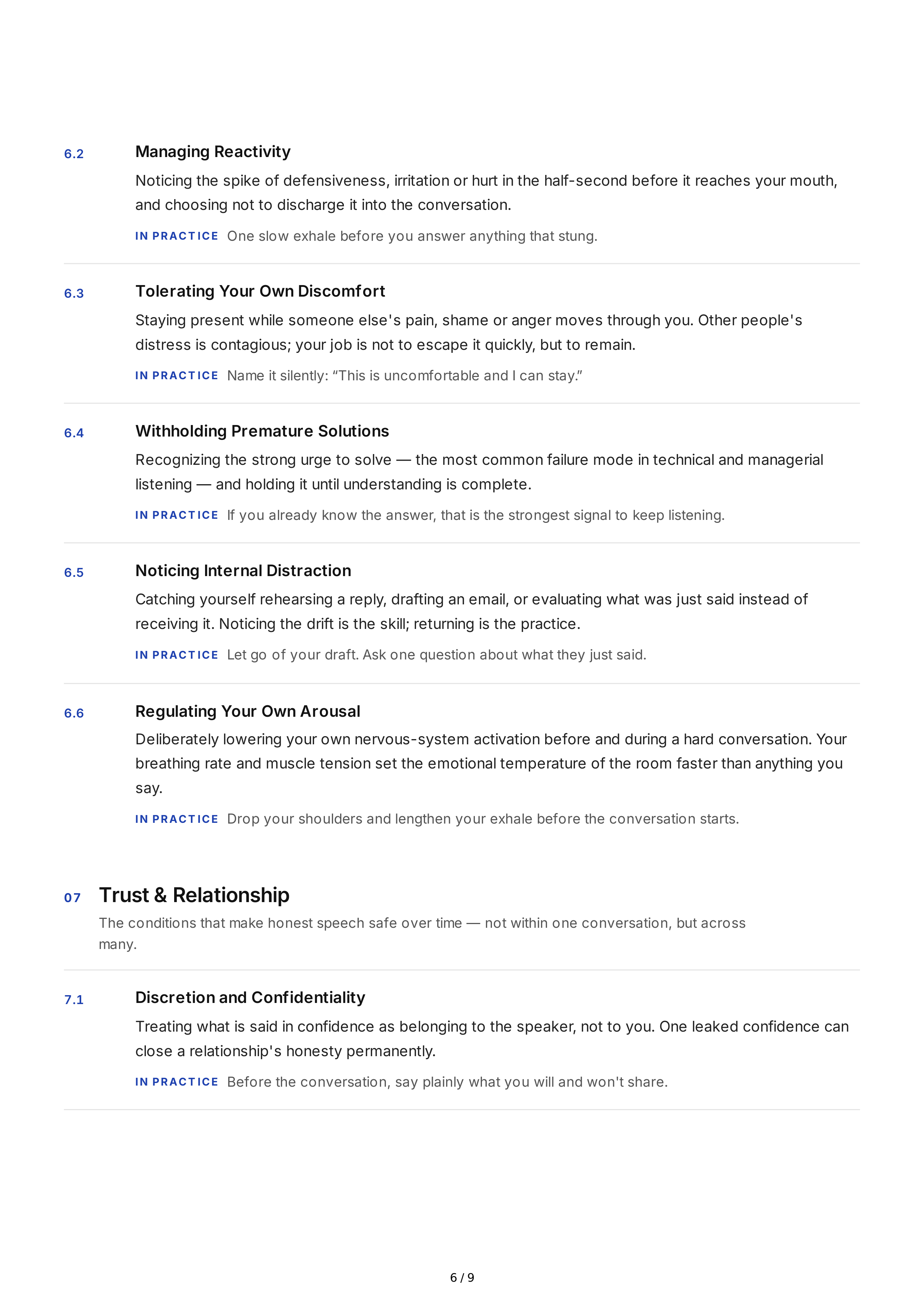
6.2
Managing
Reactivity
Noticing
the
spike
of
defensiveness
,
irritation
or
hurt
in
the
half
-
second
before
it
reaches
your
mouth
,
and
choosing
not
to
discharge
it
into
the
conversation
.
IN
PRACT ICE
One
slow
exhale
before
you
answer
anything
that
stung
.
6.3
Tolerating
Your
Own
Discomfort
Staying
present
while
someone
else
'
s
pain
,
shame
or
anger
moves
through
you
.
Other
people
'
s
distress
is
contagious
;
your
job
is
not
to
escape
it
quickly
,
but
to
remain
.
IN
PRACT ICE
Name
it
silently
: “
This
is
uncomfortable
and
I
can
stay
.”
6.4
Withholding
Premature
Solutions
Recognizing
the
strong
urge
to
solve
—
the
most
common
failure
mode
in
technical
and
managerial
listening
—
and
holding
it
until
understanding
is
complete
.
IN
PRACT ICE
If
you
already
know
the
answer
,
that
is
the
strongest
signal
to
keep
listening
.
6.5
Noticing
Internal
Distraction
Catching
yourself
rehearsing
a
reply
,
drafting
an
email
,
or
evaluating
what
was
just
said
instead
of
receiving
it
.
Noticing
the
drift
is
the
skill
;
returning
is
the
practice
.
IN
PRACT ICE
Let
go
of
your
draft
.
Ask
one
question
about
what
they
just
said
.
6.6
Regulating
Your
Own
Arousal
Deliberately
lowering
your
own
nervous
-
system
activation
before
and
during
a
hard
conversation
.
Your
breathing
rate
and
muscle
tension
set
the
emotional
temperature
of
the
room
faster
than
anything
you
say
.
IN
PRACT ICE
Drop
your
shoulders
and
lengthen
your
exhale
before
the
conversation
starts
.
07
Trust
&
Relationship
The
conditions
that
make
honest
speech
safe
over
time
—
not
within
one
conversation
,
but
across
many
.
7.1
Discretion
and
Confidentiality
Treating
what
is
said
in
confidence
as
belonging
to
the
speaker
,
not
to
you
.
One
leaked
confidence
can
close
a
relationship
'
s
honesty
permanently
.
IN
PRACT ICE
Before
the
conversation
,
say
plainly
what
you
will
and
won
'
t
share
.
6 / 9
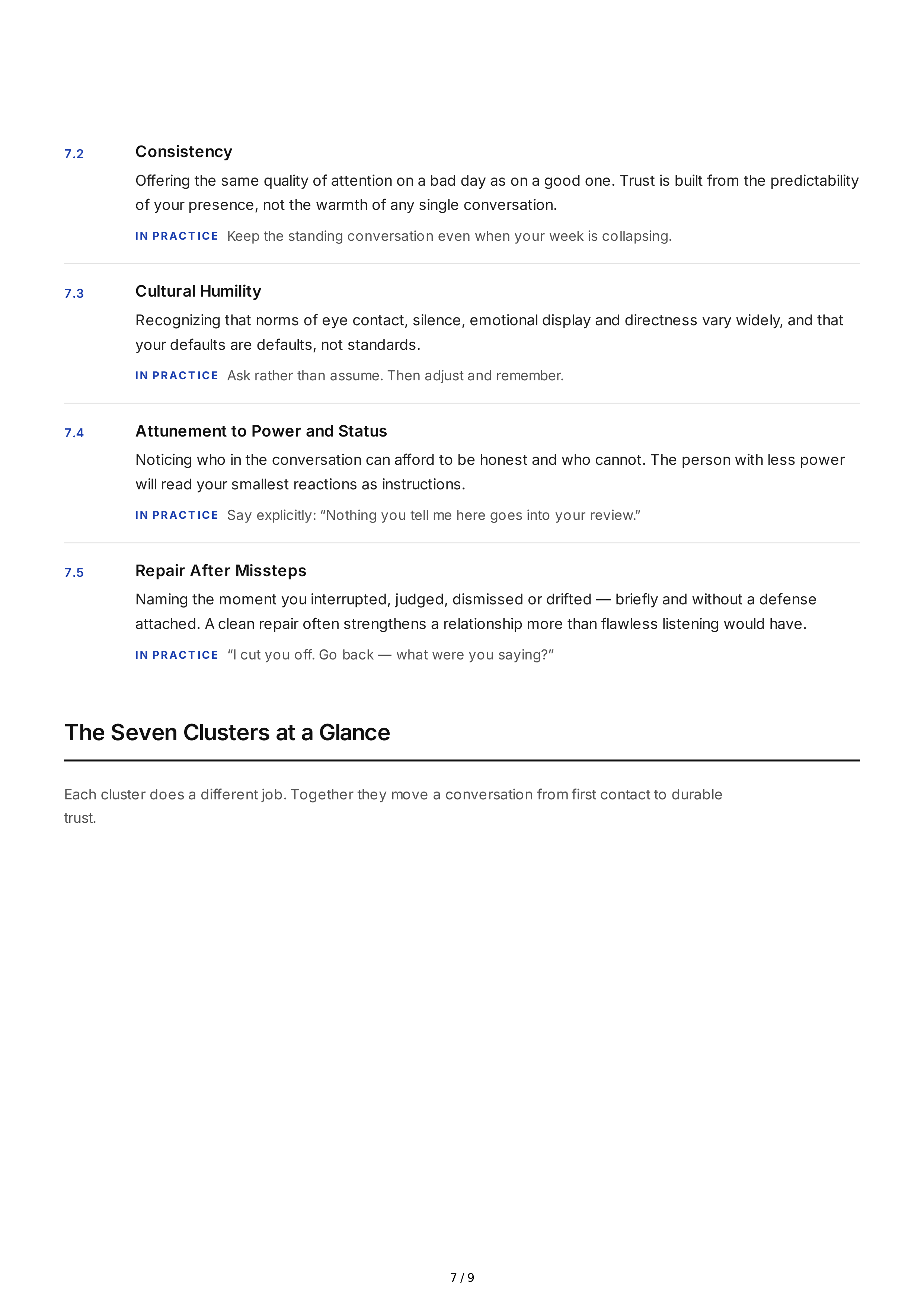
7.2
Consistency
Offering
the
same
quality
of
attention
on
a
bad
day
as
on
a
good
one
.
Trust
is
built
from
the
predictability
of
your
presence
,
not
the
warmth
of
any
single
conversation
.
IN
PRACT ICE
Keep
the
standing
conversation
even
when
your
week
is
collapsing
.
7.3
Cultural
Humility
Recognizing
that
norms
of
eye
contact
,
silence
,
emotional
display
and
directness
vary
widely
,
and
that
your
defaults
are
defaults
,
not
standards
.
IN
PRACT ICE
Ask
rather
than
assume
.
Then
adjust
and
remember
.
7.4
Attunement
to
Power
and
Status
Noticing
who
in
the
conversation
can
afford
to
be
honest
and
who
cannot
.
The
person
with
less
power
will
read
your
smallest
reactions
as
instructions
.
IN
PRACT ICE
Say
explicitly
: “
Nothing
you
tell
me
here
goes
into
your
review
.”
7.5
Repair
After
Missteps
Naming
the
moment
you
interrupted
,
judged
,
dismissed
or
drifted
—
briefly
and
without
a
defense
attached
.
A
clean
repair
often
strengthens
a
relationship
more
than
flawless
listening
would
have
.
IN
PRACT ICE
“
I
cut
you
off
.
Go
back
—
what
were
you
saying
?”
The
Seven
Clusters
at
a
Glance
Each
cluster
does
a
different
job
.
Together
they
move
a
conversation
from
first
contact
to
durable
trust
.
7 / 9
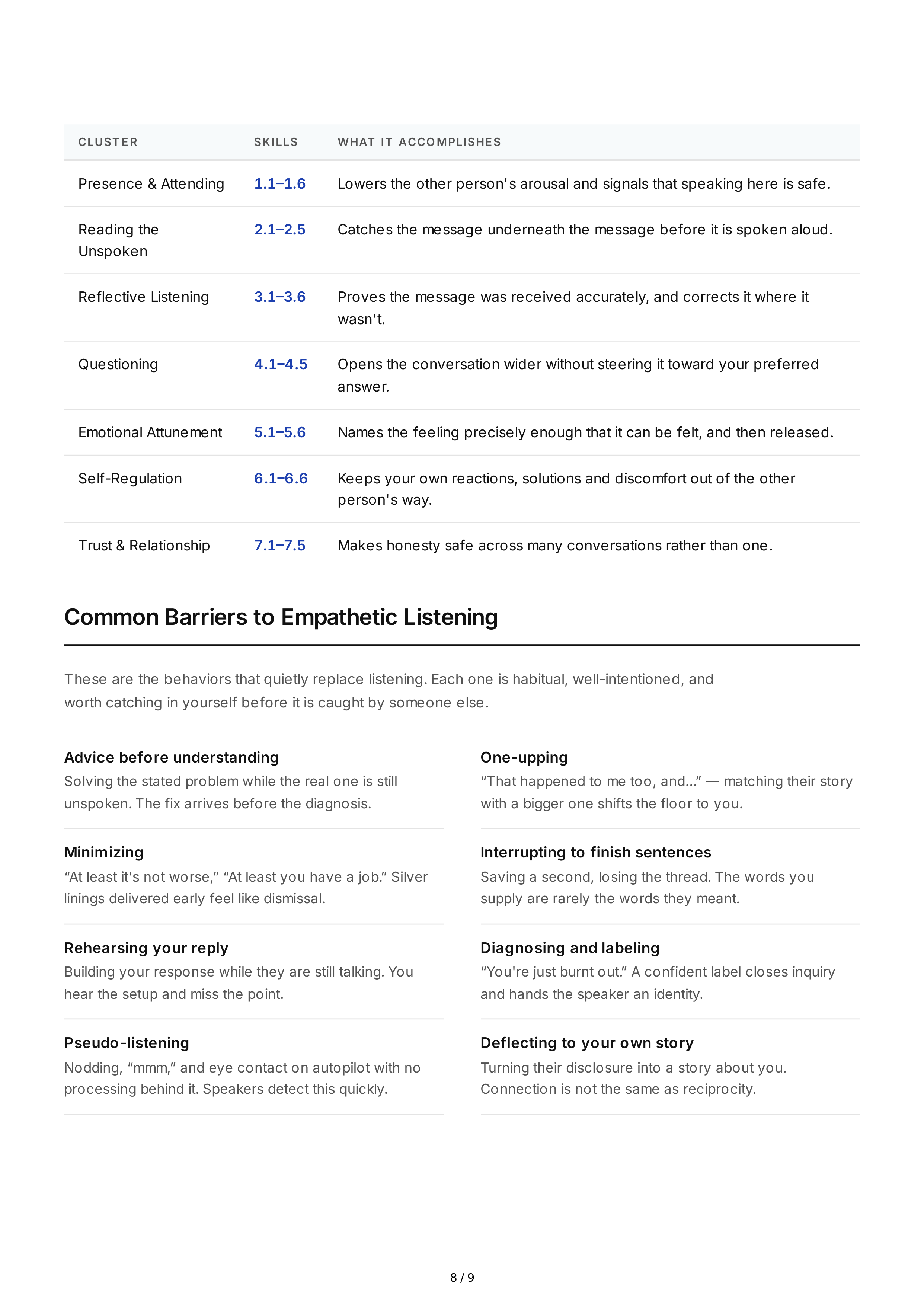
CLUST ER
SKILLS
WHAT
IT
ACCO MPLISHES
Presence
&
Attending
1.1–1.6
Lowers
the
other
person
'
s
arousal
and
signals
that
speaking
here
is
safe
.
Reading
the
Unspoken
2.1–2.5
Catches
the
message
underneath
the
message
before
it
is
spoken
aloud
.
Reflective
Listening
3.1–3.6
Proves
the
message
was
received
accurately
,
and
corrects
it
where
it
wasn
'
t
.
Questioning
4.1–4.5
Opens
the
conversation
wider
without
steering
it
toward
your
preferred
answer
.
Emotional
Attunement
5.1–5.6
Names
the
feeling
precisely
enough
that
it
can
be
felt
,
and
then
released
.
Self
-
Regulation
6.1–6.6
Keeps
your
own
reactions
,
solutions
and
discomfort
out
of
the
other
person
'
s
way
.
Trust
&
Relationship
7.1–7.5
Makes
honesty
safe
across
many
conversations
rather
than
one
.
Common
Barriers
to
Empathetic
Listening
These
are
the
behaviors
that
quietly
replace
listening
.
Each
one
is
habitual
,
well
-
intentioned
,
and
worth
catching
in
yourself
before
it
is
caught
by
someone
else
.
Advice
before
understanding
Solving
the
stated
problem
while
the
real
one
is
still
unspoken
.
The
fix
arrives
before
the
diagnosis
.
One
-
upping
“
That
happened
to
me
too
,
and
…” —
matching
their
story
with
a
bigger
one
shifts
the
floor
to
you
.
Minimizing
“
At
least
it
'
s
not
worse
,” “
At
least
you
have
a
job
.”
Silver
linings
delivered
early
feel
like
dismissal
.
Interrupting
to
finish
sentences
Saving
a
second
,
losing
the
thread
.
The
words
you
supply
are
rarely
the
words
they
meant
.
Rehearsing
your
reply
Building
your
response
while
they
are
still
talking
.
You
hear
the
setup
and
miss
the
point
.
Diagnosing
and
labeling
“
You
'
re
just
burnt
out
.”
A
confident
label
closes
inquiry
and
hands
the
speaker
an
identity
.
Pseudo
-
listening
Nodding
, “
mmm
,”
and
eye
contact
on
autopilot
with
no
processing
behind
it
.
Speakers
detect
this
quickly
.
Deflecting
to
your
own
story
Turning
their
disclosure
into
a
story
about
you
.
Connection
is
not
the
same
as
reciprocity
.
8 / 9
Fixing
instead
of
feeling
Reaching
for
a
solution
because
their
distress
is
hard
for
you
to
hold
,
not
because
it
is
needed
yet
.
Checking
the
phone
A
single
glance
at
a
screen
tells
the
speaker
they
have
fallen
down
your
priority
list
.
Three
Practices
That
Build
the
Rest
The
three
-
second
rule
For
one
week
,
wait
a
full
three
seconds
after
the
other
person
stops
speaking
before
you
respond
.
Most
people
will
fill
the
pause
themselves
,
and
what
they
add
is
usually
the
thing
they
actually
came
to
say
.
01
The
paraphrase
check
Once
per
conversation
,
say
“
Let
me
make
sure
I
'
ve
got
this
right
,”
and
summarize
what
you
heard
in
two
sentences
.
Then
stop
and
let
them
correct
you
.
Being
corrected
is
the
point
—
not
being
right
.
02
The
feeling
-
word
drill
When
someone
describes
a
hard
situation
,
offer
one
specific
feeling
word
rather
than
a
generic
one
.
Say
“
That
sounds
humiliating
”
instead
of
“
That
sounds
hard
.”
Track
how
often
you
were
close
,
and
how
often
the
correction
itself
opened
the
conversation
further
.
03
9 / 9
