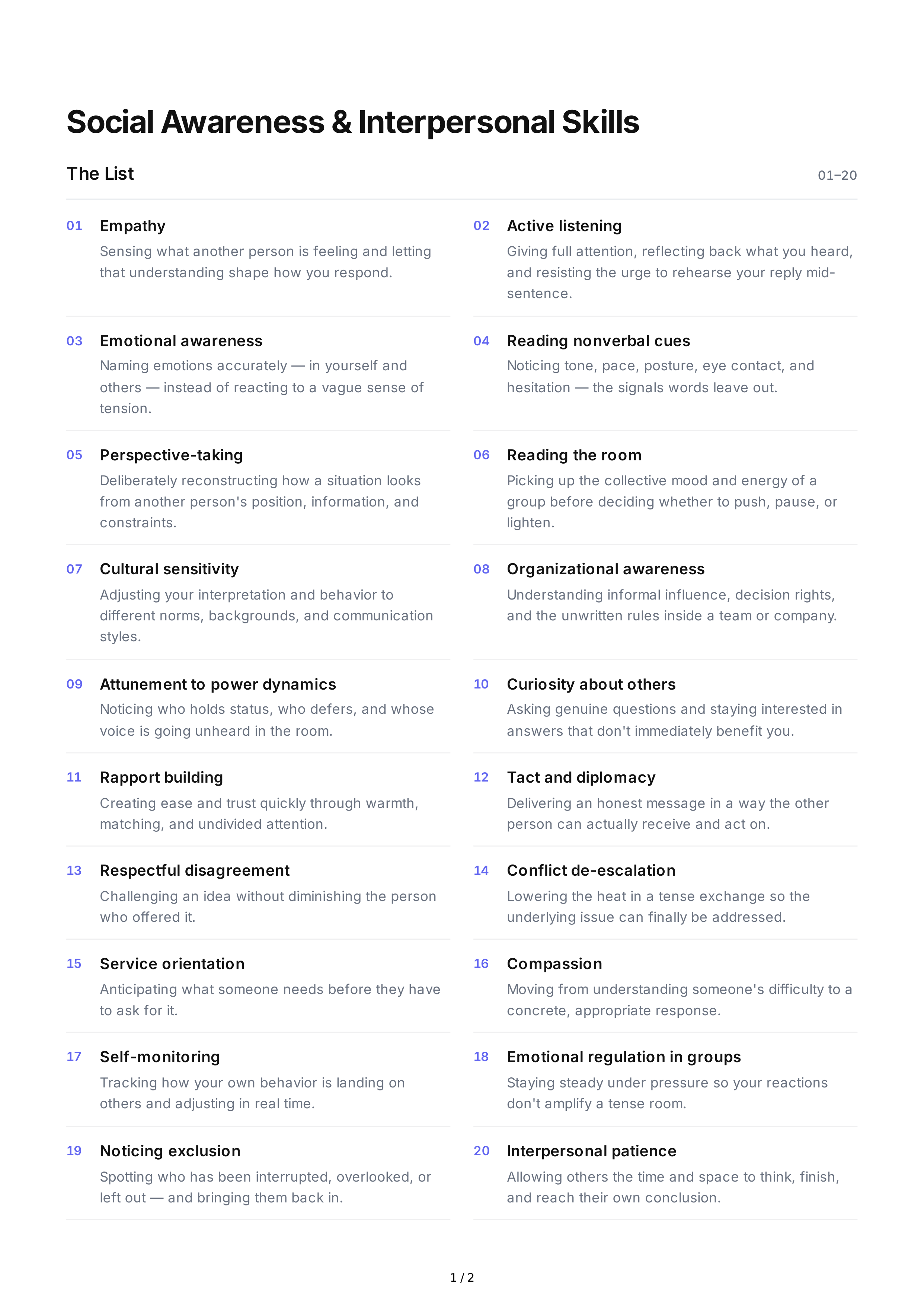
Social
Awareness
&
Interpersonal
Skills
The
List
01–20
01
Empathy
Sensing
what
another
person
is
feeling
and
letting
that
understanding
shape
how
you
respond
.
02
Active
listening
Giving
full
attention
,
reflecting
back
what
you
heard
,
and
resisting
the
urge
to
rehearse
your
reply
mid
-
sentence
.
03
Emotional
awareness
Naming
emotions
accurately
—
in
yourself
and
others
—
instead
of
reacting
to
a
vague
sense
of
tension
.
04
Reading
nonverbal
cues
Noticing
tone
,
pace
,
posture
,
eye
contact
,
and
hesitation
—
the
signals
words
leave
out
.
05
Perspective
-
taking
Deliberately
reconstructing
how
a
situation
looks
from
another
person
'
s
position
,
information
,
and
constraints
.
06
Reading
the
room
Picking
up
the
collective
mood
and
energy
of
a
group
before
deciding
whether
to
push
,
pause
,
or
lighten
.
07
Cultural
sensitivity
Adjusting
your
interpretation
and
behavior
to
different
norms
,
backgrounds
,
and
communication
styles
.
08
Organizational
awareness
Understanding
informal
influence
,
decision
rights
,
and
the
unwritten
rules
inside
a
team
or
company
.
09
Attunement
to
power
dynamics
Noticing
who
holds
status
,
who
defers
,
and
whose
voice
is
going
unheard
in
the
room
.
10
Curiosity
about
others
Asking
genuine
questions
and
staying
interested
in
answers
that
don
'
t
immediately
benefit
you
.
11
Rapport
building
Creating
ease
and
trust
quickly
through
warmth
,
matching
,
and
undivided
attention
.
12
Tact
and
diplomacy
Delivering
an
honest
message
in
a
way
the
other
person
can
actually
receive
and
act
on
.
13
Respectful
disagreement
Challenging
an
idea
without
diminishing
the
person
who
offered
it
.
14
Conflict
de
-
escalation
Lowering
the
heat
in
a
tense
exchange
so
the
underlying
issue
can
finally
be
addressed
.
15
Service
orientation
Anticipating
what
someone
needs
before
they
have
to
ask
for
it
.
16
Compassion
Moving
from
understanding
someone
'
s
difficulty
to
a
concrete
,
appropriate
response
.
17
Self
-
monitoring
Tracking
how
your
own
behavior
is
landing
on
others
and
adjusting
in
real
time
.
18
Emotional
regulation
in
groups
Staying
steady
under
pressure
so
your
reactions
don
'
t
amplify
a
tense
room
.
19
Noticing
exclusion
Spotting
who
has
been
interrupted
,
overlooked
,
or
left
out
—
and
bringing
them
back
in
.
20
Interpersonal
patience
Allowing
others
the
time
and
space
to
think
,
finish
,
and
reach
their
own
conclusion
.
1 / 2