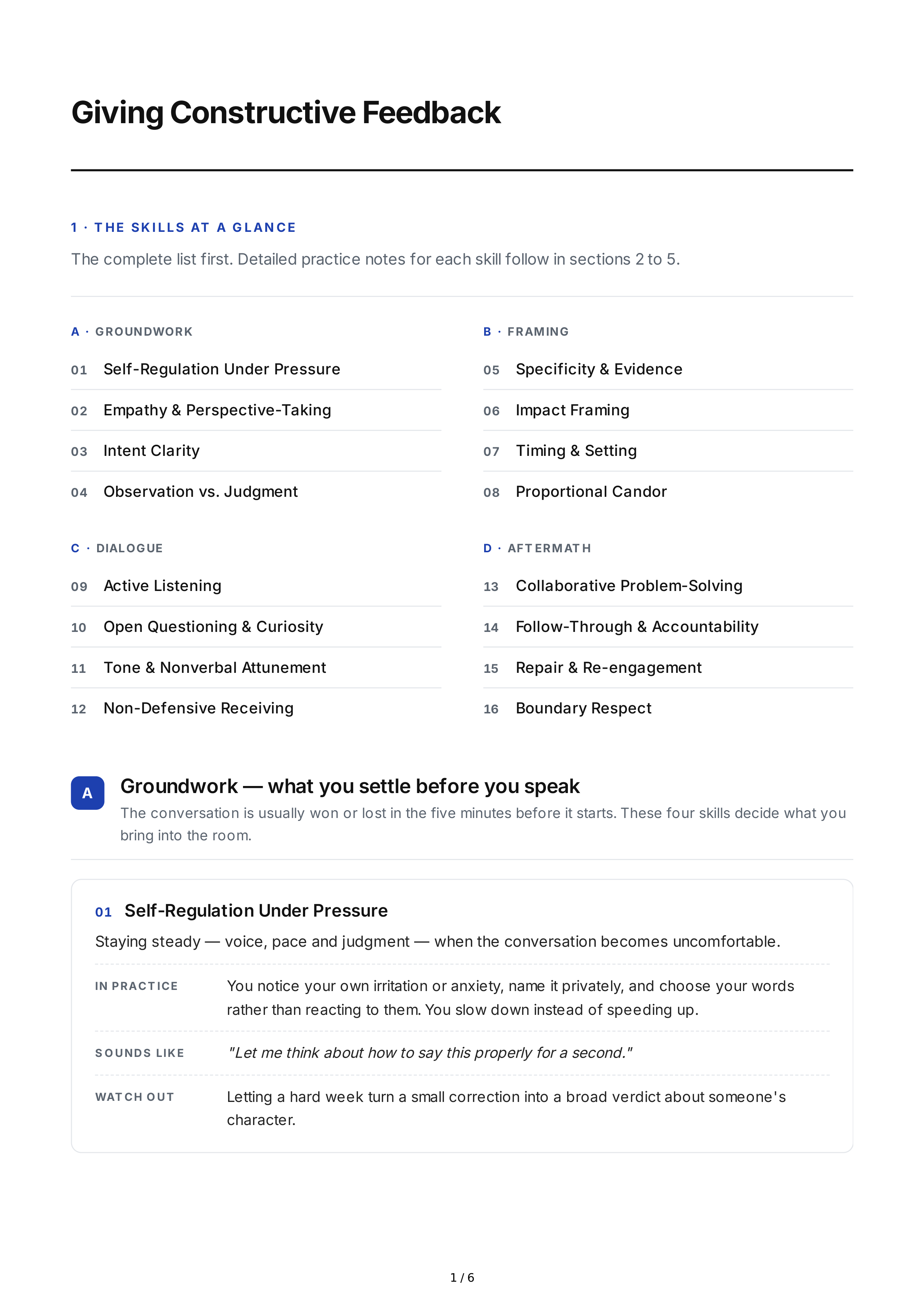
Giving
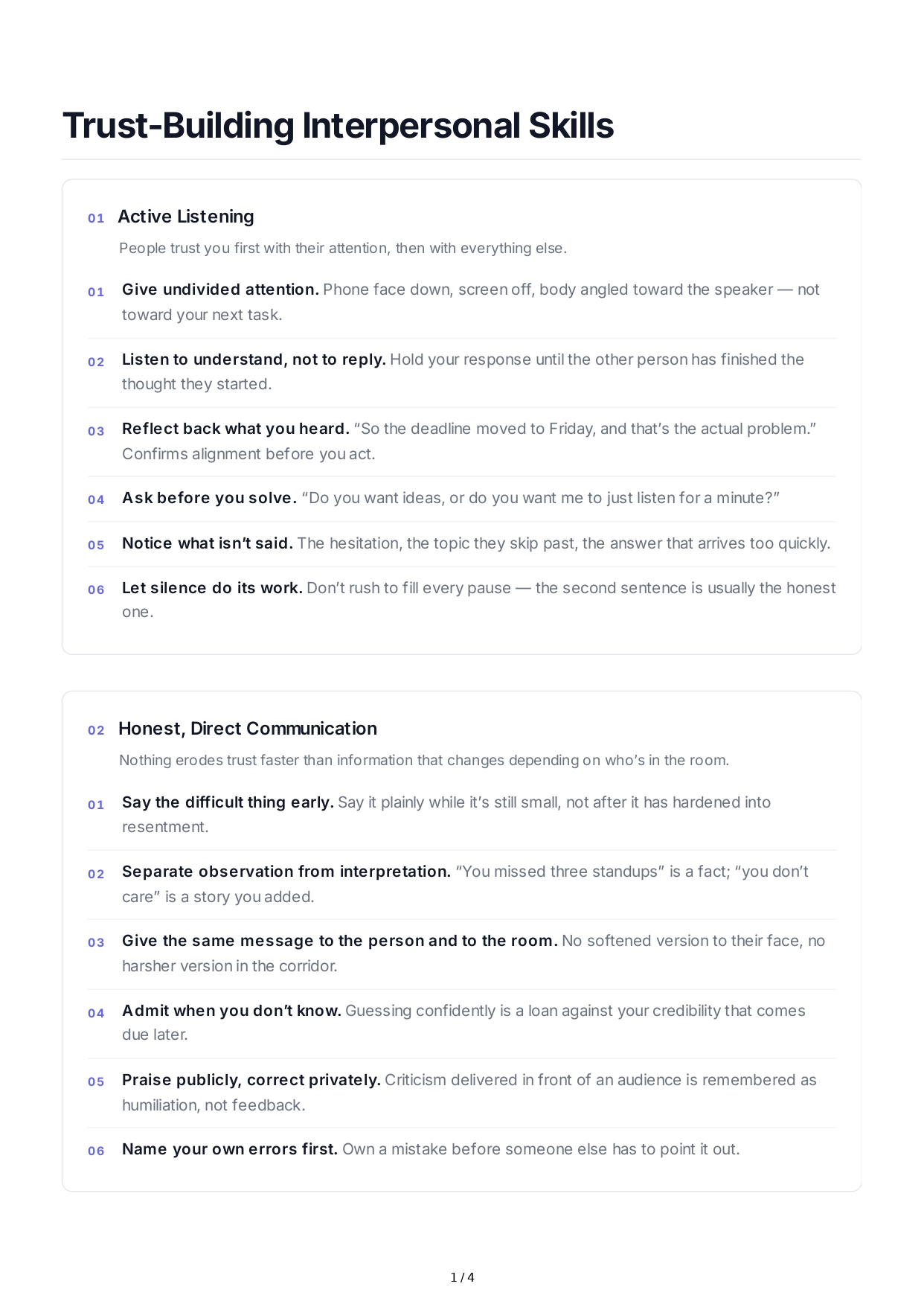
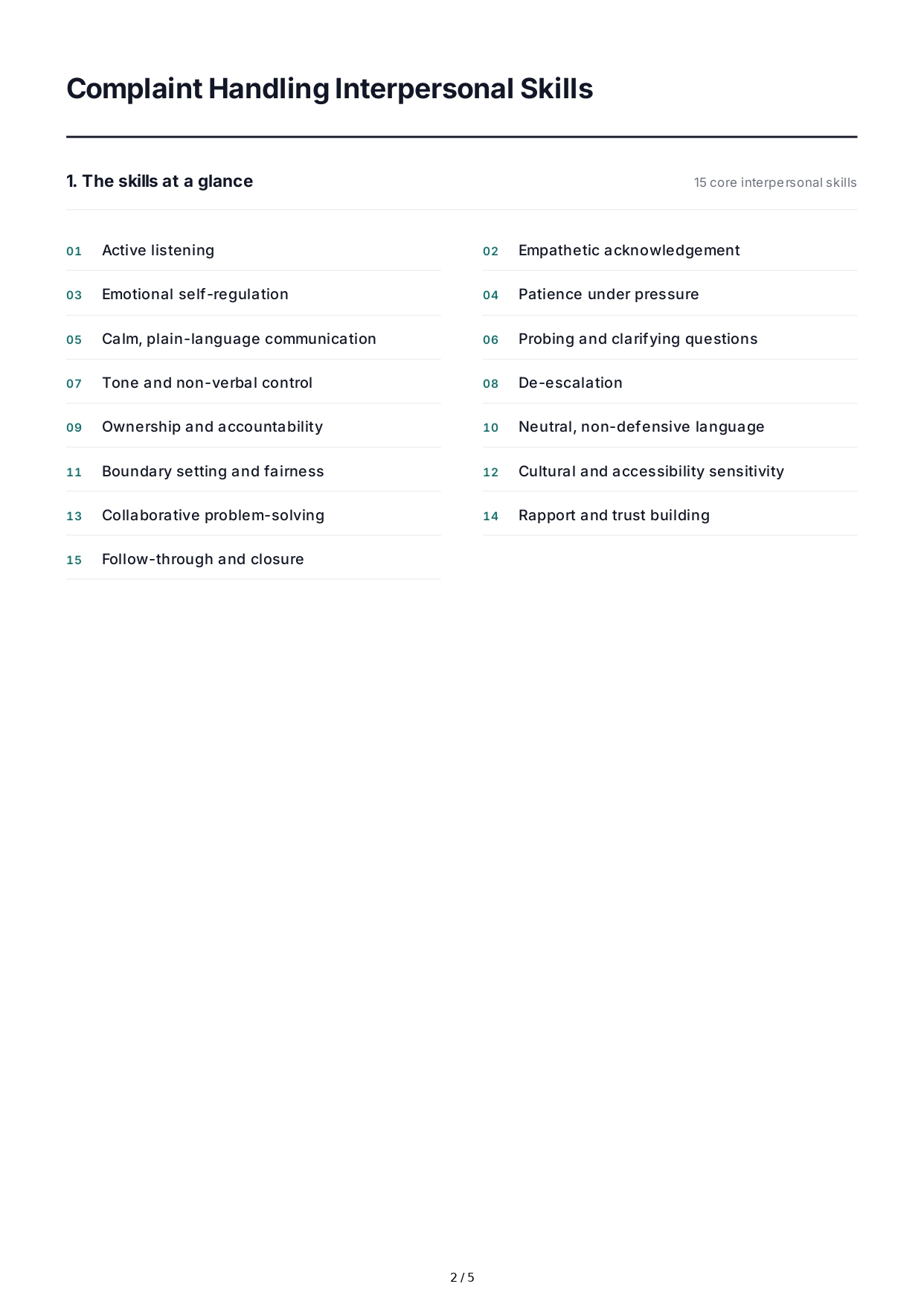
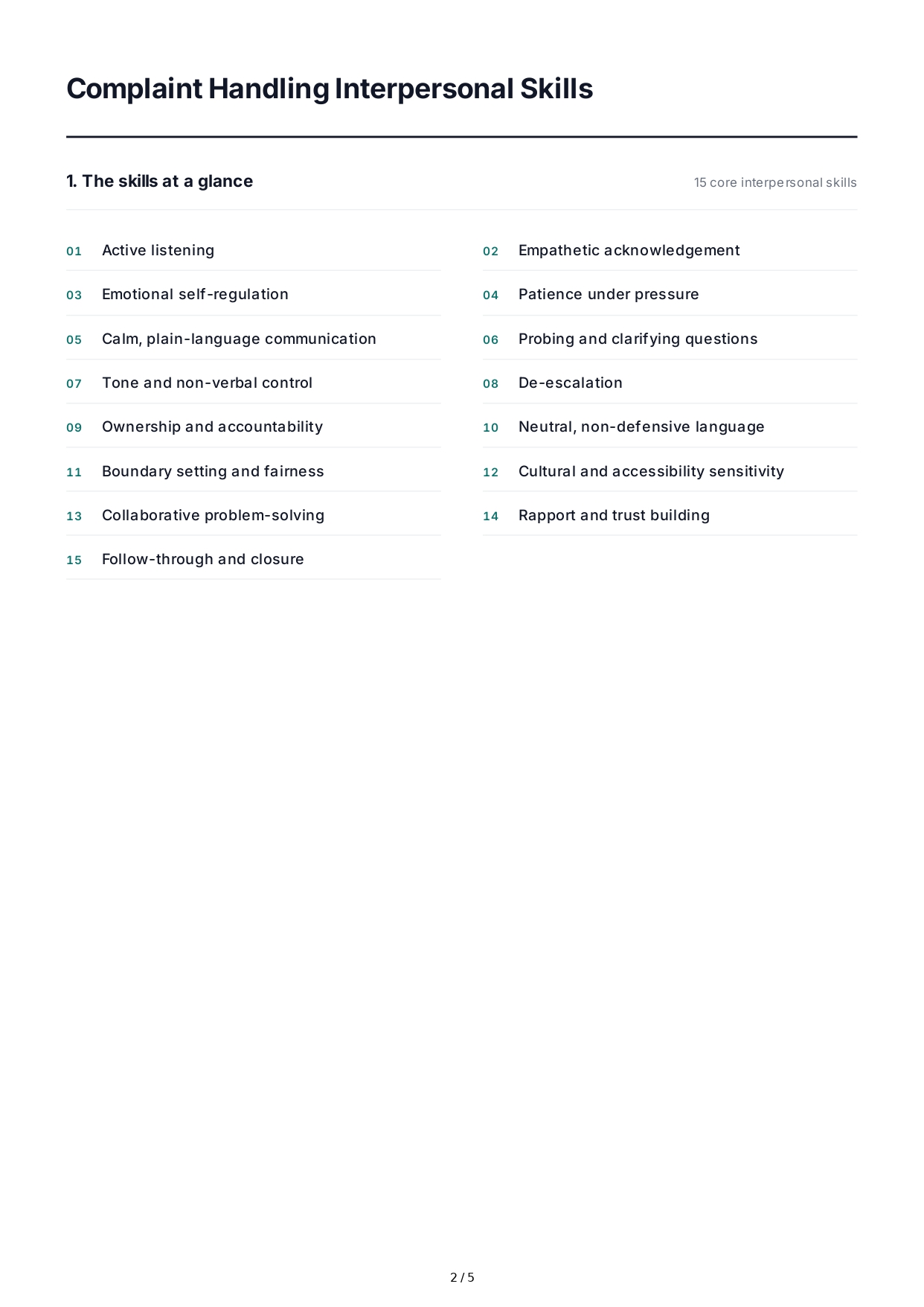
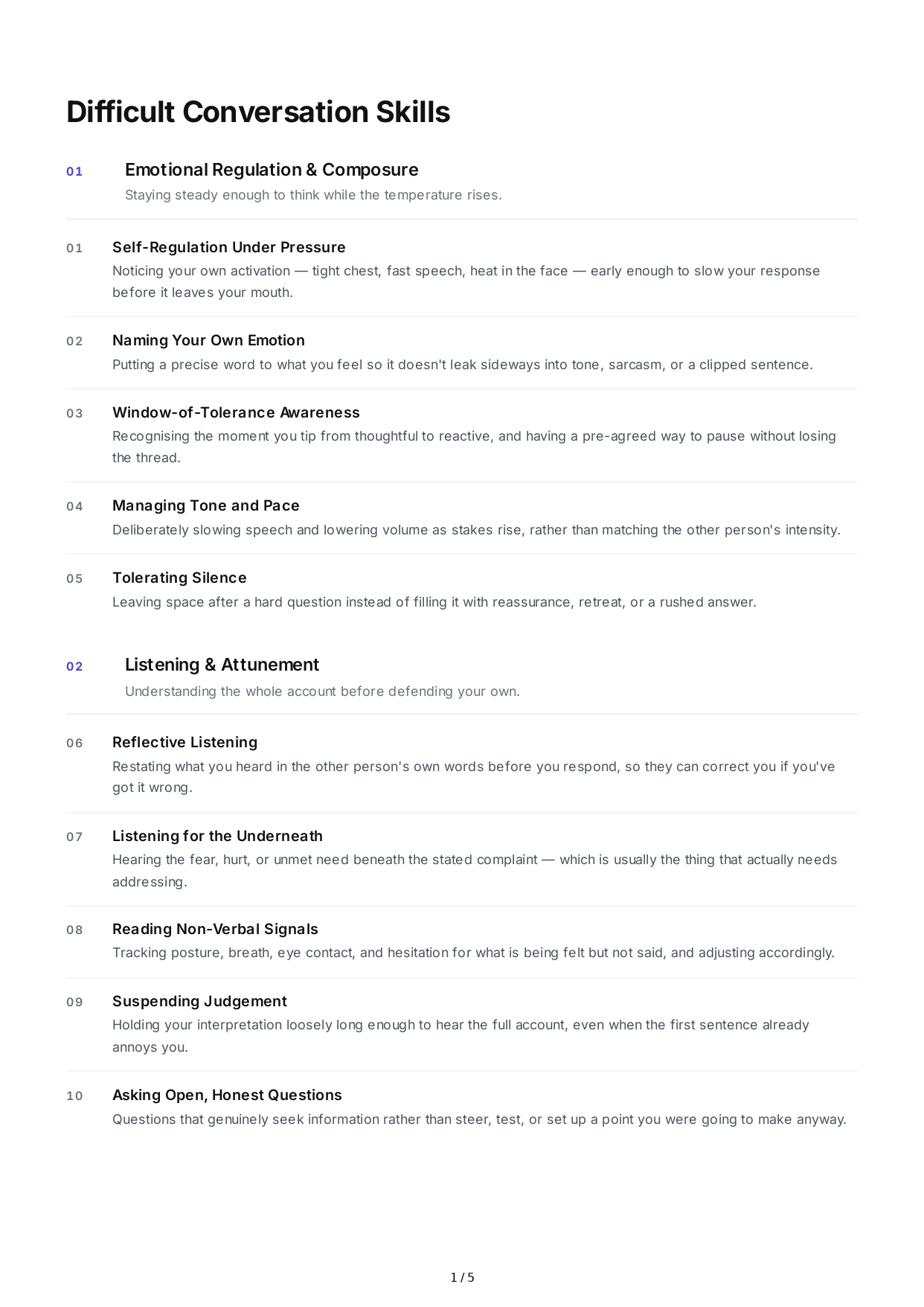
Constructive
Feedback
1 ·
T HE
SK I LLS
AT
A
G LAN CE
The
complete
list
first
.
Detailed
practice
notes
for
each
skill
follow
in
sections
2
to
5.
A
·
GROUNDWORK
01
Self
-
Regulation
Under
Pressure
02
Empathy
&
Perspective
-
Taking
03
Intent
Clarity
04
Observation
vs
.
Judgment
B
·
FRAMING
05
Specificity
&
Evidence
06
Impact
Framing
07
Timing
&
Setting
08
Proportional
Candor
C
·
DIALOGUE
09
Active
Listening
10
Open
Questioning
&
Curiosity
11
Tone
&
Nonverbal
Attunement
12
Non
-
Defensive
Receiving
D
·
AFT ERMAT H
13
Collaborative
Problem
-
Solving
14
Follow
-
Through
&
Accountability
15
Repair
&
Re
-
engagement
16
Boundary
Respect
A
Groundwork
—
what
you
settle
before
you
speak
The
conversation
is
usually
won
or
lost
in
the
five
minutes
before
it
starts
.
These
four
skills
decide
what
you
bring
into
the
room
.
01
Self
-
Regulation
Under
Pressure
Staying
steady
—
voice
,
pace
and
judgment
—
when
the
conversation
becomes
uncomfortable
.
IN
PRACT ICE
You
notice
your
own
irritation
or
anxiety
,
name
it
privately
,
and
choose
your
words
rather
than
reacting
to
them
.
You
slow
down
instead
of
speeding
up
.
S O UNDS
LIKE
"
Let
me
think
about
how
to
say
this
properly
for
a
second
."
WAT CH
O UT
Letting
a
hard
week
turn
a
small
correction
into
a
broad
verdict
about
someone
'
s
character
.
1 / 6
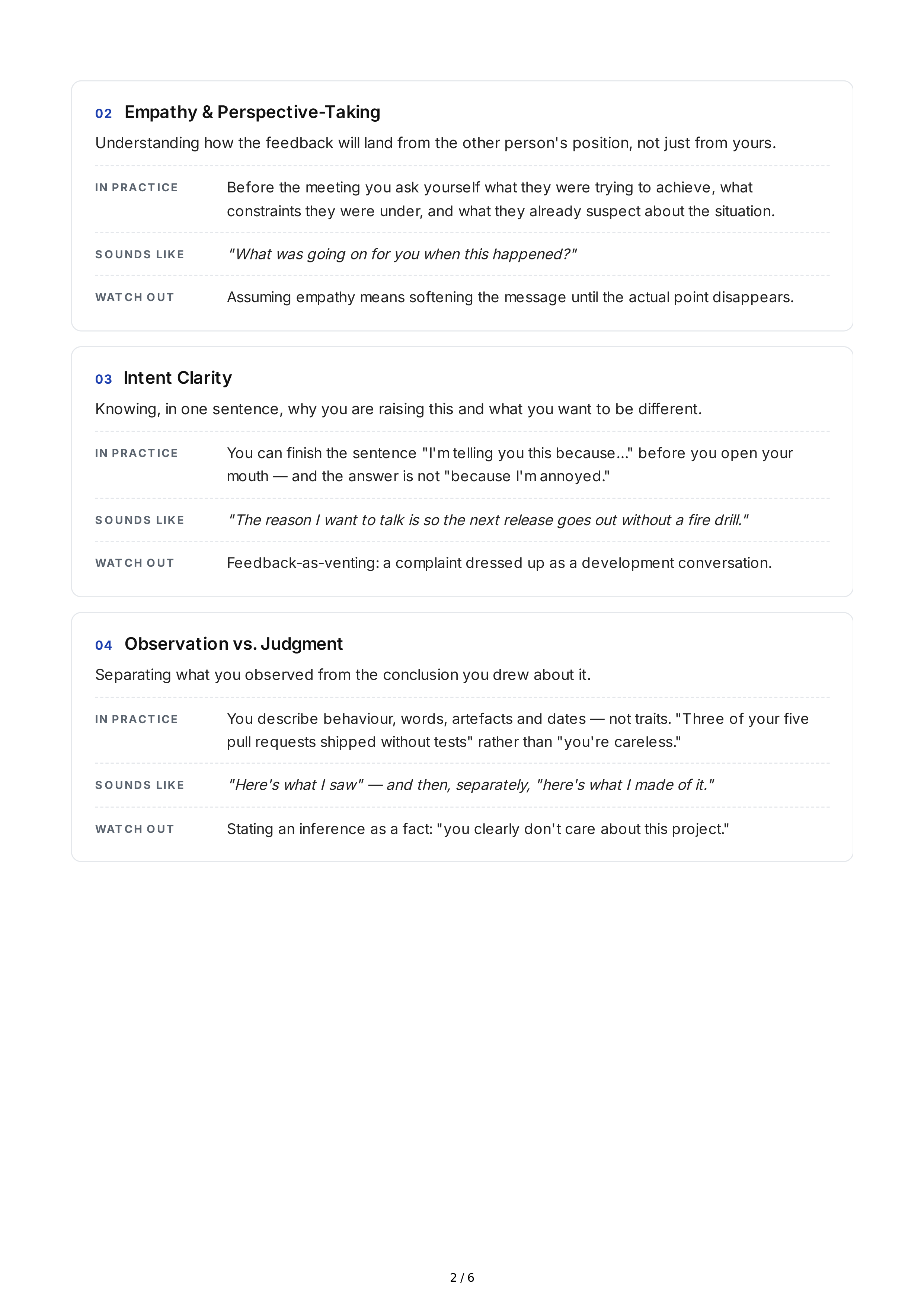
02
Empathy
&
Perspective
-
Taking
Understanding
how
the
feedback
will
land
from
the
other
person
'
s
position
,
not
just
from
yours
.
IN
PRACT ICE
Before
the
meeting
you
ask
yourself
what
they
were
trying
to
achieve
,
what
constraints
they
were
under
,
and
what
they
already
suspect
about
the
situation
.
S O UNDS
LIKE
"
What
was
going
on
for
you
when
this
happened
?"
WAT CH
O UT
Assuming
empathy
means
softening
the
message
until
the
actual
point
disappears
.
03
Intent
Clarity
Knowing
,
in
one
sentence
,
why
you
are
raising
this
and
what
you
want
to
be
different
.
IN
PRACT ICE
You
can
finish
the
sentence
"
I
'
m
telling
you
this
because
…"
before
you
open
your
mouth
—
and
the
answer
is
not
"
because
I
'
m
annoyed
."
S O UNDS
LIKE
"
The
reason
I
want
to
talk
is
so
the
next
release
goes
out
without
a
fire
drill
."
WAT CH
O UT
Feedback
-
as
-
venting
:
a
complaint
dressed
up
as
a
development
conversation
.
04
Observation
vs
.
Judgment
Separating
what
you
observed
from
the
conclusion
you
drew
about
it
.
IN
PRACT ICE
You
describe
behaviour
,
words
,
artefacts
and
dates
—
not
traits
. "
Three
of
your
five
pull
requests
shipped
without
tests
"
rather
than
"
you
'
re
careless
."
S O UNDS
LIKE
"
Here
'
s
what
I
saw
" —
and
then
,
separately
, "
here
'
s
what
I
made
of
it
."
WAT CH
O UT
Stating
an
inference
as
a
fact
: "
you
clearly
don
'
t
care
about
this
project
."
2 / 6
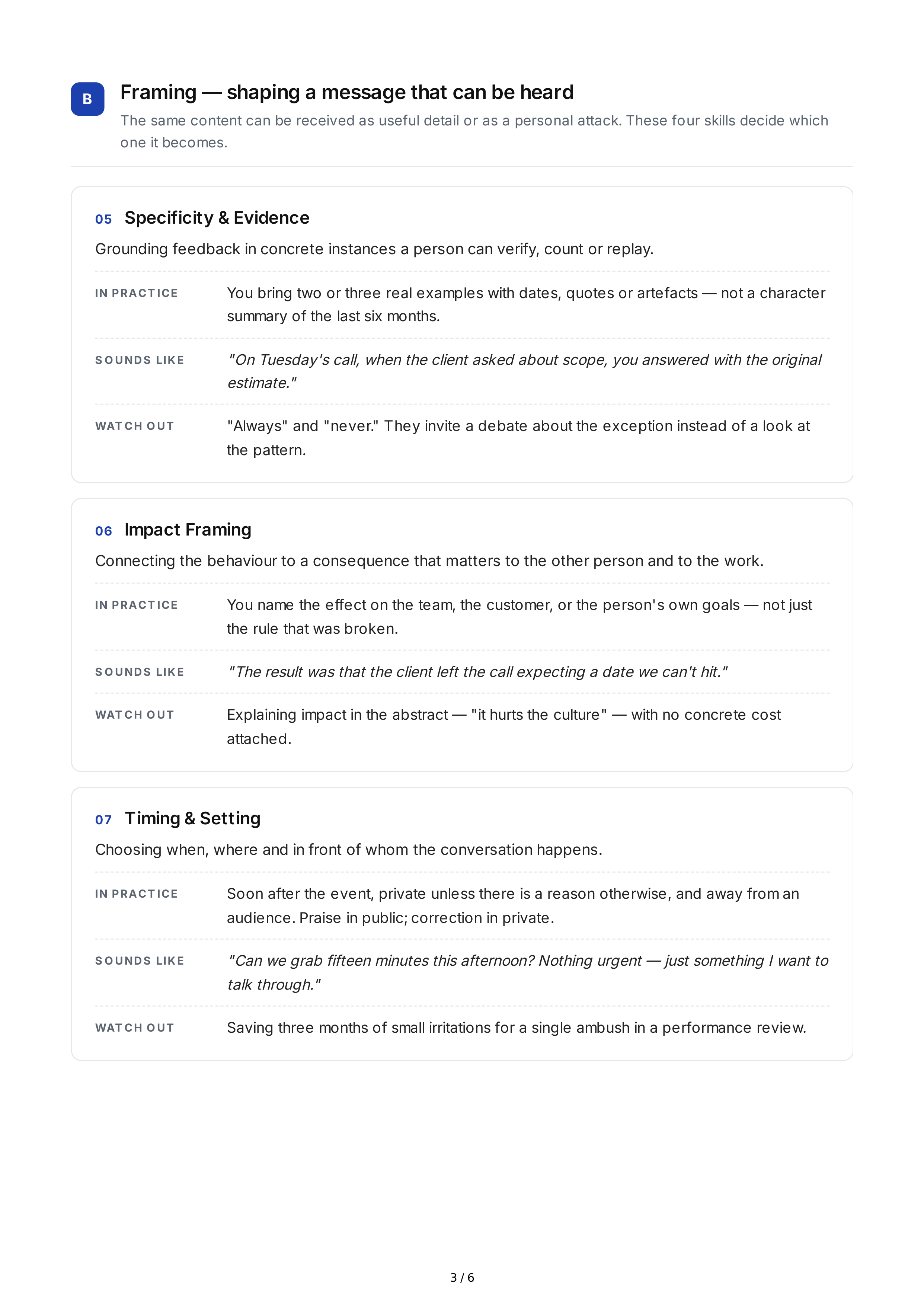
B
Framing
—
shaping
a
message
that
can
be
heard
The
same
content
can
be
received
as
useful
detail
or
as
a
personal
attack
.
These
four
skills
decide
which
one
it
becomes
.
05
Specificity
&
Evidence
Grounding
feedback
in
concrete
instances
a
person
can
verify
,
count
or
replay
.
IN
PRACT ICE
You
bring
two
or
three
real
examples
with
dates
,
quotes
or
artefacts
—
not
a
character
summary
of
the
last
six
months
.
S O UNDS
LIKE
"
On
Tuesday
'
s
call
,
when
the
client
asked
about
scope
,
you
answered
with
the
original
estimate
."
WAT CH
O UT
"
Always
"
and
"
never
."
They
invite
a
debate
about
the
exception
instead
of
a
look
at
the
pattern
.
06
Impact
Framing
Connecting
the
behaviour
to
a
consequence
that
matters
to
the
other
person
and
to
the
work
.
IN
PRACT ICE
You
name
the
effect
on
the
team
,
the
customer
,
or
the
person
'
s
own
goals
—
not
just
the
rule
that
was
broken
.
S O UNDS
LIKE
"
The
result
was
that
the
client
left
the
call
expecting
a
date
we
can
'
t
hit
."
WAT CH
O UT
Explaining
impact
in
the
abstract
— "
it
hurts
the
culture
" —
with
no
concrete
cost
attached
.
07
Timing
&
Setting
Choosing
when
,
where
and
in
front
of
whom
the
conversation
happens
.
IN
PRACT ICE
Soon
after
the
event
,
private
unless
there
is
a
reason
otherwise
,
and
away
from
an
audience
.
Praise
in
public
;
correction
in
private
.
S O UNDS
LIKE
"
Can
we
grab
fifteen
minutes
this
afternoon
?
Nothing
urgent
—
just
something
I
want
to
talk
through
."
WAT CH
O UT
Saving
three
months
of
small
irritations
for
a
single
ambush
in
a
performance
review
.
3 / 6
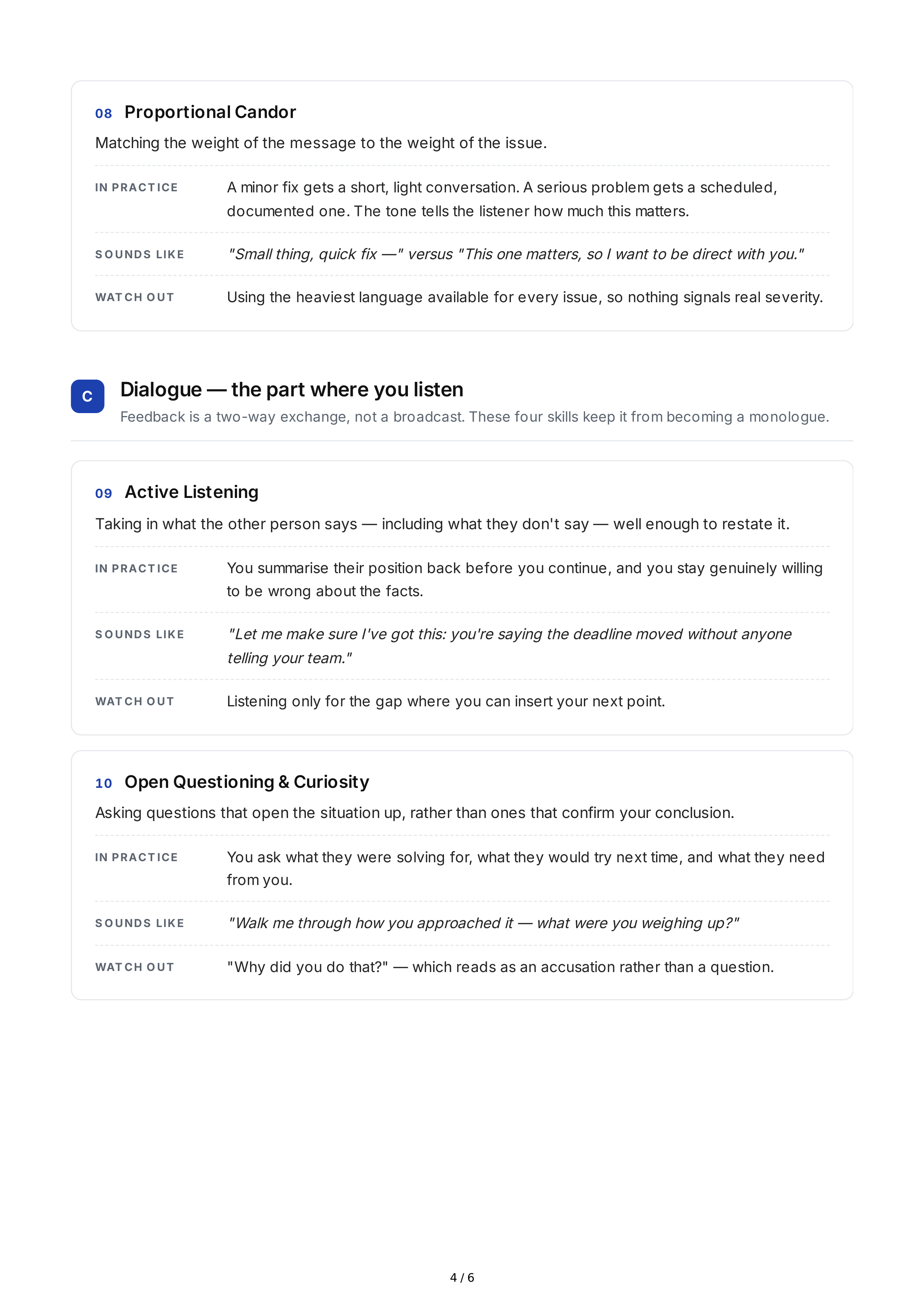
08
Proportional
Candor
Matching
the
weight
of
the
message
to
the
weight
of
the
issue
.
IN
PRACT ICE
A
minor
fix
gets
a
short
,
light
conversation
.
A
serious
problem
gets
a
scheduled
,
documented
one
.
The
tone
tells
the
listener
how
much
this
matters
.
S O UNDS
LIKE
"
Small
thing
,
quick
fix
—"
versus
"
This
one
matters
,
so
I
want
to
be
direct
with
you
."
WAT CH
O UT
Using
the
heaviest
language
available
for
every
issue
,
so
nothing
signals
real
severity
.
C
Dialogue
—
the
part
where
you
listen
Feedback
is
a
two
-
way
exchange
,
not
a
broadcast
.
These
four
skills
keep
it
from
becoming
a
monologue
.
09
Active
Listening
Taking
in
what
the
other
person
says
—
including
what
they
don
'
t
say
—
well
enough
to
restate
it
.
IN
PRACT ICE
You
summarise
their
position
back
before
you
continue
,
and
you
stay
genuinely
willing
to
be
wrong
about
the
facts
.
S O UNDS
LIKE
"
Let
me
make
sure
I
'
ve
got
this
:
you
'
re
saying
the
deadline
moved
without
anyone
telling
your
team
."
WAT CH
O UT
Listening
only
for
the
gap
where
you
can
insert
your
next
point
.
10
Open
Questioning
&
Curiosity
Asking
questions
that
open
the
situation
up
,
rather
than
ones
that
confirm
your
conclusion
.
IN
PRACT ICE
You
ask
what
they
were
solving
for
,
what
they
would
try
next
time
,
and
what
they
need
from
you
.
S O UNDS
LIKE
"
Walk
me
through
how
you
approached
it
—
what
were
you
weighing
up
?"
WAT CH
O UT
"
Why
did
you
do
that
?" —
which
reads
as
an
accusation
rather
than
a
question
.
4 / 6
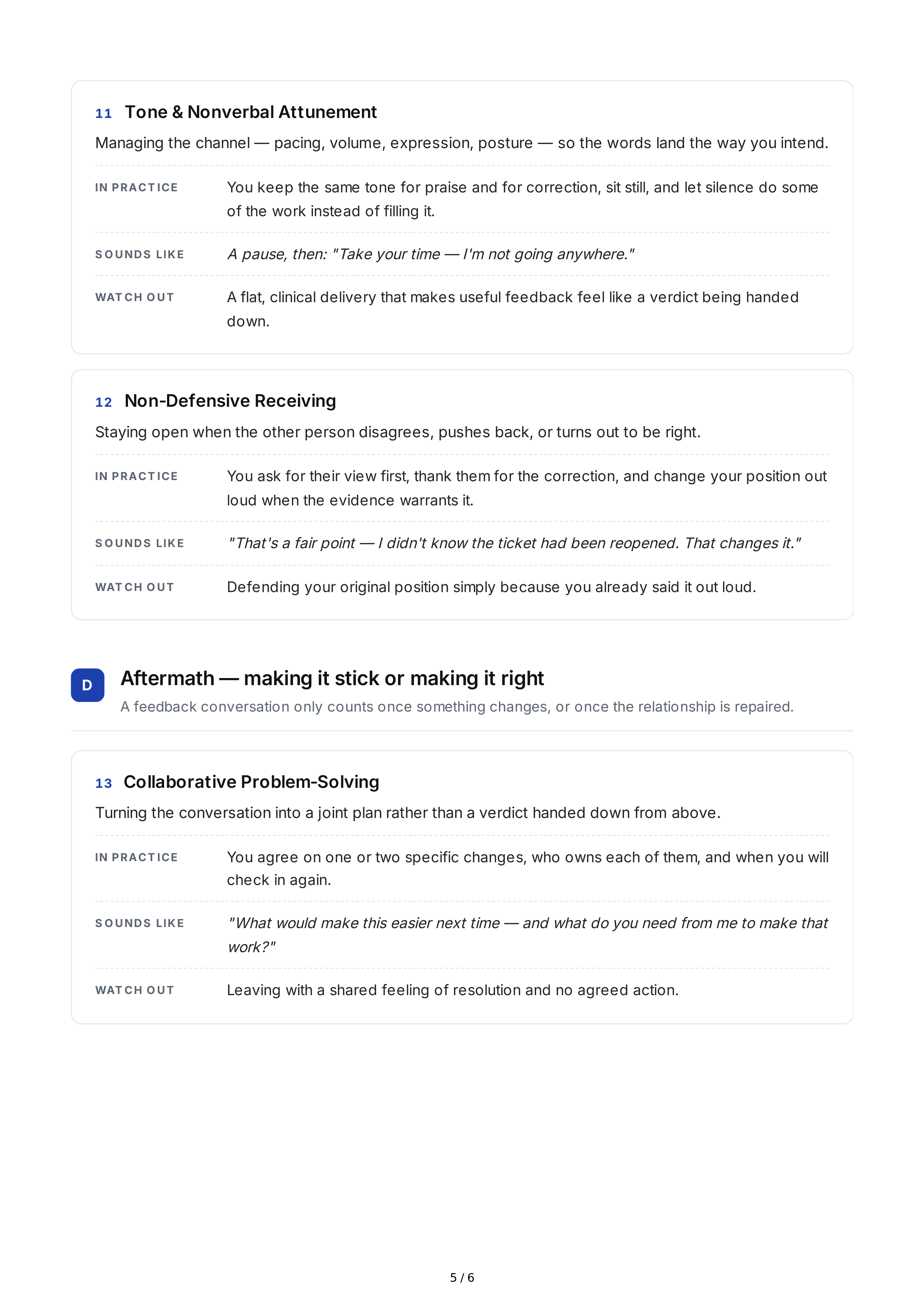
11
Tone
&
Nonverbal
Attunement
Managing
the
channel
—
pacing
,
volume
,
expression
,
posture
—
so
the
words
land
the
way
you
intend
.
IN
PRACT ICE
You
keep
the
same
tone
for
praise
and
for
correction
,
sit
still
,
and
let
silence
do
some
of
the
work
instead
of
filling
it
.
S O UNDS
LIKE
A
pause
,
then
: "
Take
your
time
—
I
'
m
not
going
anywhere
."
WAT CH
O UT
A
flat
,
clinical
delivery
that
makes
useful
feedback
feel
like
a
verdict
being
handed
down
.
12
Non
-
Defensive
Receiving
Staying
open
when
the
other
person
disagrees
,
pushes
back
,
or
turns
out
to
be
right
.
IN
PRACT ICE
You
ask
for
their
view
first
,
thank
them
for
the
correction
,
and
change
your
position
out
loud
when
the
evidence
warrants
it
.
S O UNDS
LIKE
"
That
'
s
a
fair
point
—
I
didn
'
t
know
the
ticket
had
been
reopened
.
That
changes
it
."
WAT CH
O UT
Defending
your
original
position
simply
because
you
already
said
it
out
loud
.
D
Aftermath
—
making
it
stick
or
making
it
right
A
feedback
conversation
only
counts
once
something
changes
,
or
once
the
relationship
is
repaired
.
13
Collaborative
Problem
-
Solving
Turning
the
conversation
into
a
joint
plan
rather
than
a
verdict
handed
down
from
above
.
IN
PRACT ICE
You
agree
on
one
or
two
specific
changes
,
who
owns
each
of
them
,
and
when
you
will
check
in
again
.
S O UNDS
LIKE
"
What
would
make
this
easier
next
time
—
and
what
do
you
need
from
me
to
make
that
work
?"
WAT CH
O UT
Leaving
with
a
shared
feeling
of
resolution
and
no
agreed
action
.
5 / 6
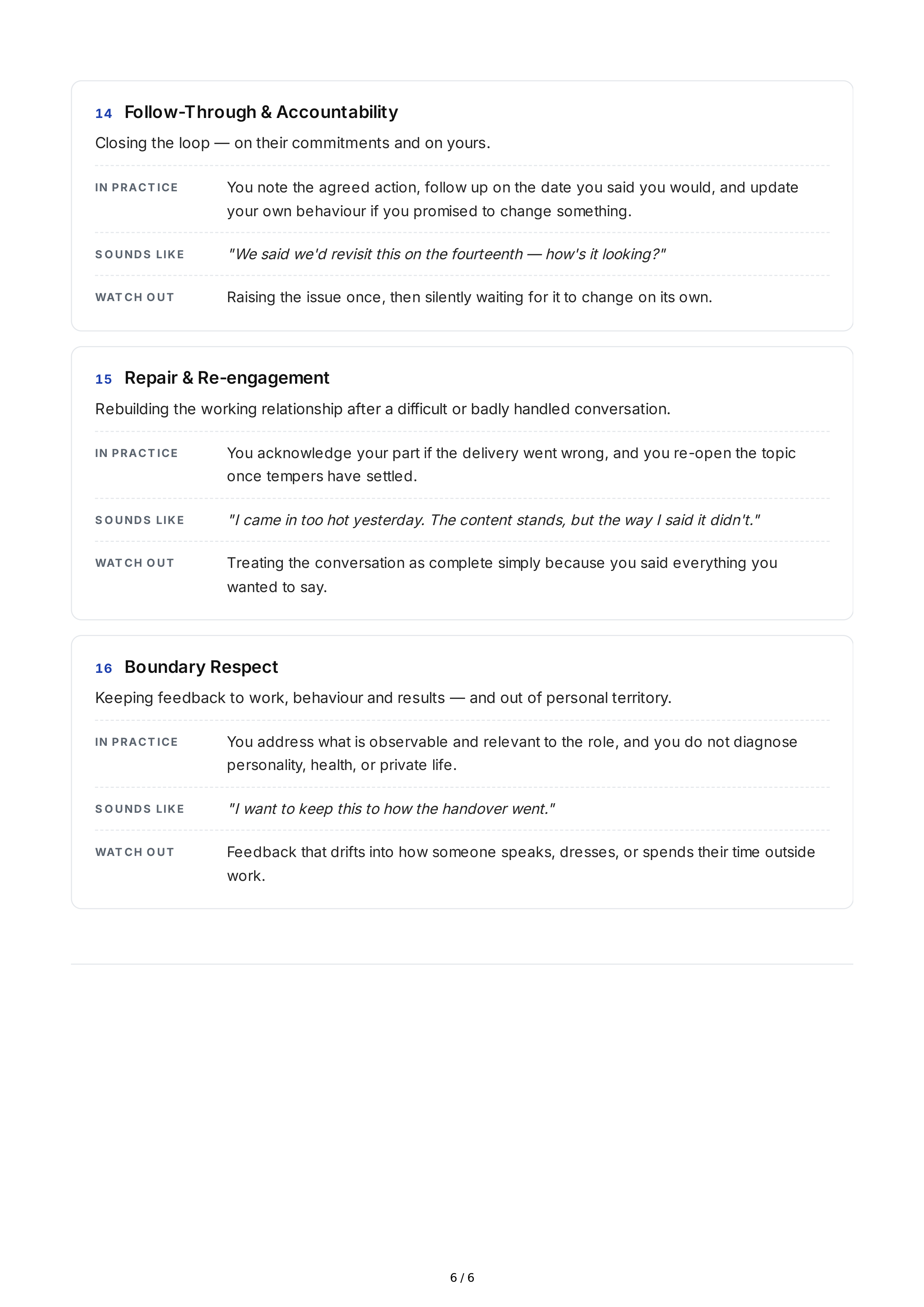
14
Follow
-
Through
&
Accountability
Closing
the
loop
—
on
their
commitments
and
on
yours
.
IN
PRACT ICE
You
note
the
agreed
action
,
follow
up
on
the
date
you
said
you
would
,
and
update
your
own
behaviour
if
you
promised
to
change
something
.
S O UNDS
LIKE
"
We
said
we
'
d
revisit
this
on
the
fourteenth
—
how
'
s
it
looking
?"
WAT CH
O UT
Raising
the
issue
once
,
then
silently
waiting
for
it
to
change
on
its
own
.
15
Repair
&
Re
-
engagement
Rebuilding
the
working
relationship
after
a
difficult
or
badly
handled
conversation
.
IN
PRACT ICE
You
acknowledge
your
part
if
the
delivery
went
wrong
,
and
you
re
-
open
the
topic
once
tempers
have
settled
.
S O UNDS
LIKE
"
I
came
in
too
hot
yesterday
.
The
content
stands
,
but
the
way
I
said
it
didn
'
t
."
WAT CH
O UT
Treating
the
conversation
as
complete
simply
because
you
said
everything
you
wanted
to
say
.
16
Boundary
Respect
Keeping
feedback
to
work
,
behaviour
and
results
—
and
out
of
personal
territory
.
IN
PRACT ICE
You
address
what
is
observable
and
relevant
to
the
role
,
and
you
do
not
diagnose
personality
,
health
,
or
private
life
.
S O UNDS
LIKE
"
I
want
to
keep
this
to
how
the
handover
went
."
WAT CH
O UT
Feedback
that
drifts
into
how
someone
speaks
,
dresses
,
or
spends
their
time
outside
work
.
6 / 6