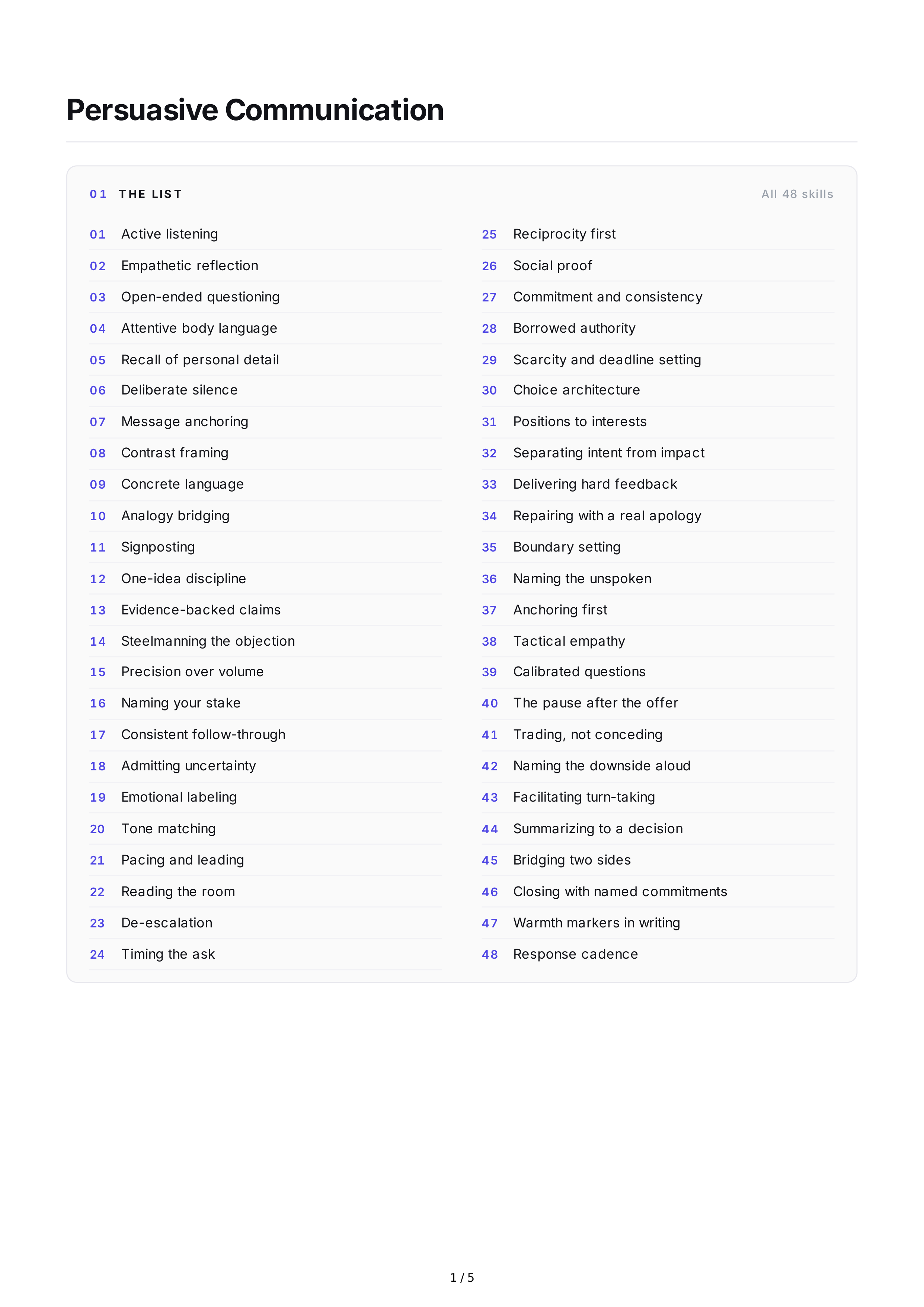
Persuasive
Communication
0 1
T HE
LIS T
All
48
skills
01
Active
listening
02
Empathetic
reflection
03
Open
-
ended
questioning
04
Attentive
body
language
05
Recall
of
personal
detail
06
Deliberate
silence
07
Message
anchoring
08
Contrast
framing
09
Concrete
language
10
Analogy
bridging
11
Signposting
12
One
-
idea
discipline
13
Evidence
-
backed
claims
14
Steelmanning
the
objection
15
Precision
over
volume
16
Naming
your
stake
17
Consistent
follow
-
through
18
Admitting
uncertainty
19
Emotional
labeling
20
Tone
matching
21
Pacing
and
leading
22
Reading
the
room
23
De
-
escalation
24
Timing
the
ask
25
Reciprocity
first
26
Social
proof
27
Commitment
and
consistency
28
Borrowed
authority
29
Scarcity
and
deadline
setting
30
Choice
architecture
31
Positions
to
interests
32
Separating
intent
from
impact
33
Delivering
hard
feedback
34
Repairing
with
a
real
apology
35
Boundary
setting
36
Naming
the
unspoken
37
Anchoring
first
38
Tactical
empathy
39
Calibrated
questions
40
The
pause
after
the
offer
41
Trading
,
not
conceding
42
Naming
the
downside
aloud
43
Facilitating
turn
-
taking
44
Summarizing
to
a
decision
45
Bridging
two
sides
46
Closing
with
named
commitments
47
Warmth
markers
in
writing
48
Response
cadence
1 / 5
0 2
T HE
LIS T
,
IN
PRACT ICE
One
line
per
skill
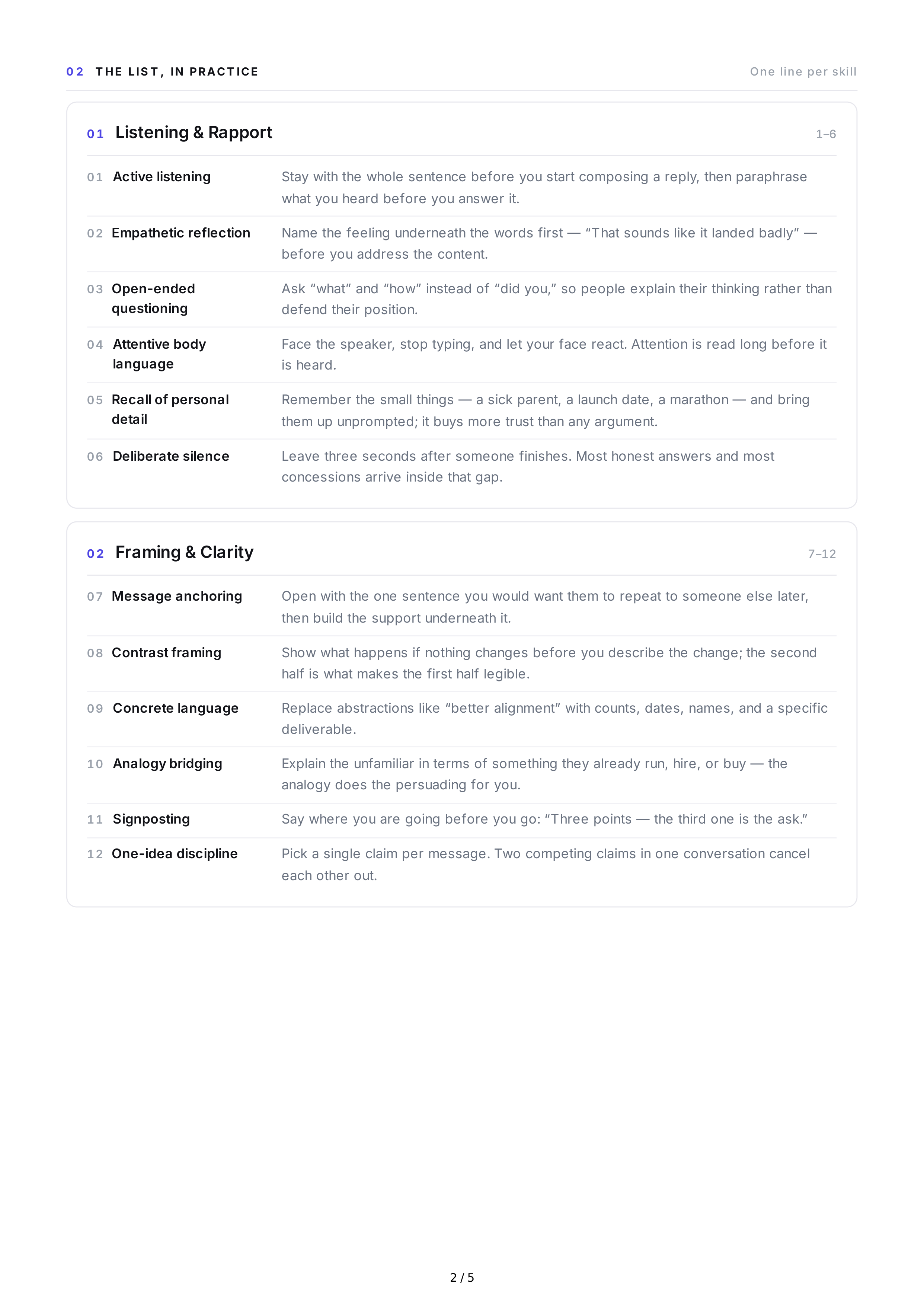
0 1
Listening
&
Rapport
1–6
01
Active
listening
Stay
with
the
whole
sentence
before
you
start
composing
a
reply
,
then
paraphrase
what
you
heard
before
you
answer
it
.
02
Empathetic
reflection
Name
the
feeling
underneath
the
words
first
— “
That
sounds
like
it
landed
badly
” —
before
you
address
the
content
.
03
Open
-
ended
questioning
Ask
“
what
”
and
“
how
”
instead
of
“
did
you
,”
so
people
explain
their
thinking
rather
than
defend
their
position
.
04
Attentive
body
language
Face
the
speaker
,
stop
typing
,
and
let
your
face
react
.
Attention
is
read
long
before
it
is
heard
.
05
Recall
of
personal
detail
Remember
the
small
things
—
a
sick
parent
,
a
launch
date
,
a
marathon
—
and
bring
them
up
unprompted
;
it
buys
more
trust
than
any
argument
.
06
Deliberate
silence
Leave
three
seconds
after
someone
finishes
.
Most
honest
answers
and
most
concessions
arrive
inside
that
gap
.
0 2
Framing
&
Clarity
7–12
07
Message
anchoring
Open
with
the
one
sentence
you
would
want
them
to
repeat
to
someone
else
later
,
then
build
the
support
underneath
it
.
08
Contrast
framing
Show
what
happens
if
nothing
changes
before
you
describe
the
change
;
the
second
half
is
what
makes
the
first
half
legible
.
09
Concrete
language
Replace
abstractions
like
“
better
alignment
”
with
counts
,
dates
,
names
,
and
a
specific
deliverable
.
10
Analogy
bridging
Explain
the
unfamiliar
in
terms
of
something
they
already
run
,
hire
,
or
buy
—
the
analogy
does
the
persuading
for
you
.
11
Signposting
Say
where
you
are
going
before
you
go
: “
Three
points
—
the
third
one
is
the
ask
.”
12
One
-
idea
discipline
Pick
a
single
claim
per
message
.
Two
competing
claims
in
one
conversation
cancel
each
other
out
.
2 / 5
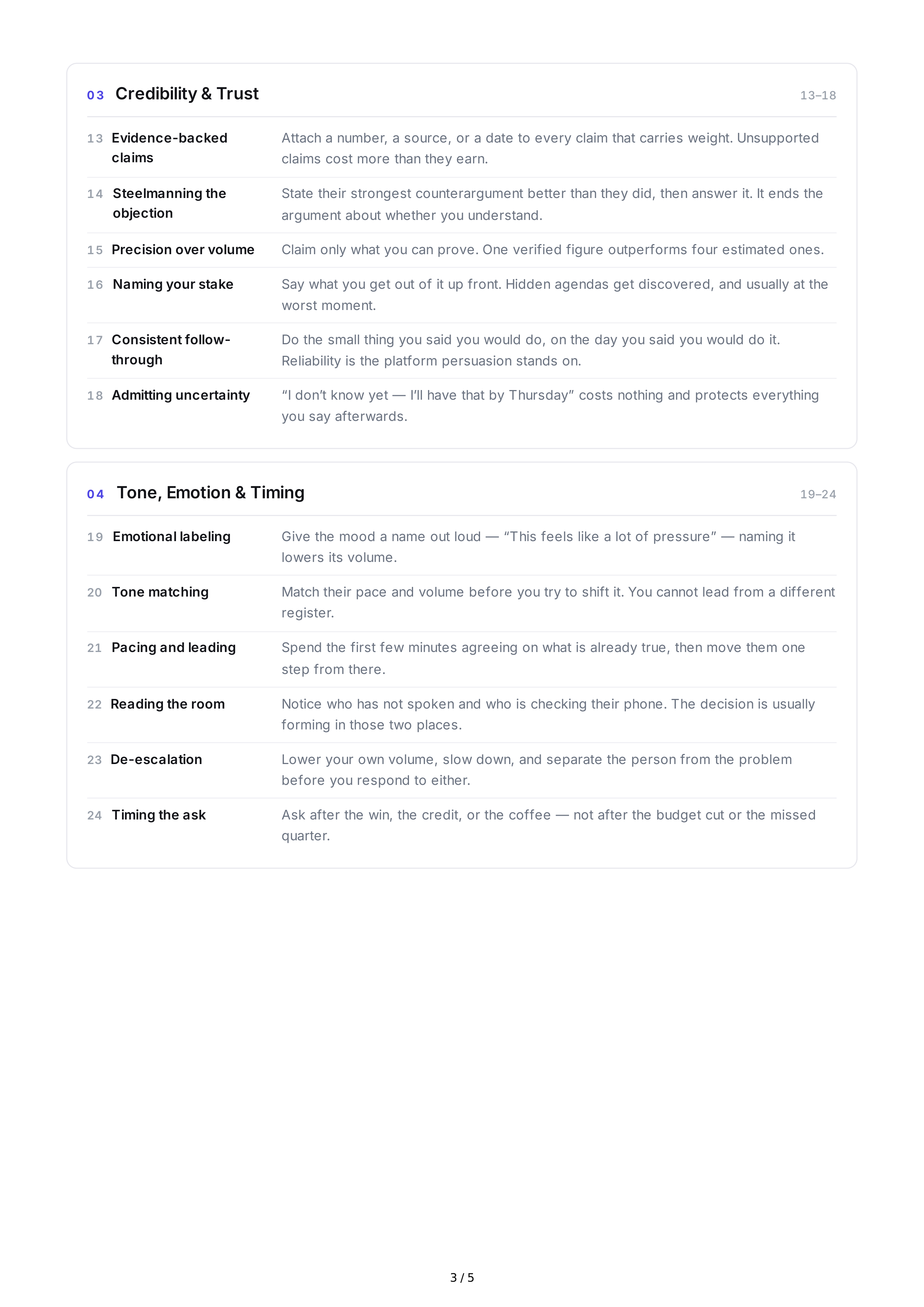
0 3
Credibility
&
Trust
13–18
13
Evidence
-
backed
claims
Attach
a
number
,
a
source
,
or
a
date
to
every
claim
that
carries
weight
.
Unsupported
claims
cost
more
than
they
earn
.
14
Steelmanning
the
objection
State
their
strongest
counterargument
better
than
they
did
,
then
answer
it
.
It
ends
the
argument
about
whether
you
understand
.
15
Precision
over
volume
Claim
only
what
you
can
prove
.
One
verified
figure
outperforms
four
estimated
ones
.
16
Naming
your
stake
Say
what
you
get
out
of
it
up
front
.
Hidden
agendas
get
discovered
,
and
usually
at
the
worst
moment
.
17
Consistent
follow
-
through
Do
the
small
thing
you
said
you
would
do
,
on
the
day
you
said
you
would
do
it
.
Reliability
is
the
platform
persuasion
stands
on
.
18
Admitting
uncertainty
“
I
don
’
t
know
yet
—
I
’
ll
have
that
by
Thursday
”
costs
nothing
and
protects
everything
you
say
afterwards
.
0 4
Tone
,
Emotion
&
Timing
19–24
19
Emotional
labeling
Give
the
mood
a
name
out
loud
— “
This
feels
like
a
lot
of
pressure
” —
naming
it
lowers
its
volume
.
20
Tone
matching
Match
their
pace
and
volume
before
you
try
to
shift
it
.
You
cannot
lead
from
a
different
register
.
21
Pacing
and
leading
Spend
the
first
few
minutes
agreeing
on
what
is
already
true
,
then
move
them
one
step
from
there
.
22
Reading
the
room
Notice
who
has
not
spoken
and
who
is
checking
their
phone
.
The
decision
is
usually
forming
in
those
two
places
.
23
De
-
escalation
Lower
your
own
volume
,
slow
down
,
and
separate
the
person
from
the
problem
before
you
respond
to
either
.
24
Timing
the
ask
Ask
after
the
win
,
the
credit
,
or
the
coffee
—
not
after
the
budget
cut
or
the
missed
quarter
.
3 / 5
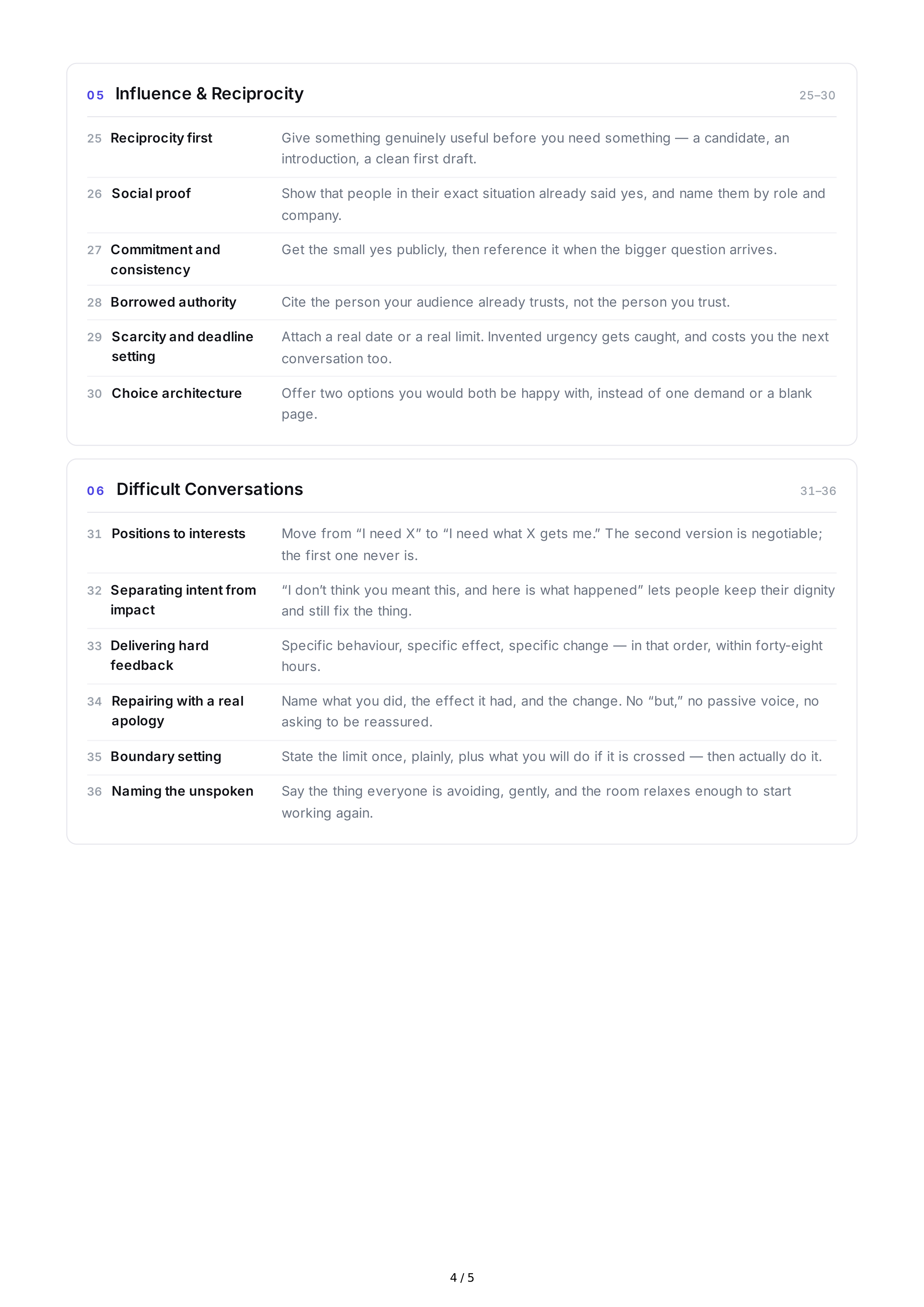
0 5
Influence
&
Reciprocity
25–30
25
Reciprocity
first
Give
something
genuinely
useful
before
you
need
something
—
a
candidate
,
an
introduction
,
a
clean
first
draft
.
26
Social
proof
Show
that
people
in
their
exact
situation
already
said
yes
,
and
name
them
by
role
and
company
.
27
Commitment
and
consistency
Get
the
small
yes
publicly
,
then
reference
it
when
the
bigger
question
arrives
.
28
Borrowed
authority
Cite
the
person
your
audience
already
trusts
,
not
the
person
you
trust
.
29
Scarcity
and
deadline
setting
Attach
a
real
date
or
a
real
limit
.
Invented
urgency
gets
caught
,
and
costs
you
the
next
conversation
too
.
30
Choice
architecture
Offer
two
options
you
would
both
be
happy
with
,
instead
of
one
demand
or
a
blank
page
.
0 6
Difficult
Conversations
31–36
31
Positions
to
interests
Move
from
“
I
need
X
”
to
“
I
need
what
X
gets
me
.”
The
second
version
is
negotiable
;
the
first
one
never
is
.
32
Separating
intent
from
impact
“
I
don
’
t
think
you
meant
this
,
and
here
is
what
happened
”
lets
people
keep
their
dignity
and
still
fix
the
thing
.
33
Delivering
hard
feedback
Specific
behaviour
,
specific
effect
,
specific
change
—
in
that
order
,
within
forty
-
eight
hours
.
34
Repairing
with
a
real
apology
Name
what
you
did
,
the
effect
it
had
,
and
the
change
.
No
“
but
,”
no
passive
voice
,
no
asking
to
be
reassured
.
35
Boundary
setting
State
the
limit
once
,
plainly
,
plus
what
you
will
do
if
it
is
crossed
—
then
actually
do
it
.
36
Naming
the
unspoken
Say
the
thing
everyone
is
avoiding
,
gently
,
and
the
room
relaxes
enough
to
start
working
again
.
4 / 5
0 7
Negotiation
Edge
37–42
37
Anchoring
first
Put
a
specific
,
defensible
number
on
the
table
early
.
The
first
credible
figure
shapes
the
whole
range
.
38
Tactical
empathy
Understand
their
constraints
out
loud
—
headcount
,
a
board
meeting
,
a
school
run
—
before
you
test
them
.
39
Calibrated
questions
Ask
“
How
am
I
supposed
to
do
that
?”
or
“
What
would
have
to
be
true
?”
and
let
them
solve
your
problem
for
you
.
40
The
pause
after
the
offer
Say
your
number
,
then
stop
talking
.
The
next
person
to
speak
is
usually
the
one
who
moves
.
41
Trading
,
not
conceding
Every
concession
gets
a
matching
concession
: “
I
can
move
on
price
if
the
term
moves
to
twenty
-
four
months
.”
42
Naming
the
downside
aloud
Say
the
risk
before
they
find
it
.
It
makes
you
the
honest
party
in
the
room
,
which
is
worth
more
than
the
discount
.
0 8
Meeting
&
Written
Fluency
43–48
43
Facilitating
turn
-
taking
Bring
the
quiet
expert
in
by
name
,
and
cap
the
loudest
voice
with
a
summary
rather
than
a
correction
.
44
Summarizing
to
a
decision
“
So
we
are
agreeing
to
X
by
Friday
,
and
Y
stays
open
”
turns
an
hour
of
talk
into
a
resolution
.
45
Bridging
two
sides
Restate
each
side
’
s
strongest
point
in
the
other
side
’
s
language
until
one
of
them
nods
.
46
Closing
with
named
commitments
End
every
meeting
with
who
does
what
by
when
,
said
out
loud
,
with
everyone
still
in
the
room
.
47
Warmth
markers
in
writing
One
human
sentence
at
the
top
of
the
email
—
no
exclamation
inflation
,
just
a
person
writing
to
a
person
.
48
Response
cadence
Reply
at
a
predictable
speed
you
can
keep
for
years
.
Erratic
responsiveness
reads
as
indifference
.
5 / 5
