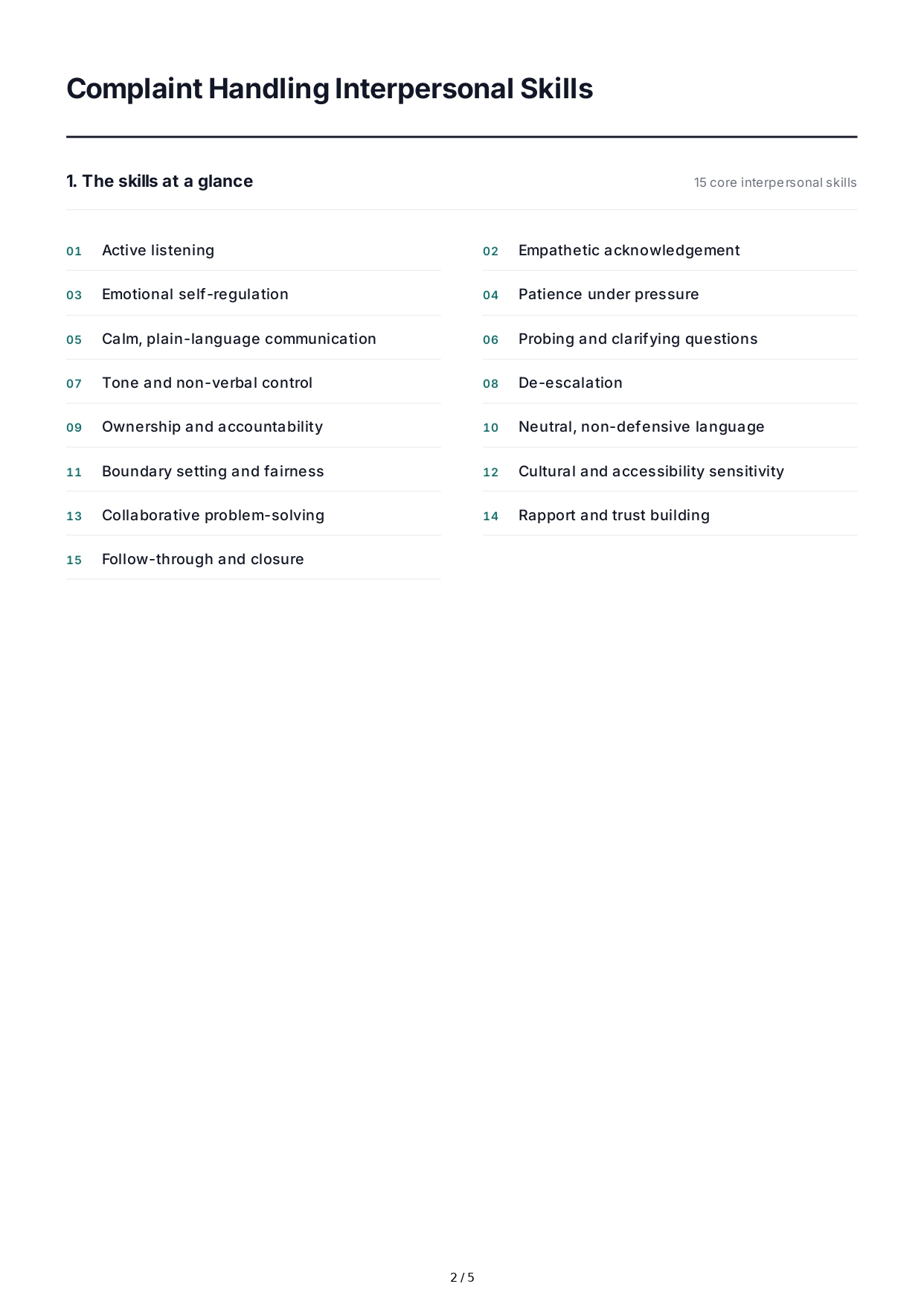
Complaint
Handling
Interpersonal
Skills
1.
The
skills
at
a
glance
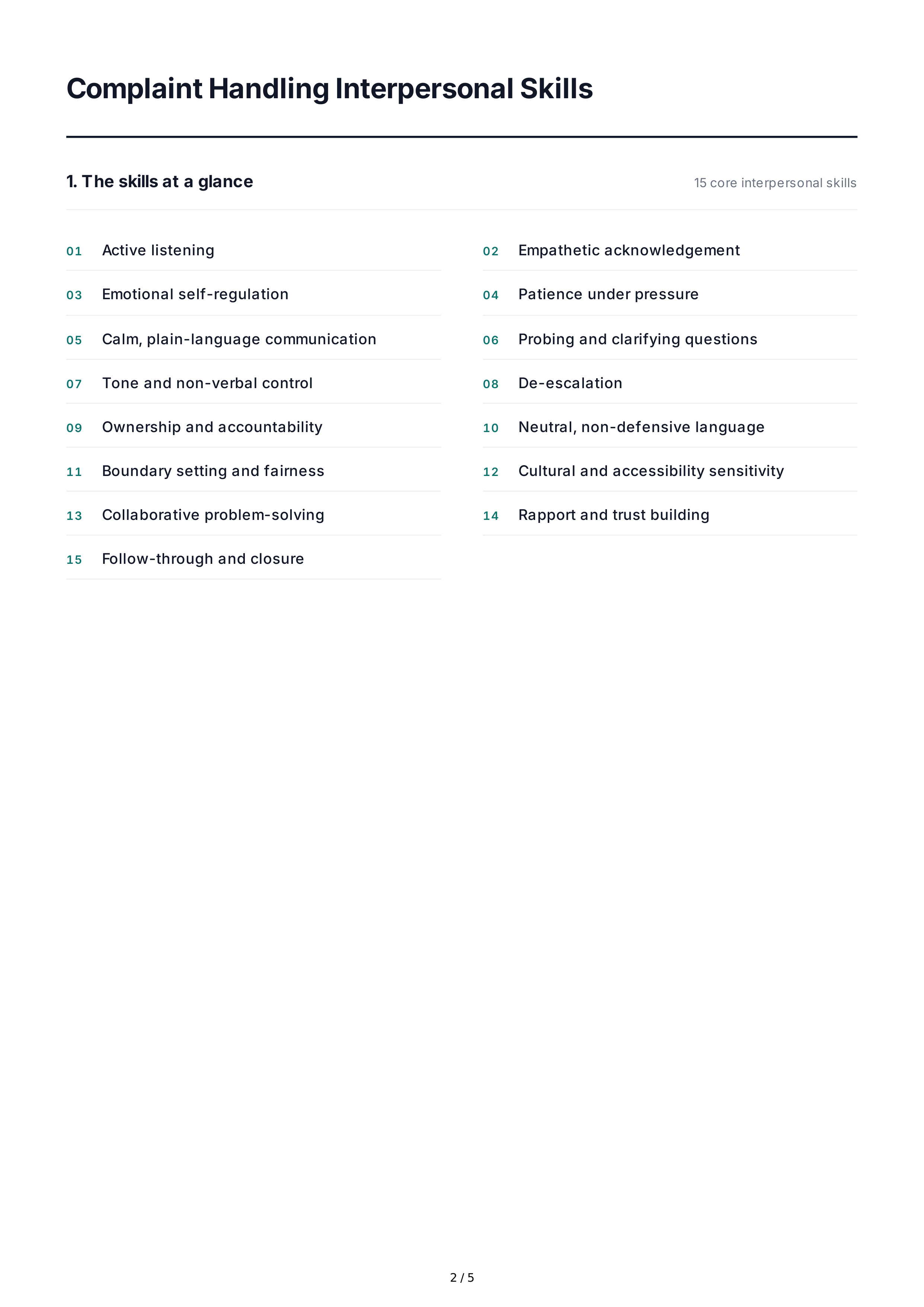
15
core
interpersonal
skills
01
Active
listening
02
Empathetic
acknowledgement
03
Emotional
self
-
regulation
04
Patience
under
pressure
05
Calm
,
plain
-
language
communication
06
Probing
and
clarifying
questions
07
Tone
and
non
-
verbal
control
08
De
-
escalation
09
Ownership
and
accountability
10
Neutral
,
non
-
defensive
language
11
Boundary
setting
and
fairness
12
Cultural
and
accessibility
sensitivity
13
Collaborative
problem
-
solving
14
Rapport
and
trust
building
15
Follow
-
through
and
closure
2 / 5
2.
Detailed
skills
by
cluster
Definition
+
in
-
practice
behaviour
C L US T ER
A
Listening
&
Understanding
Skills
1–3
01
Active
listening
Giving
the
complainant
your
full
,
undivided
attention
on
the
first
telling
—
without
interrupting
,
drafting
a
reply
,
or
steering
them
toward
the
outcome
you
already
have
in
mind
.
In
practice
:
Let
the
account
finish
,
then
reflect
it
back
— “
So
the
order
arrived
three
days
late
and
the
replacement
was
the
wrong
size
.
Have
I
got
that
right
?”
02
Empathetic
acknowledgement
Naming
the
impact
on
the
customer
before
moving
to
process
.
Acknowledgement
is
not
an
admission
of
fault
—
it
is
confirmation
that
you
have
heard
the
cost
of
the
problem
.
In
practice
:
“
That
’
s
a
wasted
trip
on
your
only
day
off
—
I
understand
why
that
’
s
frustrating
.”
03
Probing
and
clarifying
questions
Asking
short
,
open
questions
that
fill
the
gaps
in
the
record
,
then
confirming
understanding
before
acting
.
Complaints
are
usually
resolved
by
the
details
,
not
the
summary
.
In
practice
:
“
When
you
say
the
account
was
‘
locked
’,
was
that
at
login
or
at
checkout
?”
C L US T ER
B
Emotional
Composure
Skills
4–6
04
Emotional
self
-
regulation
Maintaining
a
steady
internal
state
when
you
are
blamed
,
shouted
at
,
or
misrepresented
.
Your
calm
is
the
mechanism
that
regulates
the
room
—
and
it
only
works
if
it
is
genuine
.
In
practice
:
Pause
one
beat
and
lower
your
volume
rather
than
matching
theirs
;
slow
your
speech
rate
deliberately
.
05
Patience
under
pressure
Allowing
a
complainant
to
repeat
themselves
,
work
through
the
story
in
a
non
-
linear
order
,
or
need
time
to
find
information
—
without
showing
impatience
or
rushing
the
close
.
In
practice
:
“
Take
the
time
you
need
—
I
’
ll
stay
on
the
line
while
you
find
the
reference
number
.”
06
Tone
and
non
-
verbal
control
Managing
pitch
,
pace
,
volume
,
and
body
language
so
the
message
lands
as
helpful
rather
than
brisk
,
defensive
,
or
scripted
.
On
the
phone
and
in
person
,
tone
is
the
delivery
system
for
every
other
skill
.
In
practice
:
Warm
and
level
for
the
apology
,
firm
and
unambiguous
when
setting
a
boundary
.
3 / 5
C L US T ER
C
Communication
Craft
Skills
7–9
07
Calm
,
plain
-
language
communication
Explaining
what
happened
,
what
happens
next
,
and
by
when
—
in
short
sentences
,
without
jargon
,
policy
codes
,
or
internal
terminology
the
customer
cannot
act
on
.
In
practice
:
“
The
refund
leaves
our
system
today
.
It
will
show
in
your
account
within
five
working
days
.”
08
Neutral
,
non
-
defensive
language
Avoiding
phrasing
that
blames
the
customer
,
hides
behind
policy
,
or
sounds
like
a
correction
.
Defensive
wording
converts
a
solvable
complaint
into
a
dispute
about
who
is
right
.
In
practice
:
Say
“
The
form
didn
’
t
save
the
details
”
rather
than
“
You
must
have
missed
the
submit
button
.”
09
Ownership
and
accountability
Using
first
-
person
commitments
— “
I
’
ll
do
this
,
by
then
” —
instead
of
handing
the
customer
between
teams
.
Even
when
the
fault
lies
elsewhere
,
the
customer
needs
one
responsible
point
of
contact
.
In
practice
:
“
I
’
ll
take
this
from
here
and
call
you
back
by
4
pm
with
the
outcome
.”
C L US T ER
D
Conflict
&
De
-
escalation
Skills
10–12
10
De
-
escalation
Reducing
the
emotional
temperature
step
by
step
—
through
acknowledgement
,
reduced
resistance
,
and
a
visible
trade
of
facts
for
movement
—
before
attempting
to
solve
anything
.
In
practice
:
Agree
the
version
of
events
first
,
then
introduce
the
resolution
once
the
volume
has
dropped
.
11
Boundary
setting
and
fairness
Stating
clearly
and
without
hostility
what
you
can
and
cannot
do
,
and
applying
the
same
standard
to
every
complainant
—
including
the
difficult
ones
.
Consistency
is
what
makes
the
boundary
credible
.
In
practice
:
“
I
can
offer
a
replacement
or
a
full
refund
—
the
choice
is
yours
.
I
’
m
not
able
to
do
both
.”
12
Assertiveness
under
abuse
Ending
aggression
without
abandoning
the
customer
:
naming
the
behaviour
,
restating
what
you
can
do
,
and
setting
a
consequence
if
it
continues
—
calmly
,
once
,
and
without
threats
.
In
practice
:
“
I
want
to
resolve
this
,
but
I
can
’
t
keep
going
if
you
continue
to
speak
to
me
that
way
.
Shall
we
carry
on
?”
4 / 5
C L US T ER
E
Resolution
&
Trust
Skills
13–15
13
Collaborative
problem
-
solving
Treating
the
complaint
as
a
shared
problem
rather
than
a
contest
.
That
means
offering
genuine
options
,
checking
which
the
customer
prefers
,
and
being
transparent
about
constraints
.
In
practice
:
“
Here
are
the
two
routes
I
can
take
.
Which
would
work
better
for
you
?”
14
Cultural
and
accessibility
sensitivity
Adapting
language
,
pace
,
and
assumptions
to
the
person
in
front
of
you
—
accounting
for
language
barriers
,
disability
,
neurodivergence
,
and
differing
expectations
about
how
complaints
are
properly
raised
.
In
practice
:
Offer
written
confirmation
,
a
slower
pace
,
or
an
interpreter
rather
than
repeating
the
same
explanation
louder
.
15
Follow
-
through
and
closure
Doing
the
thing
you
promised
,
on
the
schedule
you
promised
,
and
checking
back
once
it
is
done
.
Follow
-
through
is
the
only
interpersonal
skill
the
customer
can
verify
independently
.
In
practice
:
Log
the
commitment
,
meet
the
deadline
,
then
confirm
: “
The
refund
cleared
today
—
is
there
anything
else
you
need
?”
5 / 5