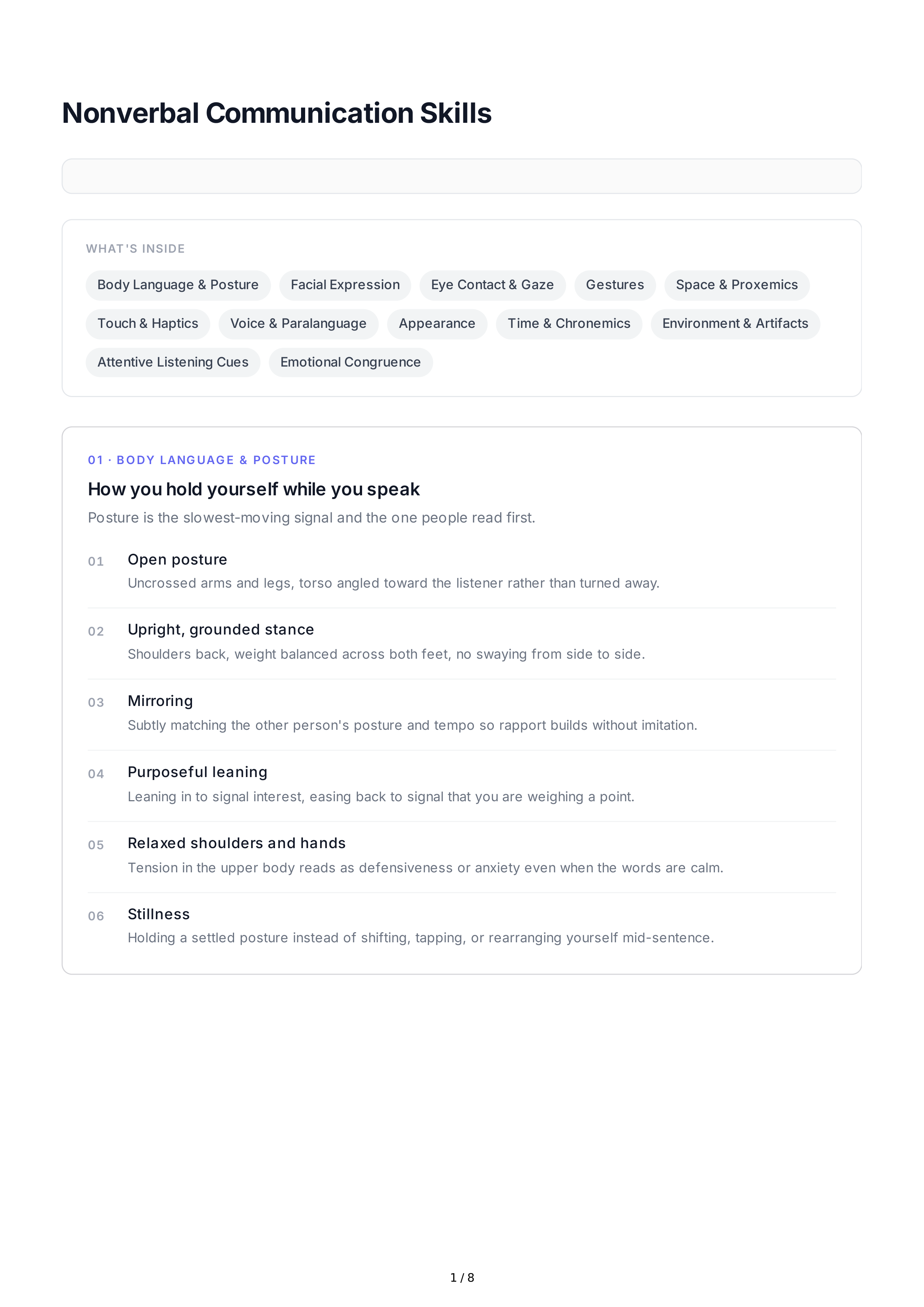
Nonverbal
Communication
Skills
WHAT
'
S
INSIDE
Body
Language
&
Posture
Facial
Expression
Eye
Contact
&
Gaze
Gestures
Space
&
Proxemics
Touch
&
Haptics
Voice
&
Paralanguage
Appearance
Time
&
Chronemics
Environment
&
Artifacts
Attentive
Listening
Cues
Emotional
Congruence
0 1 ·
B O DY
LANG UAG E
&
PO ST URE
How
you
hold
yourself
while
you
speak
Posture
is
the
slowest
-
moving
signal
and
the
one
people
read
first
.
01
Open
posture
Uncrossed
arms
and
legs
,
torso
angled
toward
the
listener
rather
than
turned
away
.
02
Upright
,
grounded
stance
Shoulders
back
,
weight
balanced
across
both
feet
,
no
swaying
from
side
to
side
.
03
Mirroring
Subtly
matching
the
other
person
'
s
posture
and
tempo
so
rapport
builds
without
imitation
.
04
Purposeful
leaning
Leaning
in
to
signal
interest
,
easing
back
to
signal
that
you
are
weighing
a
point
.
05
Relaxed
shoulders
and
hands
Tension
in
the
upper
body
reads
as
defensiveness
or
anxiety
even
when
the
words
are
calm
.
06
Stillness
Holding
a
settled
posture
instead
of
shifting
,
tapping
,
or
rearranging
yourself
mid
-
sentence
.
1 / 8
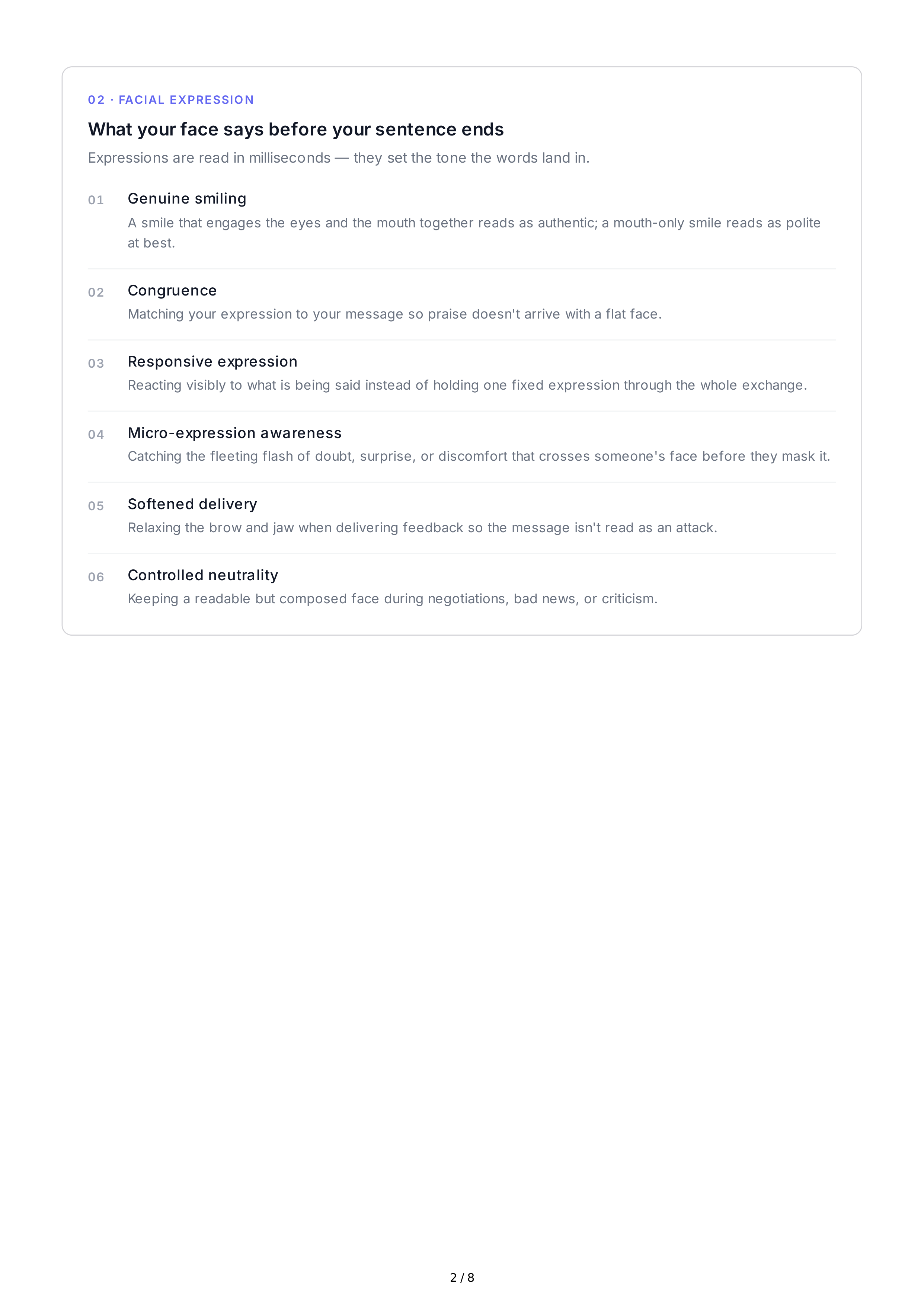
0 2 ·
FACIAL
EXPRESSIO N
What
your
face
says
before
your
sentence
ends
Expressions
are
read
in
milliseconds
—
they
set
the
tone
the
words
land
in
.
01
Genuine
smiling
A
smile
that
engages
the
eyes
and
the
mouth
together
reads
as
authentic
;
a
mouth
-
only
smile
reads
as
polite
at
best
.
02
Congruence
Matching
your
expression
to
your
message
so
praise
doesn
'
t
arrive
with
a
flat
face
.
03
Responsive
expression
Reacting
visibly
to
what
is
being
said
instead
of
holding
one
fixed
expression
through
the
whole
exchange
.
04
Micro
-
expression
awareness
Catching
the
fleeting
flash
of
doubt
,
surprise
,
or
discomfort
that
crosses
someone
'
s
face
before
they
mask
it
.
05
Softened
delivery
Relaxing
the
brow
and
jaw
when
delivering
feedback
so
the
message
isn
'
t
read
as
an
attack
.
06
Controlled
neutrality
Keeping
a
readable
but
composed
face
during
negotiations
,
bad
news
,
or
criticism
.
2 / 8
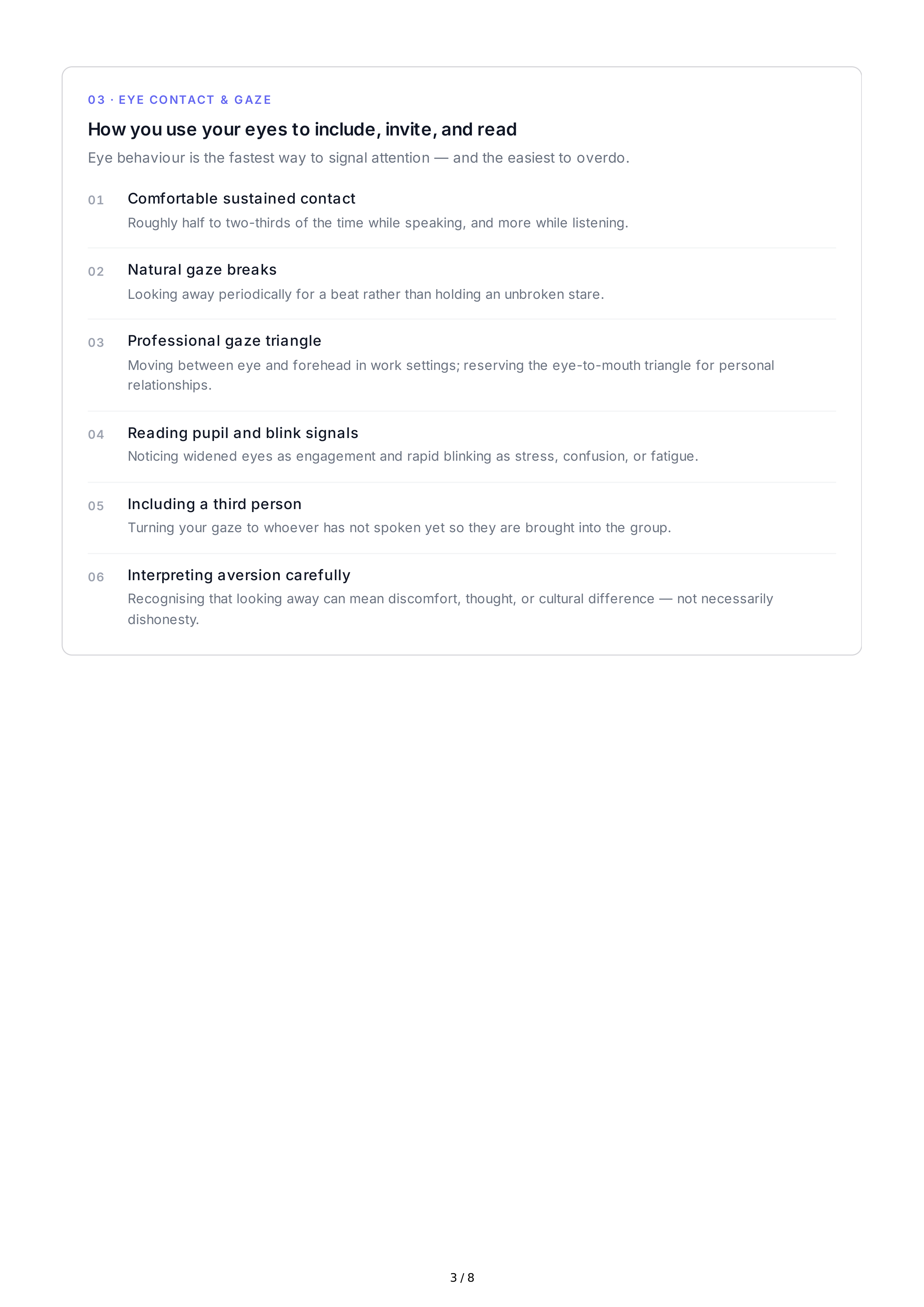
0 3 ·
EYE
CO NTACT
&
G AZ E
How
you
use
your
eyes
to
include
,
invite
,
and
read
Eye
behaviour
is
the
fastest
way
to
signal
attention
—
and
the
easiest
to
overdo
.
01
Comfortable
sustained
contact
Roughly
half
to
two
-
thirds
of
the
time
while
speaking
,
and
more
while
listening
.
02
Natural
gaze
breaks
Looking
away
periodically
for
a
beat
rather
than
holding
an
unbroken
stare
.
03
Professional
gaze
triangle
Moving
between
eye
and
forehead
in
work
settings
;
reserving
the
eye
-
to
-
mouth
triangle
for
personal
relationships
.
04
Reading
pupil
and
blink
signals
Noticing
widened
eyes
as
engagement
and
rapid
blinking
as
stress
,
confusion
,
or
fatigue
.
05
Including
a
third
person
Turning
your
gaze
to
whoever
has
not
spoken
yet
so
they
are
brought
into
the
group
.
06
Interpreting
aversion
carefully
Recognising
that
looking
away
can
mean
discomfort
,
thought
,
or
cultural
difference
—
not
necessarily
dishonesty
.
3 / 8
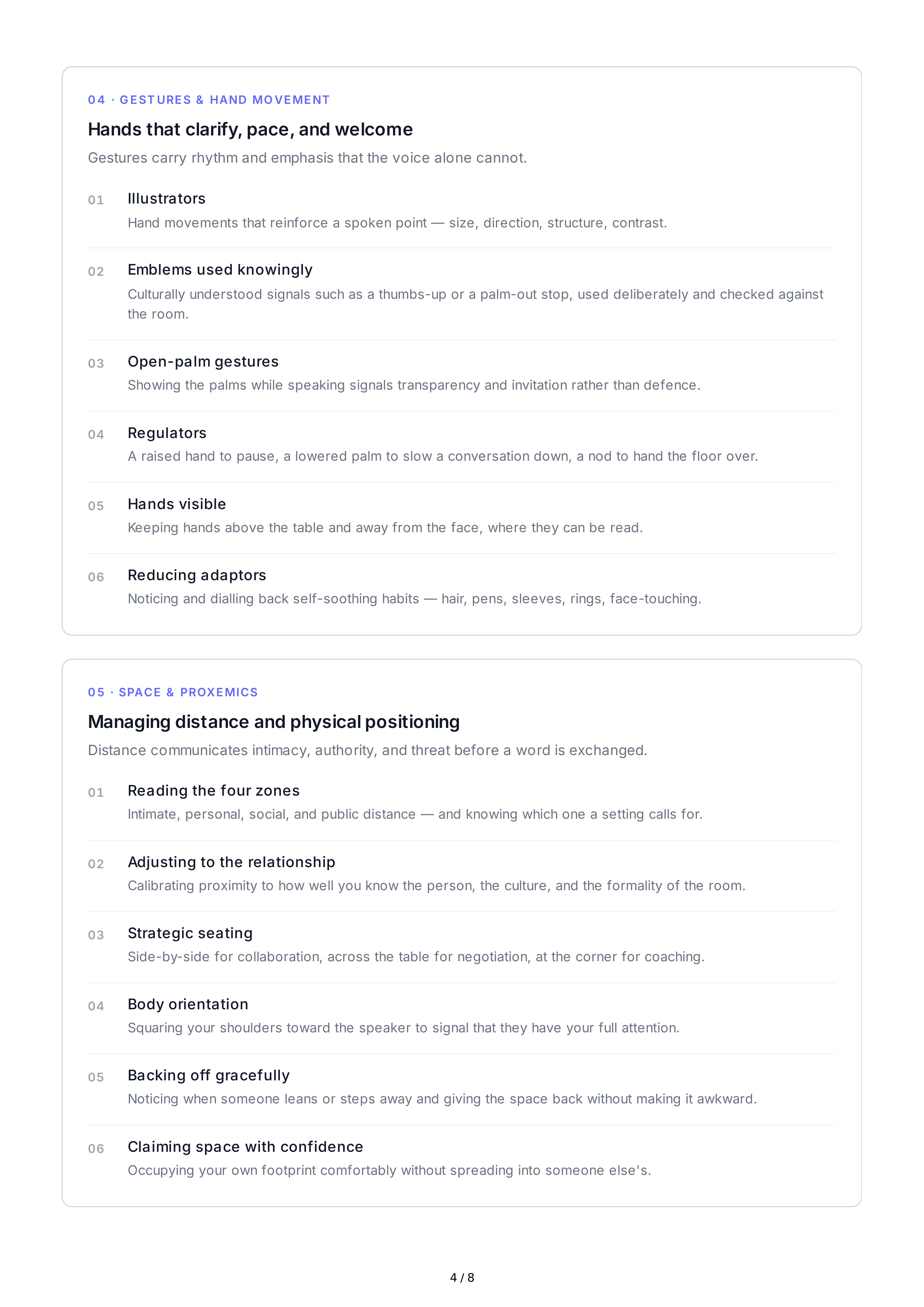
0 4 ·
G EST URES
&
HAND
MO VEMENT
Hands
that
clarify
,
pace
,
and
welcome
Gestures
carry
rhythm
and
emphasis
that
the
voice
alone
cannot
.
01
Illustrators
Hand
movements
that
reinforce
a
spoken
point
—
size
,
direction
,
structure
,
contrast
.
02
Emblems
used
knowingly
Culturally
understood
signals
such
as
a
thumbs
-
up
or
a
palm
-
out
stop
,
used
deliberately
and
checked
against
the
room
.
03
Open
-
palm
gestures
Showing
the
palms
while
speaking
signals
transparency
and
invitation
rather
than
defence
.
04
Regulators
A
raised
hand
to
pause
,
a
lowered
palm
to
slow
a
conversation
down
,
a
nod
to
hand
the
floor
over
.
05
Hands
visible
Keeping
hands
above
the
table
and
away
from
the
face
,
where
they
can
be
read
.
06
Reducing
adaptors
Noticing
and
dialling
back
self
-
soothing
habits
—
hair
,
pens
,
sleeves
,
rings
,
face
-
touching
.
0 5 ·
SPACE
&
PROXEMICS
Managing
distance
and
physical
positioning
Distance
communicates
intimacy
,
authority
,
and
threat
before
a
word
is
exchanged
.
01
Reading
the
four
zones
Intimate
,
personal
,
social
,
and
public
distance
—
and
knowing
which
one
a
setting
calls
for
.
02
Adjusting
to
the
relationship
Calibrating
proximity
to
how
well
you
know
the
person
,
the
culture
,
and
the
formality
of
the
room
.
03
Strategic
seating
Side
-
by
-
side
for
collaboration
,
across
the
table
for
negotiation
,
at
the
corner
for
coaching
.
04
Body
orientation
Squaring
your
shoulders
toward
the
speaker
to
signal
that
they
have
your
full
attention
.
05
Backing
off
gracefully
Noticing
when
someone
leans
or
steps
away
and
giving
the
space
back
without
making
it
awkward
.
06
Claiming
space
with
confidence
Occupying
your
own
footprint
comfortably
without
spreading
into
someone
else
'
s
.
4 / 8
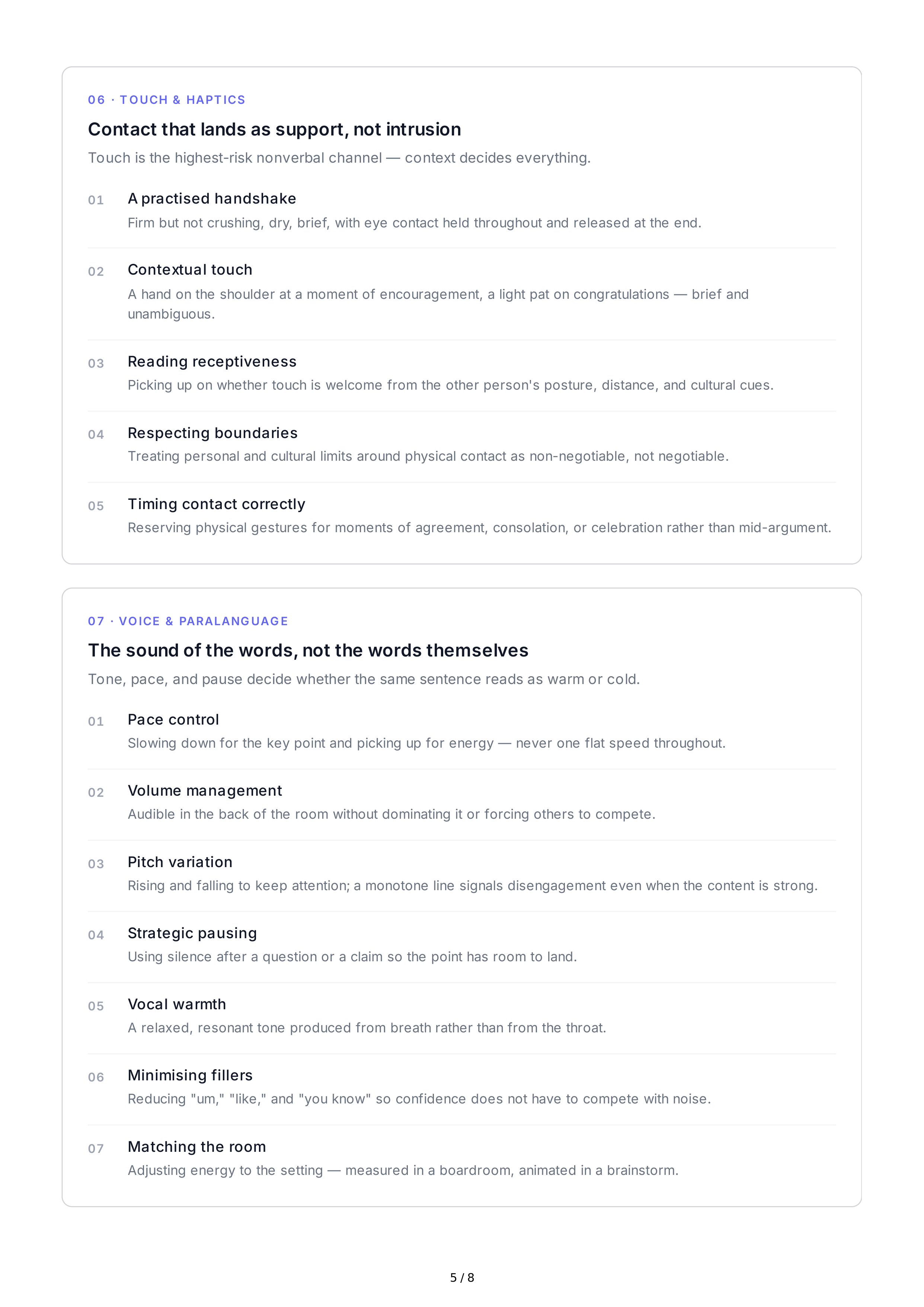
0 6 ·
T O UCH
&
HAPT ICS
Contact
that
lands
as
support
,
not
intrusion
Touch
is
the
highest
-
risk
nonverbal
channel
—
context
decides
everything
.
01
A
practised
handshake
Firm
but
not
crushing
,
dry
,
brief
,
with
eye
contact
held
throughout
and
released
at
the
end
.
02
Contextual
touch
A
hand
on
the
shoulder
at
a
moment
of
encouragement
,
a
light
pat
on
congratulations
—
brief
and
unambiguous
.
03
Reading
receptiveness
Picking
up
on
whether
touch
is
welcome
from
the
other
person
'
s
posture
,
distance
,
and
cultural
cues
.
04
Respecting
boundaries
Treating
personal
and
cultural
limits
around
physical
contact
as
non
-
negotiable
,
not
negotiable
.
05
Timing
contact
correctly
Reserving
physical
gestures
for
moments
of
agreement
,
consolation
,
or
celebration
rather
than
mid
-
argument
.
0 7 ·
VO ICE
&
PARALANG UAG E
The
sound
of
the
words
,
not
the
words
themselves
Tone
,
pace
,
and
pause
decide
whether
the
same
sentence
reads
as
warm
or
cold
.
01
Pace
control
Slowing
down
for
the
key
point
and
picking
up
for
energy
—
never
one
flat
speed
throughout
.
02
Volume
management
Audible
in
the
back
of
the
room
without
dominating
it
or
forcing
others
to
compete
.
03
Pitch
variation
Rising
and
falling
to
keep
attention
;
a
monotone
line
signals
disengagement
even
when
the
content
is
strong
.
04
Strategic
pausing
Using
silence
after
a
question
or
a
claim
so
the
point
has
room
to
land
.
05
Vocal
warmth
A
relaxed
,
resonant
tone
produced
from
breath
rather
than
from
the
throat
.
06
Minimising
fillers
Reducing
"
um
," "
like
,"
and
"
you
know
"
so
confidence
does
not
have
to
compete
with
noise
.
07
Matching
the
room
Adjusting
energy
to
the
setting
—
measured
in
a
boardroom
,
animated
in
a
brainstorm
.
5 / 8
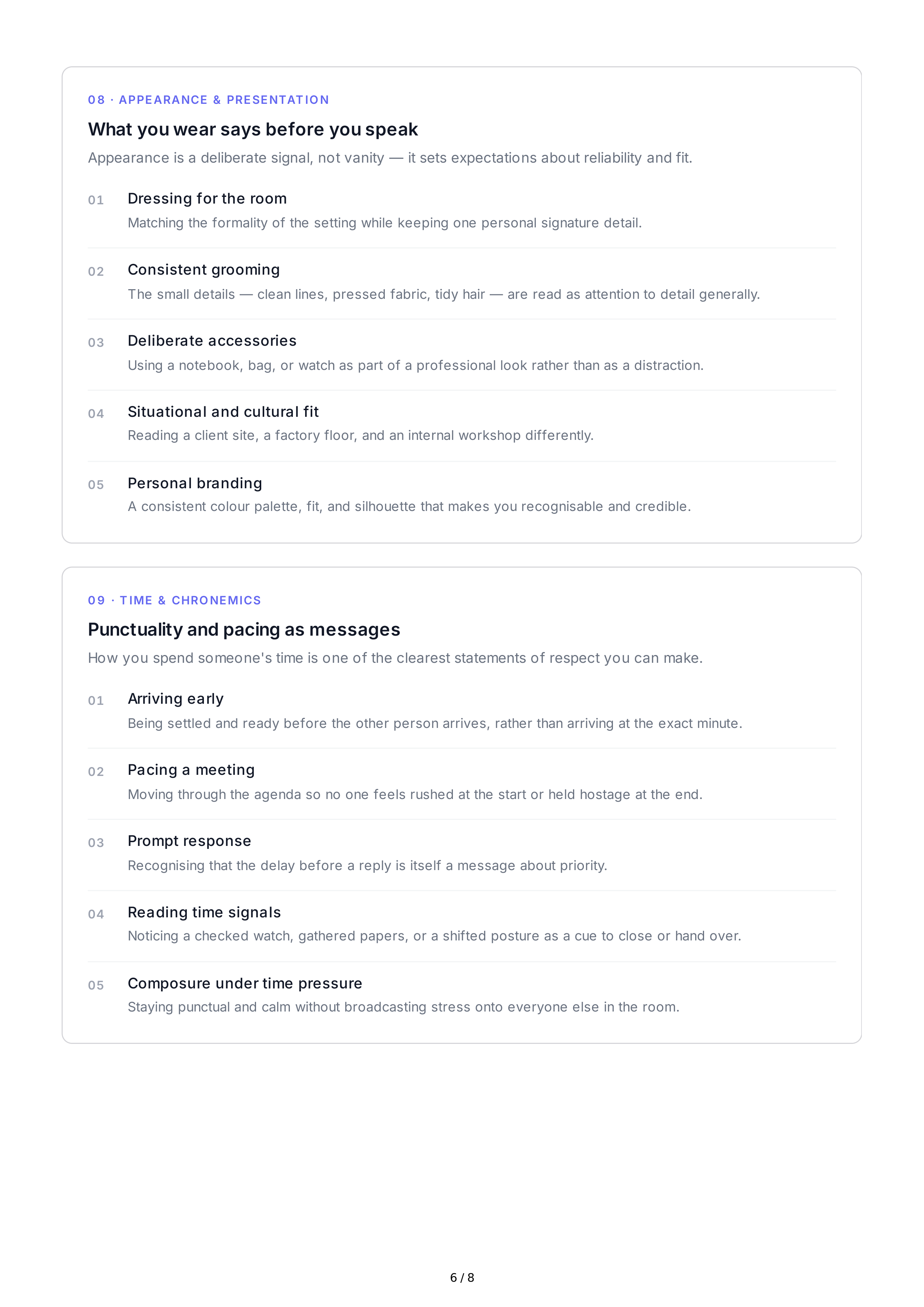
0 8 ·
APPEARANCE
&
PRESENTAT IO N
What
you
wear
says
before
you
speak
Appearance
is
a
deliberate
signal
,
not
vanity
—
it
sets
expectations
about
reliability
and
fit
.
01
Dressing
for
the
room
Matching
the
formality
of
the
setting
while
keeping
one
personal
signature
detail
.
02
Consistent
grooming
The
small
details
—
clean
lines
,
pressed
fabric
,
tidy
hair
—
are
read
as
attention
to
detail
generally
.
03
Deliberate
accessories
Using
a
notebook
,
bag
,
or
watch
as
part
of
a
professional
look
rather
than
as
a
distraction
.
04
Situational
and
cultural
fit
Reading
a
client
site
,
a
factory
floor
,
and
an
internal
workshop
differently
.
05
Personal
branding
A
consistent
colour
palette
,
fit
,
and
silhouette
that
makes
you
recognisable
and
credible
.
0 9 ·
T IME
&
CHRO NEMICS
Punctuality
and
pacing
as
messages
How
you
spend
someone
'
s
time
is
one
of
the
clearest
statements
of
respect
you
can
make
.
01
Arriving
early
Being
settled
and
ready
before
the
other
person
arrives
,
rather
than
arriving
at
the
exact
minute
.
02
Pacing
a
meeting
Moving
through
the
agenda
so
no
one
feels
rushed
at
the
start
or
held
hostage
at
the
end
.
03
Prompt
response
Recognising
that
the
delay
before
a
reply
is
itself
a
message
about
priority
.
04
Reading
time
signals
Noticing
a
checked
watch
,
gathered
papers
,
or
a
shifted
posture
as
a
cue
to
close
or
hand
over
.
05
Composure
under
time
pressure
Staying
punctual
and
calm
without
broadcasting
stress
onto
everyone
else
in
the
room
.
6 / 8
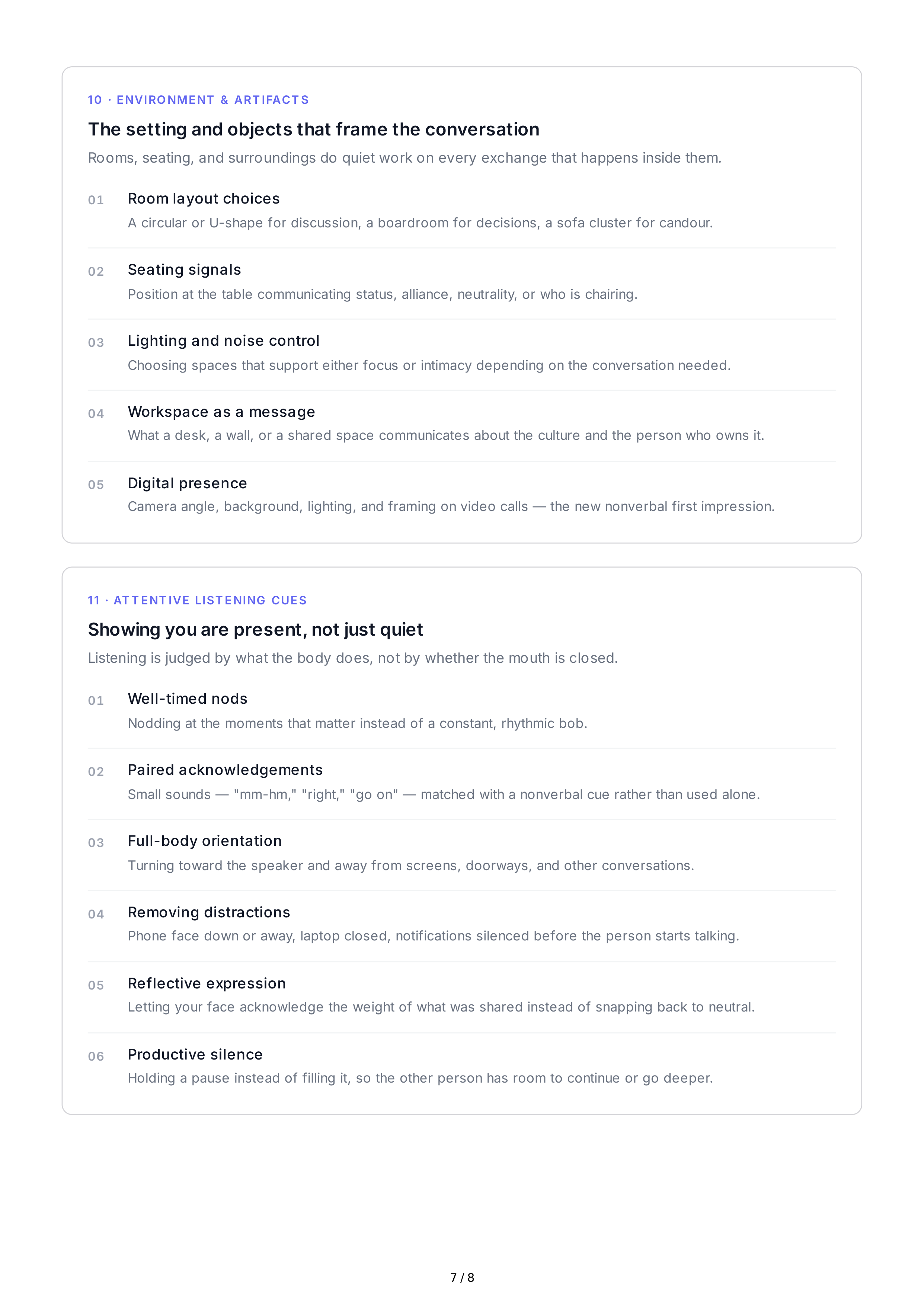
10 ·
ENVIRO NMENT
&
ART IFACT S
The
setting
and
objects
that
frame
the
conversation
Rooms
,
seating
,
and
surroundings
do
quiet
work
on
every
exchange
that
happens
inside
them
.
01
Room
layout
choices
A
circular
or
U
-
shape
for
discussion
,
a
boardroom
for
decisions
,
a
sofa
cluster
for
candour
.
02
Seating
signals
Position
at
the
table
communicating
status
,
alliance
,
neutrality
,
or
who
is
chairing
.
03
Lighting
and
noise
control
Choosing
spaces
that
support
either
focus
or
intimacy
depending
on
the
conversation
needed
.
04
Workspace
as
a
message
What
a
desk
,
a
wall
,
or
a
shared
space
communicates
about
the
culture
and
the
person
who
owns
it
.
05
Digital
presence
Camera
angle
,
background
,
lighting
,
and
framing
on
video
calls
—
the
new
nonverbal
first
impression
.
11 ·
AT T ENT IVE
LIST ENING
CUES
Showing
you
are
present
,
not
just
quiet
Listening
is
judged
by
what
the
body
does
,
not
by
whether
the
mouth
is
closed
.
01
Well
-
timed
nods
Nodding
at
the
moments
that
matter
instead
of
a
constant
,
rhythmic
bob
.
02
Paired
acknowledgements
Small
sounds
— "
mm
-
hm
," "
right
," "
go
on
" —
matched
with
a
nonverbal
cue
rather
than
used
alone
.
03
Full
-
body
orientation
Turning
toward
the
speaker
and
away
from
screens
,
doorways
,
and
other
conversations
.
04
Removing
distractions
Phone
face
down
or
away
,
laptop
closed
,
notifications
silenced
before
the
person
starts
talking
.
05
Reflective
expression
Letting
your
face
acknowledge
the
weight
of
what
was
shared
instead
of
snapping
back
to
neutral
.
06
Productive
silence
Holding
a
pause
instead
of
filling
it
,
so
the
other
person
has
room
to
continue
or
go
deeper
.
7 / 8
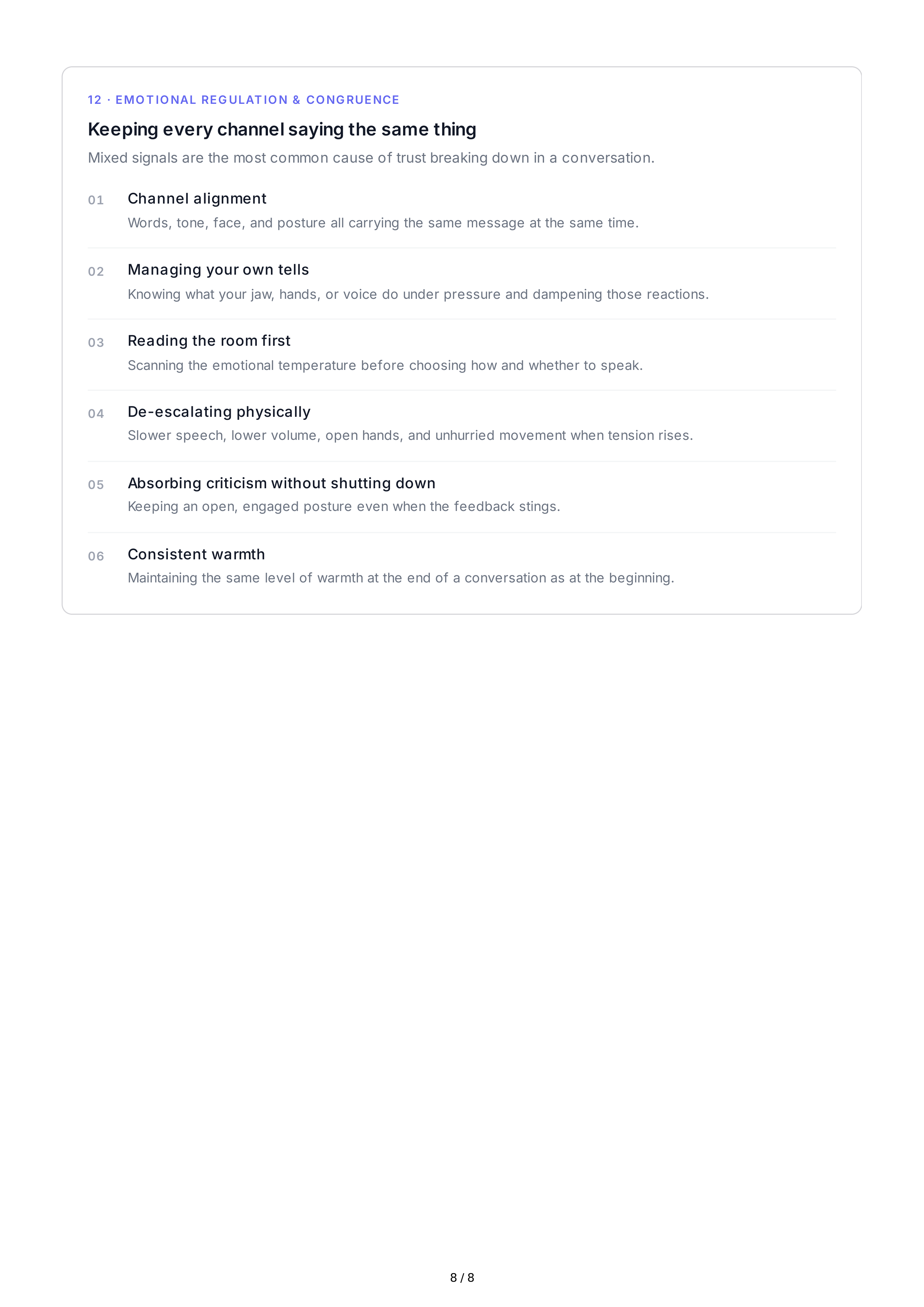
12 ·
EMO T IO NAL
REG ULAT IO N
&
CO NG RUENCE
Keeping
every
channel
saying
the
same
thing
Mixed
signals
are
the
most
common
cause
of
trust
breaking
down
in
a
conversation
.
01
Channel
alignment
Words
,
tone
,
face
,
and
posture
all
carrying
the
same
message
at
the
same
time
.
02
Managing
your
own
tells
Knowing
what
your
jaw
,
hands
,
or
voice
do
under
pressure
and
dampening
those
reactions
.
03
Reading
the
room
first
Scanning
the
emotional
temperature
before
choosing
how
and
whether
to
speak
.
04
De
-
escalating
physically
Slower
speech
,
lower
volume
,
open
hands
,
and
unhurried
movement
when
tension
rises
.
05
Absorbing
criticism
without
shutting
down
Keeping
an
open
,
engaged
posture
even
when
the
feedback
stings
.
06
Consistent
warmth
Maintaining
the
same
level
of
warmth
at
the
end
of
a
conversation
as
at
the
beginning
.
8 / 8
