Group
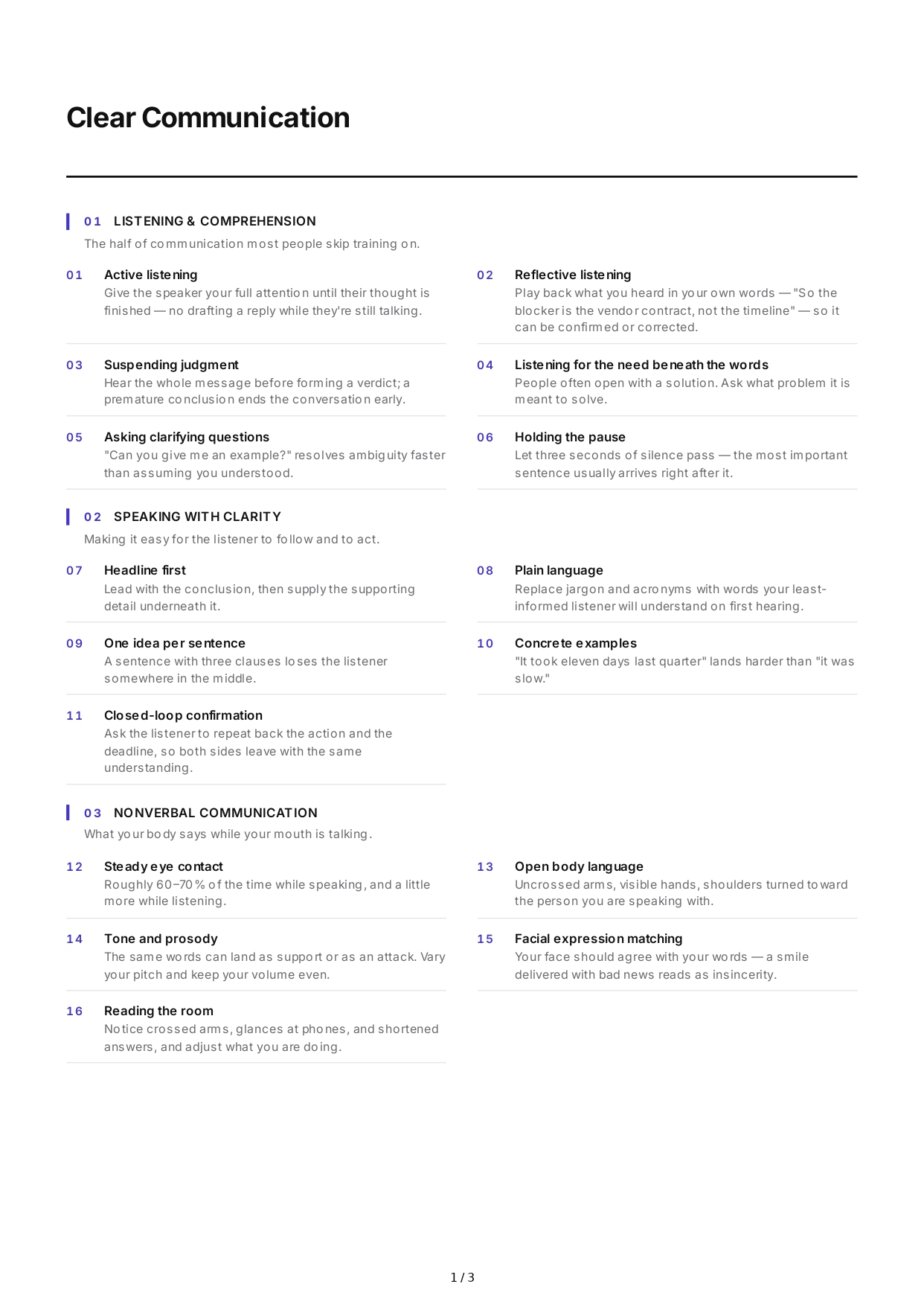
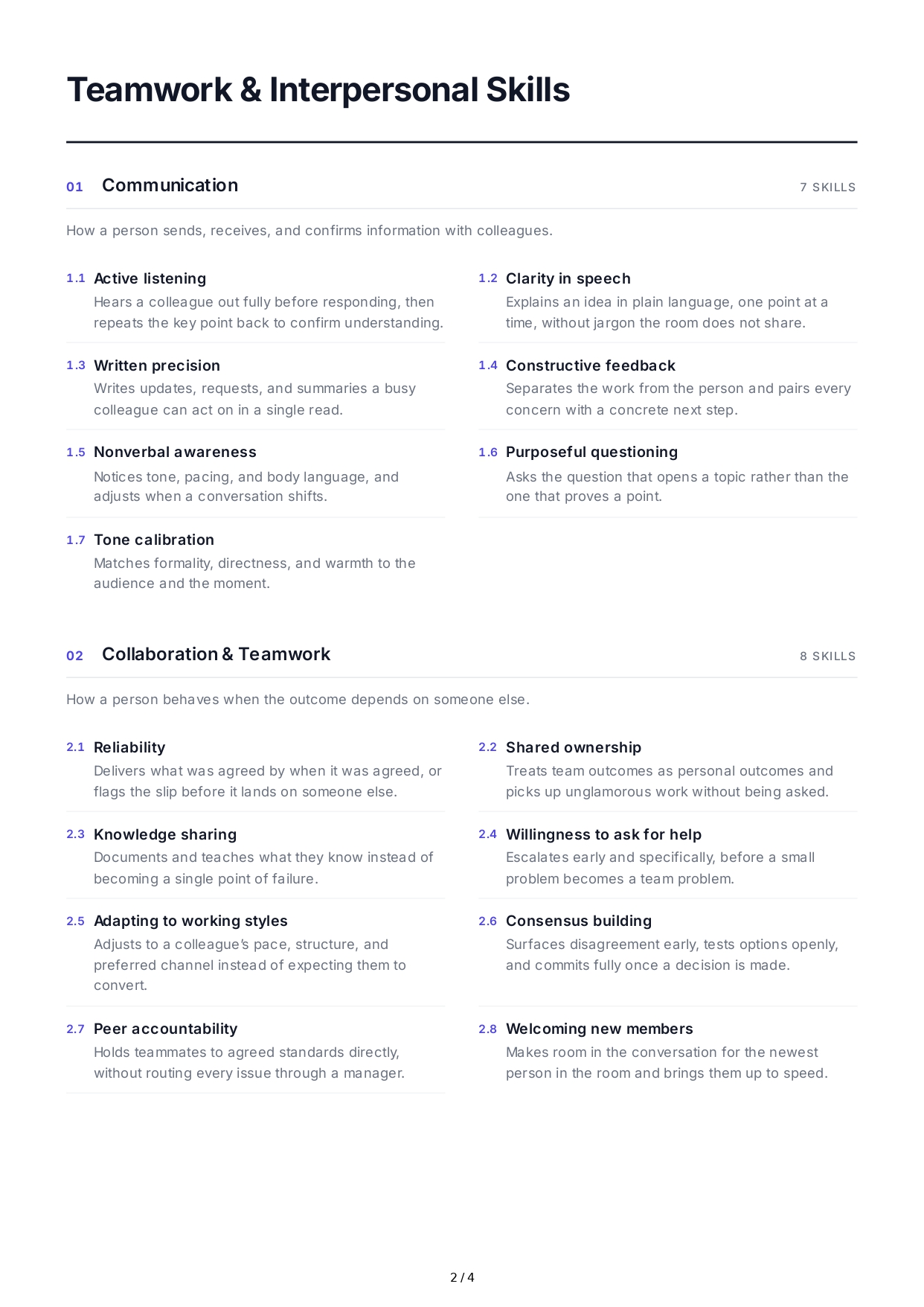
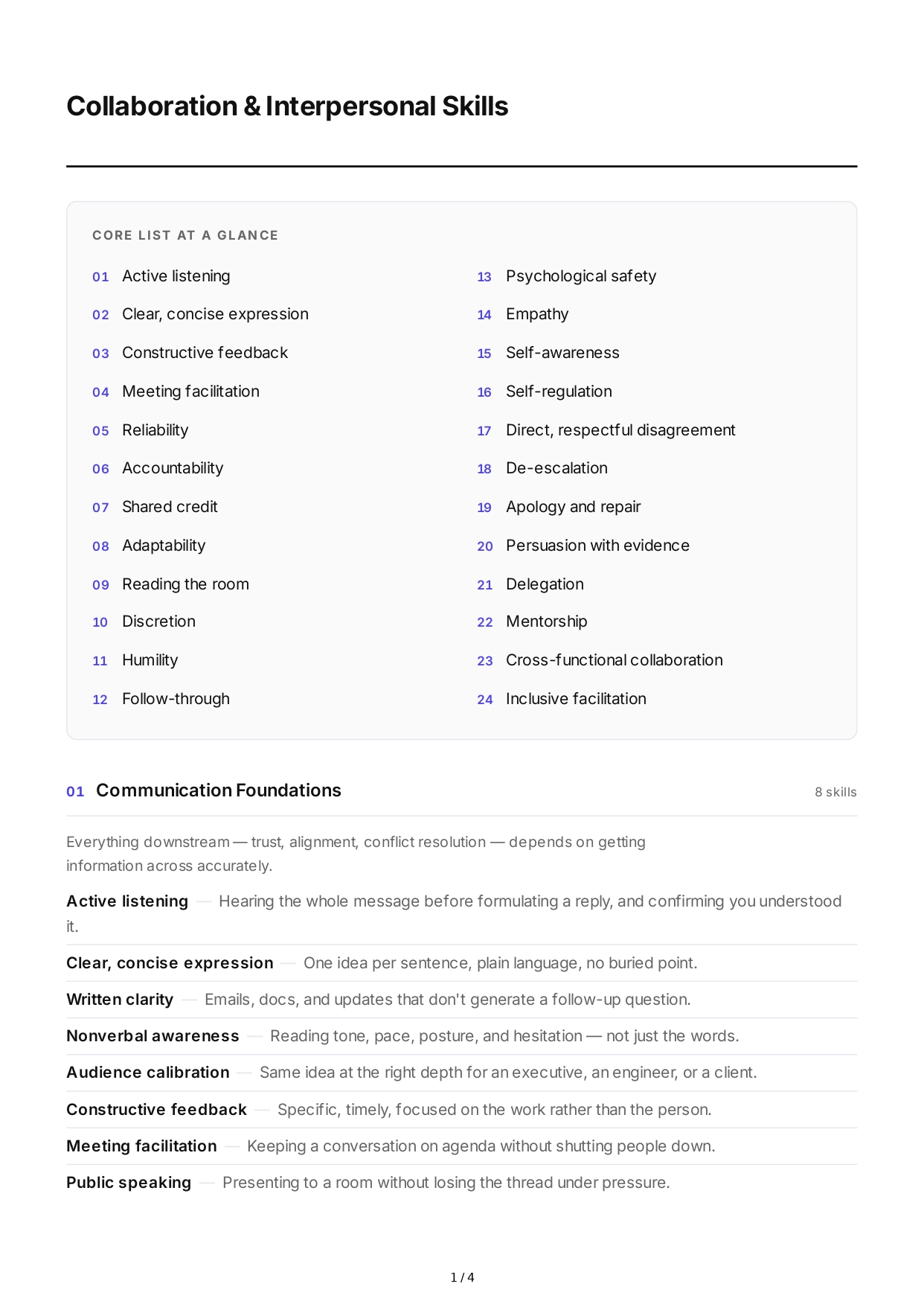
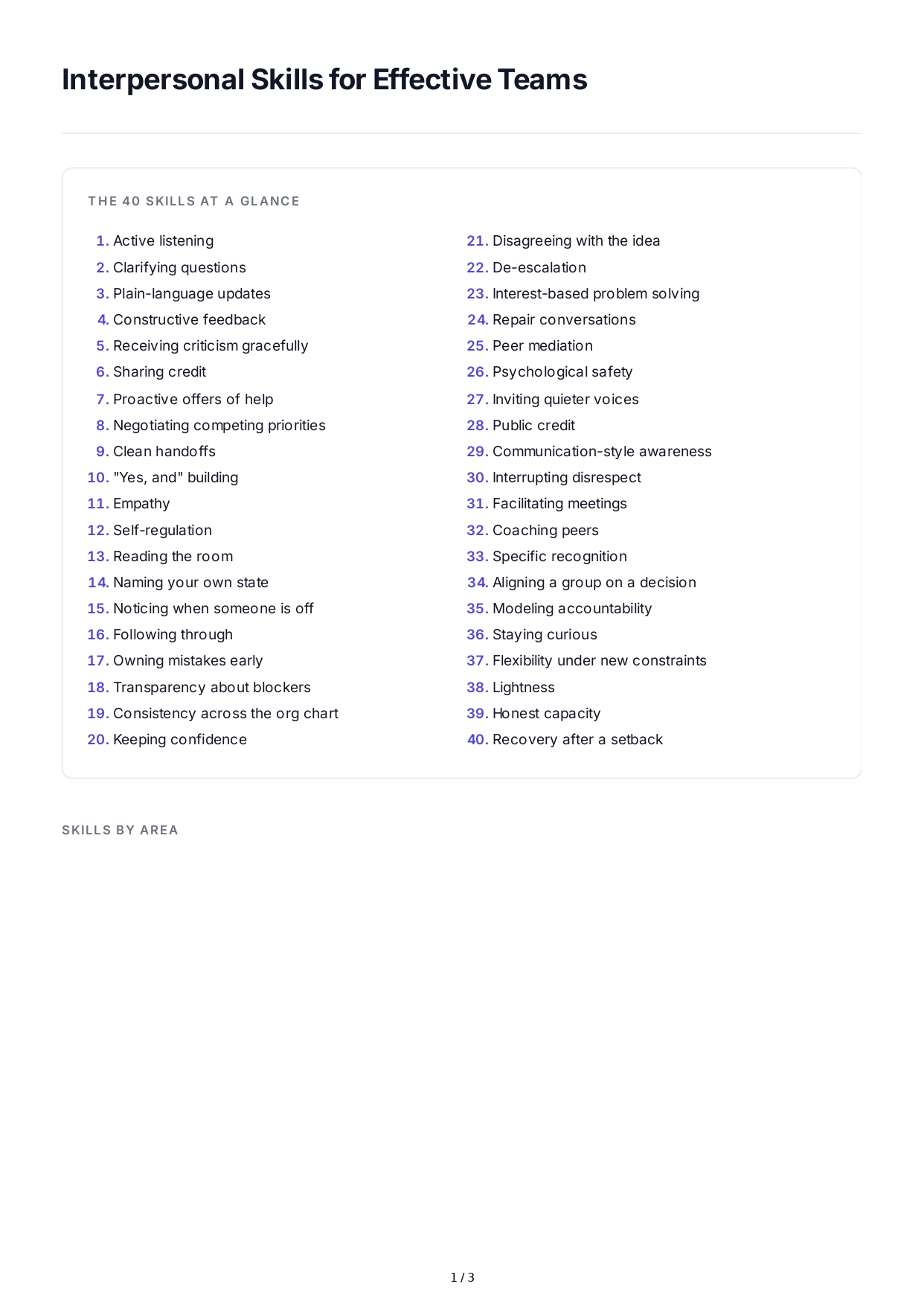
Communication
Interpersonal
Skills
1
Speaking
&
Message
Delivery
10
SKILLS
1.1
Clarity
of
expression
—
say
it
in
plain
words
the
newest
person
in
the
room
can
follow
.
1.2
Conciseness
—
deliver
the
point
in
fewer
sentences
than
expected
,
and
leave
room
for
others
.
1.3
Headline
-
first
structure
—
state
the
conclusion
,
then
the
reasoning
,
then
the
detail
only
if
it
is
asked
for
.
1.4
Voice
projection
and
pace
—
reach
the
back
of
the
room
without
rushing
the
sentence
.
1.5
Tone
and
pitch
control
—
match
warmth
and
formality
to
the
room
you
are
actually
in
.
1.6
Strategic
pausing
—
use
silence
to
let
a
point
land
and
to
invite
a
response
.
1.7
Register
shifting
—
move
between
technical
,
executive
,
and
casual
language
inside
one
meeting
.
1.8
Precision
in
instructions
—
give
steps
,
owners
,
and
success
criteria
without
ambiguity
.
1.9
Storytelling
for
shared
context
—
turn
a
dry
status
update
into
an
example
people
remember
next
week
.
1.10
Summarising
the
group
'
s
position
—
restate
aloud
what
the
group
has
actually
agreed
,
not
what
you
hoped
it
agreed
.
2
Listening
10
SKILLS
2.1
Active
listening
—
full
attention
on
the
speaker
,
not
on
drafting
your
reply
.
2.2
Empathetic
listening
—
hearing
the
feeling
underneath
the
words
,
not
only
the
content
.
2.3
Reflective
listening
—
paraphrase
back
what
you
heard
so
the
speaker
can
correct
you
.
2.4
Clarifying
questions
—
ask
the
one
specific
question
that
removes
the
ambiguity
.
2.5
Open
probing
— "
what
led
you
there
?"
instead
of
questions
that
only
accept
yes
or
no
.
2.6
Withholding
judgment
—
let
an
unfinished
idea
finish
before
you
evaluate
it
.
2.7
Suspending
the
urge
to
respond
—
sit
with
a
point
you
disagree
with
long
enough
to
understand
it
.
2.8
Listening
for
intent
—
separate
what
someone
wants
from
the
way
they
happened
to
say
it
.
2.9
Live
note
-
taking
—
capture
decisions
and
owners
while
the
discussion
is
still
running
.
2.10
Recalling
earlier
contributions
—
reference
what
a
colleague
said
twenty
minutes
ago
,
by
name
.
1 / 4
3
Nonverbal
Communication
&
Presence
10
SKILLS
3.1
Eye
contact
across
the
group
—
distribute
attention
around
the
room
instead
of
locking
onto
one
person
.
3.2
Open
posture
—
uncrossed
arms
,
squared
shoulders
,
hands
visible
on
the
table
.
3.3
Facial
responsiveness
—
let
your
face
register
that
you
are
following
the
argument
.
3.4
Reinforcing
gesture
—
hands
that
show
scale
,
sequence
,
or
contrast
rather
than
fill
silence
.
3.5
Respecting
personal
space
—
read
the
distance
each
person
is
comfortable
with
and
hold
it
.
3.6
Reading
others
'
nonverbal
cues
—
notice
the
sigh
,
the
folded
arms
,
the
glance
at
the
clock
.
3.7
Regulating
nervous
habits
—
manage
pen
-
clicking
,
pacing
,
hair
-
touching
,
and
chair
-
swivelling
.
3.8
Attentive
orientation
—
turn
your
body
and
shoulders
toward
whoever
holds
the
floor
.
3.9
Congruence
—
make
sure
your
body
agrees
with
your
words
;
groups
notice
the
mismatch
first
.
3.10
Checking
your
own
impact
—
notice
how
you
are
landing
with
the
group
and
adjust
mid
-
conversation
.
4
Emotional
&
Social
Intelligence
10
SKILLS
4.1
Self
-
awareness
—
know
your
own
mood
and
state
before
you
walk
into
the
room
.
4.2
Self
-
regulation
under
pressure
—
stay
steady
when
the
conversation
heats
up
or
the
clock
runs
out
.
4.3
Empathy
—
understand
another
person
'
s
position
from
the
inside
,
not
from
the
outside
.
4.4
Reading
the
room
—
sense
when
energy
is
dropping
,
rising
,
or
quietly
turning
against
a
proposal
.
4.5
Attunement
to
tone
shifts
—
catch
the
moment
a
topic
becomes
sensitive
and
slow
down
.
4.6
Patience
with
slow
-
forming
ideas
—
let
someone
think
out
loud
without
finishing
their
sentence
for
them
.
4.7
Tact
and
diplomacy
—
say
the
true
thing
in
a
form
that
can
actually
be
heard
.
4.8
Tolerance
for
disagreement
—
hold
your
position
without
needing
to
win
the
exchange
.
4.9
Managing
your
own
triggers
—
recognise
what
sets
you
off
and
buy
yourself
a
few
seconds
before
replying
.
4.10
Graciousness
in
being
wrong
—
correct
yourself
cleanly
,
out
loud
,
and
move
on
without
over
-
apologising
.
5
Collaboration
&
Teamwork
10
SKILLS
5.1
Shared
-
goal
orientation
—
optimise
for
the
group
outcome
rather
than
for
your
own
section
of
it
.
2 / 4
5.2
Cooperation
over
competition
—
trade
airtime
and
credit
freely
rather
than
banking
them
.
5.3
Consensus
-
building
—
find
the
version
of
the
decision
that
everyone
can
genuinely
support
.
5.4
Building
on
others
'
ideas
—
extend
a
proposal
with
"
yes
,
and
"
instead
of
flattening
it
with
"
but
".
5.5
Offering
help
—
volunteer
capacity
before
somebody
has
to
ask
you
for
it
.
5.6
Accepting
help
—
let
a
colleague
take
something
off
your
plate
without
turning
it
into
a
negotiation
.
5.7
Reliability
—
do
what
you
said
you
would
do
,
by
when
you
said
you
would
do
it
.
5.8
Distributing
airtime
—
track
who
has
not
spoken
and
make
deliberate
space
for
them
.
5.9
Supporting
quieter
members
—
bring
in
an
earlier
point
with
attribution
when
its
author
has
been
talked
over
.
5.10
Sharing
credit
—
name
who
contributed
what
,
in
public
,
without
being
prompted
.
6
Facilitating
Groups
&
Meetings
10
SKILLS
6.1
Agenda
setting
—
publish
the
purpose
,
the
questions
,
and
the
time
boxes
before
the
meeting
starts
.
6.2
Framing
the
question
—
pose
a
question
the
group
can
actually
answer
in
the
time
available
.
6.3
Facilitating
turn
-
taking
—
structure
who
speaks
,
in
what
order
,
and
for
how
long
.
6.4
Managing
dominant
voices
—
redirect
the
person
who
has
spoken
three
times
without
embarrassing
them
.
6.5
Drawing
out
quiet
participants
—
invite
specific
people
in
specific
terms
,
not
"
any
other
thoughts
?".
6.6
Parking
off
-
topic
items
—
capture
tangents
visibly
so
they
are
honoured
later
,
not
lost
or
chased
now
.
6.7
Time
-
keeping
—
cut
a
discussion
before
it
overruns
,
and
say
why
you
are
cutting
it
.
6.8
Synthesising
multiple
views
—
weave
four
divergent
threads
into
one
picture
the
group
recognises
.
6.9
Confirming
decisions
and
owners
—
say
the
decision
out
loud
with
a
name
,
a
deliverable
,
and
a
date
attached
.
6.10
Closing
the
loop
—
circulate
notes
,
decisions
,
and
next
steps
while
they
are
still
accurate
.
7
Conflict
,
Feedback
&
Boundaries
10
SKILLS
7.1
Addressing
tension
early
—
name
the
friction
before
it
hardens
into
a
standing
position
.
7.2
Separating
person
from
problem
—
press
hard
on
the
issue
while
protecting
the
relationship
around
it
.
7.3
Interest
-
based
negotiation
—
trade
on
underlying
needs
rather
than
on
stated
positions
.
3 / 4
7.4
Mediating
between
two
parties
—
hear
both
sides
,
reflect
both
accurately
,
then
locate
the
shared
ground
.
7.5
De
-
escalation
—
lower
the
temperature
using
pace
,
tone
,
and
volume
before
using
content
.
7.6
Constructive
feedback
—
specific
,
behavioural
,
timely
,
and
pointing
at
something
the
person
can
change
.
7.7
Receiving
criticism
—
ask
for
the
concrete
example
instead
of
defending
the
general
charge
.
7.8
Assertive
self
-
expression
—
state
your
need
plainly
,
with
neither
apology
nor
aggression
attached
.
7.9
Saying
no
respectfully
—
decline
the
request
while
keeping
the
relationship
and
the
reason
intact
.
7.10
Apology
and
repair
—
acknowledge
the
impact
you
had
,
not
merely
the
intent
you
held
.
8
Trust
,
Inclusion
&
Channel
Range
10
SKILLS
8.1
Confidentiality
and
discretion
—
know
precisely
which
things
stay
in
the
room
and
which
travel
.
8.2
Consistency
—
be
the
same
person
on
a
bad
day
as
on
a
good
one
.
8.3
Cultural
sensitivity
—
allow
for
different
norms
of
eye
contact
,
directness
,
and
comfortable
silence
.
8.4
Inclusive
language
—
use
terms
that
include
everyone
present
,
including
people
who
are
not
in
the
room
.
8.5
Accommodating
communication
differences
—
adjust
for
accent
,
pace
,
neurotype
,
or
fluency
without
making
it
an
event
.
8.6
Building
psychological
safety
—
make
it
safe
to
raise
a
half
-
formed
concern
out
loud
.
8.7
Virtual
meeting
etiquette
—
handle
mute
,
camera
,
chat
,
and
turn
-
taking
cleanly
on
video
calls
.
8.8
Asynchronous
clarity
—
write
updates
that
stand
alone
,
without
needing
a
follow
-
up
call
to
decode
.
8.9
Channel
-
appropriate
tone
—
match
the
medium
—
chat
,
email
,
call
,
or
document
—
to
the
weight
of
the
message
.
8.10
Rapport
and
appropriate
humour
—
build
ease
in
the
group
without
making
anyone
the
joke
.
4 / 4