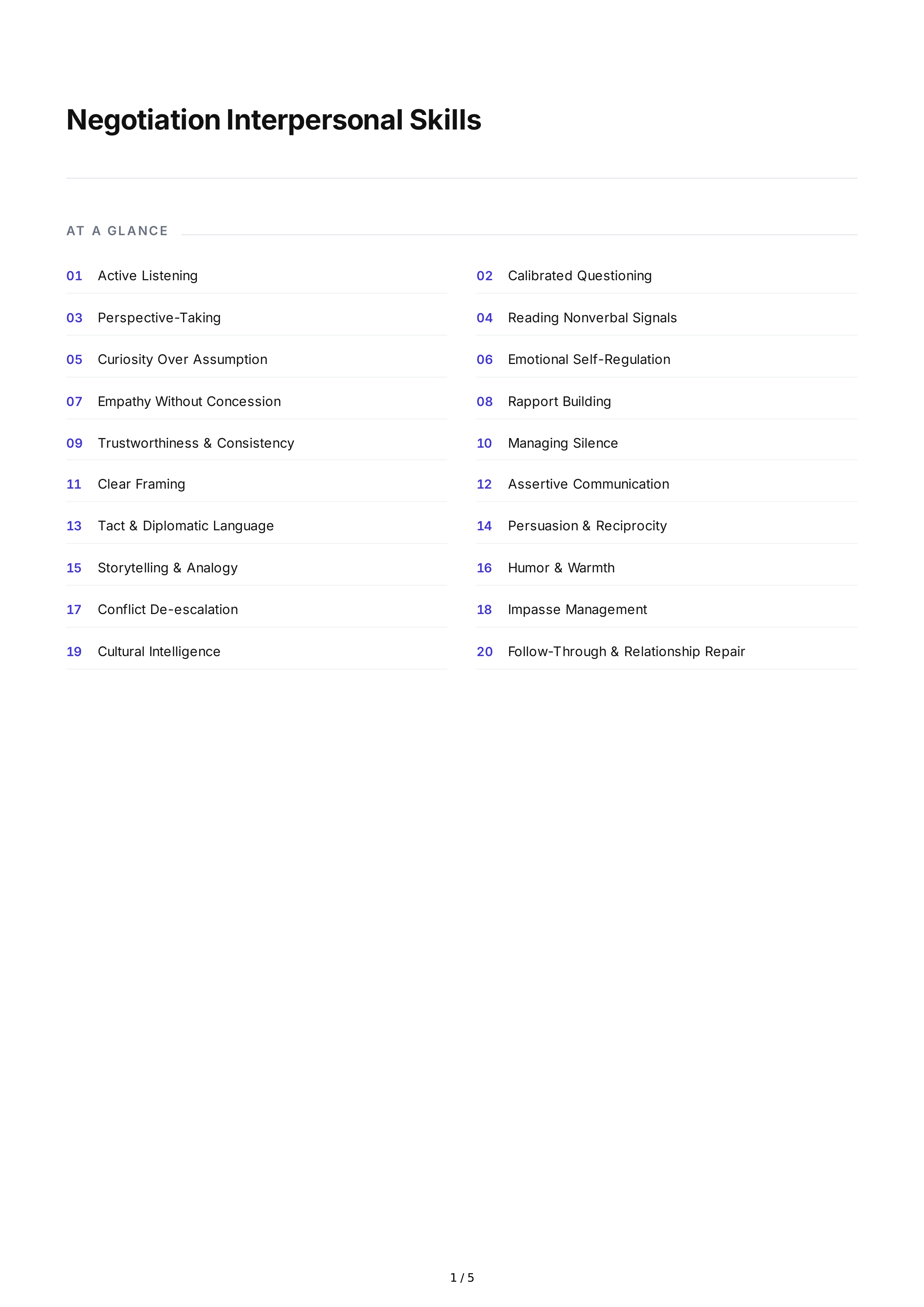
Negotiation
Interpersonal
Skills
AT
A
GLANCE
01
Active
Listening
02
Calibrated
Questioning
03
Perspective
-
Taking
04
Reading
Nonverbal
Signals
05
Curiosity
Over
Assumption
06
Emotional
Self
-
Regulation
07
Empathy
Without
Concession
08
Rapport
Building
09
Trustworthiness
&
Consistency
10
Managing
Silence
11
Clear
Framing
12
Assertive
Communication
13
Tact
&
Diplomatic
Language
14
Persuasion
&
Reciprocity
15
Storytelling
&
Analogy
16
Humor
&
Warmth
17
Conflict
De
-
escalation
18
Impasse
Management
19
Cultural
Intelligence
20
Follow
-
Through
&
Relationship
Repair
1 / 5
A
.
Listening
&
Perception
Getting
accurate
information
out
of
the
room
before
trying
to
change
it
.
01
Active
Listening
Fully
attending
to
the
other
side
'
s
words
,
tone
,
and
emphasis
,
then
confirming
what
you
heard
before
responding
to
it
.
Listening
is
the
data
-
collection
phase
of
every
negotiation
.
IN
T HE
RO O M
"
So
the
blocker
isn
'
t
the
price
,
it
'
s
the
delivery
window
—
have
I
got
that
right
?"
02
Calibrated
Questioning
Asking
open
,
non
-
threatening
questions
that
make
the
other
side
solve
your
problem
for
you
,
rather
than
questions
that
can
be
answered
with
a
simple
yes
or
no
.
IN
T HE
RO O M
"
What
would
have
to
be
true
for
a
three
-
year
term
to
work
on
your
side
?"
03
Perspective
-
Taking
Reconstructing
the
counterpart
'
s
interests
,
pressures
,
incentives
,
and
constraints
accurately
enough
to
predict
their
next
move
before
they
make
it
.
IN
T HE
RO O M
"
If
I
were
their
procurement
lead
,
my
bonus
would
hinge
on
the
discount
line
.
That
explains
the
push
."
04
Reading
Nonverbal
Signals
Noticing
shifts
in
posture
,
pace
,
tone
,
and
eye
contact
that
reveal
when
a
position
is
firm
and
when
it
is
only
a
probe
.
IN
T HE
RO O M
Two
colleagues
glance
at
each
other
before
answering
on
price
—
that
number
is
a
position
,
not
a
probe
.
05
Curiosity
Over
Assumption
Treating
an
early
position
as
information
rather
than
an
obstacle
,
and
testing
hypotheses
instead
of
arguing
against
them
.
IN
T HE
RO O M
"
You
'
ve
said
no
twice
to
the
same
structure
.
Tell
me
what
it
'
s
protecting
."
2 / 5
B
.
Emotional
&
Relational
Keeping
the
relationship
stable
while
the
terms
stay
contested
.
06
Emotional
Self
-
Regulation
Staying
level
when
provoked
,
rushed
,
or
disrespected
,
so
that
a
spike
in
emotion
never
sets
your
strategy
or
your
number
.
IN
T HE
RO O M
"
That
'
s
a
fair
challenge
.
Give
me
a
moment
to
think
about
it
properly
."
07
Empathy
Without
Concession
Acknowledging
the
other
party
'
s
feelings
and
constraints
as
legitimate
,
without
letting
that
acknowledgement
become
a
discount
.
IN
T HE
RO O M
"
I
can
see
the
budget
cycle
puts
you
in
a
hard
spot
.
I
still
can
'
t
move
on
the
rate
."
08
Rapport
Building
Finding
genuine
common
ground
early
so
the
hard
conversation
later
has
a
foundation
underneath
it
.
IN
T HE
RO O M
Ten
unhurried
minutes
on
their
new
warehouse
before
the
agenda
—
that
is
where
trust
for
the
later
ask
is
built
.
09
Trustworthiness
&
Consistency
Doing
what
you
said
you
would
do
between
sessions
.
Small
,
repeated
reliability
compounds
into
leverage
.
IN
T HE
RO O M
Sending
the
revised
draft
by
Thursday
,
as
promised
,
without
being
chased
for
it
.
10
Managing
Silence
Letting
a
pause
do
the
work
instead
of
filling
it
,
and
reading
what
the
other
party
says
first
in
order
to
end
the
silence
.
IN
T HE
RO O M
Offer
made
.
Say
nothing
.
Let
them
speak
first
.
3 / 5
C
.
Expression
&
Influence
Making
your
position
land
in
terms
the
other
side
already
values
.
11
Clear
Framing
Presenting
your
case
in
terms
the
counterpart
already
cares
about
,
rather
than
in
terms
that
only
persuade
you
.
IN
T HE
RO O M
"
This
saves
your
team
eleven
hours
a
week
"
lands
. "
Our
platform
is
best
-
in
-
class
"
does
not
.
12
Assertive
Communication
Stating
needs
and
limits
plainly
and
respectfully
,
without
apology
and
without
aggression
.
IN
T HE
RO O M
"
We
need
payment
in
30
days
.
That
isn
'
t
a
preference
—
it
'
s
how
we
'
re
financed
."
13
Tact
&
Diplomatic
Language
Delivering
a
hard
message
without
triggering
defensiveness
,
so
the
conversation
can
continue
past
the
disagreement
.
IN
T HE
RO O M
"
That
structure
creates
a
real
problem
for
us
"
instead
of
"
That
'
s
ridiculous
."
14
Persuasion
&
Reciprocity
Trading
small
,
low
-
cost
concessions
that
signal
good
faith
and
invite
a
return
of
comparable
value
.
IN
T HE
RO O M
Moving
on
the
payment
schedule
first
,
so
the
discount
ask
can
be
made
later
without
friction
.
15
Storytelling
&
Analogy
Making
an
abstract
number
or
risk
land
by
placing
it
inside
a
concrete
,
familiar
situation
the
other
side
can
picture
.
IN
T HE
RO O M
"
Think
of
the
migration
as
changing
the
engine
mid
-
flight
—
that
'
s
why
we
need
the
extra
week
."
16
Humor
&
Warmth
Using
light
moments
to
lower
the
temperature
without
undermining
the
seriousness
of
the
terms
being
discussed
.
IN
T HE
RO O M
"
I
'
ll
take
the
coffee
,
you
take
the
first
offer
."
Then
straight
back
to
business
.
4 / 5
D
.
Conflict
,
Culture
&
Follow
-
Through
Handling
disagreement
,
difference
,
and
the
relationship
after
the
deal
.
17
Conflict
De
-
escalation
Separating
the
person
from
the
problem
and
steering
a
heated
exchange
back
toward
underlying
interests
.
IN
T HE
RO O M
"
Let
'
s
drop
the
last
two
hours
and
start
again
from
what
each
side
actually
needs
."
18
Impasse
Management
Recognising
when
to
change
the
frame
,
take
a
break
,
or
bring
in
a
third
party
rather
than
pushing
harder
on
the
same
point
.
IN
T HE
RO O M
"
We
'
ve
gone
in
a
circle
twice
.
Shall
we
take
it
offline
and
come
back
Friday
with
options
?"
19
Cultural
Intelligence
Adjusting
directness
,
pace
,
formality
,
and
decision
-
making
assumptions
to
the
norms
of
the
counterpart
'
s
context
.
IN
T HE
RO O M
Slowing
the
pace
and
dropping
the
hard
close
with
a
counterpart
who
reads
pressure
as
disrespect
.
20
Follow
-
Through
&
Relationship
Repair
Closing
the
loop
after
the
agreement
is
signed
,
and
repairing
the
relationship
when
a
negotiation
does
not
land
.
IN
T HE
RO O M
A
short
call
after
the
deal
—
and
an
equally
short
call
after
the
deal
that
never
happened
.
5 / 5