Coordination
&
Interpersonal
Skills
1 / 5
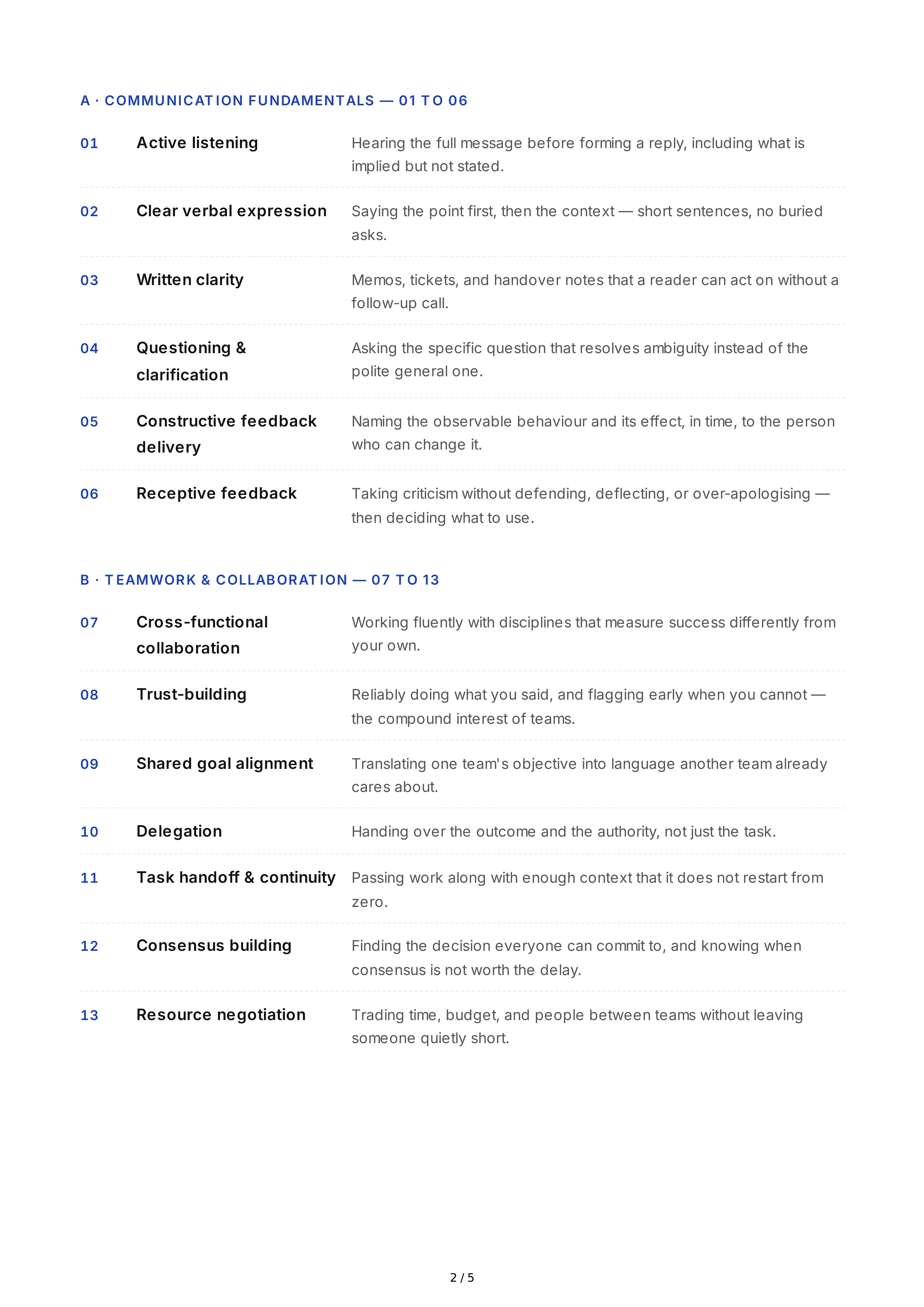
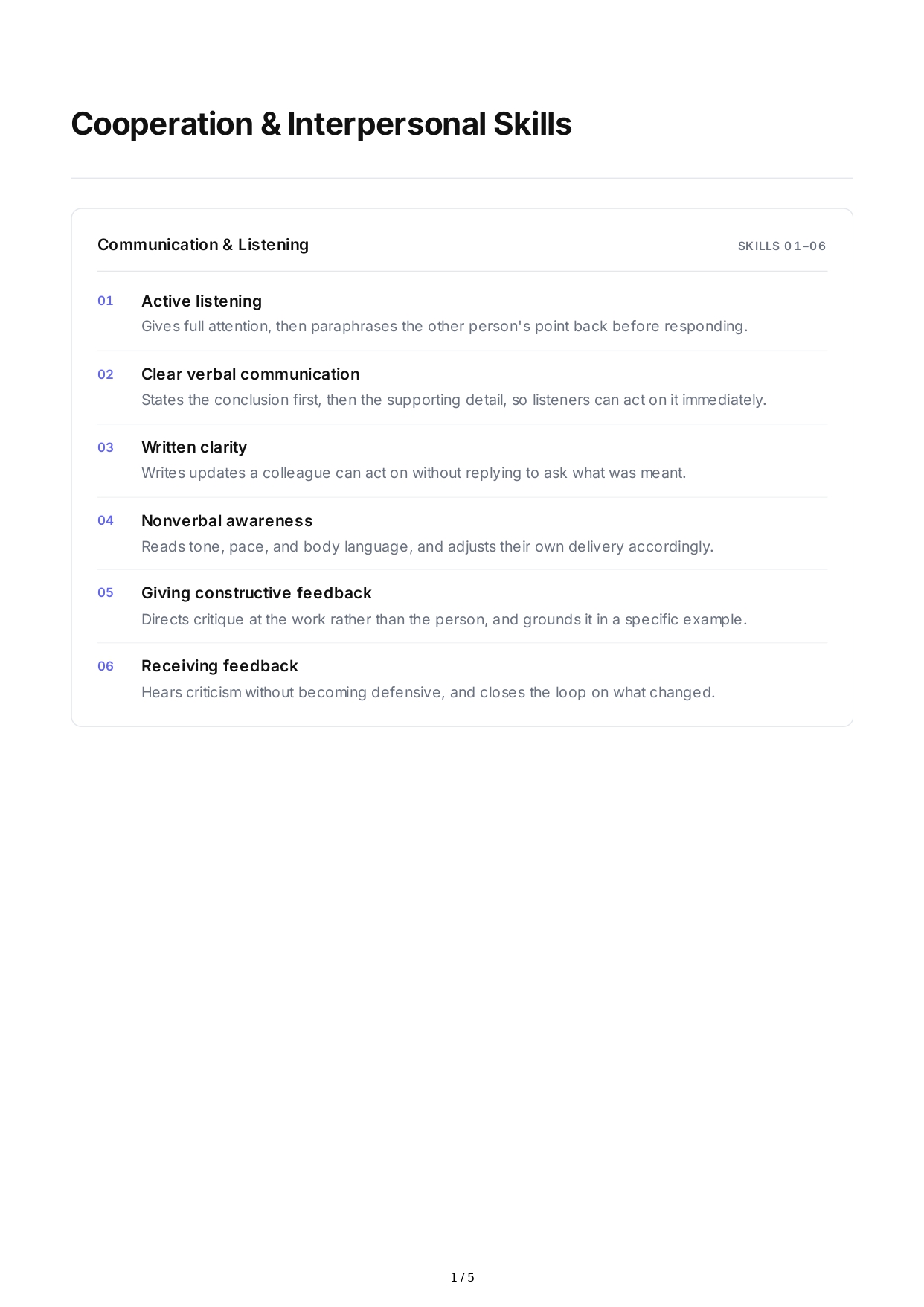
A
·
COMMUNICAT ION
FUNDAMENTALS
— 01
T O
06
01
Active
listening
Hearing
the
full
message
before
forming
a
reply
,
including
what
is
implied
but
not
stated
.
02
Clear
verbal
expression
Saying
the
point
first
,
then
the
context
—
short
sentences
,
no
buried
asks
.
03
Written
clarity
Memos
,
tickets
,
and
handover
notes
that
a
reader
can
act
on
without
a
follow
-
up
call
.
04
Questioning
&
clarification
Asking
the
specific
question
that
resolves
ambiguity
instead
of
the
polite
general
one
.
05
Constructive
feedback
delivery
Naming
the
observable
behaviour
and
its
effect
,
in
time
,
to
the
person
who
can
change
it
.
06
Receptive
feedback
Taking
criticism
without
defending
,
deflecting
,
or
over
-
apologising
—
then
deciding
what
to
use
.
B
·
T EAMWORK
&
COLLABORAT ION
— 07
T O
13
07
Cross
-
functional
collaboration
Working
fluently
with
disciplines
that
measure
success
differently
from
your
own
.
08
Trust
-
building
Reliably
doing
what
you
said
,
and
flagging
early
when
you
cannot
—
the
compound
interest
of
teams
.
09
Shared
goal
alignment
Translating
one
team
'
s
objective
into
language
another
team
already
cares
about
.
10
Delegation
Handing
over
the
outcome
and
the
authority
,
not
just
the
task
.
11
Task
handoff
&
continuity
Passing
work
along
with
enough
context
that
it
does
not
restart
from
zero
.
12
Consensus
building
Finding
the
decision
everyone
can
commit
to
,
and
knowing
when
consensus
is
not
worth
the
delay
.
13
Resource
negotiation
Trading
time
,
budget
,
and
people
between
teams
without
leaving
someone
quietly
short
.
2 / 5
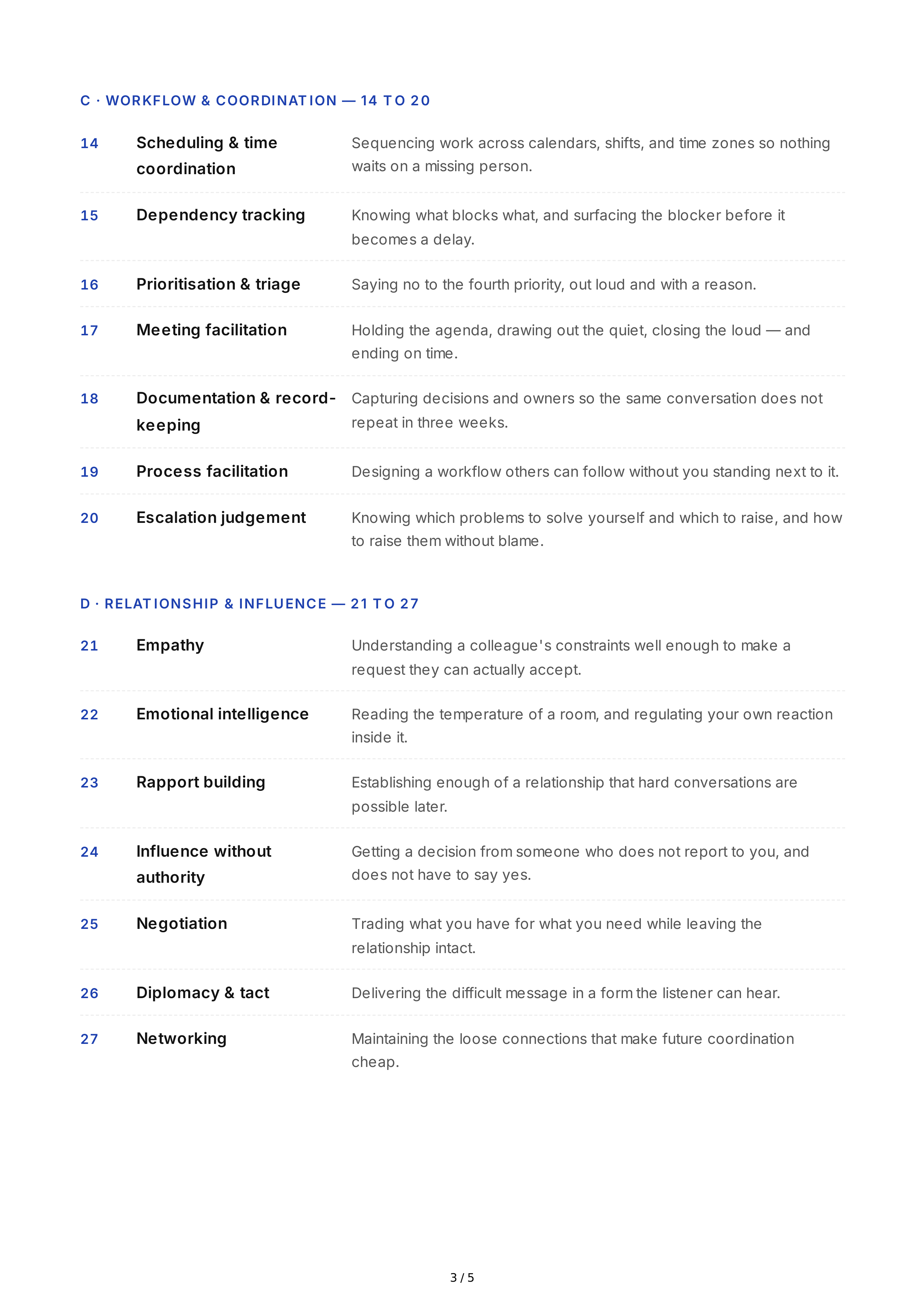
C
·
WORKFLOW
&
COORDINAT ION
— 14
T O
20
14
Scheduling
&
time
coordination
Sequencing
work
across
calendars
,
shifts
,
and
time
zones
so
nothing
waits
on
a
missing
person
.
15
Dependency
tracking
Knowing
what
blocks
what
,
and
surfacing
the
blocker
before
it
becomes
a
delay
.
16
Prioritisation
&
triage
Saying
no
to
the
fourth
priority
,
out
loud
and
with
a
reason
.
17
Meeting
facilitation
Holding
the
agenda
,
drawing
out
the
quiet
,
closing
the
loud
—
and
ending
on
time
.
18
Documentation
&
record
-
keeping
Capturing
decisions
and
owners
so
the
same
conversation
does
not
repeat
in
three
weeks
.
19
Process
facilitation
Designing
a
workflow
others
can
follow
without
you
standing
next
to
it
.
20
Escalation
judgement
Knowing
which
problems
to
solve
yourself
and
which
to
raise
,
and
how
to
raise
them
without
blame
.
D
·
RELAT IONSHIP
&
INFLUENCE
— 21
T O
27
21
Empathy
Understanding
a
colleague
'
s
constraints
well
enough
to
make
a
request
they
can
actually
accept
.
22
Emotional
intelligence
Reading
the
temperature
of
a
room
,
and
regulating
your
own
reaction
inside
it
.
23
Rapport
building
Establishing
enough
of
a
relationship
that
hard
conversations
are
possible
later
.
24
Influence
without
authority
Getting
a
decision
from
someone
who
does
not
report
to
you
,
and
does
not
have
to
say
yes
.
25
Negotiation
Trading
what
you
have
for
what
you
need
while
leaving
the
relationship
intact
.
26
Diplomacy
&
tact
Delivering
the
difficult
message
in
a
form
the
listener
can
hear
.
27
Networking
Maintaining
the
loose
connections
that
make
future
coordination
cheap
.
3 / 5
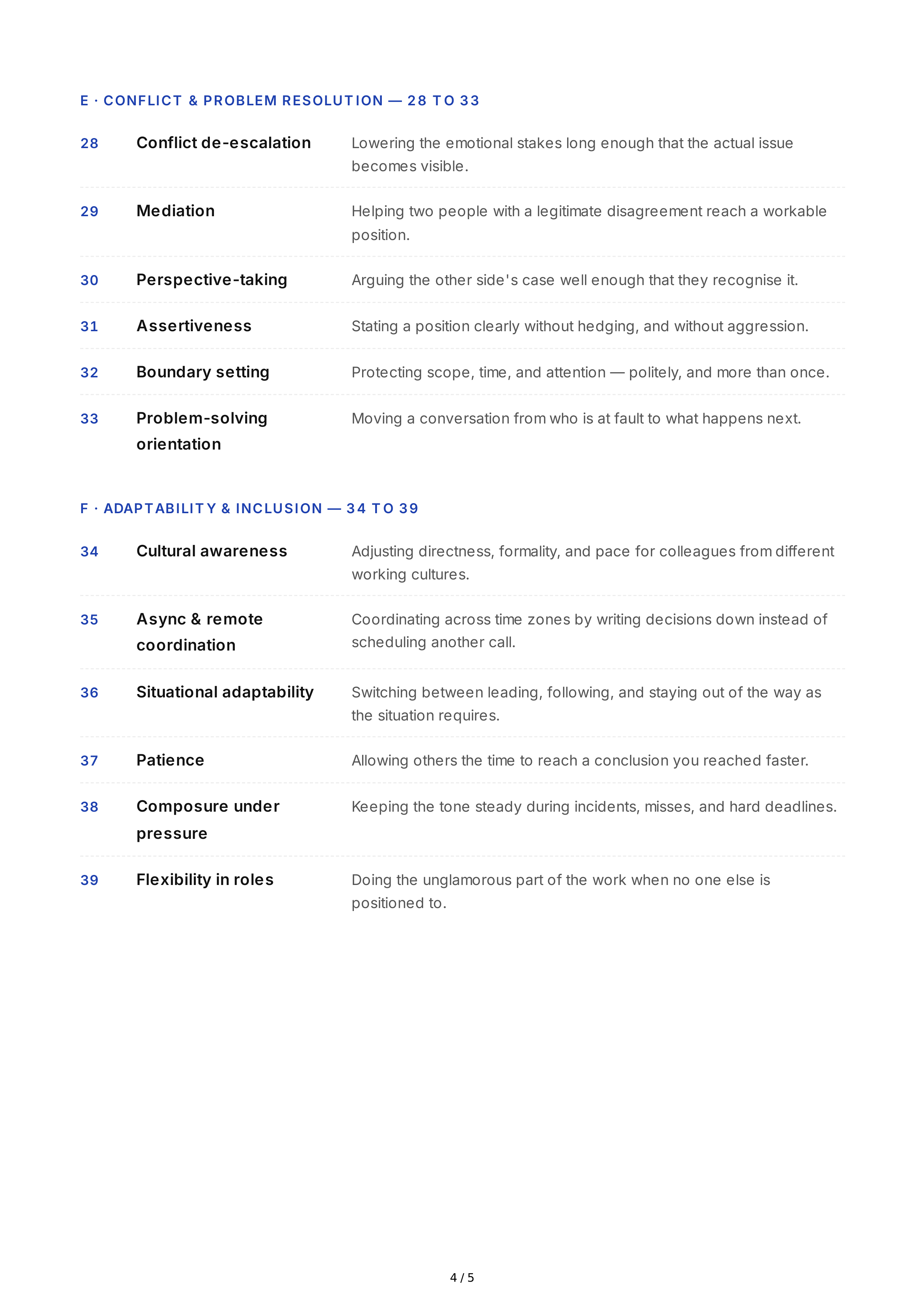
E
·
CONFLICT
&
PROBLEM
RESOLUT ION
— 28
T O
33
28
Conflict
de
-
escalation
Lowering
the
emotional
stakes
long
enough
that
the
actual
issue
becomes
visible
.
29
Mediation
Helping
two
people
with
a
legitimate
disagreement
reach
a
workable
position
.
30
Perspective
-
taking
Arguing
the
other
side
'
s
case
well
enough
that
they
recognise
it
.
31
Assertiveness
Stating
a
position
clearly
without
hedging
,
and
without
aggression
.
32
Boundary
setting
Protecting
scope
,
time
,
and
attention
—
politely
,
and
more
than
once
.
33
Problem
-
solving
orientation
Moving
a
conversation
from
who
is
at
fault
to
what
happens
next
.
F
·
ADAPTABILIT Y
&
INCLUSION
— 34
T O
39
34
Cultural
awareness
Adjusting
directness
,
formality
,
and
pace
for
colleagues
from
different
working
cultures
.
35
Async
&
remote
coordination
Coordinating
across
time
zones
by
writing
decisions
down
instead
of
scheduling
another
call
.
36
Situational
adaptability
Switching
between
leading
,
following
,
and
staying
out
of
the
way
as
the
situation
requires
.
37
Patience
Allowing
others
the
time
to
reach
a
conclusion
you
reached
faster
.
38
Composure
under
pressure
Keeping
the
tone
steady
during
incidents
,
misses
,
and
hard
deadlines
.
39
Flexibility
in
roles
Doing
the
unglamorous
part
of
the
work
when
no
one
else
is
positioned
to
.
4 / 5
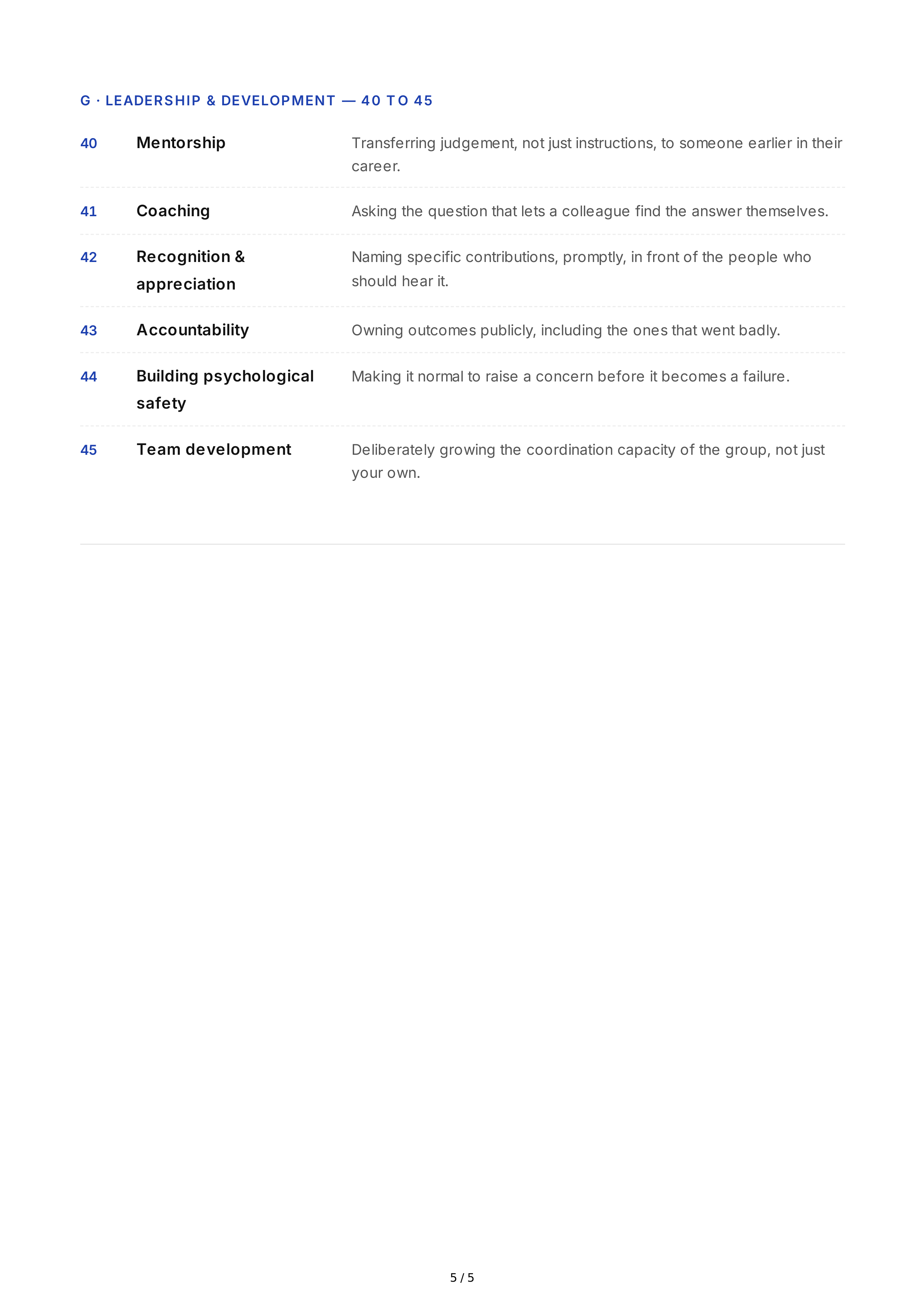
G
·
LEADERSHIP
&
DEVELOPMENT
— 40
T O
45
40
Mentorship
Transferring
judgement
,
not
just
instructions
,
to
someone
earlier
in
their
career
.
41
Coaching
Asking
the
question
that
lets
a
colleague
find
the
answer
themselves
.
42
Recognition
&
appreciation
Naming
specific
contributions
,
promptly
,
in
front
of
the
people
who
should
hear
it
.
43
Accountability
Owning
outcomes
publicly
,
including
the
ones
that
went
badly
.
44
Building
psychological
safety
Making
it
normal
to
raise
a
concern
before
it
becomes
a
failure
.
45
Team
development
Deliberately
growing
the
coordination
capacity
of
the
group
,
not
just
your
own
.
5 / 5