
Reflective
Listening
1 / 16
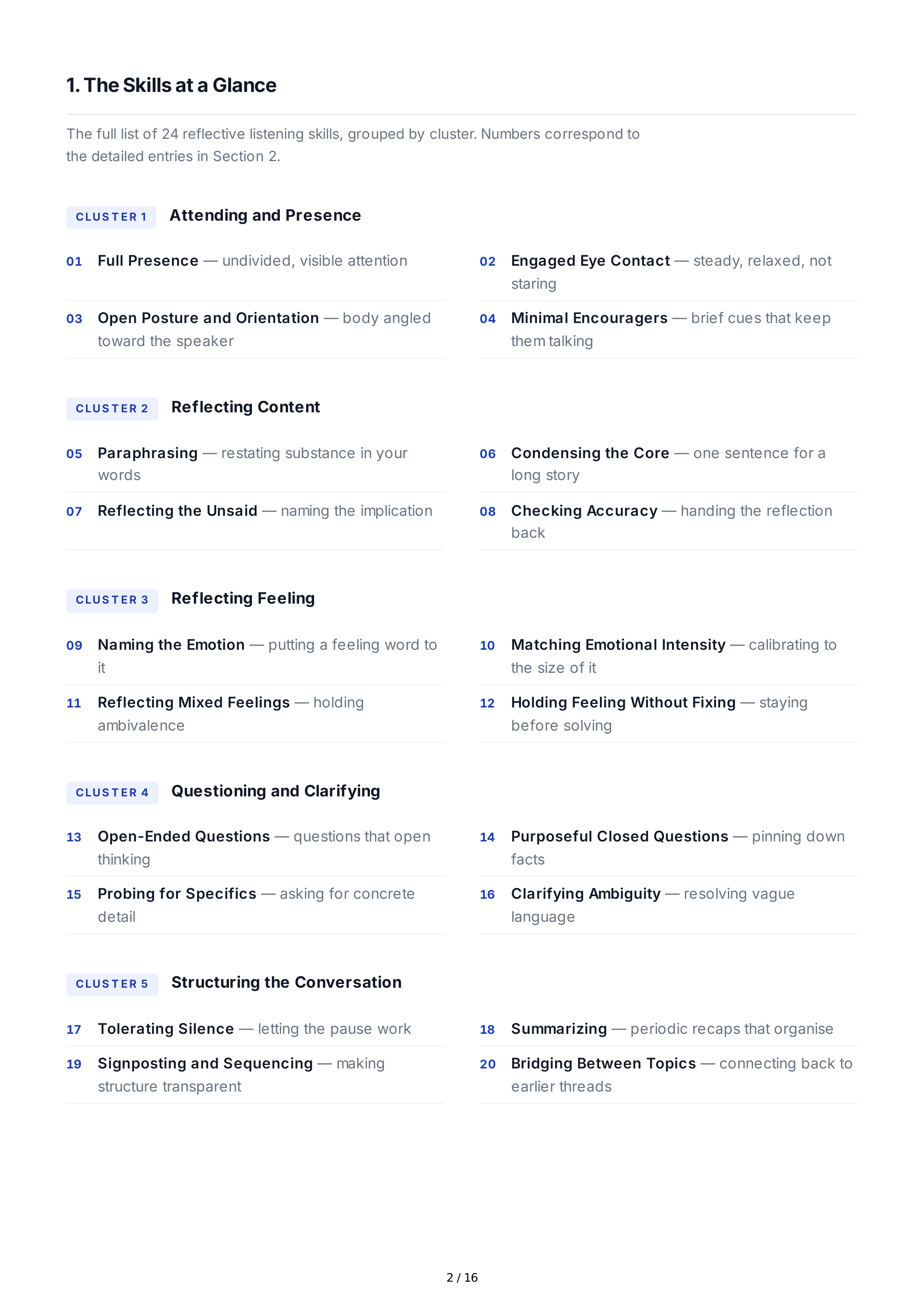
1.
The
Skills
at
a
Glance
The
full
list
of
24
reflective
listening
skills
,
grouped
by
cluster
.
Numbers
correspond
to
the
detailed
entries
in
Section
2.
CLUS T E R
1
Attending
and
Presence
01
Full
Presence
—
undivided
,
visible
attention
02
Engaged
Eye
Contact
—
steady
,
relaxed
,
not
staring
03
Open
Posture
and
Orientation
—
body
angled
toward
the
speaker
04
Minimal
Encouragers
—
brief
cues
that
keep
them
talking
CLUS T E R
2
Reflecting
Content
05
Paraphrasing
—
restating
substance
in
your
words
06
Condensing
the
Core
—
one
sentence
for
a
long
story
07
Reflecting
the
Unsaid
—
naming
the
implication
08
Checking
Accuracy
—
handing
the
reflection
back
CLUS T E R
3
Reflecting
Feeling
09
Naming
the
Emotion
—
putting
a
feeling
word
to
it
10
Matching
Emotional
Intensity
—
calibrating
to
the
size
of
it
11
Reflecting
Mixed
Feelings
—
holding
ambivalence
12
Holding
Feeling
Without
Fixing
—
staying
before
solving
CLUS T E R
4
Questioning
and
Clarifying
13
Open
-
Ended
Questions
—
questions
that
open
thinking
14
Purposeful
Closed
Questions
—
pinning
down
facts
15
Probing
for
Specifics
—
asking
for
concrete
detail
16
Clarifying
Ambiguity
—
resolving
vague
language
CLUS T E R
5
Structuring
the
Conversation
17
Tolerating
Silence
—
letting
the
pause
work
18
Summarizing
—
periodic
recaps
that
organise
19
Signposting
and
Sequencing
—
making
structure
transparent
20
Bridging
Between
Topics
—
connecting
back
to
earlier
threads
2 / 16

CLUS T E R
6
Self
-
Management
and
Moving
Forward
21
Suspending
Judgment
—
understanding
before
evaluating
22
Managing
Your
Own
Reactions
—
noticing
your
defensiveness
23
Reading
Nonverbal
Congruence
—
words
versus
body
24
Confirming
Understanding
and
Next
Steps
—
closing
the
loop
3 / 16

2.
Skills
in
Detail
Each
entry
gives
the
skill
,
what
it
actually
consists
of
,
a
line
of
language
or
behaviour
that
demonstrates
it
,
and
the
most
common
way
it
goes
wrong
.
4 / 16
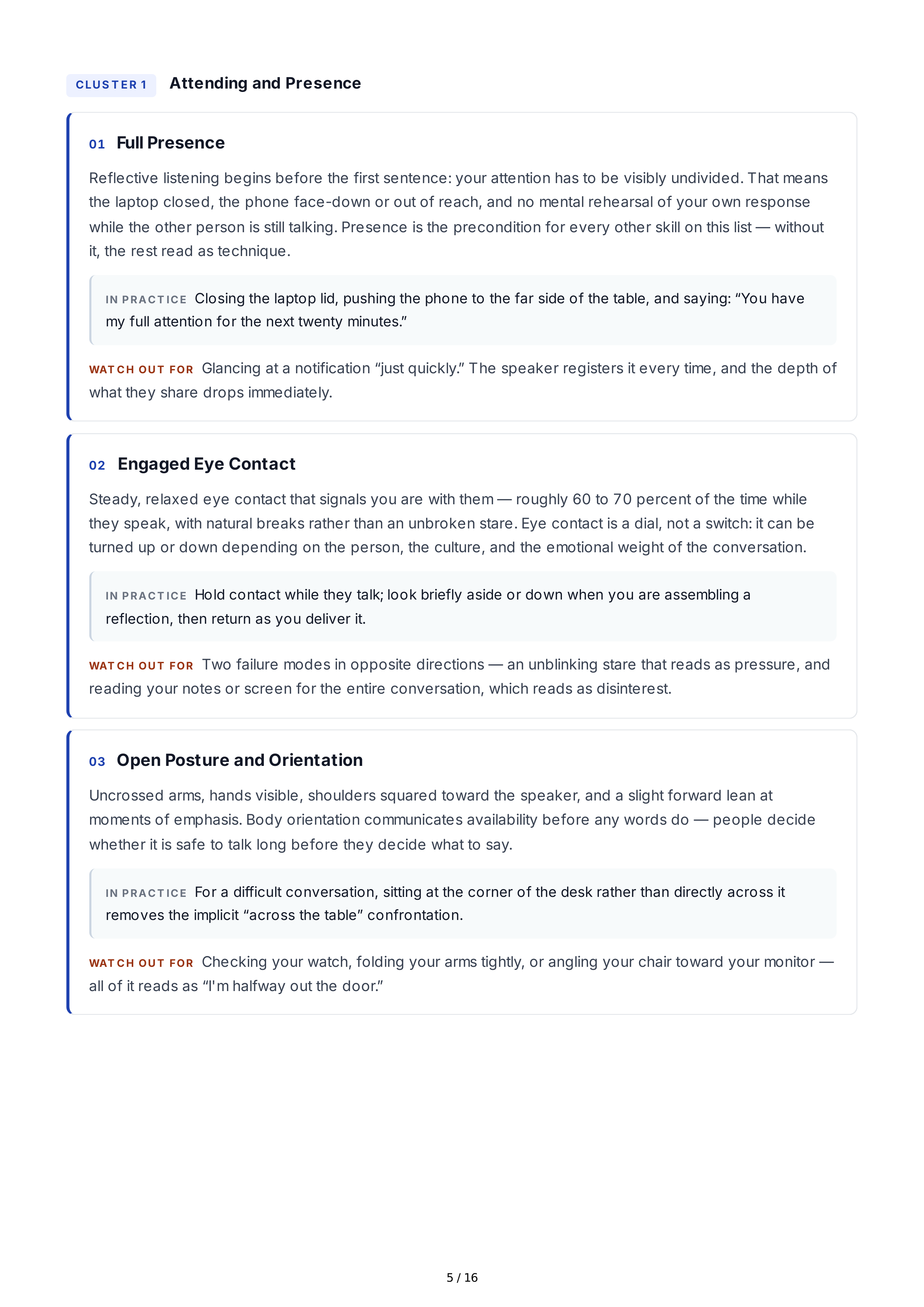
CLUS T E R
1
Attending
and
Presence
01
Full
Presence
Reflective
listening
begins
before
the
first
sentence
:
your
attention
has
to
be
visibly
undivided
.
That
means
the
laptop
closed
,
the
phone
face
-
down
or
out
of
reach
,
and
no
mental
rehearsal
of
your
own
response
while
the
other
person
is
still
talking
.
Presence
is
the
precondition
for
every
other
skill
on
this
list
—
without
it
,
the
rest
read
as
technique
.
IN
PRAC T IC E
Closing
the
laptop
lid
,
pushing
the
phone
to
the
far
side
of
the
table
,
and
saying
: “
You
have
my
full
attention
for
the
next
twenty
minutes
.”
WAT C H
OU T
FOR
Glancing
at
a
notification
“
just
quickly
.”
The
speaker
registers
it
every
time
,
and
the
depth
of
what
they
share
drops
immediately
.
02
Engaged
Eye
Contact
Steady
,
relaxed
eye
contact
that
signals
you
are
with
them
—
roughly
60
to
70
percent
of
the
time
while
they
speak
,
with
natural
breaks
rather
than
an
unbroken
stare
.
Eye
contact
is
a
dial
,
not
a
switch
:
it
can
be
turned
up
or
down
depending
on
the
person
,
the
culture
,
and
the
emotional
weight
of
the
conversation
.
IN
PRAC T IC E
Hold
contact
while
they
talk
;
look
briefly
aside
or
down
when
you
are
assembling
a
reflection
,
then
return
as
you
deliver
it
.
WAT C H
OU T
FOR
Two
failure
modes
in
opposite
directions
—
an
unblinking
stare
that
reads
as
pressure
,
and
reading
your
notes
or
screen
for
the
entire
conversation
,
which
reads
as
disinterest
.
03
Open
Posture
and
Orientation
Uncrossed
arms
,
hands
visible
,
shoulders
squared
toward
the
speaker
,
and
a
slight
forward
lean
at
moments
of
emphasis
.
Body
orientation
communicates
availability
before
any
words
do
—
people
decide
whether
it
is
safe
to
talk
long
before
they
decide
what
to
say
.
IN
PRAC T IC E
For
a
difficult
conversation
,
sitting
at
the
corner
of
the
desk
rather
than
directly
across
it
removes
the
implicit
“
across
the
table
”
confrontation
.
WAT C H
OU T
FOR
Checking
your
watch
,
folding
your
arms
tightly
,
or
angling
your
chair
toward
your
monitor
—
all
of
it
reads
as
“
I
'
m
halfway
out
the
door
.”
5 / 16

04
Minimal
Encouragers
Short
verbal
and
paralinguistic
cues
— “
mm
-
hm
,” “
go
on
,” “
right
,” “
I
see
” —
plus
small
nods
that
keep
the
speaker
going
without
taking
the
floor
.
They
are
the
conversational
equivalent
of
holding
a
door
open
:
they
cost
almost
nothing
and
they
change
what
happens
next
.
SOU ND S
LIKE
“
Mm
-
hm
.
Keep
going
—
I
want
to
hear
the
rest
of
it
before
I
say
anything
.”
WAT C H
OU T
FOR
Overusing
them
until
they
become
a
tic
,
or
letting
them
drift
into
agreement
(“
right
,
exactly
”)
when
you
do
not
actually
agree
yet
.
Once
you
have
signalled
agreement
,
the
speaker
will
hear
your
later
objection
as
a
reversal
.
6 / 16
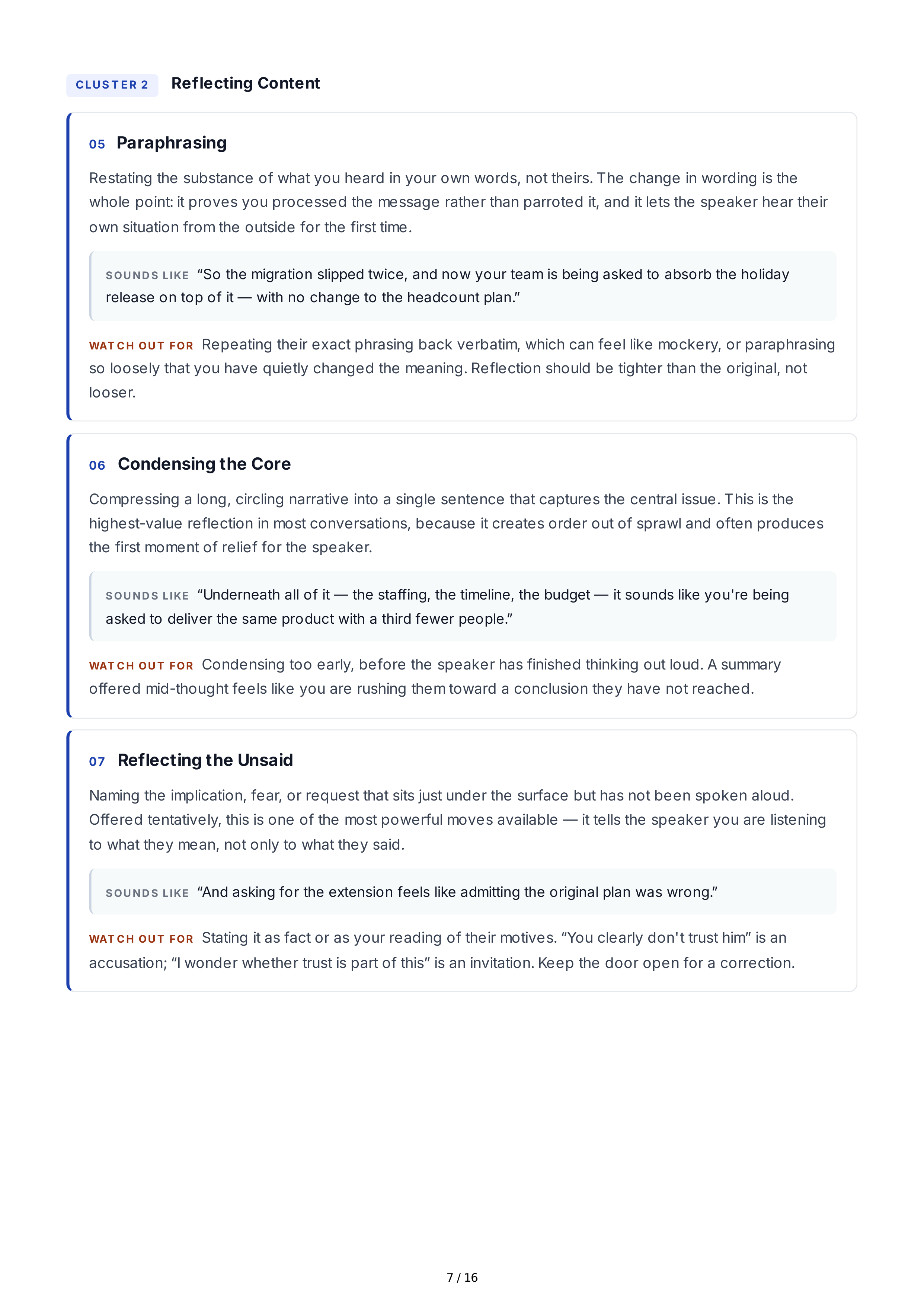
CLUS T E R
2
Reflecting
Content
05
Paraphrasing
Restating
the
substance
of
what
you
heard
in
your
own
words
,
not
theirs
.
The
change
in
wording
is
the
whole
point
:
it
proves
you
processed
the
message
rather
than
parroted
it
,
and
it
lets
the
speaker
hear
their
own
situation
from
the
outside
for
the
first
time
.
SOU ND S
LIKE
“
So
the
migration
slipped
twice
,
and
now
your
team
is
being
asked
to
absorb
the
holiday
release
on
top
of
it
—
with
no
change
to
the
headcount
plan
.”
WAT C H
OU T
FOR
Repeating
their
exact
phrasing
back
verbatim
,
which
can
feel
like
mockery
,
or
paraphrasing
so
loosely
that
you
have
quietly
changed
the
meaning
.
Reflection
should
be
tighter
than
the
original
,
not
looser
.
06
Condensing
the
Core
Compressing
a
long
,
circling
narrative
into
a
single
sentence
that
captures
the
central
issue
.
This
is
the
highest
-
value
reflection
in
most
conversations
,
because
it
creates
order
out
of
sprawl
and
often
produces
the
first
moment
of
relief
for
the
speaker
.
SOU ND S
LIKE
“
Underneath
all
of
it
—
the
staffing
,
the
timeline
,
the
budget
—
it
sounds
like
you
'
re
being
asked
to
deliver
the
same
product
with
a
third
fewer
people
.”
WAT C H
OU T
FOR
Condensing
too
early
,
before
the
speaker
has
finished
thinking
out
loud
.
A
summary
offered
mid
-
thought
feels
like
you
are
rushing
them
toward
a
conclusion
they
have
not
reached
.
07
Reflecting
the
Unsaid
Naming
the
implication
,
fear
,
or
request
that
sits
just
under
the
surface
but
has
not
been
spoken
aloud
.
Offered
tentatively
,
this
is
one
of
the
most
powerful
moves
available
—
it
tells
the
speaker
you
are
listening
to
what
they
mean
,
not
only
to
what
they
said
.
SOU ND S
LIKE
“
And
asking
for
the
extension
feels
like
admitting
the
original
plan
was
wrong
.”
WAT C H
OU T
FOR
Stating
it
as
fact
or
as
your
reading
of
their
motives
. “
You
clearly
don
'
t
trust
him
”
is
an
accusation
; “
I
wonder
whether
trust
is
part
of
this
”
is
an
invitation
.
Keep
the
door
open
for
a
correction
.
7 / 16

08
Checking
Accuracy
Explicitly
handing
the
reflection
back
for
verification
instead
of
assuming
you
got
it
right
.
This
is
the
step
that
turns
a
monologue
into
a
dialogue
and
gives
the
speaker
control
over
the
record
of
their
own
experience
.
SOU ND S
LIKE
“
Am
I
getting
that
right
?” · “
How
close
am
I
?” · “
What
did
I
miss
?”
WAT C H
OU T
FOR
Skipping
verification
on
emotionally
loaded
content
—
the
misread
compounds
,
and
the
speaker
has
to
spend
energy
correcting
you
instead
of
continuing
to
think
.
8 / 16
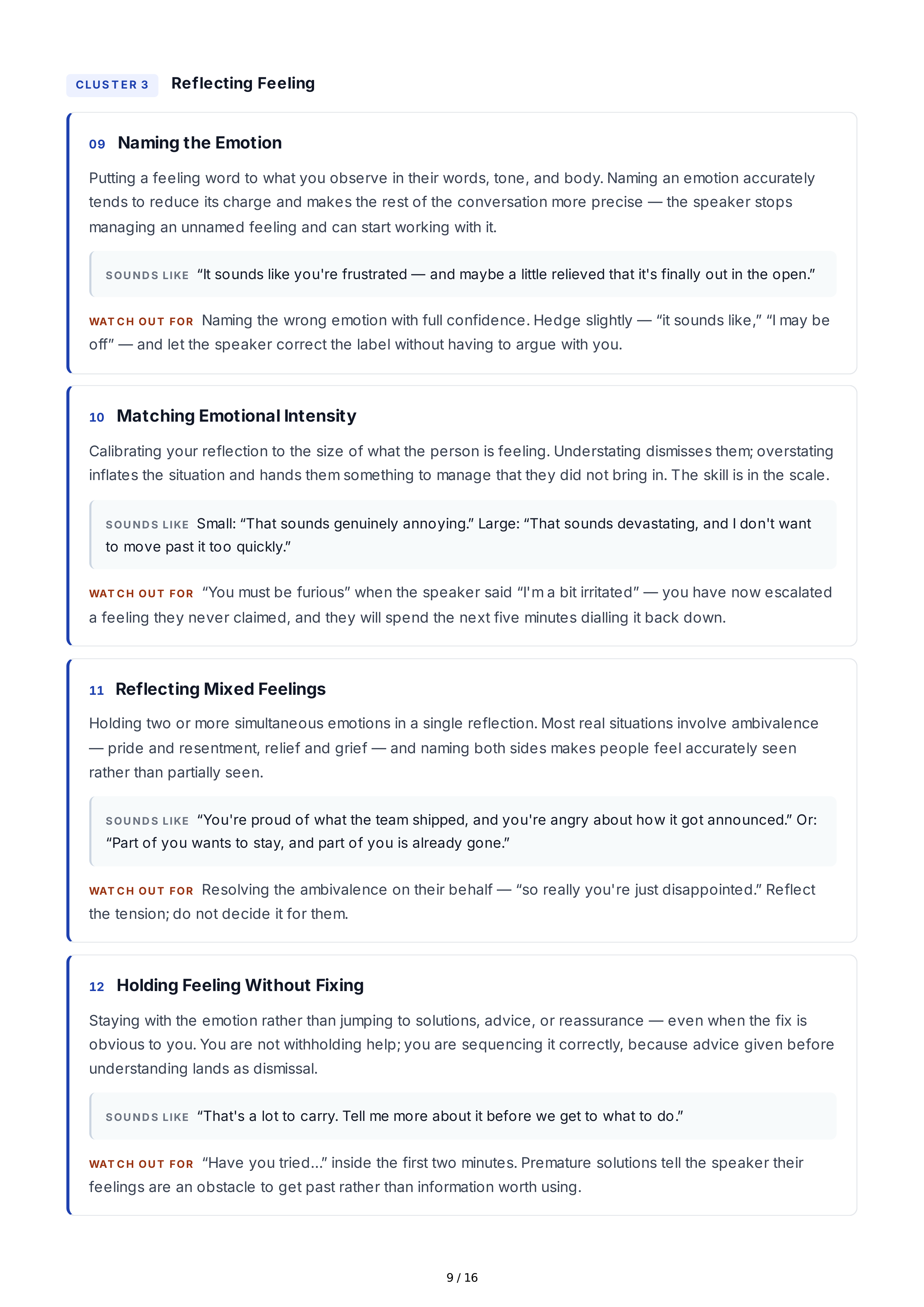
CLUS T E R
3
Reflecting
Feeling
09
Naming
the
Emotion
Putting
a
feeling
word
to
what
you
observe
in
their
words
,
tone
,
and
body
.
Naming
an
emotion
accurately
tends
to
reduce
its
charge
and
makes
the
rest
of
the
conversation
more
precise
—
the
speaker
stops
managing
an
unnamed
feeling
and
can
start
working
with
it
.
SOU ND S
LIKE
“
It
sounds
like
you
'
re
frustrated
—
and
maybe
a
little
relieved
that
it
'
s
finally
out
in
the
open
.”
WAT C H
OU T
FOR
Naming
the
wrong
emotion
with
full
confidence
.
Hedge
slightly
— “
it
sounds
like
,” “
I
may
be
off
” —
and
let
the
speaker
correct
the
label
without
having
to
argue
with
you
.
10
Matching
Emotional
Intensity
Calibrating
your
reflection
to
the
size
of
what
the
person
is
feeling
.
Understating
dismisses
them
;
overstating
inflates
the
situation
and
hands
them
something
to
manage
that
they
did
not
bring
in
.
The
skill
is
in
the
scale
.
SOU ND S
LIKE
Small
: “
That
sounds
genuinely
annoying
.”
Large
: “
That
sounds
devastating
,
and
I
don
'
t
want
to
move
past
it
too
quickly
.”
WAT C H
OU T
FOR
“
You
must
be
furious
”
when
the
speaker
said
“
I
'
m
a
bit
irritated
” —
you
have
now
escalated
a
feeling
they
never
claimed
,
and
they
will
spend
the
next
five
minutes
dialling
it
back
down
.
11
Reflecting
Mixed
Feelings
Holding
two
or
more
simultaneous
emotions
in
a
single
reflection
.
Most
real
situations
involve
ambivalence
—
pride
and
resentment
,
relief
and
grief
—
and
naming
both
sides
makes
people
feel
accurately
seen
rather
than
partially
seen
.
SOU ND S
LIKE
“
You
'
re
proud
of
what
the
team
shipped
,
and
you
'
re
angry
about
how
it
got
announced
.”
Or
:
“
Part
of
you
wants
to
stay
,
and
part
of
you
is
already
gone
.”
WAT C H
OU T
FOR
Resolving
the
ambivalence
on
their
behalf
— “
so
really
you
'
re
just
disappointed
.”
Reflect
the
tension
;
do
not
decide
it
for
them
.
12
Holding
Feeling
Without
Fixing
Staying
with
the
emotion
rather
than
jumping
to
solutions
,
advice
,
or
reassurance
—
even
when
the
fix
is
obvious
to
you
.
You
are
not
withholding
help
;
you
are
sequencing
it
correctly
,
because
advice
given
before
understanding
lands
as
dismissal
.
SOU ND S
LIKE
“
That
'
s
a
lot
to
carry
.
Tell
me
more
about
it
before
we
get
to
what
to
do
.”
WAT C H
OU T
FOR
“
Have
you
tried
…”
inside
the
first
two
minutes
.
Premature
solutions
tell
the
speaker
their
feelings
are
an
obstacle
to
get
past
rather
than
information
worth
using
.
9 / 16
CLUS T E R
4
Questioning
and
Clarifying
13
Open
-
Ended
Questions
Questions
that
cannot
be
answered
with
yes
or
no
,
which
hand
the
speaker
room
to
think
rather
than
simply
confirm
.
Good
open
questions
are
short
,
plain
,
and
slightly
brave
—
they
invite
the
person
to
go
somewhere
they
have
not
planned
to
go
.
SOU ND S
LIKE
“
What
was
that
like
for
you
?” · “
What
'
s
the
part
that
'
s
weighing
on
you
most
?” · “
What
would
change
if
this
went
differently
?”
WAT C H
OU T
FOR
“
Why
”
questions
,
which
land
as
accusation
in
most
workplace
and
family
contexts
. “
Why
did
you
do
that
?”
is
better
heard
as
“
What
was
going
on
for
you
when
that
happened
?”
14
Purposeful
Closed
Questions
Yes
/
no
and
factual
questions
used
deliberately
to
pin
down
specifics
:
dates
,
numbers
,
decisions
,
commitments
.
Closed
questions
are
not
the
enemy
—
they
are
precision
tools
,
and
refusing
to
use
them
leaves
important
details
permanently
vague
.
SOU ND S
LIKE
“
Did
the
client
sign
the
revised
scope
of
work
?” · “
Is
the
deadline
the
14
th
or
the
21
st
?”
WAT C H
OU T
FOR
Strings
of
closed
questions
.
Four
in
a
row
turns
a
conversation
into
an
interrogation
,
and
the
speaker
stops
volunteering
anything
you
did
not
ask
for
.
15
Probing
for
Specifics
Asking
for
concrete
detail
when
the
account
stays
abstract
—
which
usually
means
the
speaker
is
either
protecting
someone
,
protecting
themselves
,
or
has
not
examined
the
moment
closely
yet
.
Specificity
is
where
vague
distress
becomes
workable
information
.
SOU ND S
LIKE
“
What
did
she
say
,
exactly
?” · “
When
did
that
start
?” · “
Walk
me
through
the
last
five
minutes
of
that
meeting
.”
WAT C H
OU T
FOR
Probing
like
a
cross
-
examination
.
Pair
every
probe
with
a
reflection
so
it
reads
as
interest
rather
than
audit
— “
that
sounds
like
it
landed
badly
.
What
did
she
actually
say
?”
10 / 16
16
Clarifying
Ambiguity
Resolving
pronouns
,
vague
timelines
,
and
loaded
shorthand
before
they
cause
a
misunderstanding
downstream
.
Ambiguity
is
comfortable
in
the
moment
and
expensive
later
,
which
is
why
this
skill
feels
awkward
precisely
when
it
matters
most
.
SOU ND S
LIKE
“
When
you
say
they
,
who
do
you
mean
?” · “
You
said
soon
—
is
that
this
week
or
this
quarter
?”
WAT C H
OU T
FOR
Letting
ambiguity
slide
to
keep
the
conversation
comfortable
.
The
misunderstanding
does
not
disappear
;
it
surfaces
later
,
usually
at
a
worse
moment
and
with
more
people
involved
.
11 / 16
CLUS T E R
5
Structuring
the
Conversation
17
Tolerating
Silence
Letting
three
to
five
seconds
of
quiet
stand
.
Silence
is
where
people
locate
the
thing
they
actually
came
to
say
;
filling
it
is
almost
always
about
your
own
discomfort
rather
than
their
need
.
This
is
the
single
hardest
skill
on
the
list
for
most
people
.
SOU ND S
LIKE
“
You
said
you
'
d
email
me
when
it
was
clear
in
your
head
.
I
'
m
not
in
a
rush
.” —
you
say
nothing
after
“
I
'
ll
email
you
when
it
'
s
clear
in
my
head
,”
and
nod
.
WAT C H
OU T
FOR
Filling
the
gap
with
advice
,
a
story
of
your
own
,
or
“
well
,
at
least
…”.
The
most
important
sentence
in
the
conversation
often
arrives
directly
after
the
pause
you
were
tempted
to
break
.
18
Summarizing
Periodic
recaps
that
pull
scattered
threads
into
order
and
give
the
speaker
a
chance
to
hear
their
own
situation
from
outside
.
A
good
summary
is
also
the
natural
hinge
point
of
a
conversation
—
it
marks
where
listening
ends
and
responding
begins
.
SOU ND S
LIKE
“
Let
me
pull
together
what
I
'
ve
heard
so
far
:
the
scope
grew
,
the
deadline
didn
'
t
,
and
you
'
ve
been
absorbing
it
personally
instead
of
escalating
.
Is
that
the
shape
of
it
?”
WAT C H
OU T
FOR
Summarizing
as
a
way
to
end
the
conversation
prematurely
.
A
summary
should
open
a
door
,
not
close
the
topic
—
check
whether
there
is
more
before
you
move
on
.
19
Signposting
and
Sequencing
Telling
the
speaker
what
you
are
about
to
do
and
in
what
order
,
so
the
structure
of
the
conversation
is
transparent
rather
than
implicit
.
Signposting
respects
the
speaker
'
s
time
and
makes
it
easier
for
them
to
follow
where
you
are
going
.
SOU ND S
LIKE
“
Before
we
move
on
,
I
want
to
check
one
thing
.” · “
There
are
three
threads
here
—
can
we
take
them
one
at
a
time
?”
WAT C H
OU T
FOR
Silent
topic
changes
.
The
speaker
feels
yanked
,
does
not
know
which
of
their
points
you
dropped
,
and
often
repeats
themselves
because
they
are
not
sure
you
took
it
in
.
12 / 16

20
Bridging
Between
Topics
Connecting
what
is
being
said
now
to
something
raised
earlier
.
Bridging
demonstrates
continuity
of
attention
and
often
surfaces
a
pattern
the
speaker
had
not
noticed
—
the
same
frustration
showing
up
in
three
different
places
.
SOU ND S
LIKE
“
This
connects
to
what
you
mentioned
about
the
reorganisation
in
March
—
is
this
the
same
thing
showing
up
again
?”
WAT C H
OU T
FOR
Forcing
a
link
that
is
not
there
in
order
to
look
insightful
.
If
the
bridge
is
weak
,
the
speaker
spends
energy
explaining
why
it
does
not
fit
and
you
lose
ground
.
13 / 16
CLUS T E R
6
Self
-
Management
and
Moving
Forward
21
Suspending
Judgment
Deferring
evaluation
long
enough
to
actually
understand
.
You
can
hold
an
opinion
and
still
not
lead
with
it
—
in
fact
,
your
opinion
is
worth
far
more
once
the
other
person
believes
you
understood
the
situation
first
.
IN
PRAC T IC E
Notice
the
internal
“
you
should
have
…”
and
set
it
aside
for
later
.
If
it
needs
to
be
said
,
say
it
after
the
person
feels
understood
,
not
before
.
WAT C H
OU T
FOR
Disguised
judgment
— “
I
'
m
just
saying
,
some
people
would
have
handled
that
differently
.”
It
lands
the
same
as
open
criticism
,
and
the
speaker
knows
it
.
22
Managing
Your
Own
Reactions
Noticing
your
own
defensiveness
,
discomfort
,
boredom
,
or
urge
to
advise
,
and
choosing
your
response
rather
than
discharging
the
reaction
.
Reflective
listening
is
not
the
absence
of
reaction
;
it
is
the
ability
to
have
one
without
making
it
the
other
person
'
s
problem
.
SOU ND S
LIKE
“
Can
I
take
ten
seconds
on
that
?
I
want
to
answer
it
properly
and
I
'
m
having
a
reaction
.”
WAT C H
OU T
FOR
Treating
your
discomfort
as
evidence
that
the
speaker
is
wrong
.
Usually
it
is
evidence
that
they
have
touched
something
true
,
and
the
reaction
is
information
about
you
.
23
Reading
Nonverbal
Congruence
Attending
to
mismatches
between
what
is
said
and
what
the
body
,
face
,
or
voice
is
doing
—
and
gently
naming
the
gap
.
Incongruence
is
usually
not
deception
;
it
is
a
person
still
deciding
whether
it
is
safe
to
say
the
true
thing
.
SOU ND S
LIKE
“
You
said
it
'
s
fine
,
but
you
'
ve
checked
the
door
twice
.
Is
there
something
we
'
re
not
saying
?”
WAT C H
OU T
FOR
Interpreting
a
single
cue
as
fact
—
ask
rather
than
announce
.
Also
check
your
own
congruence
:
nodding
while
you
glance
at
your
phone
teaches
people
not
to
trust
what
your
face
is
doing
.
24
Confirming
Understanding
and
Next
Steps
Closing
the
loop
:
state
what
you
understood
,
what
you
will
do
,
and
what
you
need
,
then
invite
correction
.
Reflective
listening
is
not
an
end
in
itself
—
it
is
the
foundation
a
useful
agreement
gets
built
on
.
SOU ND S
LIKE
“
Here
'
s
what
I
'
m
taking
away
—
you
need
the
deadline
moved
to
the
21
st
and
a
decision
on
the
contractor
by
Wednesday
.
I
'
ll
raise
it
with
Priya
tomorrow
and
confirm
by
end
of
day
.
Did
I
miss
anything
?”
WAT C H
OU T
FOR
Ending
on
a
warm
feeling
with
no
concrete
commitment
.
The
conversation
felt
good
,
the
person
felt
heard
,
and
nothing
about
their
situation
changed
.
14 / 16
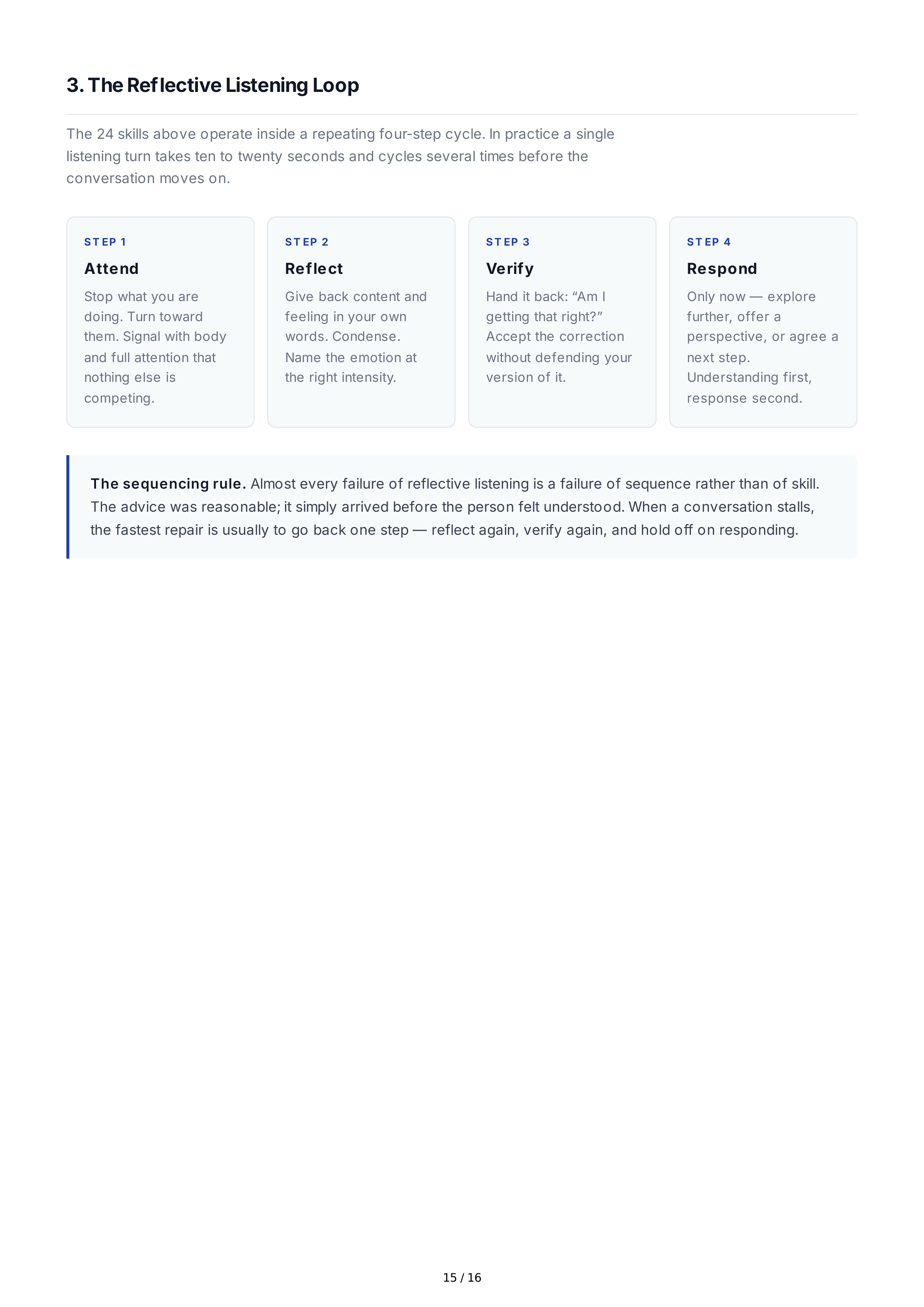
3.
The
Reflective
Listening
Loop
The
24
skills
above
operate
inside
a
repeating
four
-
step
cycle
.
In
practice
a
single
listening
turn
takes
ten
to
twenty
seconds
and
cycles
several
times
before
the
conversation
moves
on
.
ST EP
1
Attend
Stop
what
you
are
doing
.
Turn
toward
them
.
Signal
with
body
and
full
attention
that
nothing
else
is
competing
.
ST EP
2
Reflect
Give
back
content
and
feeling
in
your
own
words
.
Condense
.
Name
the
emotion
at
the
right
intensity
.
ST EP
3
Verify
Hand
it
back
: “
Am
I
getting
that
right
?”
Accept
the
correction
without
defending
your
version
of
it
.
ST EP
4
Respond
Only
now
—
explore
further
,
offer
a
perspective
,
or
agree
a
next
step
.
Understanding
first
,
response
second
.
The
sequencing
rule
.
Almost
every
failure
of
reflective
listening
is
a
failure
of
sequence
rather
than
of
skill
.
The
advice
was
reasonable
;
it
simply
arrived
before
the
person
felt
understood
.
When
a
conversation
stalls
,
the
fastest
repair
is
usually
to
go
back
one
step
—
reflect
again
,
verify
again
,
and
hold
off
on
responding
.
15 / 16
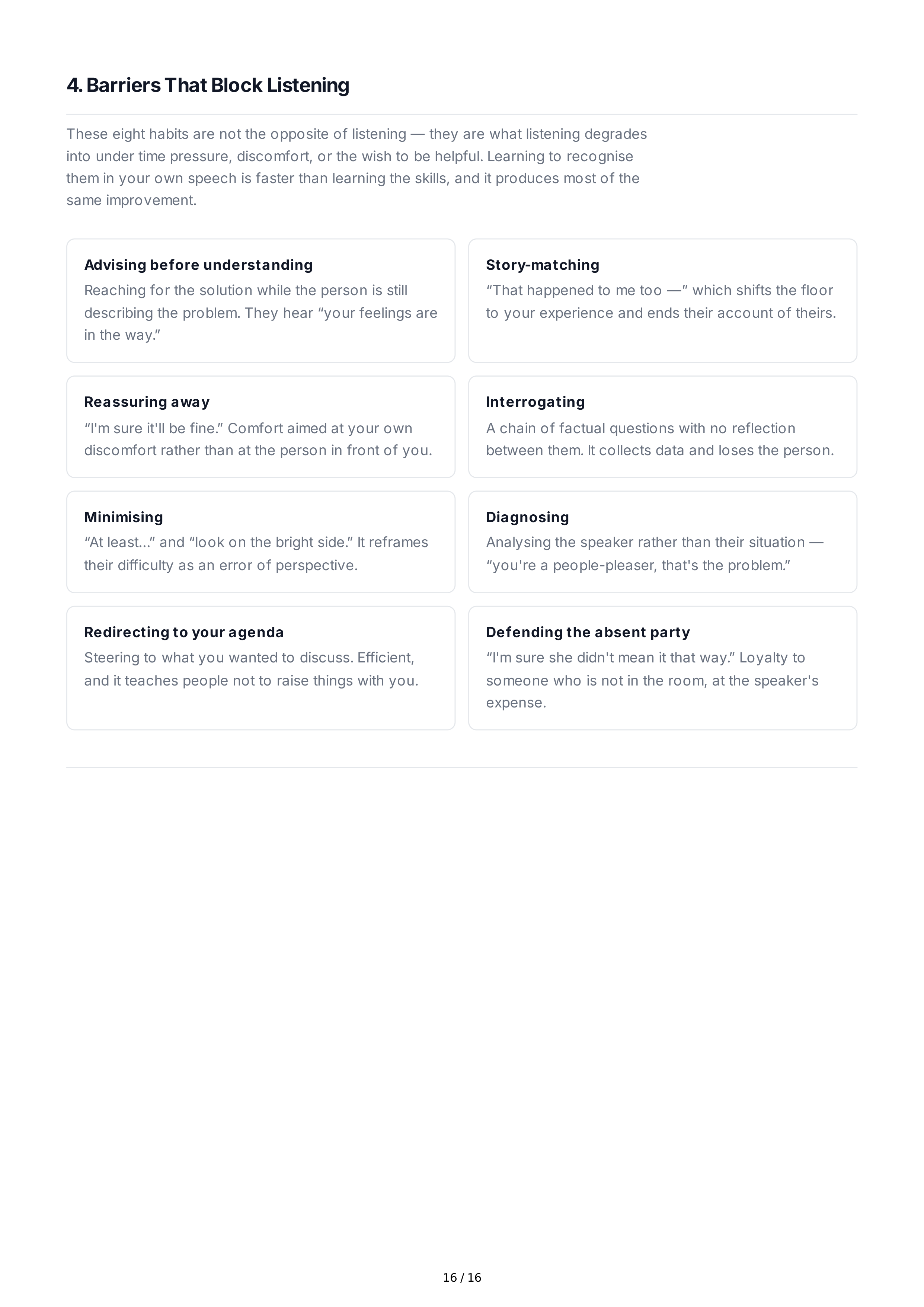
4.
Barriers
That
Block
Listening
These
eight
habits
are
not
the
opposite
of
listening
—
they
are
what
listening
degrades
into
under
time
pressure
,
discomfort
,
or
the
wish
to
be
helpful
.
Learning
to
recognise
them
in
your
own
speech
is
faster
than
learning
the
skills
,
and
it
produces
most
of
the
same
improvement
.
Advising
before
understanding
Reaching
for
the
solution
while
the
person
is
still
describing
the
problem
.
They
hear
“
your
feelings
are
in
the
way
.”
Story
-
matching
“
That
happened
to
me
too
—”
which
shifts
the
floor
to
your
experience
and
ends
their
account
of
theirs
.
Reassuring
away
“
I
'
m
sure
it
'
ll
be
fine
.”
Comfort
aimed
at
your
own
discomfort
rather
than
at
the
person
in
front
of
you
.
Interrogating
A
chain
of
factual
questions
with
no
reflection
between
them
.
It
collects
data
and
loses
the
person
.
Minimising
“
At
least
…”
and
“
look
on
the
bright
side
.”
It
reframes
their
difficulty
as
an
error
of
perspective
.
Diagnosing
Analysing
the
speaker
rather
than
their
situation
—
“
you
'
re
a
people
-
pleaser
,
that
'
s
the
problem
.”
Redirecting
to
your
agenda
Steering
to
what
you
wanted
to
discuss
.
Efficient
,
and
it
teaches
people
not
to
raise
things
with
you
.
Defending
the
absent
party
“
I
'
m
sure
she
didn
'
t
mean
it
that
way
.”
Loyalty
to
someone
who
is
not
in
the
room
,
at
the
speaker
'
s
expense
.
16 / 16
