Trust
-
Building
Interpersonal
Skills
01
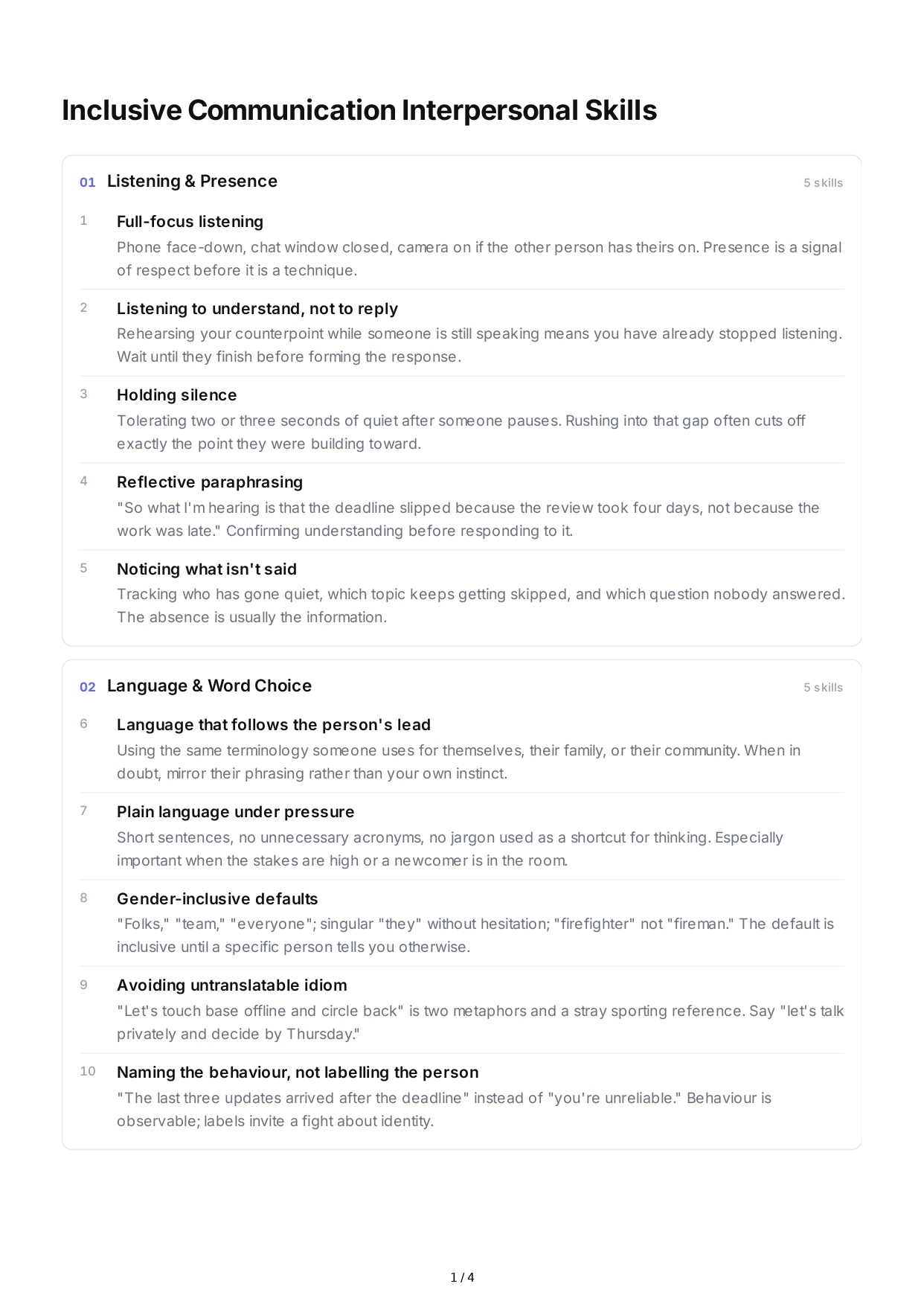
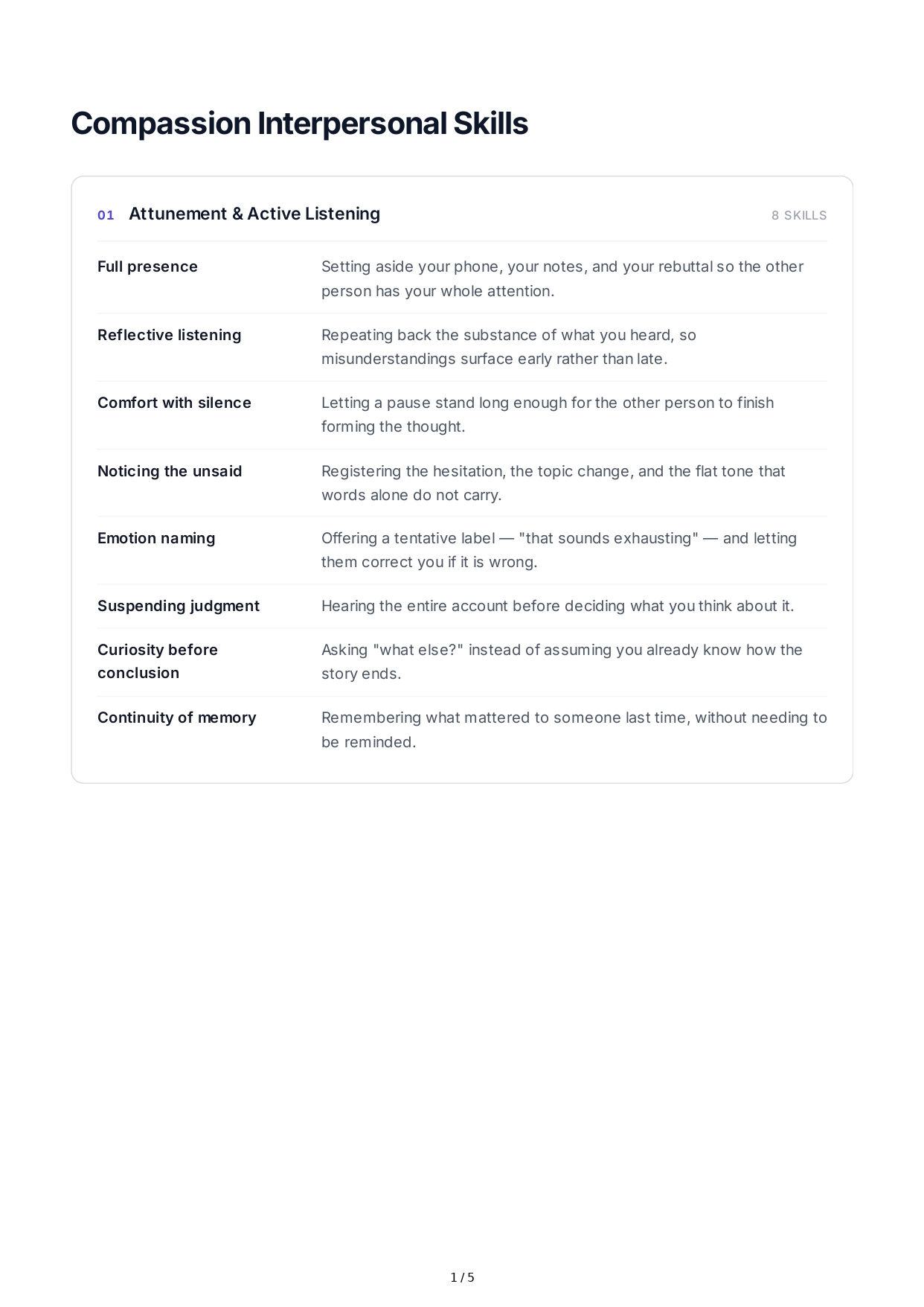
Active
Listening
People
trust
you
first
with
their
attention
,
then
with
everything
else
.
01
Give
undivided
attention
.
Phone
face
down
,
screen
off
,
body
angled
toward
the
speaker
—
not
toward
your
next
task
.
02
Listen
to
understand
,
not
to
reply
.
Hold
your
response
until
the
other
person
has
finished
the
thought
they
started
.
03
Reflect
back
what
you
heard
.
“
So
the
deadline
moved
to
Friday
,
and
that
’
s
the
actual
problem
.”
Confirms
alignment
before
you
act
.
04
Ask
before
you
solve
.
“
Do
you
want
ideas
,
or
do
you
want
me
to
just
listen
for
a
minute
?”
05
Notice
what
isn
’
t
said
.
The
hesitation
,
the
topic
they
skip
past
,
the
answer
that
arrives
too
quickly
.
06
Let
silence
do
its
work
.
Don
’
t
rush
to
fill
every
pause
—
the
second
sentence
is
usually
the
honest
one
.
02
Honest
,
Direct
Communication
Nothing
erodes
trust
faster
than
information
that
changes
depending
on
who
’
s
in
the
room
.
01
Say
the
difficult
thing
early
.
Say
it
plainly
while
it
’
s
still
small
,
not
after
it
has
hardened
into
resentment
.
02
Separate
observation
from
interpretation
.
“
You
missed
three
standups
”
is
a
fact
; “
you
don
’
t
care
”
is
a
story
you
added
.
03
Give
the
same
message
to
the
person
and
to
the
room
.
No
softened
version
to
their
face
,
no
harsher
version
in
the
corridor
.
04
Admit
when
you
don
’
t
know
.
Guessing
confidently
is
a
loan
against
your
credibility
that
comes
due
later
.
05
Praise
publicly
,
correct
privately
.
Criticism
delivered
in
front
of
an
audience
is
remembered
as
humiliation
,
not
feedback
.
06
Name
your
own
errors
first
.
Own
a
mistake
before
someone
else
has
to
point
it
out
.
1 / 4
03
Reliability
&
Follow
-
Through
Predictability
is
the
cheapest
and
most
durable
form
of
respect
.
01
Do
what
you
said
,
by
when
you
said
.
The
small
commitments
are
the
ones
people
use
to
calibrate
everything
else
.
02
Renegotiate
deadlines
before
they
pass
.
A
message
on
Thursday
that
says
“
this
slips
to
Monday
”
beats
silence
until
Monday
.
03
Keep
the
unglamorous
promises
.
The
follow
-
up
email
,
the
introduction
,
the
document
you
said
you
’
d
send
.
04
Be
steady
across
moods
and
weeks
.
Consistency
on
a
bad
day
is
what
proves
the
good
days
were
real
.
05
Under
-
commit
slightly
,
over
-
deliver
quietly
.
Surprises
should
be
pleasant
,
not
structural
.
06
Show
up
on
time
—
and
announce
it
when
you
won
’
t
.
Lateness
with
a
message
is
a
cost
;
lateness
without
one
is
a
message
.
04
Empathy
&
Emotional
Attunement
Trust
grows
when
people
believe
you
’
re
tracking
them
,
not
just
the
task
.
01
Read
the
room
before
you
speak
into
it
.
Timing
is
part
of
the
message
,
not
separate
from
it
.
02
Name
the
emotion
without
weaponising
it
.
“
This
sounds
frustrating
”
lands
; “
calm
down
”
does
not
.
03
Remember
the
human
context
.
The
sick
parent
,
the
visa
paperwork
,
the
first
job
,
the
anniversary
week
.
04
Ask
what
would
actually
help
.
“
What
would
make
this
easier
right
now
?”
beats
guessing
and
delivering
the
wrong
thing
.
05
Match
your
energy
to
theirs
.
Don
’
t
celebrate
loudly
beside
someone
who
’
s
grieving
,
or
grieve
loudly
beside
a
win
.
06
Validate
the
feeling
without
conceding
the
argument
.
You
can
take
someone
seriously
and
still
disagree
with
them
.
2 / 4
05
Respect
for
Boundaries
How
you
handle
a
“
no
”
tells
people
everything
about
how
you
’
ll
handle
their
confidence
.
01
Take
“
no
”
as
a
complete
answer
.
The
first
time
.
Negotiating
past
a
clear
boundary
is
a
withdrawal
from
the
trust
account
.
02
Ask
before
you
share
.
Someone
’
s
story
,
name
,
screenshot
,
or
number
isn
’
t
yours
to
circulate
.
03
Respect
hours
and
time
zones
.
Unless
it
’
s
genuinely
urgent
,
and
you
say
why
it
’
s
urgent
.
04
Don
’
t
make
someone
repeat
a
boundary
.
Needing
to
say
it
twice
signals
it
was
never
really
heard
.
05
Keep
confidences
out
of
casual
conversation
.
Not
in
the
kitchen
,
not
in
the
group
chat
,
not
as
a
“
funny
story
”.
06
Allow
people
to
change
their
mind
.
Let
a
revised
position
be
progress
rather
than
evidence
to
hold
against
them
.
06
Accountability
&
Repair
Trust
isn
’
t
built
by
never
breaking
something
—
it
’
s
built
by
how
cleanly
you
fix
it
.
01
Apologise
with
specifics
.
What
you
did
,
who
it
affected
,
and
what
changes
as
a
result
.
02
Don
’
t
attach
a
“
but
”
to
an
apology
.
The
“
but
”
deletes
everything
that
came
before
it
.
03
Fix
the
process
,
not
just
the
moment
.
Repair
that
leaves
the
cause
in
place
is
a
promise
to
repeat
it
.
04
Accept
feedback
without
defending
.
Understand
it
first
;
decide
what
to
do
with
it
afterwards
.
05
Circle
back
after
a
conflict
.
Silence
after
a
disagreement
reads
as
either
a
grudge
or
a
victory
lap
.
06
Check
how
you
landed
.
“
Did
I
get
that
right
?”
is
cheaper
than
discovering
in
three
months
that
you
didn
’
t
.
3 / 4
07
Consistency
&
Fairness
People
trust
a
standard
they
can
predict
more
than
a
favour
they
had
to
earn
.
01
Apply
one
standard
to
everyone
.
Especially
to
the
person
you
like
and
the
person
you
don
’
t
.
02
Share
information
evenly
.
An
insider
lane
for
a
few
people
reads
to
everyone
else
as
a
warning
.
03
Give
credit
precisely
.
Name
who
did
what
— “
the
team
”
is
a
convenient
way
to
erase
someone
.
04
Speak
the
same
way
when
people
are
absent
.
What
you
say
about
someone
who
isn
’
t
there
is
your
actual
opinion
of
them
.
05
Rotate
the
unglamorous
work
.
Reliable
people
shouldn
’
t
be
punished
with
all
of
the
cleanup
.
06
Follow
the
rules
you
enforce
.
Exempting
yourself
once
costs
more
than
the
rule
was
worth
.
08
Navigating
Disagreement
Conflict
handled
well
is
the
fastest
trust
-
builder
there
is
—
it
proves
the
relationship
can
hold
weight
.
01
Attack
the
problem
,
not
the
person
holding
it
.
The
moment
it
becomes
about
character
,
the
discussion
is
over
.
02
State
your
position
once
,
clearly
.
Then
genuinely
listen
to
the
reply
instead
of
reloading
.
03
Concede
what
you
can
concede
.
Acknowledging
one
good
point
is
what
makes
the
rest
of
your
argument
credible
.
04
Disagree
in
the
meeting
,
not
in
the
hallway
.
Post
-
meeting
dissent
is
how
decisions
quietly
fail
.
05
Repair
the
relationship
even
when
you
lose
the
decision
.
The
outcome
is
temporary
;
the
working
relationship
isn
’
t
.
06
Separate
“
I
was
wrong
”
from
“
you
were
wrong
”.
They
don
’
t
need
to
arrive
in
the
same
sentence
—
or
the
same
month
.
4 / 4