Inclusive
Communication
Interpersonal
Skills
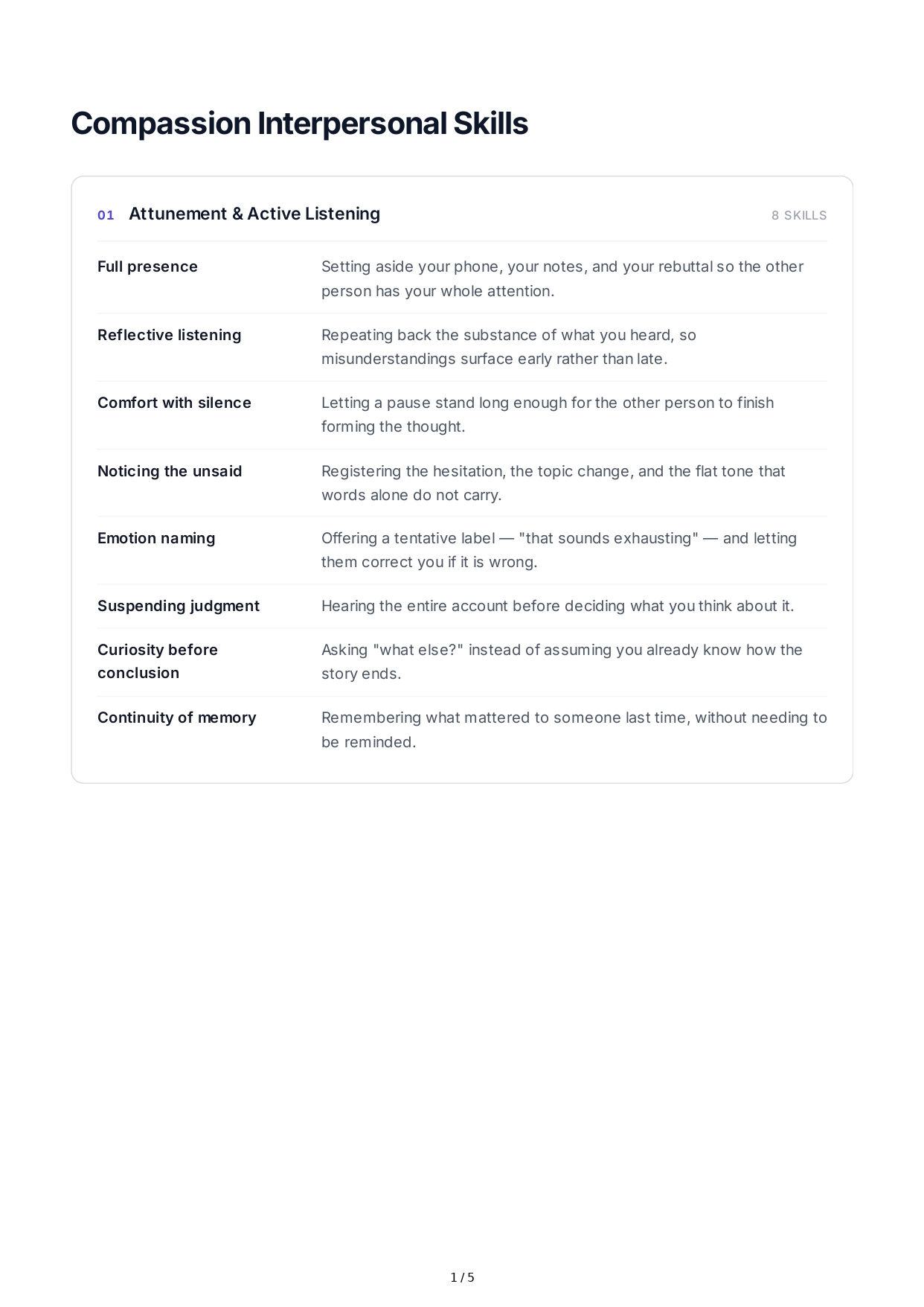
01
Listening
&
Presence
5
skills
1
Full
-
focus
listening
Phone
face
-
down
,
chat
window
closed
,
camera
on
if
the
other
person
has
theirs
on
.
Presence
is
a
signal
of
respect
before
it
is
a
technique
.
2
Listening
to
understand
,
not
to
reply
Rehearsing
your
counterpoint
while
someone
is
still
speaking
means
you
have
already
stopped
listening
.
Wait
until
they
finish
before
forming
the
response
.
3
Holding
silence
Tolerating
two
or
three
seconds
of
quiet
after
someone
pauses
.
Rushing
into
that
gap
often
cuts
off
exactly
the
point
they
were
building
toward
.
4
Reflective
paraphrasing
"
So
what
I
'
m
hearing
is
that
the
deadline
slipped
because
the
review
took
four
days
,
not
because
the
work
was
late
."
Confirming
understanding
before
responding
to
it
.
5
Noticing
what
isn
'
t
said
Tracking
who
has
gone
quiet
,
which
topic
keeps
getting
skipped
,
and
which
question
nobody
answered
.
The
absence
is
usually
the
information
.
02
Language
&
Word
Choice
5
skills
6
Language
that
follows
the
person
'
s
lead
Using
the
same
terminology
someone
uses
for
themselves
,
their
family
,
or
their
community
.
When
in
doubt
,
mirror
their
phrasing
rather
than
your
own
instinct
.
7
Plain
language
under
pressure
Short
sentences
,
no
unnecessary
acronyms
,
no
jargon
used
as
a
shortcut
for
thinking
.
Especially
important
when
the
stakes
are
high
or
a
newcomer
is
in
the
room
.
8
Gender
-
inclusive
defaults
"
Folks
," "
team
," "
everyone
";
singular
"
they
"
without
hesitation
; "
firefighter
"
not
"
fireman
."
The
default
is
inclusive
until
a
specific
person
tells
you
otherwise
.
9
Avoiding
untranslatable
idiom
"
Let
'
s
touch
base
offline
and
circle
back
"
is
two
metaphors
and
a
stray
sporting
reference
.
Say
"
let
'
s
talk
privately
and
decide
by
Thursday
."
10
Naming
the
behaviour
,
not
labelling
the
person
"
The
last
three
updates
arrived
after
the
deadline
"
instead
of
"
you
'
re
unreliable
."
Behaviour
is
observable
;
labels
invite
a
fight
about
identity
.
1 / 4
03
Empathy
&
Emotional
Attunement
5
skills
11
Reading
tone
and
pace
as
data
A
shorter
answer
than
usual
,
a
slower
tempo
,
a
sentence
that
trails
off
.
Treating
these
as
information
rather
than
noise
,
and
asking
about
them
when
it
matters
.
12
Validating
before
problem
-
solving
"
That
sounds
genuinely
frustrating
,
and
it
makes
sense
you
'
d
be
annoyed
."
Acknowledging
the
feeling
first
,
offering
the
fix
second
—
or
not
at
all
,
if
a
fix
wasn
'
t
requested
.
13
Checking
your
own
read
"
I
might
be
misreading
this
—
tell
me
if
I
'
m
off
."
Naming
your
interpretation
as
an
interpretation
leaves
room
for
it
to
be
corrected
without
friction
.
14
Holding
space
without
rushing
to
fix
Sitting
with
someone
'
s
bad
news
,
disappointment
,
or
anger
for
a
full
minute
before
reaching
for
a
solution
.
Most
people
want
to
be
heard
before
they
want
to
be
helped
.
15
Matching
the
level
of
disclosure
When
someone
shares
a
difficult
work
situation
,
responding
with
proportionate
honesty
rather
than
either
a
wall
or
a
flood
.
Reciprocity
,
not
oversharing
.
04
Cultural
Awareness
&
Humility
5
skills
16
Asking
about
norms
rather
than
assuming
them
"
How
do
people
here
usually
handle
disagreement
in
meetings
?"
A
single
question
replaces
a
year
of
guessing
at
unwritten
rules
.
17
High
-
context
and
low
-
context
fluency
Recognising
that
some
people
read
meaning
from
what
is
implied
,
and
some
read
it
only
from
what
is
stated
.
Adjusting
your
explicitness
to
the
person
,
not
the
org
chart
.
18
Respecting
varied
comfort
with
directness
A
blunt
"
that
won
'
t
work
"
reads
as
efficient
to
one
colleague
and
as
a
reprimand
to
another
.
Calibrating
challenge
without
softening
the
substance
.
19
Learning
names
and
saying
them
correctly
Asking
for
pronunciation
once
,
writing
it
down
phonetically
,
and
using
it
.
Repeatedly
getting
someone
'
s
name
wrong
communicates
where
they
sit
in
your
attention
.
20
Treating
your
own
defaults
as
one
option
Noticing
that
"
professional
," "
punctual
,"
and
"
polite
"
are
culturally
specific
,
and
that
your
version
of
normal
is
a
version
—
not
the
baseline
everyone
else
is
failing
to
hit
.
2 / 4
05
Psychological
Safety
&
Inclusion
5
skills
21
Explicit
invitation
"
I
'
d
especially
like
to
hear
from
Sam
and
Priya
—
I
don
'
t
think
we
'
ve
heard
a
dissenting
view
yet
."
Naming
the
gap
in
the
conversation
rather
than
waiting
for
it
to
fill
itself
.
22
Credit
and
amplification
"
That
was
Amara
'
s
idea
from
Tuesday
—
I
'
m
just
repeating
it
."
Attributing
the
thought
to
its
source
,
especially
when
the
room
has
moved
on
without
noticing
who
said
it
first
.
23
Interrupting
the
interruption
"
Hold
on
—
let
Dev
finish
the
point
."
Applied
consistently
,
including
when
the
interruption
comes
from
someone
senior
to
you
.
24
Disagreeing
with
the
idea
,
not
the
person
"
I
see
three
problems
with
this
approach
"
rather
than
"
you
haven
'
t
thought
this
through
."
Same
level
of
challenge
,
no
damage
to
the
person
holding
the
view
.
25
Normalising
"
I
don
'
t
know
"
and
"
I
was
wrong
"
Saying
both
out
loud
,
early
,
and
without
a
lengthy
preamble
.
Leaders
who
model
this
give
everyone
else
permission
to
do
the
same
.
06
Feedback
&
Conflict
Repair
5
skills
26
Specific
,
behavioural
,
timely
feedback
"
In
yesterday
'
s
review
you
cut
off
the
client
twice
while
they
were
explaining
the
delay
."
Specific
,
close
to
the
event
,
and
about
something
that
actually
happened
.
27
Separating
intent
from
impact
"
I
know
you
meant
it
as
a
joke
,
and
it
landed
badly
in
the
room
."
Good
intent
does
not
cancel
the
impact
,
and
naming
both
keeps
the
conversation
honest
.
28
Receiving
feedback
without
defending
"
Thank
you
—
let
me
sit
with
that
."
Taking
the
note
,
asking
a
clarifying
question
if
needed
,
and
saving
the
explanation
for
later
or
not
at
all
.
29
Repairing
after
a
misstep
Acknowledge
,
apologise
,
adjust
,
move
on
.
Four
steps
,
in
that
order
.
Over
-
explaining
the
apology
usually
shifts
the
burden
back
onto
the
person
who
was
harmed
.
30
Correcting
privately
,
crediting
publicly
Critical
notes
go
one
-
to
-
one
,
in
a
channel
the
person
chose
.
Praise
goes
in
the
room
where
the
work
happened
.
3 / 4
07
Meeting
&
Group
Dynamics
5
skills
31
Structured
turn
-
taking
A
round
-
robin
,
a
written
check
-
in
,
or
a
"
let
'
s
hear
from
everyone
before
we
open
it
up
."
Structure
is
how
you
stop
airtime
from
defaulting
to
the
loudest
voice
.
32
Async
options
for
people
who
think
in
writing
Posting
the
question
the
day
before
,
accepting
a
written
reply
in
place
of
a
live
one
,
and
reading
the
doc
before
the
meeting
rather
than
during
it
.
33
Time
-
zone
and
caregiving
-
aware
scheduling
Rotating
the
inconvenient
slot
instead
of
leaving
it
permanently
on
one
region
or
one
parent
.
Checking
whether
8
am
means
school
drop
-
off
for
someone
.
34
Parking
dominant
voices
and
inviting
quiet
ones
"
Let
'
s
park
that
and
come
back
to
it
—
first
,
I
want
to
hear
the
objection
I
saw
in
the
chat
."
Managing
the
room
,
not
just
the
agenda
.
35
Documenting
decisions
and
dissent
Writing
down
what
was
decided
,
who
decided
it
,
and
what
concern
was
raised
and
set
aside
.
The
quietest
room
should
not
produce
the
loudest
record
.
08
Accessibility
&
Channel
Awareness
5
skills
36
Captions
on
by
default
Every
video
call
,
not
just
the
ones
with
a
known
Deaf
or
hard
-
of
-
hearing
participant
.
Default
-
on
removes
the
need
for
anyone
to
ask
and
out
themselves
.
37
Materials
shared
in
advance
Agenda
,
slides
,
and
the
question
being
decided
,
sent
the
day
before
.
This
is
the
single
highest
-
leverage
accommodation
in
most
workplaces
and
it
costs
nothing
.
38
Describing
visuals
out
loud
"
The
chart
shows
revenue
flattening
in
Q
3
while
headcount
kept
climbing
."
Anyone
on
audio
-
only
,
in
a
car
,
or
with
a
screen
reader
gets
the
same
information
.
39
Offering
multiple
channels
for
the
same
message
Talk
it
through
,
write
it
up
,
or
do
it
one
-
to
-
one
—
the
sender
'
s
preference
gets
a
voice
,
the
receiver
'
s
gets
a
choice
.
Same
content
,
different
doorways
.
40
Respecting
sensory
and
energy
limits
Twenty
-
five
minute
meetings
by
default
,
cameras
optional
,
breaks
built
into
long
sessions
,
and
no
penalty
for
the
person
who
leaves
on
time
.
4 / 4