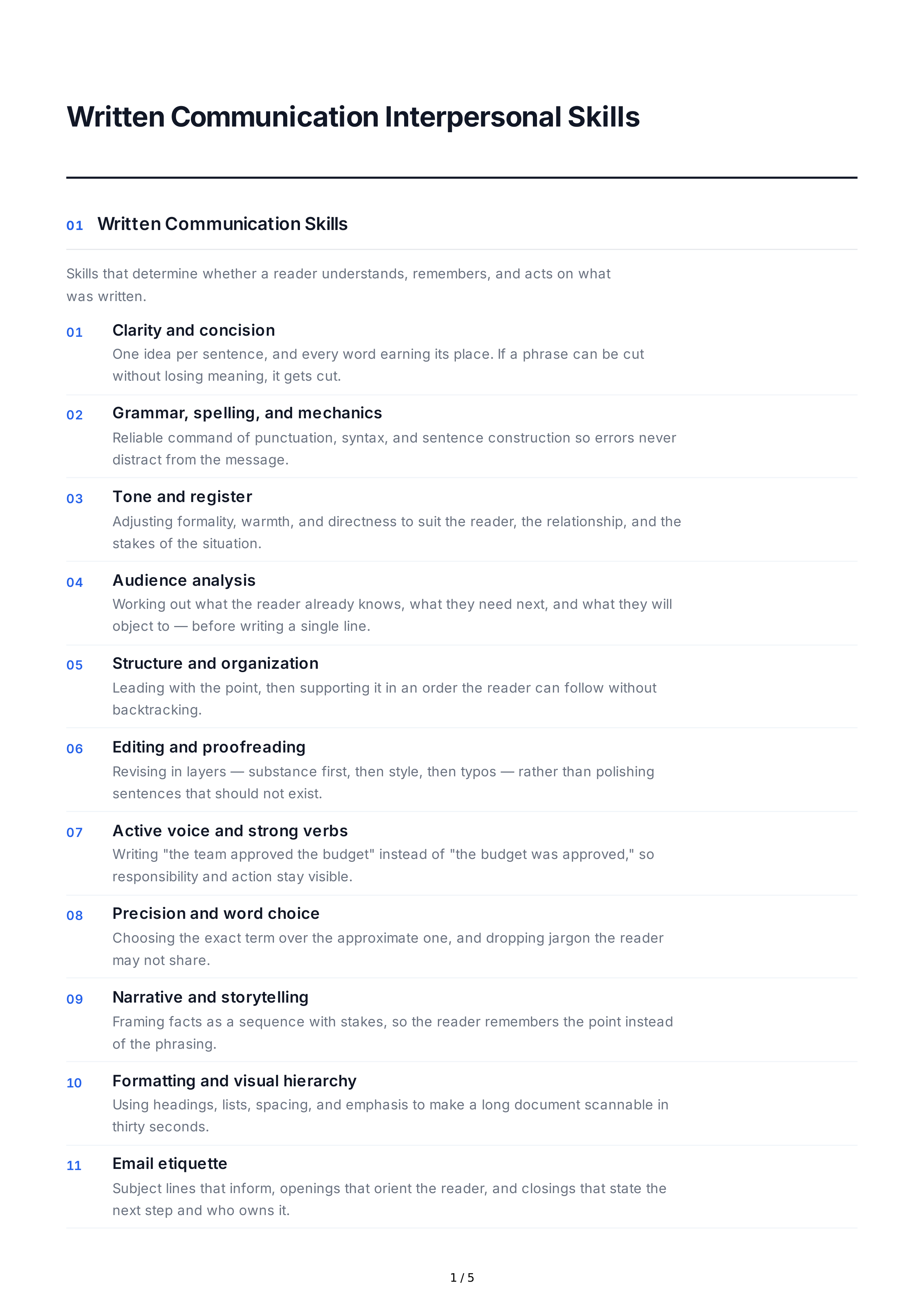
Written
Communication
Interpersonal
Skills
01
Written
Communication
Skills
Skills
that
determine
whether
a
reader
understands
,
remembers
,
and
acts
on
what
was
written
.
01
Clarity
and
concision
One
idea
per
sentence
,
and
every
word
earning
its
place
.
If
a
phrase
can
be
cut
without
losing
meaning
,
it
gets
cut
.
02
Grammar
,
spelling
,
and
mechanics
Reliable
command
of
punctuation
,
syntax
,
and
sentence
construction
so
errors
never
distract
from
the
message
.
03
Tone
and
register
Adjusting
formality
,
warmth
,
and
directness
to
suit
the
reader
,
the
relationship
,
and
the
stakes
of
the
situation
.
04
Audience
analysis
Working
out
what
the
reader
already
knows
,
what
they
need
next
,
and
what
they
will
object
to
—
before
writing
a
single
line
.
05
Structure
and
organization
Leading
with
the
point
,
then
supporting
it
in
an
order
the
reader
can
follow
without
backtracking
.
06
Editing
and
proofreading
Revising
in
layers
—
substance
first
,
then
style
,
then
typos
—
rather
than
polishing
sentences
that
should
not
exist
.
07
Active
voice
and
strong
verbs
Writing
"
the
team
approved
the
budget
"
instead
of
"
the
budget
was
approved
,"
so
responsibility
and
action
stay
visible
.
08
Precision
and
word
choice
Choosing
the
exact
term
over
the
approximate
one
,
and
dropping
jargon
the
reader
may
not
share
.
09
Narrative
and
storytelling
Framing
facts
as
a
sequence
with
stakes
,
so
the
reader
remembers
the
point
instead
of
the
phrasing
.
10
Formatting
and
visual
hierarchy
Using
headings
,
lists
,
spacing
,
and
emphasis
to
make
a
long
document
scannable
in
thirty
seconds
.
11
Email
etiquette
Subject
lines
that
inform
,
openings
that
orient
the
reader
,
and
closings
that
state
the
next
step
and
who
owns
it
.
1 / 5
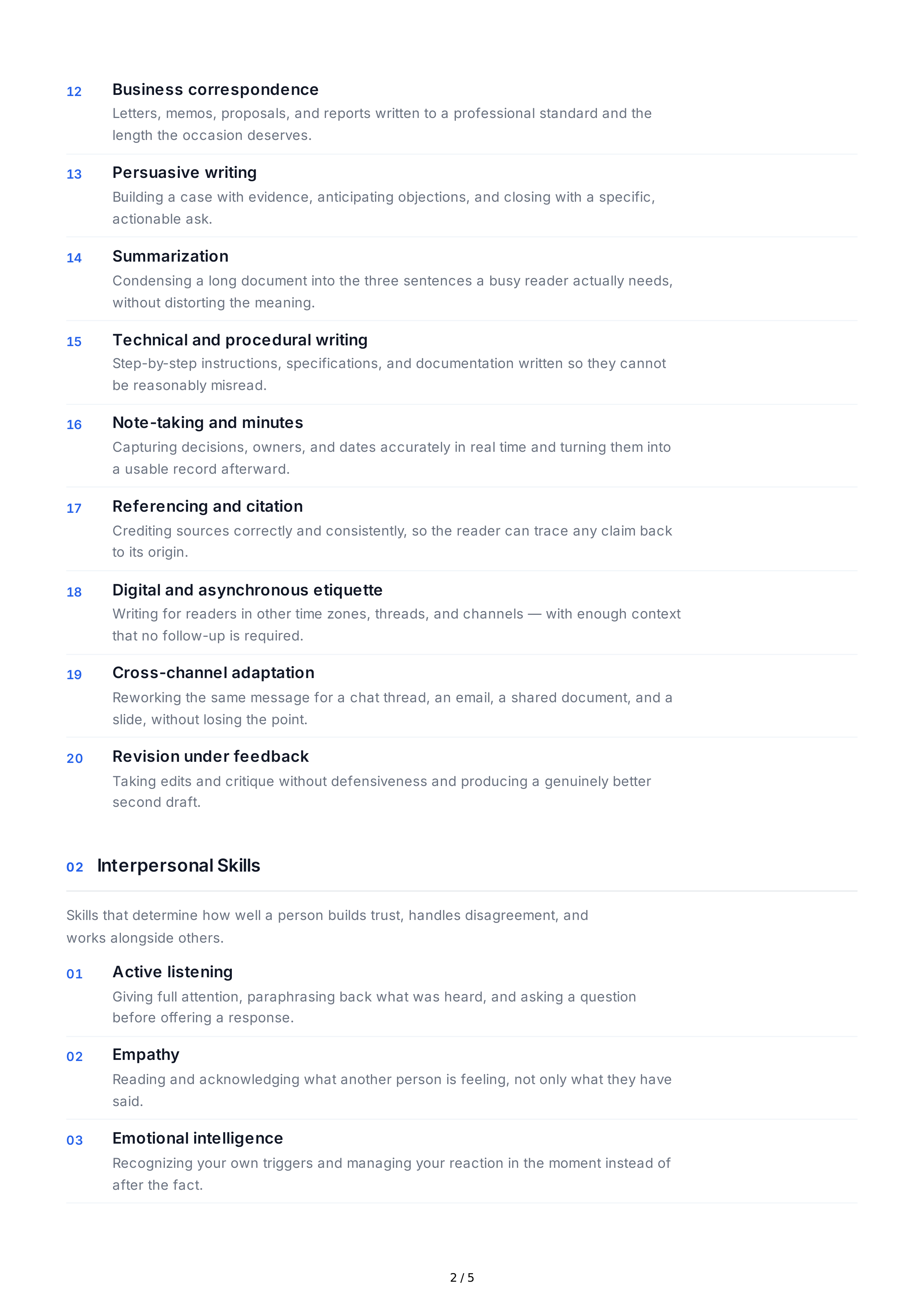
12
Business
correspondence
Letters
,
memos
,
proposals
,
and
reports
written
to
a
professional
standard
and
the
length
the
occasion
deserves
.
13
Persuasive
writing
Building
a
case
with
evidence
,
anticipating
objections
,
and
closing
with
a
specific
,
actionable
ask
.
14
Summarization
Condensing
a
long
document
into
the
three
sentences
a
busy
reader
actually
needs
,
without
distorting
the
meaning
.
15
Technical
and
procedural
writing
Step
-
by
-
step
instructions
,
specifications
,
and
documentation
written
so
they
cannot
be
reasonably
misread
.
16
Note
-
taking
and
minutes
Capturing
decisions
,
owners
,
and
dates
accurately
in
real
time
and
turning
them
into
a
usable
record
afterward
.
17
Referencing
and
citation
Crediting
sources
correctly
and
consistently
,
so
the
reader
can
trace
any
claim
back
to
its
origin
.
18
Digital
and
asynchronous
etiquette
Writing
for
readers
in
other
time
zones
,
threads
,
and
channels
—
with
enough
context
that
no
follow
-
up
is
required
.
19
Cross
-
channel
adaptation
Reworking
the
same
message
for
a
chat
thread
,
an
email
,
a
shared
document
,
and
a
slide
,
without
losing
the
point
.
20
Revision
under
feedback
Taking
edits
and
critique
without
defensiveness
and
producing
a
genuinely
better
second
draft
.
02
Interpersonal
Skills
Skills
that
determine
how
well
a
person
builds
trust
,
handles
disagreement
,
and
works
alongside
others
.
01
Active
listening
Giving
full
attention
,
paraphrasing
back
what
was
heard
,
and
asking
a
question
before
offering
a
response
.
02
Empathy
Reading
and
acknowledging
what
another
person
is
feeling
,
not
only
what
they
have
said
.
03
Emotional
intelligence
Recognizing
your
own
triggers
and
managing
your
reaction
in
the
moment
instead
of
after
the
fact
.
2 / 5
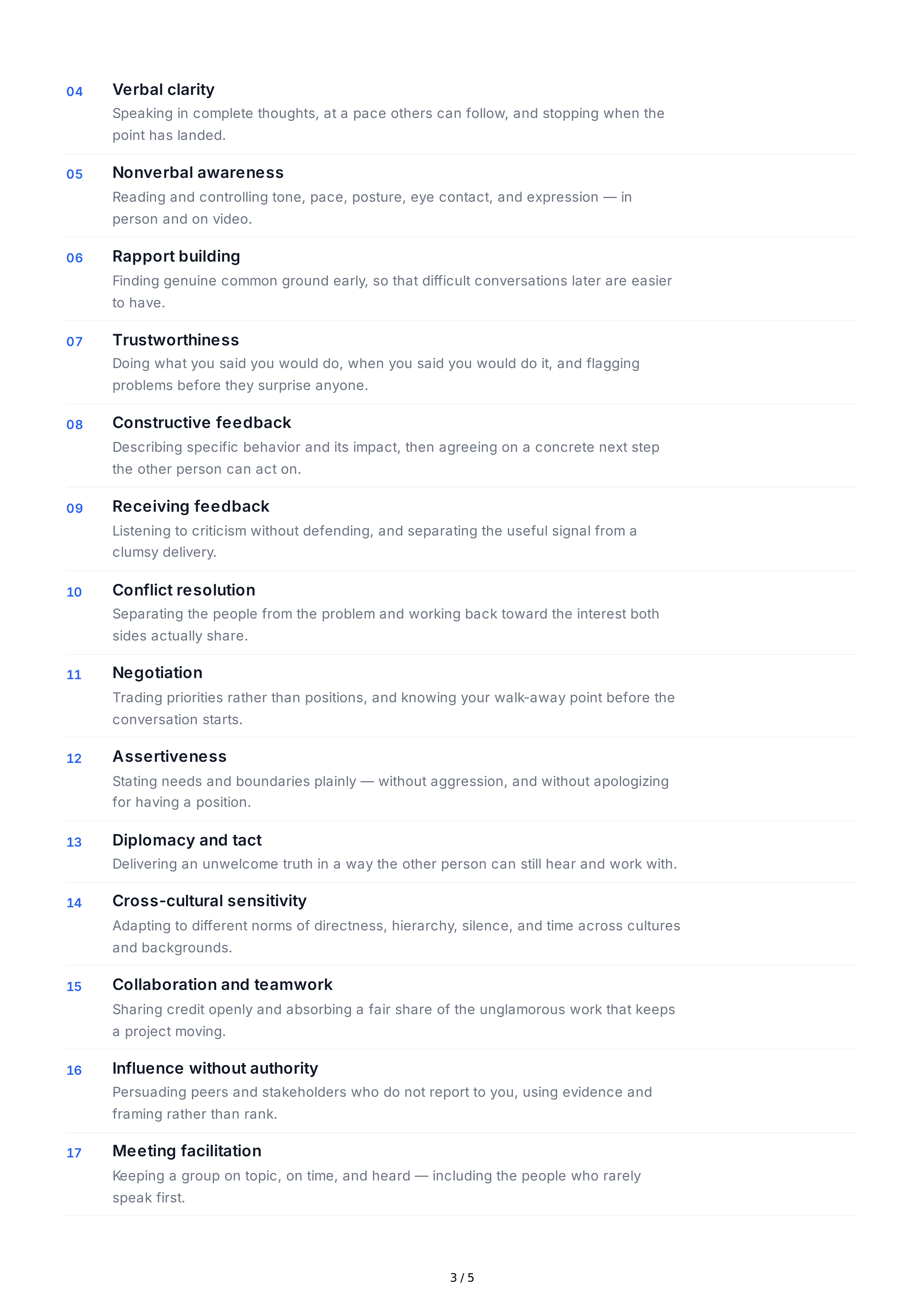
04
Verbal
clarity
Speaking
in
complete
thoughts
,
at
a
pace
others
can
follow
,
and
stopping
when
the
point
has
landed
.
05
Nonverbal
awareness
Reading
and
controlling
tone
,
pace
,
posture
,
eye
contact
,
and
expression
—
in
person
and
on
video
.
06
Rapport
building
Finding
genuine
common
ground
early
,
so
that
difficult
conversations
later
are
easier
to
have
.
07
Trustworthiness
Doing
what
you
said
you
would
do
,
when
you
said
you
would
do
it
,
and
flagging
problems
before
they
surprise
anyone
.
08
Constructive
feedback
Describing
specific
behavior
and
its
impact
,
then
agreeing
on
a
concrete
next
step
the
other
person
can
act
on
.
09
Receiving
feedback
Listening
to
criticism
without
defending
,
and
separating
the
useful
signal
from
a
clumsy
delivery
.
10
Conflict
resolution
Separating
the
people
from
the
problem
and
working
back
toward
the
interest
both
sides
actually
share
.
11
Negotiation
Trading
priorities
rather
than
positions
,
and
knowing
your
walk
-
away
point
before
the
conversation
starts
.
12
Assertiveness
Stating
needs
and
boundaries
plainly
—
without
aggression
,
and
without
apologizing
for
having
a
position
.
13
Diplomacy
and
tact
Delivering
an
unwelcome
truth
in
a
way
the
other
person
can
still
hear
and
work
with
.
14
Cross
-
cultural
sensitivity
Adapting
to
different
norms
of
directness
,
hierarchy
,
silence
,
and
time
across
cultures
and
backgrounds
.
15
Collaboration
and
teamwork
Sharing
credit
openly
and
absorbing
a
fair
share
of
the
unglamorous
work
that
keeps
a
project
moving
.
16
Influence
without
authority
Persuading
peers
and
stakeholders
who
do
not
report
to
you
,
using
evidence
and
framing
rather
than
rank
.
17
Meeting
facilitation
Keeping
a
group
on
topic
,
on
time
,
and
heard
—
including
the
people
who
rarely
speak
first
.
3 / 5
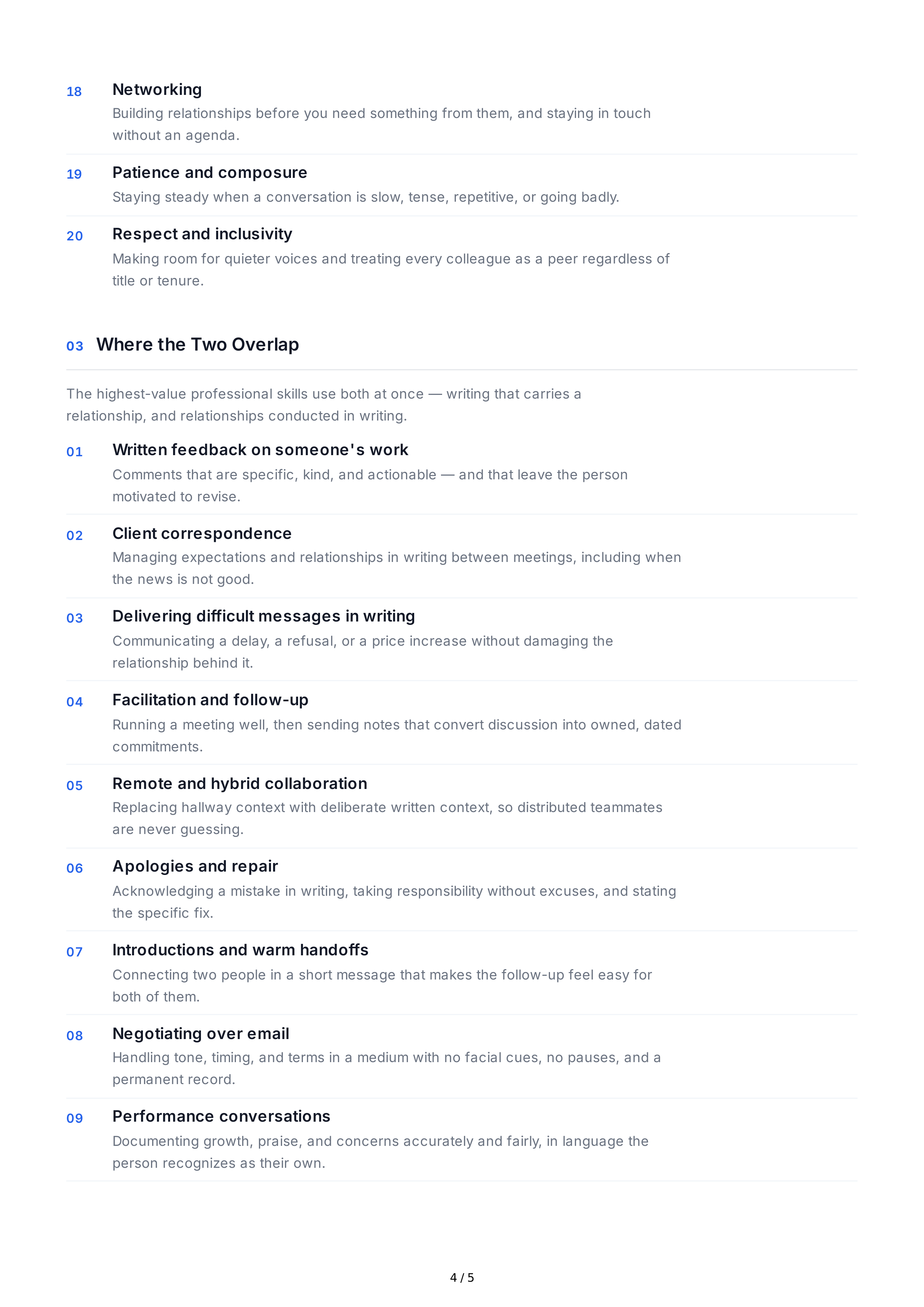
18
Networking
Building
relationships
before
you
need
something
from
them
,
and
staying
in
touch
without
an
agenda
.
19
Patience
and
composure
Staying
steady
when
a
conversation
is
slow
,
tense
,
repetitive
,
or
going
badly
.
20
Respect
and
inclusivity
Making
room
for
quieter
voices
and
treating
every
colleague
as
a
peer
regardless
of
title
or
tenure
.
03
Where
the
Two
Overlap
The
highest
-
value
professional
skills
use
both
at
once
—
writing
that
carries
a
relationship
,
and
relationships
conducted
in
writing
.
01
Written
feedback
on
someone
'
s
work
Comments
that
are
specific
,
kind
,
and
actionable
—
and
that
leave
the
person
motivated
to
revise
.
02
Client
correspondence
Managing
expectations
and
relationships
in
writing
between
meetings
,
including
when
the
news
is
not
good
.
03
Delivering
difficult
messages
in
writing
Communicating
a
delay
,
a
refusal
,
or
a
price
increase
without
damaging
the
relationship
behind
it
.
04
Facilitation
and
follow
-
up
Running
a
meeting
well
,
then
sending
notes
that
convert
discussion
into
owned
,
dated
commitments
.
05
Remote
and
hybrid
collaboration
Replacing
hallway
context
with
deliberate
written
context
,
so
distributed
teammates
are
never
guessing
.
06
Apologies
and
repair
Acknowledging
a
mistake
in
writing
,
taking
responsibility
without
excuses
,
and
stating
the
specific
fix
.
07
Introductions
and
warm
handoffs
Connecting
two
people
in
a
short
message
that
makes
the
follow
-
up
feel
easy
for
both
of
them
.
08
Negotiating
over
email
Handling
tone
,
timing
,
and
terms
in
a
medium
with
no
facial
cues
,
no
pauses
,
and
a
permanent
record
.
09
Performance
conversations
Documenting
growth
,
praise
,
and
concerns
accurately
and
fairly
,
in
language
the
person
recognizes
as
their
own
.
4 / 5

10
Public
and
internal
announcing
Writing
posts
,
updates
,
and
announcements
that
represent
a
team
or
a
company
to
an
audience
that
is
watching
.
5 / 5
