Conflict
Management
Interpersonal
Skills
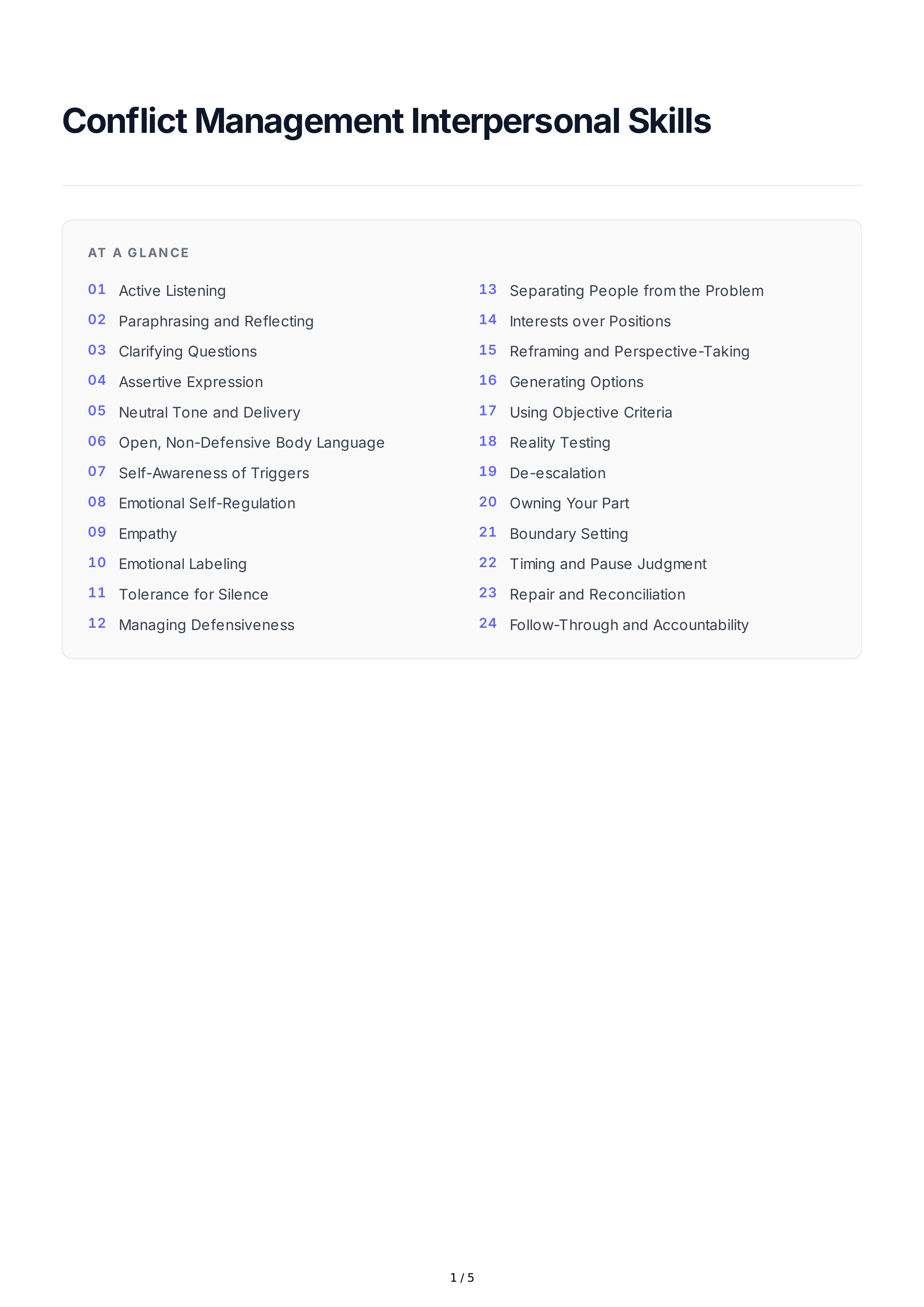
AT
A
G LAN CE
01
Active
Listening
13
Separating
People
from
the
Problem
02
Paraphrasing
and
Reflecting
14
Interests
over
Positions
03
Clarifying
Questions
15
Reframing
and
Perspective
-
Taking
04
Assertive
Expression
16
Generating
Options
05
Neutral
Tone
and
Delivery
17
Using
Objective
Criteria
06
Open
,
Non
-
Defensive
Body
Language
18
Reality
Testing
07
Self
-
Awareness
of
Triggers
19
De
-
escalation
08
Emotional
Self
-
Regulation
20
Owning
Your
Part
09
Empathy
21
Boundary
Setting
10
Emotional
Labeling
22
Timing
and
Pause
Judgment
11
Tolerance
for
Silence
23
Repair
and
Reconciliation
12
Managing
Defensiveness
24
Follow
-
Through
and
Accountability
1 / 5
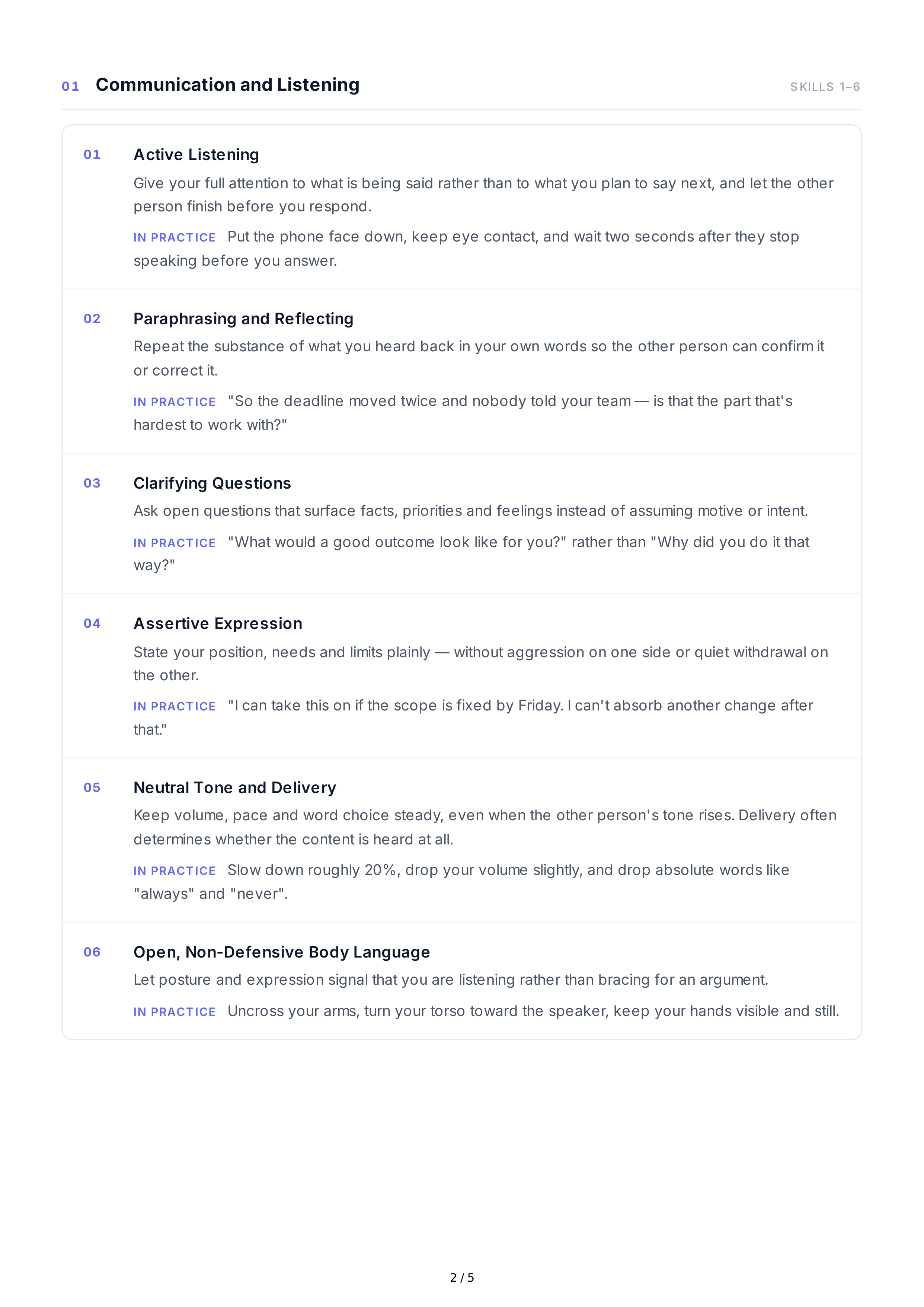
01
Communication
and
Listening
S KILLS
1–6
01
Active
Listening
Give
your
full
attention
to
what
is
being
said
rather
than
to
what
you
plan
to
say
next
,
and
let
the
other
person
finish
before
you
respond
.
IN
PRACTICE
Put
the
phone
face
down
,
keep
eye
contact
,
and
wait
two
seconds
after
they
stop
speaking
before
you
answer
.
02
Paraphrasing
and
Reflecting
Repeat
the
substance
of
what
you
heard
back
in
your
own
words
so
the
other
person
can
confirm
it
or
correct
it
.
IN
PRACTICE
"
So
the
deadline
moved
twice
and
nobody
told
your
team
—
is
that
the
part
that
'
s
hardest
to
work
with
?"
03
Clarifying
Questions
Ask
open
questions
that
surface
facts
,
priorities
and
feelings
instead
of
assuming
motive
or
intent
.
IN
PRACTICE
"
What
would
a
good
outcome
look
like
for
you
?"
rather
than
"
Why
did
you
do
it
that
way
?"
04
Assertive
Expression
State
your
position
,
needs
and
limits
plainly
—
without
aggression
on
one
side
or
quiet
withdrawal
on
the
other
.
IN
PRACTICE
"
I
can
take
this
on
if
the
scope
is
fixed
by
Friday
.
I
can
'
t
absorb
another
change
after
that
."
05
Neutral
Tone
and
Delivery
Keep
volume
,
pace
and
word
choice
steady
,
even
when
the
other
person
'
s
tone
rises
.
Delivery
often
determines
whether
the
content
is
heard
at
all
.
IN
PRACTICE
Slow
down
roughly
20%,
drop
your
volume
slightly
,
and
drop
absolute
words
like
"
always
"
and
"
never
".
06
Open
,
Non
-
Defensive
Body
Language
Let
posture
and
expression
signal
that
you
are
listening
rather
than
bracing
for
an
argument
.
IN
PRACTICE
Uncross
your
arms
,
turn
your
torso
toward
the
speaker
,
keep
your
hands
visible
and
still
.
2 / 5
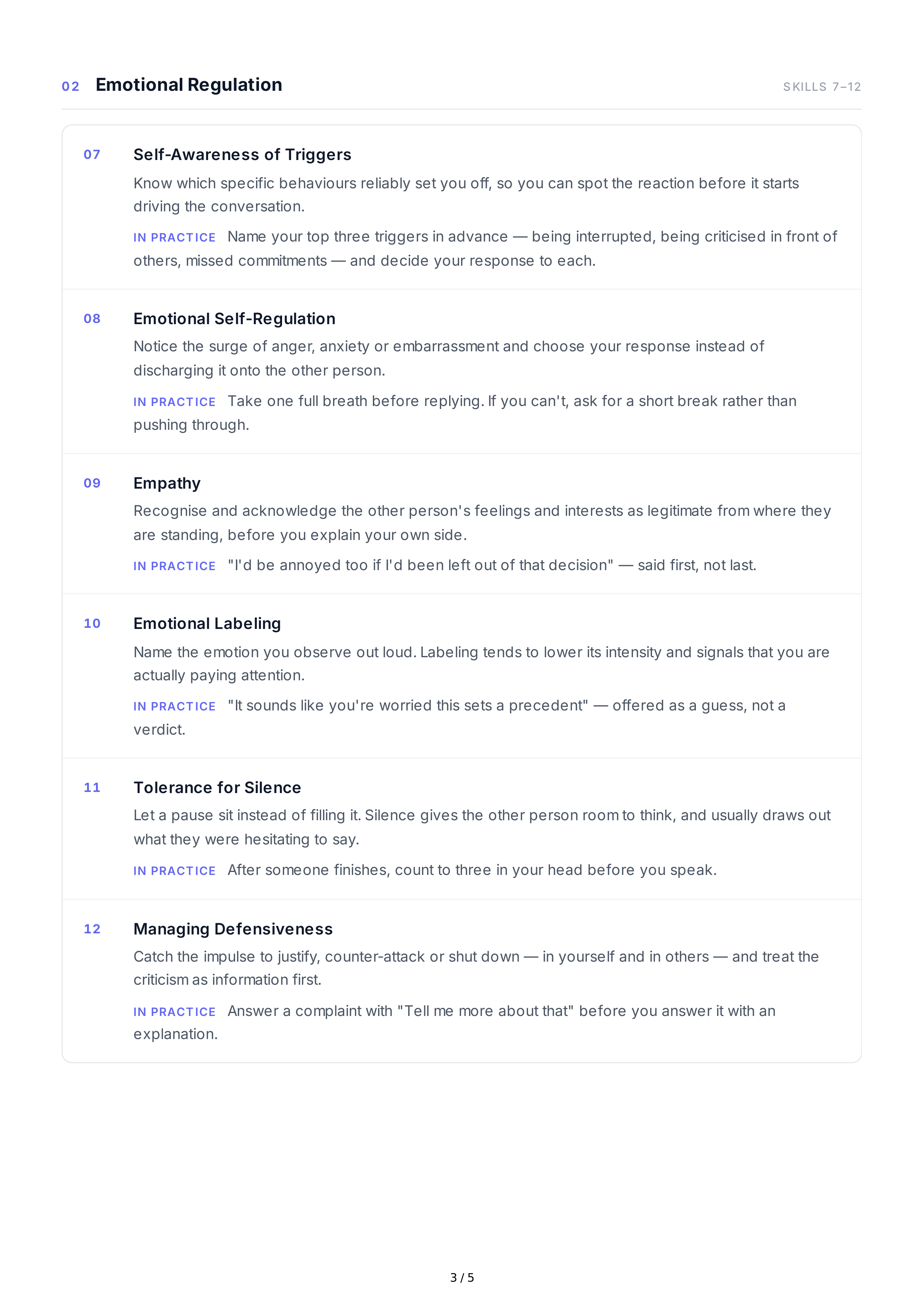
02
Emotional
Regulation
S KILLS
7–12
07
Self
-
Awareness
of
Triggers
Know
which
specific
behaviours
reliably
set
you
off
,
so
you
can
spot
the
reaction
before
it
starts
driving
the
conversation
.
IN
PRACTICE
Name
your
top
three
triggers
in
advance
—
being
interrupted
,
being
criticised
in
front
of
others
,
missed
commitments
—
and
decide
your
response
to
each
.
08
Emotional
Self
-
Regulation
Notice
the
surge
of
anger
,
anxiety
or
embarrassment
and
choose
your
response
instead
of
discharging
it
onto
the
other
person
.
IN
PRACTICE
Take
one
full
breath
before
replying
.
If
you
can
'
t
,
ask
for
a
short
break
rather
than
pushing
through
.
09
Empathy
Recognise
and
acknowledge
the
other
person
'
s
feelings
and
interests
as
legitimate
from
where
they
are
standing
,
before
you
explain
your
own
side
.
IN
PRACTICE
"
I
'
d
be
annoyed
too
if
I
'
d
been
left
out
of
that
decision
" —
said
first
,
not
last
.
10
Emotional
Labeling
Name
the
emotion
you
observe
out
loud
.
Labeling
tends
to
lower
its
intensity
and
signals
that
you
are
actually
paying
attention
.
IN
PRACTICE
"
It
sounds
like
you
'
re
worried
this
sets
a
precedent
" —
offered
as
a
guess
,
not
a
verdict
.
11
Tolerance
for
Silence
Let
a
pause
sit
instead
of
filling
it
.
Silence
gives
the
other
person
room
to
think
,
and
usually
draws
out
what
they
were
hesitating
to
say
.
IN
PRACTICE
After
someone
finishes
,
count
to
three
in
your
head
before
you
speak
.
12
Managing
Defensiveness
Catch
the
impulse
to
justify
,
counter
-
attack
or
shut
down
—
in
yourself
and
in
others
—
and
treat
the
criticism
as
information
first
.
IN
PRACTICE
Answer
a
complaint
with
"
Tell
me
more
about
that
"
before
you
answer
it
with
an
explanation
.
3 / 5
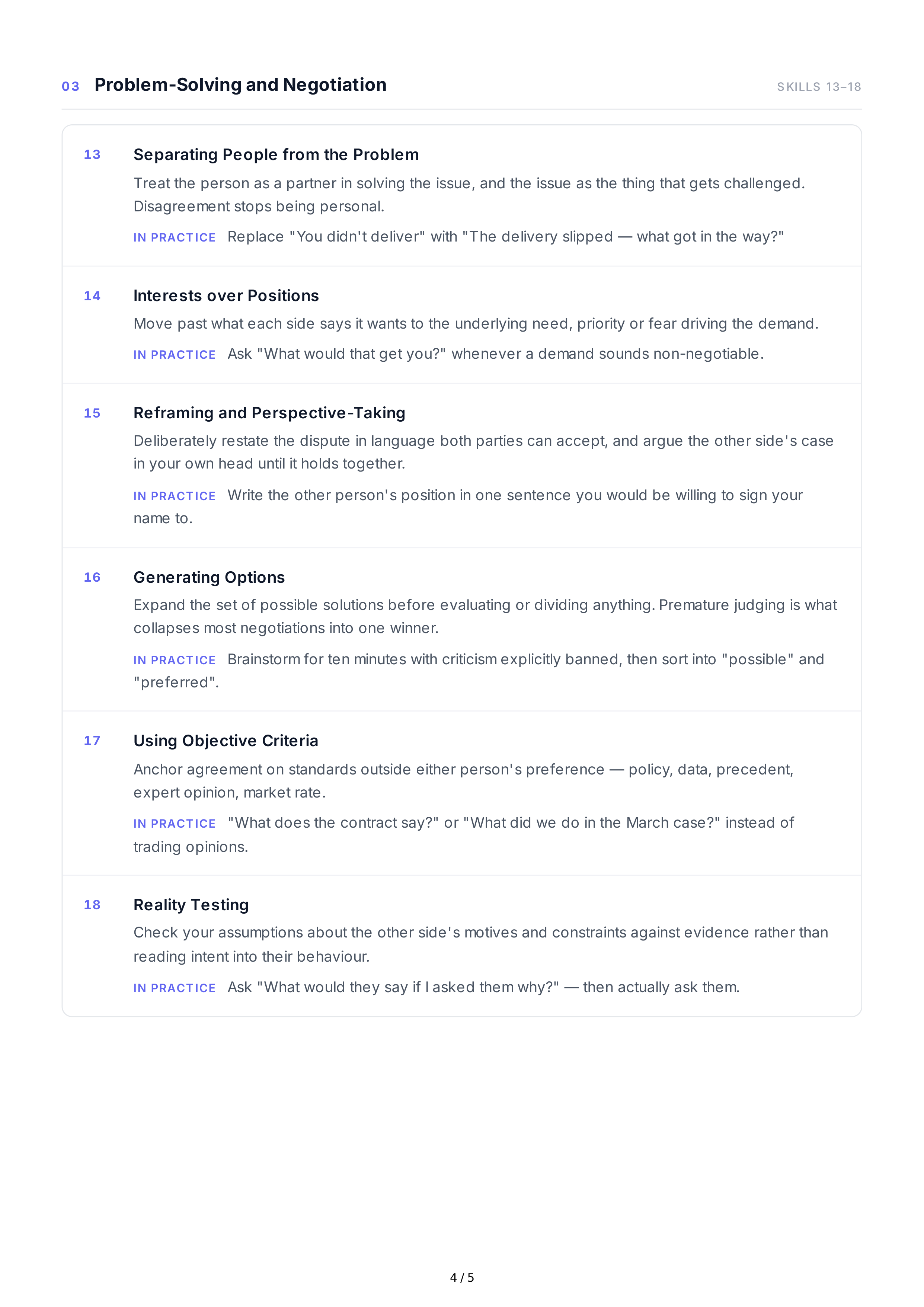
03
Problem
-
Solving
and
Negotiation
S KILLS
13–18
13
Separating
People
from
the
Problem
Treat
the
person
as
a
partner
in
solving
the
issue
,
and
the
issue
as
the
thing
that
gets
challenged
.
Disagreement
stops
being
personal
.
IN
PRACTICE
Replace
"
You
didn
'
t
deliver
"
with
"
The
delivery
slipped
—
what
got
in
the
way
?"
14
Interests
over
Positions
Move
past
what
each
side
says
it
wants
to
the
underlying
need
,
priority
or
fear
driving
the
demand
.
IN
PRACTICE
Ask
"
What
would
that
get
you
?"
whenever
a
demand
sounds
non
-
negotiable
.
15
Reframing
and
Perspective
-
Taking
Deliberately
restate
the
dispute
in
language
both
parties
can
accept
,
and
argue
the
other
side
'
s
case
in
your
own
head
until
it
holds
together
.
IN
PRACTICE
Write
the
other
person
'
s
position
in
one
sentence
you
would
be
willing
to
sign
your
name
to
.
16
Generating
Options
Expand
the
set
of
possible
solutions
before
evaluating
or
dividing
anything
.
Premature
judging
is
what
collapses
most
negotiations
into
one
winner
.
IN
PRACTICE
Brainstorm
for
ten
minutes
with
criticism
explicitly
banned
,
then
sort
into
"
possible
"
and
"
preferred
".
17
Using
Objective
Criteria
Anchor
agreement
on
standards
outside
either
person
'
s
preference
—
policy
,
data
,
precedent
,
expert
opinion
,
market
rate
.
IN
PRACTICE
"
What
does
the
contract
say
?"
or
"
What
did
we
do
in
the
March
case
?"
instead
of
trading
opinions
.
18
Reality
Testing
Check
your
assumptions
about
the
other
side
'
s
motives
and
constraints
against
evidence
rather
than
reading
intent
into
their
behaviour
.
IN
PRACTICE
Ask
"
What
would
they
say
if
I
asked
them
why
?" —
then
actually
ask
them
.
4 / 5
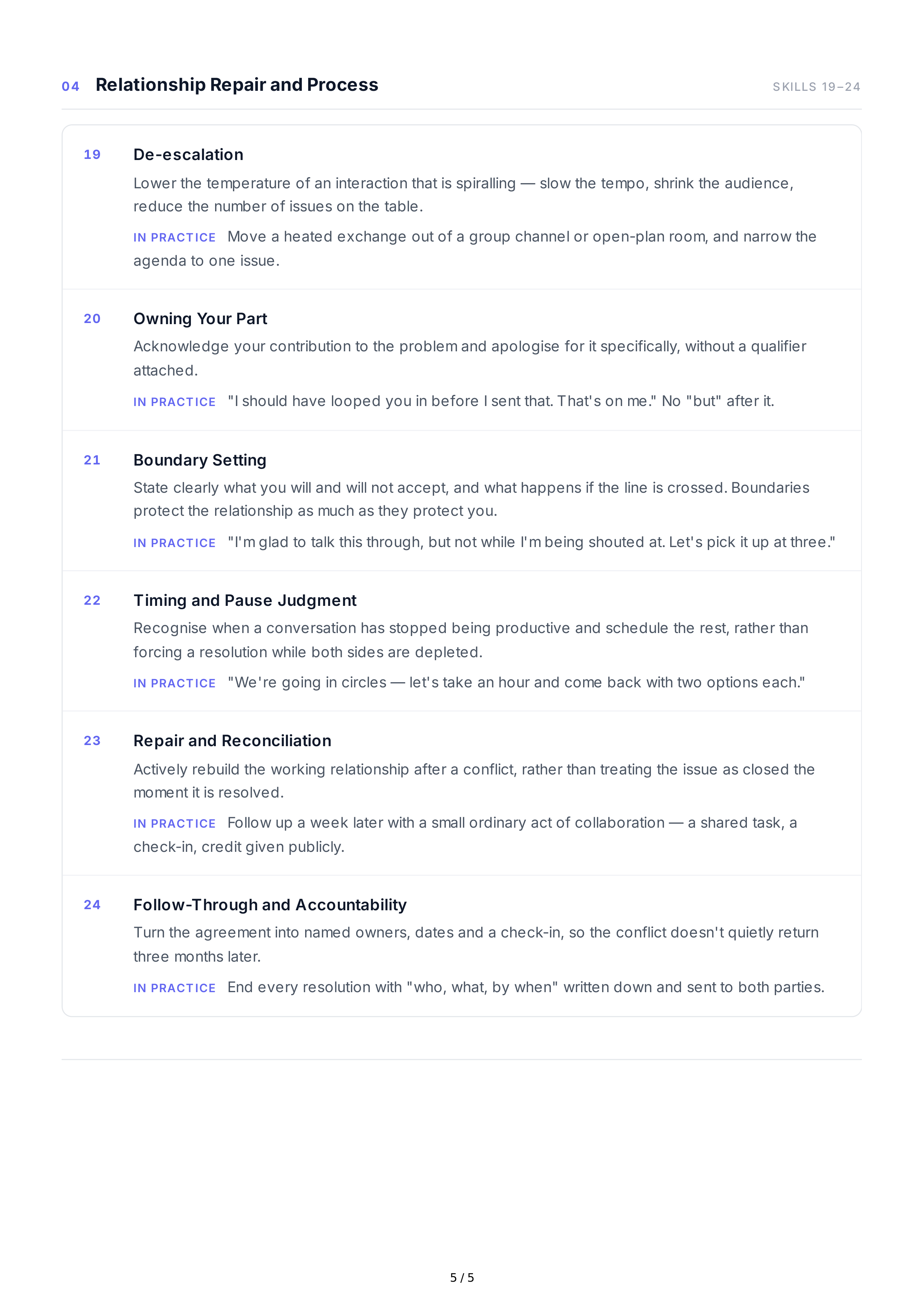
04
Relationship
Repair
and
Process
S KILLS
19 –24
19
De
-
escalation
Lower
the
temperature
of
an
interaction
that
is
spiralling
—
slow
the
tempo
,
shrink
the
audience
,
reduce
the
number
of
issues
on
the
table
.
IN
PRACTICE
Move
a
heated
exchange
out
of
a
group
channel
or
open
-
plan
room
,
and
narrow
the
agenda
to
one
issue
.
20
Owning
Your
Part
Acknowledge
your
contribution
to
the
problem
and
apologise
for
it
specifically
,
without
a
qualifier
attached
.
IN
PRACTICE
"
I
should
have
looped
you
in
before
I
sent
that
.
That
'
s
on
me
."
No
"
but
"
after
it
.
21
Boundary
Setting
State
clearly
what
you
will
and
will
not
accept
,
and
what
happens
if
the
line
is
crossed
.
Boundaries
protect
the
relationship
as
much
as
they
protect
you
.
IN
PRACTICE
"
I
'
m
glad
to
talk
this
through
,
but
not
while
I
'
m
being
shouted
at
.
Let
'
s
pick
it
up
at
three
."
22
Timing
and
Pause
Judgment
Recognise
when
a
conversation
has
stopped
being
productive
and
schedule
the
rest
,
rather
than
forcing
a
resolution
while
both
sides
are
depleted
.
IN
PRACTICE
"
We
'
re
going
in
circles
—
let
'
s
take
an
hour
and
come
back
with
two
options
each
."
23
Repair
and
Reconciliation
Actively
rebuild
the
working
relationship
after
a
conflict
,
rather
than
treating
the
issue
as
closed
the
moment
it
is
resolved
.
IN
PRACTICE
Follow
up
a
week
later
with
a
small
ordinary
act
of
collaboration
—
a
shared
task
,
a
check
-
in
,
credit
given
publicly
.
24
Follow
-
Through
and
Accountability
Turn
the
agreement
into
named
owners
,
dates
and
a
check
-
in
,
so
the
conflict
doesn
'
t
quietly
return
three
months
later
.
IN
PRACTICE
End
every
resolution
with
"
who
,
what
,
by
when
"
written
down
and
sent
to
both
parties
.
5 / 5