Collaborative
Decision
-
Making
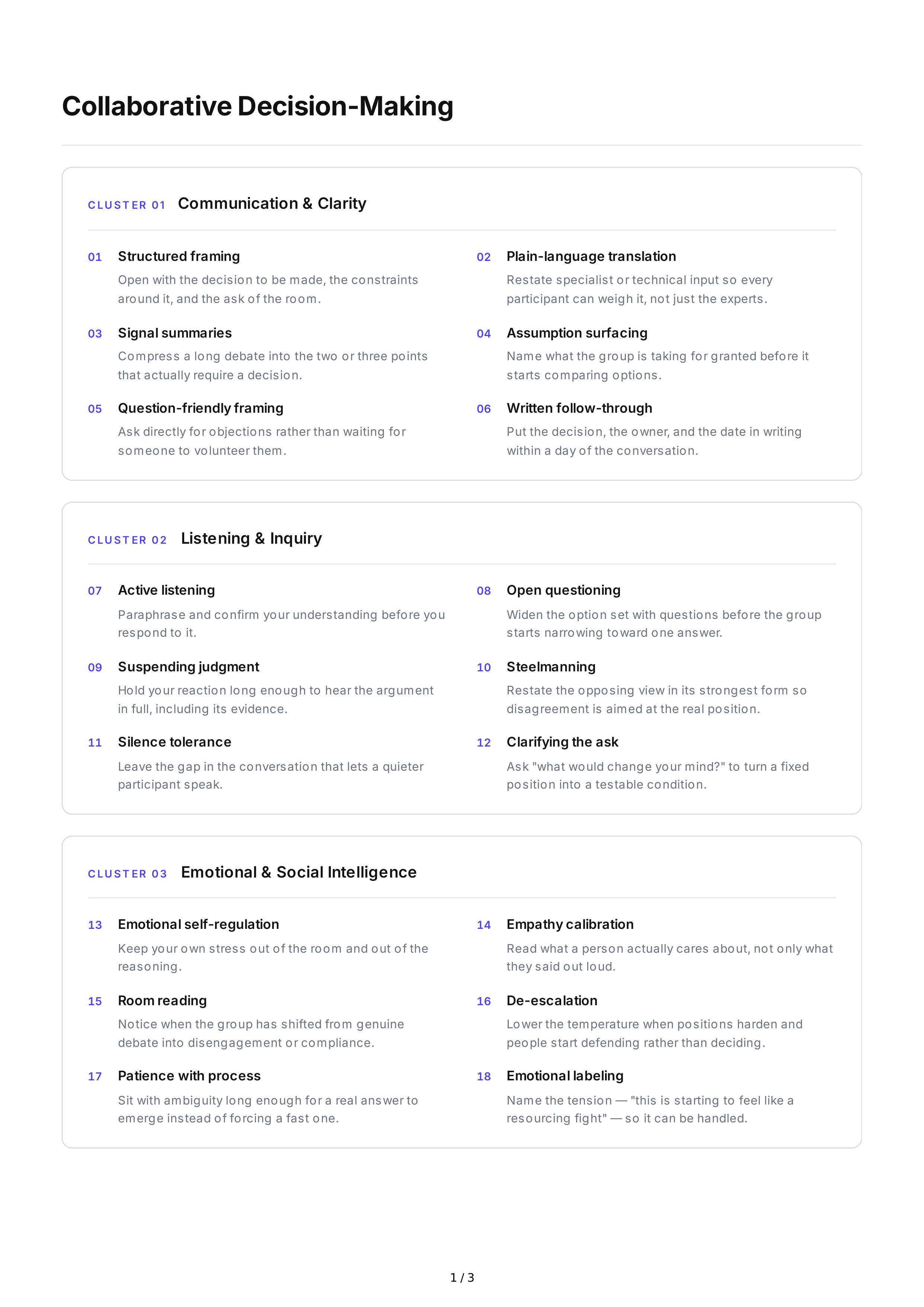
C LU S T ER
01
Communication
&
Clarity
01
Structured
framing
Open
with
the
decision
to
be
made
,
the
constraints
around
it
,
and
the
ask
of
the
room
.
02
Plain
-
language
translation
Restate
specialist
or
technical
input
so
every
participant
can
weigh
it
,
not
just
the
experts
.
03
Signal
summaries
Compress
a
long
debate
into
the
two
or
three
points
that
actually
require
a
decision
.
04
Assumption
surfacing
Name
what
the
group
is
taking
for
granted
before
it
starts
comparing
options
.
05
Question
-
friendly
framing
Ask
directly
for
objections
rather
than
waiting
for
someone
to
volunteer
them
.
06
Written
follow
-
through
Put
the
decision
,
the
owner
,
and
the
date
in
writing
within
a
day
of
the
conversation
.
C LU S T ER
02
Listening
&
Inquiry
07
Active
listening
Paraphrase
and
confirm
your
understanding
before
you
respond
to
it
.
08
Open
questioning
Widen
the
option
set
with
questions
before
the
group
starts
narrowing
toward
one
answer
.
09
Suspending
judgment
Hold
your
reaction
long
enough
to
hear
the
argument
in
full
,
including
its
evidence
.
10
Steelmanning
Restate
the
opposing
view
in
its
strongest
form
so
disagreement
is
aimed
at
the
real
position
.
11
Silence
tolerance
Leave
the
gap
in
the
conversation
that
lets
a
quieter
participant
speak
.
12
Clarifying
the
ask
Ask
"
what
would
change
your
mind
?"
to
turn
a
fixed
position
into
a
testable
condition
.
C LU S T ER
03
Emotional
&
Social
Intelligence
13
Emotional
self
-
regulation
Keep
your
own
stress
out
of
the
room
and
out
of
the
reasoning
.
14
Empathy
calibration
Read
what
a
person
actually
cares
about
,
not
only
what
they
said
out
loud
.
15
Room
reading
Notice
when
the
group
has
shifted
from
genuine
debate
into
disengagement
or
compliance
.
16
De
-
escalation
Lower
the
temperature
when
positions
harden
and
people
start
defending
rather
than
deciding
.
17
Patience
with
process
Sit
with
ambiguity
long
enough
for
a
real
answer
to
emerge
instead
of
forcing
a
fast
one
.
18
Emotional
labeling
Name
the
tension
— "
this
is
starting
to
feel
like
a
resourcing
fight
" —
so
it
can
be
handled
.
1 / 3
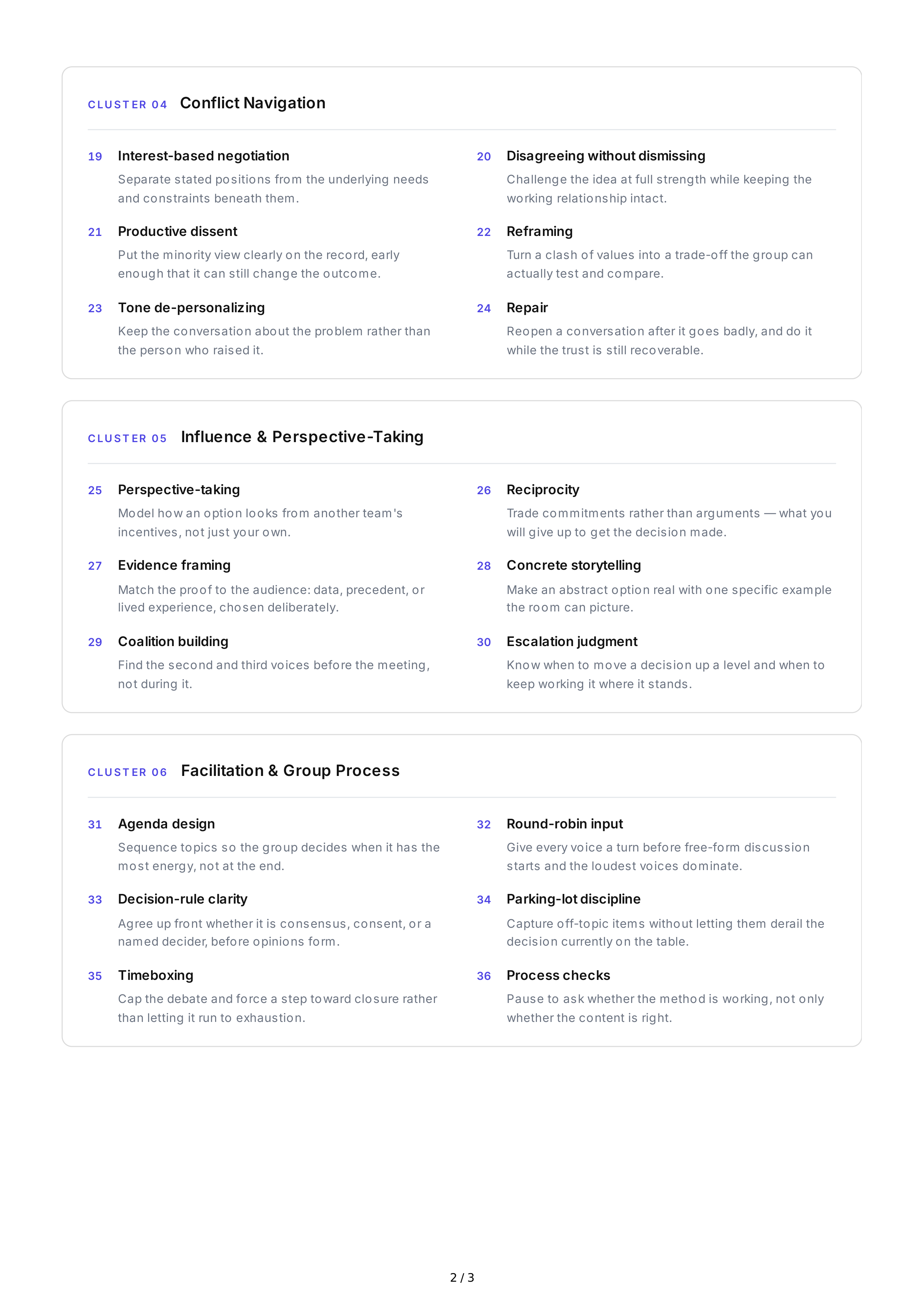
C LU S T ER
04
Conflict
Navigation
19
Interest
-
based
negotiation
Separate
stated
positions
from
the
underlying
needs
and
constraints
beneath
them
.
20
Disagreeing
without
dismissing
Challenge
the
idea
at
full
strength
while
keeping
the
working
relationship
intact
.
21
Productive
dissent
Put
the
minority
view
clearly
on
the
record
,
early
enough
that
it
can
still
change
the
outcome
.
22
Reframing
Turn
a
clash
of
values
into
a
trade
-
off
the
group
can
actually
test
and
compare
.
23
Tone
de
-
personalizing
Keep
the
conversation
about
the
problem
rather
than
the
person
who
raised
it
.
24
Repair
Reopen
a
conversation
after
it
goes
badly
,
and
do
it
while
the
trust
is
still
recoverable
.
C LU S T ER
05
Influence
&
Perspective
-
Taking
25
Perspective
-
taking
Model
how
an
option
looks
from
another
team
'
s
incentives
,
not
just
your
own
.
26
Reciprocity
Trade
commitments
rather
than
arguments
—
what
you
will
give
up
to
get
the
decision
made
.
27
Evidence
framing
Match
the
proof
to
the
audience
:
data
,
precedent
,
or
lived
experience
,
chosen
deliberately
.
28
Concrete
storytelling
Make
an
abstract
option
real
with
one
specific
example
the
room
can
picture
.
29
Coalition
building
Find
the
second
and
third
voices
before
the
meeting
,
not
during
it
.
30
Escalation
judgment
Know
when
to
move
a
decision
up
a
level
and
when
to
keep
working
it
where
it
stands
.
C LU S T ER
06
Facilitation
&
Group
Process
31
Agenda
design
Sequence
topics
so
the
group
decides
when
it
has
the
most
energy
,
not
at
the
end
.
32
Round
-
robin
input
Give
every
voice
a
turn
before
free
-
form
discussion
starts
and
the
loudest
voices
dominate
.
33
Decision
-
rule
clarity
Agree
up
front
whether
it
is
consensus
,
consent
,
or
a
named
decider
,
before
opinions
form
.
34
Parking
-
lot
discipline
Capture
off
-
topic
items
without
letting
them
derail
the
decision
currently
on
the
table
.
35
Timeboxing
Cap
the
debate
and
force
a
step
toward
closure
rather
than
letting
it
run
to
exhaustion
.
36
Process
checks
Pause
to
ask
whether
the
method
is
working
,
not
only
whether
the
content
is
right
.
2 / 3

C LU S T ER
07
Trust
,
Accountability
&
Culture
37
Reliability
Do
what
you
said
you
would
do
between
meetings
,
every
time
.
38
Interest
transparency
Disclose
your
own
stake
in
the
outcome
before
you
argue
for
your
preferred
option
.
39
Disagree
and
commit
Say
you
will
support
the
decision
out
loud
,
then
support
it
in
practice
.
40
Blameless
review
Examine
the
decision
process
for
its
flaws
without
assigning
fault
to
the
people
in
it
.
41
Credit
sharing
Name
the
contributors
by
name
when
the
outcome
is
reported
upward
or
outward
.
42
Psychological
safety
Make
it
visibly
safe
to
raise
a
risk
,
admit
an
error
,
or
say
"
I
don
'
t
know
yet
."
3 / 3