Mediation
Interpersonal
Skills
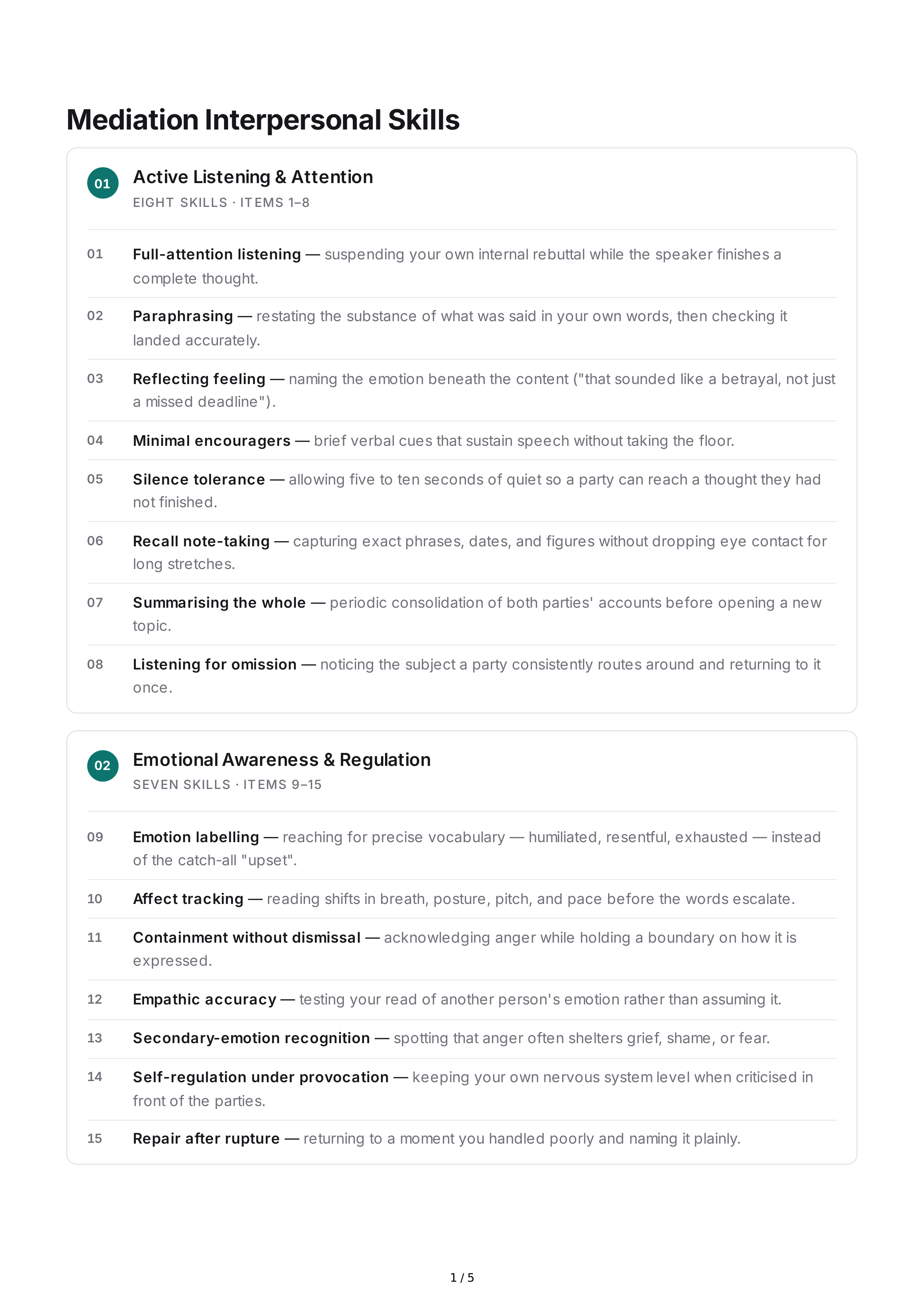
01
Active
Listening
&
Attention
EIGHT
SKILLS
·
IT EMS
1–8
01
Full
-
attention
listening
—
suspending
your
own
internal
rebuttal
while
the
speaker
finishes
a
complete
thought
.
02
Paraphrasing
—
restating
the
substance
of
what
was
said
in
your
own
words
,
then
checking
it
landed
accurately
.
03
Reflecting
feeling
—
naming
the
emotion
beneath
the
content
("
that
sounded
like
a
betrayal
,
not
just
a
missed
deadline
").
04
Minimal
encouragers
—
brief
verbal
cues
that
sustain
speech
without
taking
the
floor
.
05
Silence
tolerance
—
allowing
five
to
ten
seconds
of
quiet
so
a
party
can
reach
a
thought
they
had
not
finished
.
06
Recall
note
-
taking
—
capturing
exact
phrases
,
dates
,
and
figures
without
dropping
eye
contact
for
long
stretches
.
07
Summarising
the
whole
—
periodic
consolidation
of
both
parties
'
accounts
before
opening
a
new
topic
.
08
Listening
for
omission
—
noticing
the
subject
a
party
consistently
routes
around
and
returning
to
it
once
.
02
Emotional
Awareness
&
Regulation
SEVEN
SKILLS
·
IT EMS
9–15
09
Emotion
labelling
—
reaching
for
precise
vocabulary
—
humiliated
,
resentful
,
exhausted
—
instead
of
the
catch
-
all
"
upset
".
10
Affect
tracking
—
reading
shifts
in
breath
,
posture
,
pitch
,
and
pace
before
the
words
escalate
.
11
Containment
without
dismissal
—
acknowledging
anger
while
holding
a
boundary
on
how
it
is
expressed
.
12
Empathic
accuracy
—
testing
your
read
of
another
person
'
s
emotion
rather
than
assuming
it
.
13
Secondary
-
emotion
recognition
—
spotting
that
anger
often
shelters
grief
,
shame
,
or
fear
.
14
Self
-
regulation
under
provocation
—
keeping
your
own
nervous
system
level
when
criticised
in
front
of
the
parties
.
15
Repair
after
rupture
—
returning
to
a
moment
you
handled
poorly
and
naming
it
plainly
.
1 / 5
03
Communication
&
Language
EIGHT
SKILLS
·
IT EMS
16–23
16
Plain
-
language
precision
—
short
sentences
and
concrete
nouns
,
especially
where
parties
use
different
professional
vocabularies
.
17
Neutral
phrasing
—
describing
behaviour
and
impact
rather
than
intent
or
character
.
18
Reframing
—
restating
a
hostile
statement
in
interest
-
based
terms
without
changing
its
substance
.
19
Framing
statements
—
telling
parties
how
the
conversation
will
run
before
it
begins
,
so
surprises
stay
low
.
20
Word
choice
under
pressure
—
avoiding
absolutes
such
as
"
always
"
and
"
never
"
that
trigger
defence
rather
than
reflection
.
21
Pace
control
—
deliberately
slowing
delivery
when
the
stakes
in
the
room
rise
.
22
Multi
-
partial
language
—
addressing
each
party
in
turn
with
equivalent
weight
and
respect
.
23
Written
clarity
—
drafting
summaries
each
side
can
read
without
feeling
caricatured
or
misquoted
.
04
Rapport
&
Trust
Building
SEVEN
SKILLS
·
IT EMS
24–30
24
Unconditional
positive
regard
—
treating
each
party
as
worthy
of
respect
regardless
of
their
conduct
in
the
dispute
.
25
Predictability
—
saying
what
you
will
do
and
doing
it
,
on
time
and
in
the
order
promised
.
26
Confidentiality
discipline
—
explaining
exactly
what
is
and
is
not
confidential
,
then
holding
that
line
without
exception
.
27
Small
human
moments
—
brief
,
non
-
manipulative
warmth
:
water
offered
,
a
name
remembered
,
a
chair
moved
.
28
Separating
person
from
problem
—
challenging
behaviour
without
diminishing
the
person
who
displayed
it
.
29
Consistency
across
parties
—
equal
greeting
,
equal
airtime
,
equal
follow
-
up
after
the
session
.
30
Patience
with
repetition
—
allowing
a
party
to
tell
the
story
again
until
they
are
finished
with
it
.
2 / 5
05
Neutrality
,
Impartiality
&
Ethics
EIGHT
SKILLS
·
IT EMS
31–38
31
Structural
neutrality
—
designing
a
process
in
which
neither
party
holds
a
built
-
in
procedural
advantage
.
32
Bias
self
-
monitoring
—
noticing
when
ideology
,
background
,
or
personal
affinity
is
pulling
you
toward
one
side
.
33
Redistributing
airtime
—
actively
creating
space
for
the
quieter
or
less
fluent
party
to
speak
at
length
.
34
Caucus
sealing
—
keeping
private
-
session
information
genuinely
private
unless
a
party
authorises
release
.
35
Declaring
conflicts
—
disclosing
prior
relationships
or
interests
before
accepting
the
matter
,
and
standing
down
when
needed
.
36
Interest
over
position
—
helping
parties
move
from
what
they
demand
to
why
they
need
it
.
37
Respect
for
self
-
determination
—
accepting
an
outcome
the
parties
choose
even
when
you
would
have
decided
differently
.
38
Transparency
about
the
process
—
explaining
the
mediator
'
s
role
,
limits
of
authority
,
and
what
happens
if
no
agreement
is
reached
.
06
Questioning
&
Inquiry
SEVEN
SKILLS
·
IT EMS
39–45
39
Open
-
ended
questioning
—
asking
"
what
would
need
to
be
true
for
this
to
work
?"
rather
than
"
do
you
agree
?"
40
Circular
questioning
—
asking
one
party
what
the
other
might
say
,
which
surfaces
the
pattern
between
them
.
41
Clarifying
questions
—
pinning
down
a
vague
term
:
what
counts
as
respect
,
on
time
,
or
reasonable
in
their
context
.
42
Future
-
focused
questions
—
moving
the
room
from
history
to
design
:
what
does
the
first
month
look
like
?
43
Reality
testing
—
probing
feasibility
and
consequences
without
advocating
a
position
of
your
own
.
44
Caucus
questioning
—
using
private
sessions
to
surface
what
will
not
be
said
in
joint
session
.
45
Non
-
leading
framing
—
keeping
your
preferred
outcome
out
of
the
shape
of
the
question
.
3 / 5
07
Reframing
&
Joint
Problem
-
Solving
SEVEN
SKILLS
·
IT EMS
46–52
46
Interest
identification
—
separating
needs
,
interests
,
and
positions
and
keeping
all
three
visible
on
the
table
.
47
Joint
-
problem
framing
—
converting
"
you
versus
me
"
into
"
us
versus
the
issue
"
in
explicit
,
repeatable
language
.
48
Option
generation
—
brainstorming
without
evaluation
first
,
then
screening
together
.
49
Objective
criteria
—
introducing
standards
,
precedents
,
or
expert
data
that
both
sides
can
accept
as
fair
.
50
Package
building
—
combining
issues
so
that
each
party
gains
something
it
genuinely
values
.
51
Consequence
reality
-
checking
—
exploring
the
cost
of
no
agreement
without
issuing
a
threat
.
52
Collaborative
drafting
—
writing
terms
in
the
room
,
in
both
parties
'
own
words
,
before
anyone
leaves
.
08
De
-
escalation
&
Managing
Difficult
Moments
EIGHT
SKILLS
·
IT EMS
53–60
53
Rate
regulation
—
slowing
speech
,
lowering
volume
,
and
lengthening
pauses
to
drop
the
tempo
of
the
room
.
54
Process
breaks
—
calling
a
pause
before
a
position
hardens
into
a
public
commitment
.
55
Ground
-
rule
enforcement
—
holding
the
agreement
set
at
the
opening
,
evenly
and
without
apology
.
56
Redirecting
personal
attacks
—
moving
from
character
back
to
issue
without
shaming
the
person
who
attacked
.
57
Splitting
the
room
—
separating
parties
physically
or
into
caucus
when
joint
session
stops
producing
movement
.
58
Acknowledging
without
agreeing
—
validating
the
experience
while
reserving
judgment
on
the
underlying
claim
.
59
Managing
power
imbalance
—
adjusting
process
and
format
to
protect
the
voice
of
the
less
powerful
party
.
60
Tracking
your
own
triggers
—
recognising
the
phrase
or
behaviour
that
reliably
destabilises
you
,
and
planning
for
it
.
4 / 5
09
Cultural
&
Contextual
Sensitivity
SIX
SKILLS
·
IT EMS
61–66
61
Cultural
framing
awareness
—
recognising
differing
norms
around
directness
,
silence
,
apology
,
and
seniority
.
62
Language
access
—
working
competently
with
interpreters
,
addressing
the
party
and
not
the
interpreter
.
63
Identity
awareness
—
accounting
for
how
race
,
gender
,
class
,
disability
,
and
faith
shape
the
dispute
.
64
Negotiation
-
style
adaptation
—
adjusting
approach
for
relationship
-
first
and
deal
-
first
negotiators
alike
.
65
Context
reading
—
understanding
the
organisational
,
familial
,
or
legal
system
the
dispute
lives
inside
.
66
Avoiding
universal
assumptions
—
testing
whether
your
"
normal
"
is
actually
shared
by
the
people
in
the
room
.
10
Reflective
Practice
&
Self
-
Management
SIX
SKILLS
·
IT EMS
67 –7 2
67
Reflective
debriefing
—
reviewing
your
own
interventions
after
each
session
while
the
detail
is
still
fresh
.
68
Supervision
and
peer
consultation
—
bringing
difficult
cases
to
a
trusted
third
party
rather
than
carrying
them
alone
.
69
Emotional
hygiene
—
having
a
deliberate
way
to
discharge
what
you
absorb
before
it
leaks
into
the
next
case
.
70
Boundary
keeping
—
knowing
what
is
not
yours
to
fix
,
decide
,
or
carry
on
behalf
of
the
parties
.
71
Continuous
learning
—
updating
method
on
purpose
through
reading
,
observation
,
co
-
mediation
,
and
training
.
72
Humility
about
outcome
—
accepting
that
some
disputes
do
not
settle
,
and
the
process
still
did
its
work
.
5 / 5