Difficult
Conversation
Skills
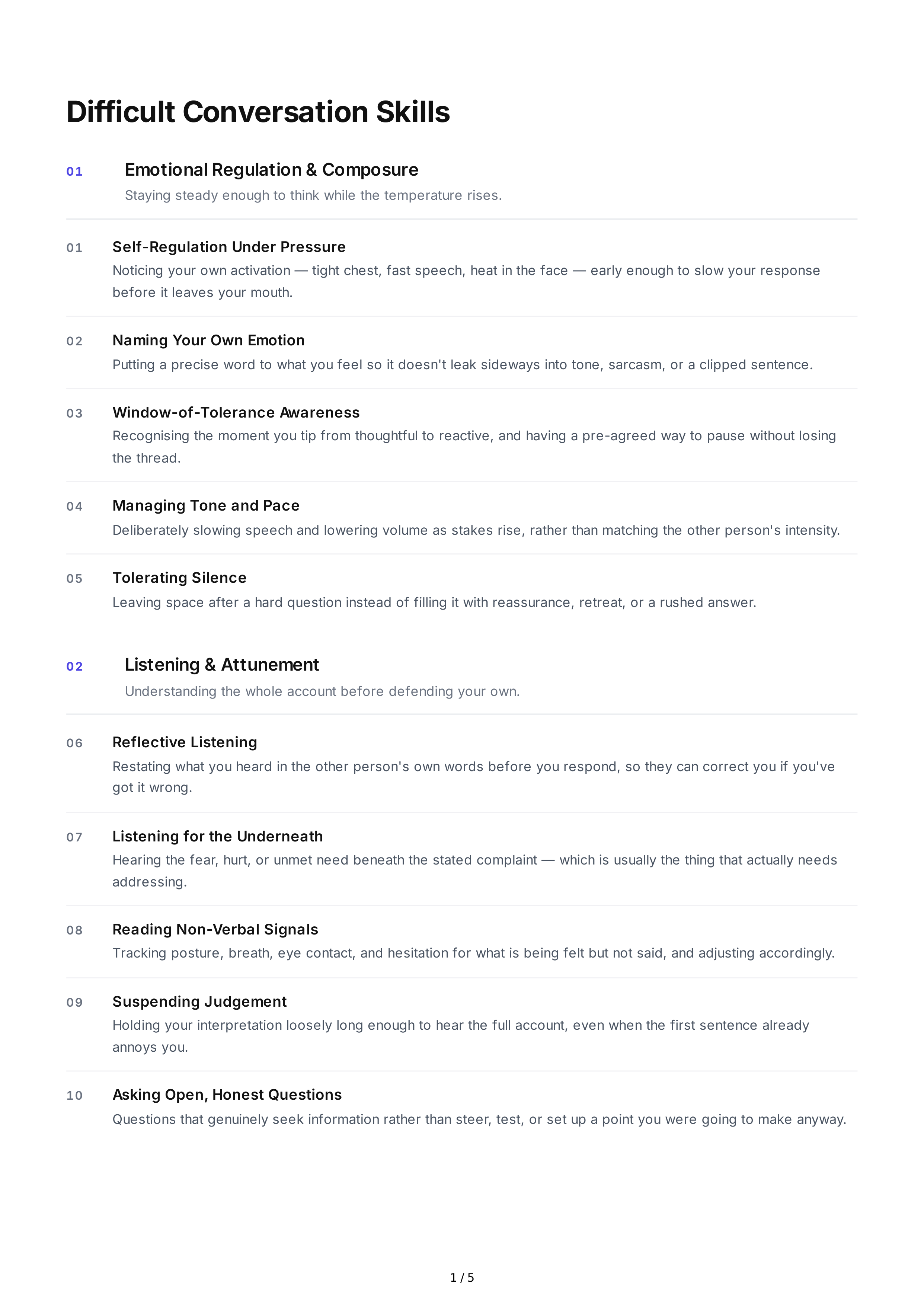
01
Emotional
Regulation
&
Composure
Staying
steady
enough
to
think
while
the
temperature
rises
.
01
Self
-
Regulation
Under
Pressure
Noticing
your
own
activation
—
tight
chest
,
fast
speech
,
heat
in
the
face
—
early
enough
to
slow
your
response
before
it
leaves
your
mouth
.
02
Naming
Your
Own
Emotion
Putting
a
precise
word
to
what
you
feel
so
it
doesn
'
t
leak
sideways
into
tone
,
sarcasm
,
or
a
clipped
sentence
.
03
Window
-
of
-
Tolerance
Awareness
Recognising
the
moment
you
tip
from
thoughtful
to
reactive
,
and
having
a
pre
-
agreed
way
to
pause
without
losing
the
thread
.
04
Managing
Tone
and
Pace
Deliberately
slowing
speech
and
lowering
volume
as
stakes
rise
,
rather
than
matching
the
other
person
'
s
intensity
.
05
Tolerating
Silence
Leaving
space
after
a
hard
question
instead
of
filling
it
with
reassurance
,
retreat
,
or
a
rushed
answer
.
02
Listening
&
Attunement
Understanding
the
whole
account
before
defending
your
own
.
06
Reflective
Listening
Restating
what
you
heard
in
the
other
person
'
s
own
words
before
you
respond
,
so
they
can
correct
you
if
you
'
ve
got
it
wrong
.
07
Listening
for
the
Underneath
Hearing
the
fear
,
hurt
,
or
unmet
need
beneath
the
stated
complaint
—
which
is
usually
the
thing
that
actually
needs
addressing
.
08
Reading
Non
-
Verbal
Signals
Tracking
posture
,
breath
,
eye
contact
,
and
hesitation
for
what
is
being
felt
but
not
said
,
and
adjusting
accordingly
.
09
Suspending
Judgement
Holding
your
interpretation
loosely
long
enough
to
hear
the
full
account
,
even
when
the
first
sentence
already
annoys
you
.
10
Asking
Open
,
Honest
Questions
Questions
that
genuinely
seek
information
rather
than
steer
,
test
,
or
set
up
a
point
you
were
going
to
make
anyway
.
1 / 5
03
Framing
&
Delivery
Setting
up
the
conversation
so
it
can
be
heard
.
11
Choosing
the
Opening
Line
The
first
sentence
sets
the
tone
for
everything
after
it
—
naming
both
your
purpose
and
your
regard
for
the
person
.
12
Separating
Observation
from
Interpretation
Describing
what
actually
happened
before
assigning
meaning
to
it
,
so
the
other
person
can
respond
to
facts
rather
than
your
conclusions
.
13
Leading
with
Intent
Stating
up
front
why
you
'
re
raising
this
now
and
what
you
hope
comes
out
of
it
,
so
the
other
person
isn
'
t
guessing
at
your
motive
.
14
Blameless
Specificity
Using
concrete
examples
and
behaviours
rather
than
character
judgements
— "
the
report
arrived
three
days
late
"
instead
of
"
you
'
re
unreliable
."
15
Timing
and
Setting
Choosing
when
,
where
,
and
how
private
a
conversation
should
be
,
and
refusing
to
open
it
in
a
corridor
or
in
front
of
an
audience
.
04
Curiosity
&
Non
-
Defensiveness
Staying
open
when
you
are
the
one
being
examined
.
16
Separating
Feedback
from
Identity
Hearing
criticism
of
your
behaviour
without
collapsing
it
into
a
verdict
on
who
you
are
as
a
person
.
17
Asking
for
the
Concrete
Requesting
a
specific
instance
when
feedback
is
vague
,
instead
of
arguing
with
the
summary
you
'
ve
been
handed
.
18
Reflecting
Back
Without
Agreeing
Acknowledging
a
perspective
accurately
without
endorsing
its
accuracy
— "
so
you
'
re
saying
it
felt
dismissive
"
is
not
a
concession
.
19
The
Pause
Before
the
Rebuttal
Resisting
the
reflex
to
explain
,
correct
,
or
contextualise
in
the
first
two
seconds
,
when
the
other
person
is
still
talking
.
20
Holding
Two
Truths
Allowing
that
both
accounts
can
be
partially
right
at
once
,
without
needing
to
establish
whose
version
wins
.
2 / 5
05
Empathy
&
Validation
Making
it
clear
you
understand
,
without
giving
up
your
position
.
21
Validation
Without
Endorsement
Confirming
that
someone
'
s
reaction
makes
sense
without
conceding
the
substance
of
the
disagreement
.
22
Perspective
-
Taking
Reconstructing
in
detail
how
the
situation
looks
from
where
they
stand
,
including
what
they
couldn
'
t
see
that
you
could
.
23
Acknowledging
Impact
Over
Intent
Recognising
the
harm
someone
experienced
regardless
of
what
you
meant
by
it
—
the
two
are
separate
and
both
matter
.
24
Sitting
with
Discomfort
Staying
present
with
someone
'
s
distress
instead
of
fixing
it
,
minimising
it
,
or
rushing
past
it
to
the
practicalities
.
25
Empathic
Accuracy
Guessing
the
specific
emotion
—
disappointment
rather
than
anger
,
or
embarrassment
rather
than
defiance
—
well
enough
that
the
person
feels
seen
.
06
Boundary
&
Assertiveness
Saying
what
you
need
and
what
you
won
'
t
do
.
26
Direct
Requests
Asking
clearly
for
what
you
need
instead
of
hinting
,
hoping
,
or
waiting
to
see
whether
they
offer
it
unprompted
.
27
Saying
No
Without
Over
-
Explaining
A
clean
refusal
with
one
honest
reason
—
not
a
defence
brief
that
invites
negotiation
on
every
clause
.
28
Stating
Limits
and
Consequences
Naming
what
you
can
and
cannot
do
,
and
what
will
happen
next
,
so
the
limit
is
real
rather
than
aspirational
.
29
Holding
a
Position
Under
Pushback
Staying
with
your
view
while
staying
connected
—
repeating
the
point
calmly
instead
of
escalating
or
caving
.
30
Respecting
Their
No
Accepting
another
person
'
s
boundary
without
renegotiating
it
,
sulking
,
or
asking
again
in
a
slightly
different
way
.
07
Repair
&
Accountability
Putting
things
right
once
something
has
gone
wrong
.
31
Owning
Your
Part
Naming
your
specific
contribution
to
the
problem
without
qualifiers
,
footnotes
,
or
a
matching
accusation
for
balance
.
3 / 5
32
The
Full
Apology
Acknowledgement
,
impact
,
responsibility
,
and
change
—
in
that
order
,
and
short
enough
to
be
believable
.
33
Naming
the
Pattern
Surfacing
the
recurring
dynamic
between
you
rather
than
relitigating
the
latest
incident
as
if
it
were
the
first
.
34
Re
-
Entry
After
a
Blow
-
Up
Cooling
down
and
deliberately
coming
back
to
the
conversation
rather
than
letting
it
end
in
silence
or
a
stalemate
.
35
Rebuilding
Trust
Over
Time
Treating
repair
as
a
series
of
small
kept
promises
rather
than
one
emotional
conversation
that
is
expected
to
settle
everything
.
08
Negotiation
&
Problem
-
Solving
Turning
a
confrontation
into
a
decision
.
36
Interest
-
Based
Framing
Moving
from
stated
positions
to
the
underlying
needs
on
both
sides
,
where
overlap
is
actually
possible
.
37
Expanding
the
Options
Generating
several
possible
paths
before
choosing
one
,
so
the
conversation
isn
'
t
a
binary
win
or
lose
.
38
Naming
the
Trade
-
offs
Saying
out
loud
what
each
option
costs
each
party
,
so
the
choice
is
made
with
eyes
open
rather
than
discovered
later
.
39
Agreeing
on
Next
Steps
Ending
with
specific
commitments
,
named
owners
,
and
dates
—
because
a
warm
ending
is
not
the
same
as
a
resolution
.
40
Knowing
When
to
Stop
Recognising
when
the
conversation
needs
more
time
,
more
data
,
or
a
third
party
,
and
saying
so
rather
than
grinding
on
.
09
Context
,
Power
&
Culture
Reading
the
room
you
'
re
actually
in
,
not
the
one
you
imagine
.
41
Power
Awareness
Accounting
for
the
consequences
the
other
person
faces
for
being
honest
with
you
,
and
adjusting
how
much
you
ask
of
them
.
42
Cultural
Norms
Around
Conflict
Recognising
that
directness
,
silence
,
emotional
expression
,
and
disagreement
read
very
differently
across
cultures
and
contexts
.
4 / 5
43
Confidentiality
Discipline
Being
deliberate
about
who
hears
what
and
when
,
rather
than
letting
a
private
conversation
travel
by
accident
.
44
Third
-
Party
Presence
Judging
when
a
mediator
,
HR
partner
,
or
manager
should
be
in
the
room
—
and
telling
the
other
person
in
advance
.
45
Documenting
the
Conversation
Recording
agreements
accurately
and
fairly
without
turning
a
working
conversation
into
evidence
-
gathering
.
10
Self
-
Awareness
&
Preparation
The
work
that
happens
before
anyone
sits
down
.
46
Pre
-
Conversation
Preparation
Writing
down
your
goal
,
the
facts
you
can
stand
behind
,
and
your
own
likely
triggers
before
you
walk
into
the
room
.
47
Checking
Your
Motive
Asking
honestly
whether
you
want
the
situation
resolved
or
want
to
be
proven
right
—
the
two
produce
very
different
conversations
.
48
Recognising
Your
Default
Style
Knowing
whether
you
tend
to
appease
,
avoid
,
or
attack
under
stress
,
and
planning
the
counter
-
move
in
advance
.
49
Anticipating
Their
Reaction
Preparing
for
the
most
likely
emotional
response
without
scripting
the
outcome
or
rehearsing
your
defence
.
50
Post
-
Conversation
Reflection
Reviewing
what
worked
,
what
you
'
d
change
,
and
what
you
committed
to
—
within
a
day
,
while
the
detail
is
still
accurate
.
5 / 5