Collaboration
&
Interpersonal
Skills
CO RE
LI ST
AT
A
G LAN CE
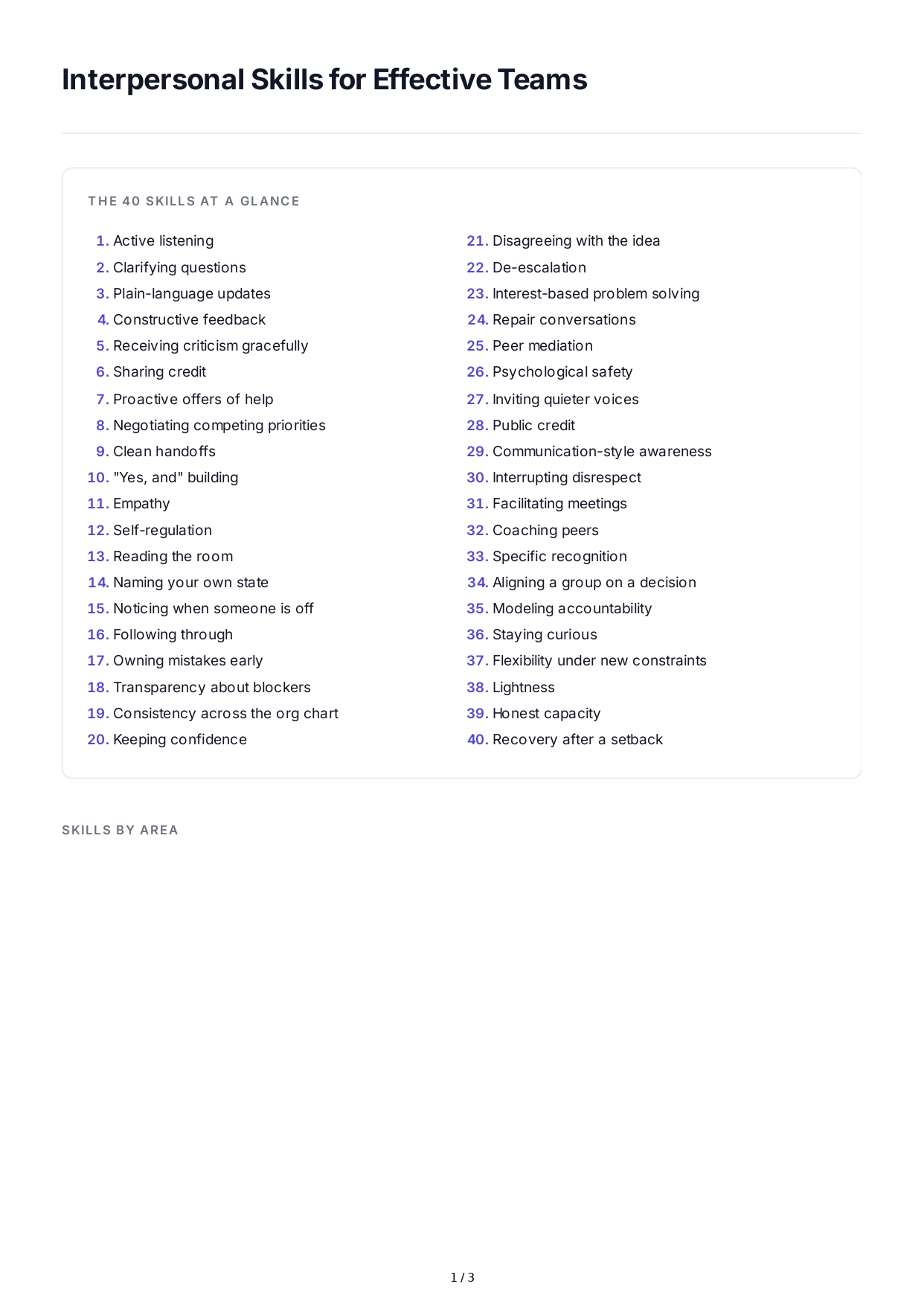
01
Active
listening
13
Psychological
safety
02
Clear
,
concise
expression
14
Empathy
03
Constructive
feedback
15
Self
-
awareness
04
Meeting
facilitation
16
Self
-
regulation
05
Reliability
17
Direct
,
respectful
disagreement
06
Accountability
18
De
-
escalation
07
Shared
credit
19
Apology
and
repair
08
Adaptability
20
Persuasion
with
evidence
09
Reading
the
room
21
Delegation
10
Discretion
22
Mentorship
11
Humility
23
Cross
-
functional
collaboration
12
Follow
-
through
24
Inclusive
facilitation
01
Communication
Foundations
8
skills
Everything
downstream
—
trust
,
alignment
,
conflict
resolution
—
depends
on
getting
information
across
accurately
.
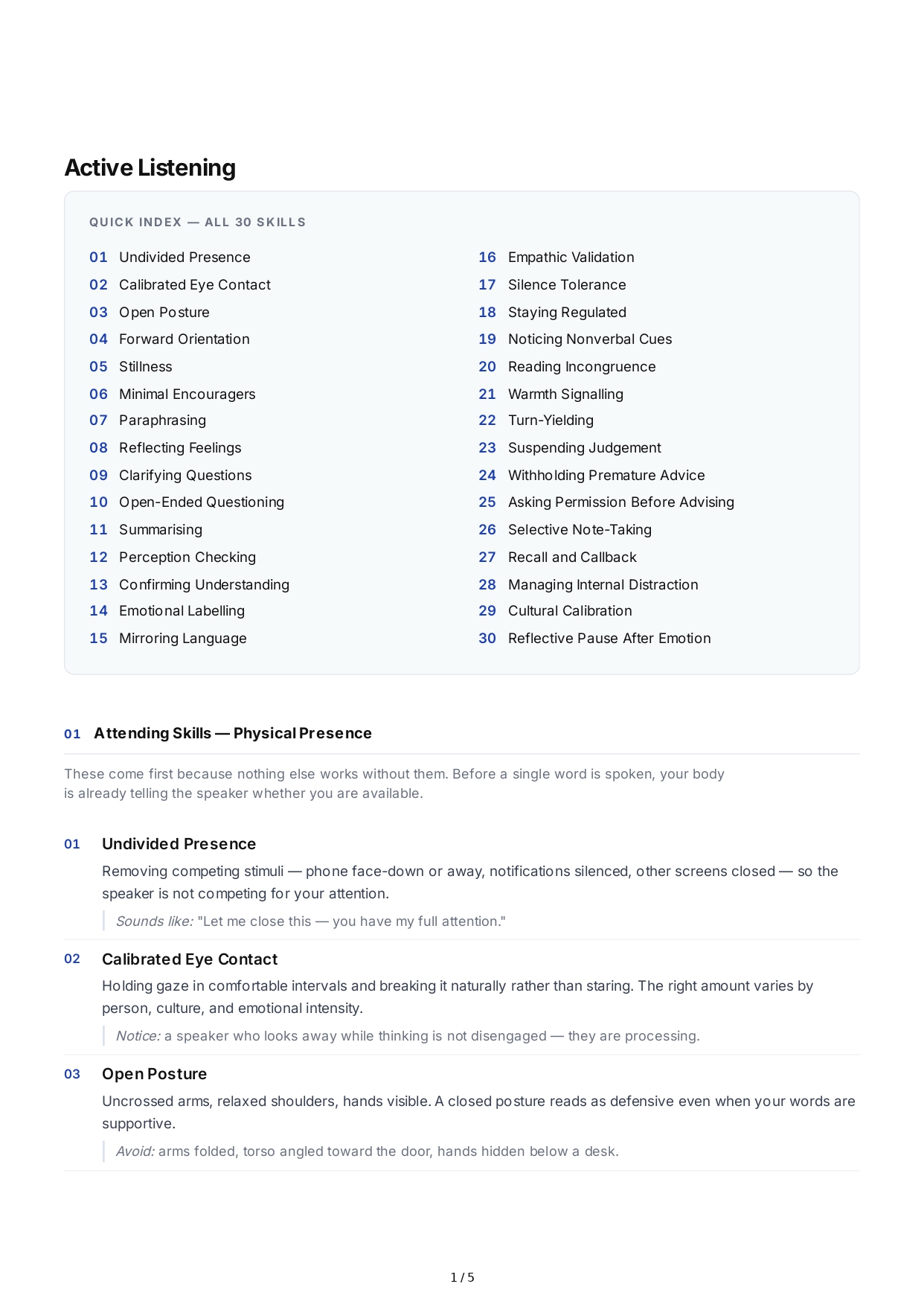
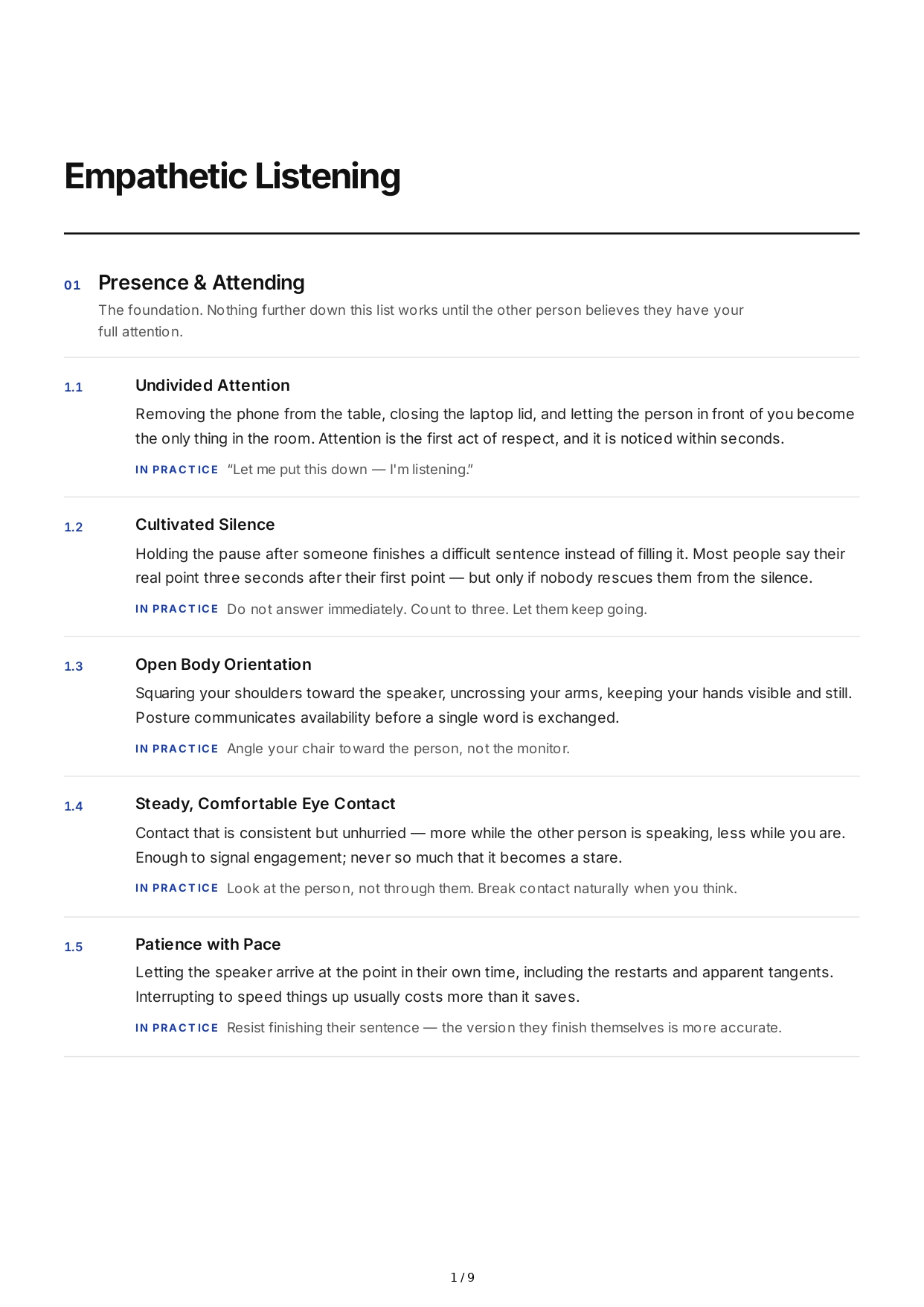
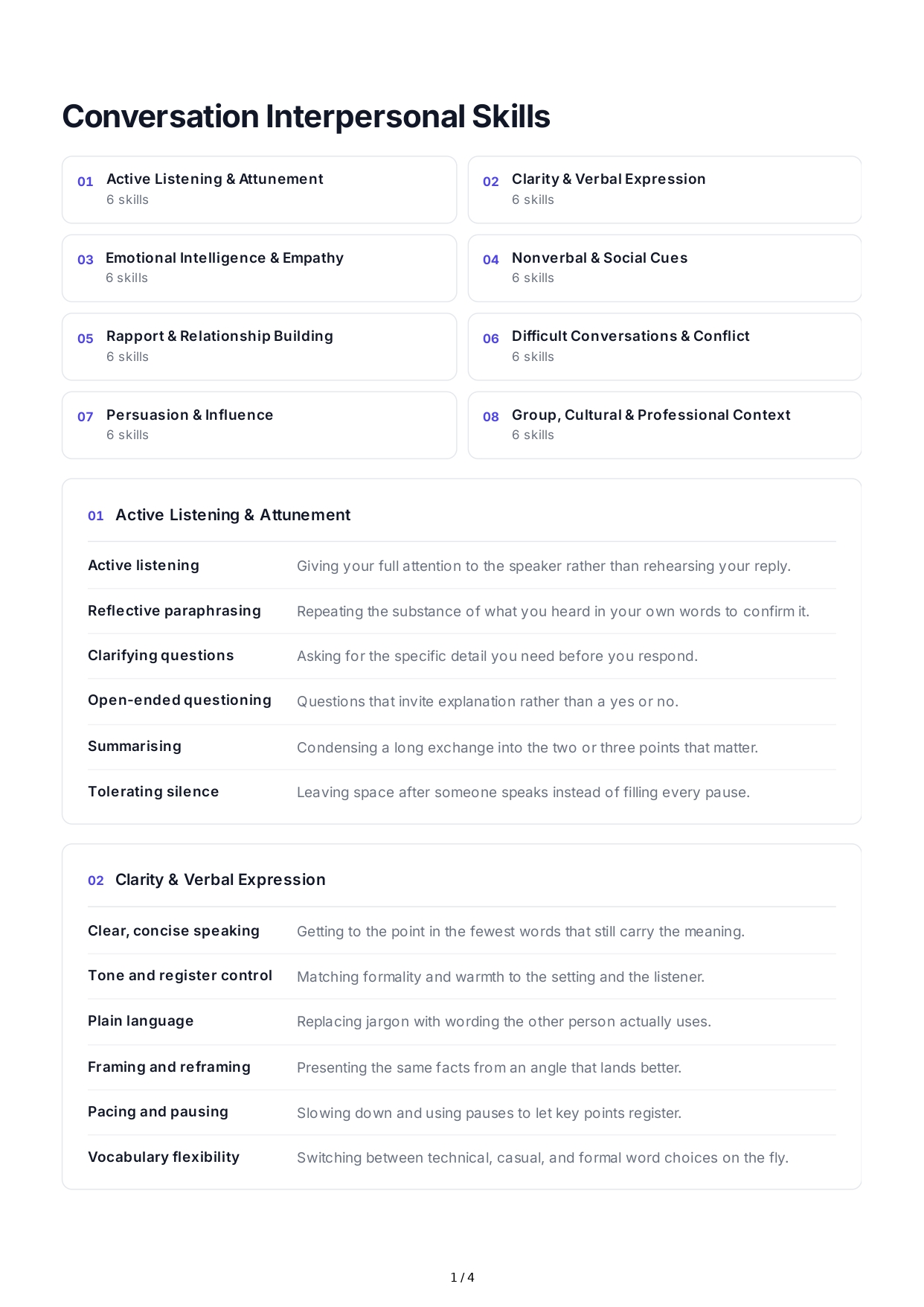
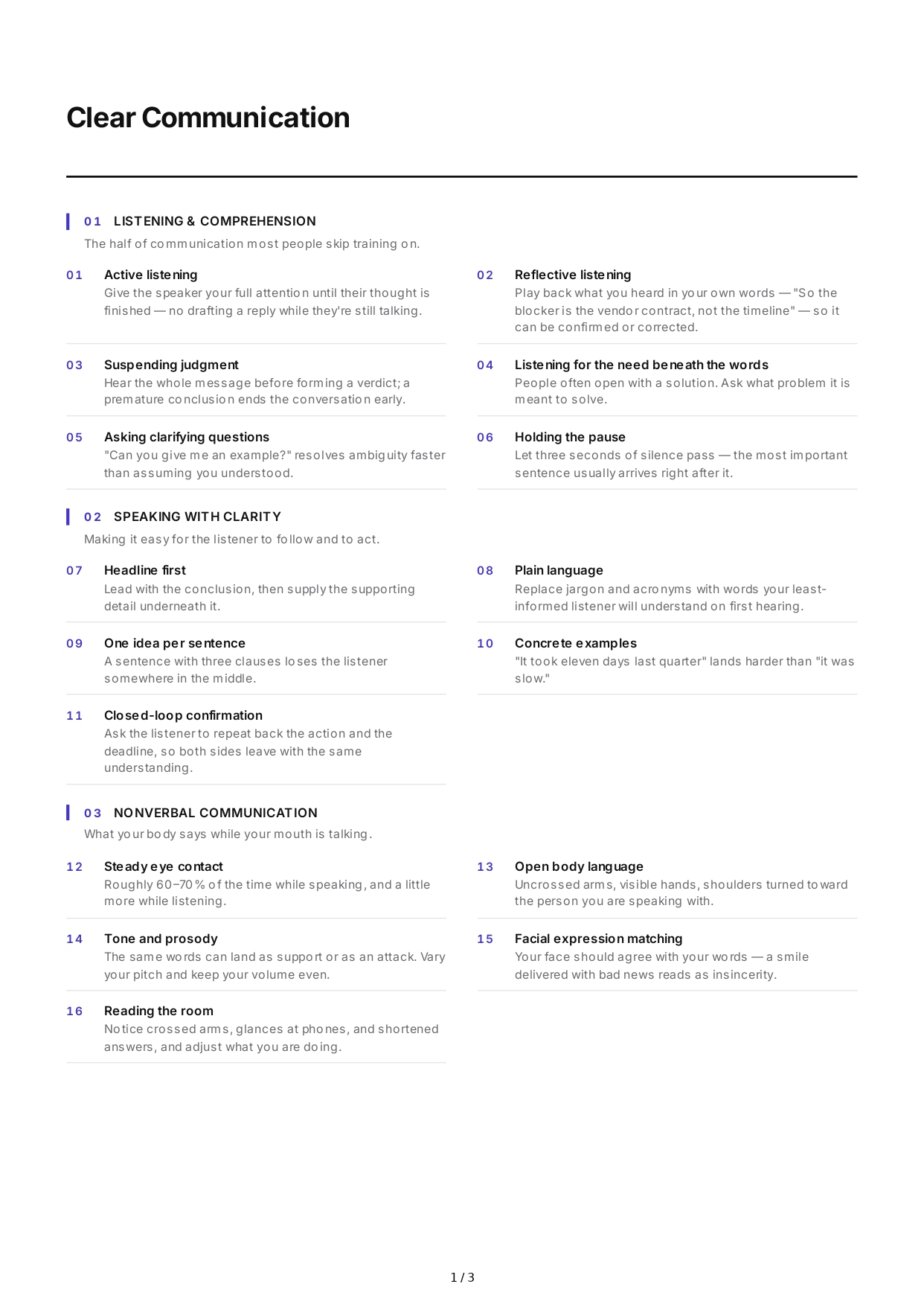
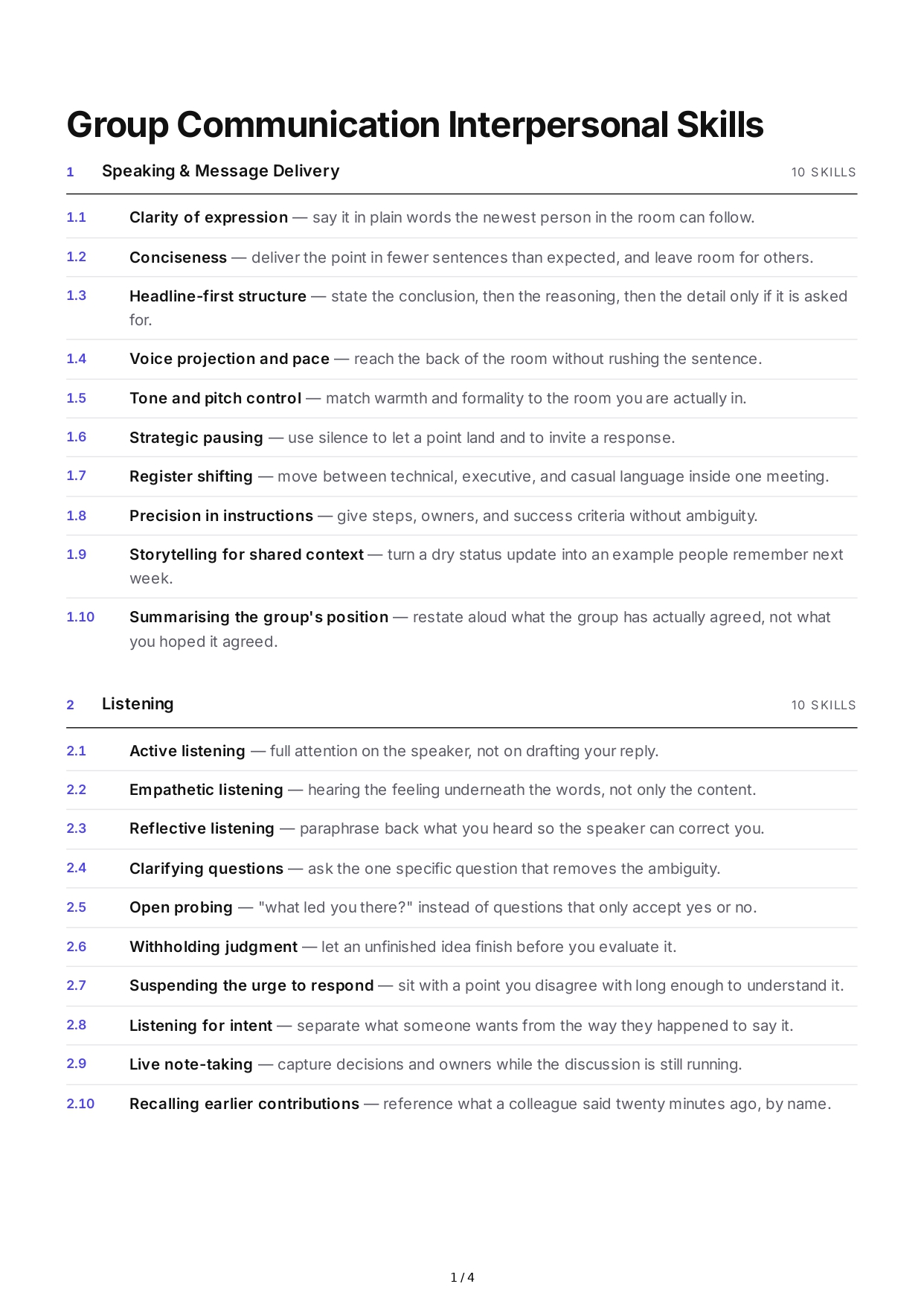
Active
listening
—
Hearing
the
whole
message
before
formulating
a
reply
,
and
confirming
you
understood
it
.
Clear
,
concise
expression
—
One
idea
per
sentence
,
plain
language
,
no
buried
point
.
Written
clarity
—
Emails
,
docs
,
and
updates
that
don
'
t
generate
a
follow
-
up
question
.
Nonverbal
awareness
—
Reading
tone
,
pace
,
posture
,
and
hesitation
—
not
just
the
words
.
Audience
calibration
—
Same
idea
at
the
right
depth
for
an
executive
,
an
engineer
,
or
a
client
.
Constructive
feedback
—
Specific
,
timely
,
focused
on
the
work
rather
than
the
person
.
Meeting
facilitation
—
Keeping
a
conversation
on
agenda
without
shutting
people
down
.
Public
speaking
—
Presenting
to
a
room
without
losing
the
thread
under
pressure
.
1 / 4
02
Teamwork
&
Trust
8
skills
Trust
is
built
by
repeated
small
evidence
,
not
by
stated
intent
.
These
are
the
behaviors
that
produce
it
.
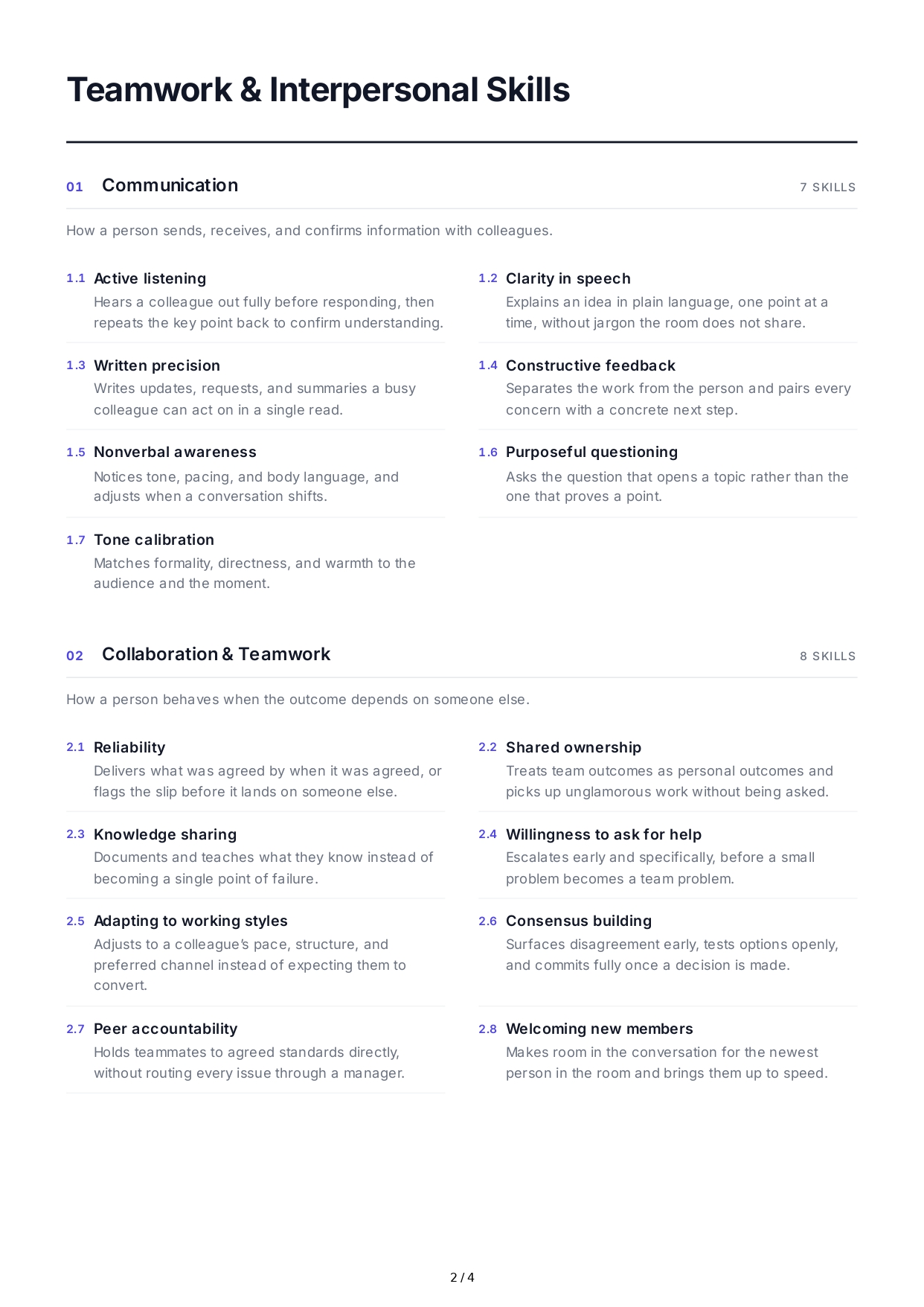
Reliability
—
Doing
what
you
said
,
when
you
said
it
,
and
flagging
early
when
you
can
'
t
.
Accountability
—
Owning
outcomes
,
including
the
misses
,
without
deflecting
to
circumstance
.
Steadiness
under
pressure
—
Staying
level
when
the
deadline
moves
or
the
plan
breaks
.
Shared
credit
—
Naming
the
people
who
actually
did
the
work
,
in
the
room
where
it
counts
.
Follow
-
through
—
Closing
loops
on
your
own
initiative
rather
than
being
chased
for
them
.
Adaptability
—
Changing
approach
when
the
evidence
changes
,
without
treating
it
as
a
loss
.
Psychological
safety
—
Making
it
cheap
for
teammates
to
raise
a
problem
early
.
Dependable
judgment
—
Knowing
when
to
decide
alone
and
when
to
bring
others
in
.
03
Emotional
Intelligence
8
skills
The
internal
skills
.
Hard
to
observe
directly
,
easy
to
observe
in
their
absence
.
Empathy
—
Recognizing
what
a
colleague
is
dealing
with
beyond
the
task
at
hand
.
Self
-
awareness
—
Knowing
your
own
triggers
,
defaults
,
and
effect
on
other
people
.
Self
-
regulation
—
Responding
rather
than
reacting
in
a
tense
moment
.
Reading
the
room
—
Noticing
when
a
discussion
has
stopped
being
productive
and
saying
so
.
Patience
—
Letting
someone
finish
a
thought
badly
before
correcting
it
.
Discretion
—
Knowing
what
stays
in
the
room
and
what
can
travel
.
Humility
—
Being
visibly
wrong
in
public
without
flinching
or
over
-
explaining
.
Composure
—
Absorbing
bad
news
without
transferring
the
anxiety
to
the
team
.
2 / 4
04
Conflict
&
Negotiation
8
skills
Disagreement
is
inevitable
on
any
real
team
.
These
skills
determine
whether
it
produces
a
better
answer
or
a
lasting
grudge
.
Direct
,
respectful
disagreement
—
"
I
see
it
differently
,
and
here
'
s
why
" —
said
to
the
person
,
not
about
them
.
De
-
escalation
—
Lowering
the
temperature
instead
of
winning
the
exchange
.
Interest
-
based
negotiation
—
Solving
for
the
need
behind
the
stated
position
.
Knowing
compromise
from
principle
—
Trading
on
preferences
,
holding
firm
on
what
actually
matters
.
Mediation
—
Helping
two
other
people
find
a
workable
middle
without
taking
sides
.
Apology
and
repair
—
Acknowledging
impact
rather
than
defending
intent
.
Boundary
-
setting
—
Saying
no
clearly
without
damaging
the
relationship
.
Assuming
good
faith
—
Testing
the
charitable
interpretation
before
the
cynical
one
.
05
Influence
&
Leadership
8
skills
Moving
a
group
without
formal
authority
over
it
—
the
defining
interpersonal
skill
of
senior
individual
contributors
.
Persuasion
with
evidence
—
Making
the
case
with
data
and
reasoning
,
not
volume
or
seniority
.
Stakeholder
alignment
—
Getting
the
yes
before
the
meeting
where
you
need
it
.
Delegation
—
Handing
over
the
outcome
and
the
authority
,
not
just
the
task
.
Mentorship
—
Growing
someone
'
s
capability
without
doing
the
work
for
them
.
Coaching
conversations
—
Asking
questions
before
offering
answers
.
Recognition
—
Specific
praise
,
given
publicly
,
in
the
channel
the
person
values
.
Deciding
in
ambiguity
—
Moving
forward
without
complete
information
,
and
saying
so
.
Managing
up
—
Keeping
a
manager
informed
and
unblocked
without
waiting
to
be
asked
.
3 / 4
06
Cross
-
Functional
&
Cultural
Collaboration
8
skills
Working
effectively
with
people
who
report
elsewhere
,
measure
different
things
,
and
may
not
share
your
norms
.
Cross
-
functional
collaboration
—
Getting
results
with
teams
whose
incentives
differ
from
yours
.
Perspective
-
taking
—
Arguing
the
other
team
'
s
case
accurately
,
out
loud
,
before
countering
it
.
Cultural
fluency
—
Adapting
norms
around
directness
,
timing
,
and
hierarchy
across
backgrounds
.
Remote
and
asynchronous
collaboration
—
Front
-
loading
context
so
colleagues
in
another
time
zone
aren
'
t
blocked
.
Inclusive
facilitation
—
Actively
making
room
for
the
quietest
and
most
junior
voice
.
Knowledge
sharing
—
Documenting
so
the
next
person
doesn
'
t
repeat
your
work
.
Relationship
building
—
Investing
in
the
connection
before
you
need
a
favor
from
it
.
Escalation
judgment
—
Knowing
when
to
resolve
it
locally
and
when
to
raise
it
.
4 / 4