Peer
Support
Interpersonal
Skills
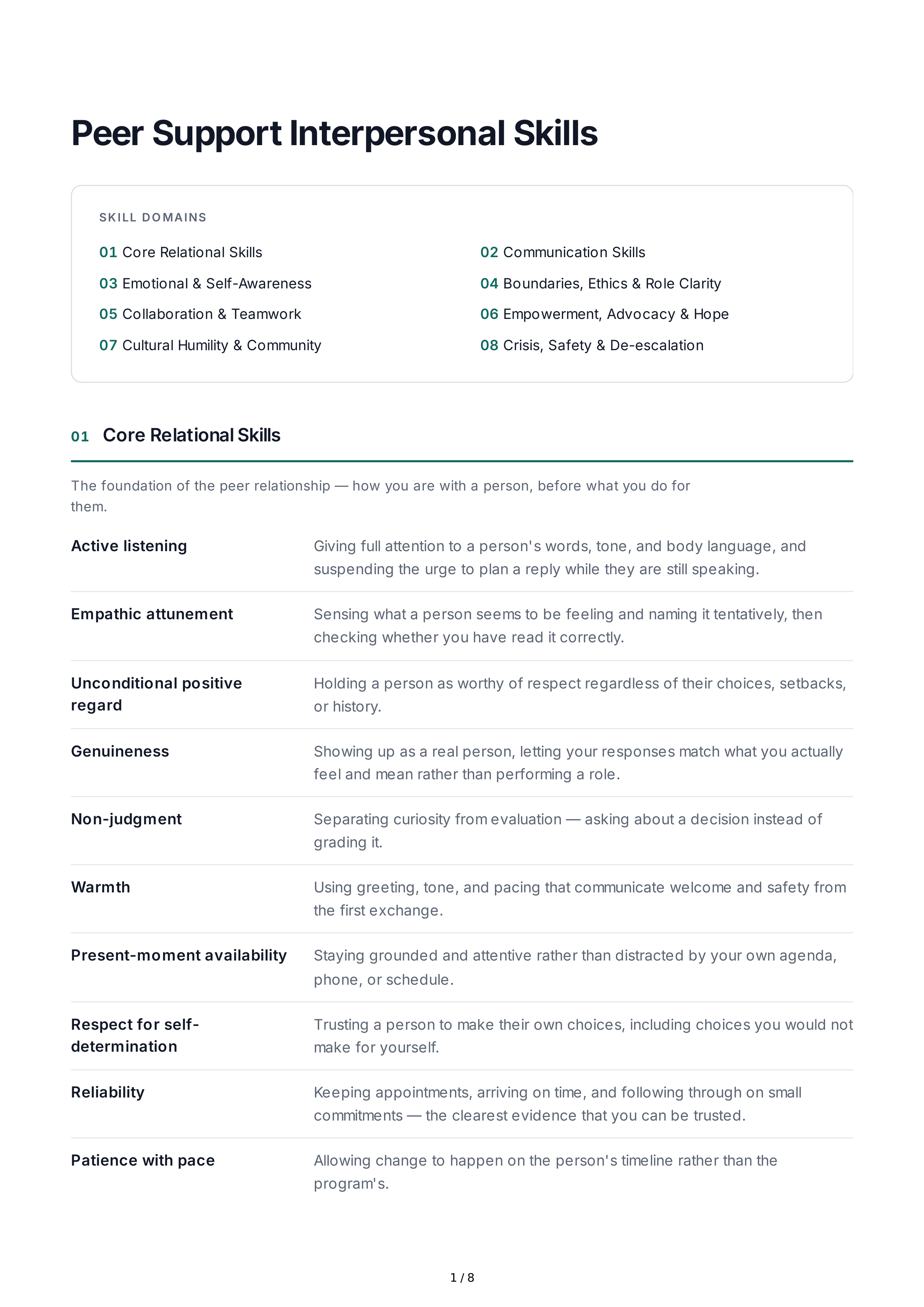
SKILL
DO MAINS
01
Core
Relational
Skills
02
Communication
Skills
03
Emotional
&
Self
-
Awareness
04
Boundaries
,
Ethics
&
Role
Clarity
05
Collaboration
&
Teamwork
06
Empowerment
,
Advocacy
&
Hope
07
Cultural
Humility
&
Community
08
Crisis
,
Safety
&
De
-
escalation
01
Core
Relational
Skills
The
foundation
of
the
peer
relationship
—
how
you
are
with
a
person
,
before
what
you
do
for
them
.
Active
listening
Giving
full
attention
to
a
person
'
s
words
,
tone
,
and
body
language
,
and
suspending
the
urge
to
plan
a
reply
while
they
are
still
speaking
.
Empathic
attunement
Sensing
what
a
person
seems
to
be
feeling
and
naming
it
tentatively
,
then
checking
whether
you
have
read
it
correctly
.
Unconditional
positive
regard
Holding
a
person
as
worthy
of
respect
regardless
of
their
choices
,
setbacks
,
or
history
.
Genuineness
Showing
up
as
a
real
person
,
letting
your
responses
match
what
you
actually
feel
and
mean
rather
than
performing
a
role
.
Non
-
judgment
Separating
curiosity
from
evaluation
—
asking
about
a
decision
instead
of
grading
it
.
Warmth
Using
greeting
,
tone
,
and
pacing
that
communicate
welcome
and
safety
from
the
first
exchange
.
Present
-
moment
availability
Staying
grounded
and
attentive
rather
than
distracted
by
your
own
agenda
,
phone
,
or
schedule
.
Respect
for
self
-
determination
Trusting
a
person
to
make
their
own
choices
,
including
choices
you
would
not
make
for
yourself
.
Reliability
Keeping
appointments
,
arriving
on
time
,
and
following
through
on
small
commitments
—
the
clearest
evidence
that
you
can
be
trusted
.
Patience
with
pace
Allowing
change
to
happen
on
the
person
'
s
timeline
rather
than
the
program
'
s
.
1 / 8
02
Communication
Skills
Specific
,
teachable
techniques
for
making
sure
the
conversation
lands
the
way
you
intend
.
Reflective
listening
Repeating
the
essence
of
what
was
said
in
your
own
words
,
so
the
person
feels
heard
and
can
hear
themselves
.
Open
-
ended
questioning
Asking
questions
that
open
a
story
("
What
was
that
week
like
?")
rather
than
close
it
("
Did
you
go
?").
Summarizing
Pulling
several
statements
into
a
brief
,
accurate
recap
that
confirms
shared
understanding
before
moving
on
.
Paraphrasing
Restating
content
in
fresh
language
without
adding
interpretation
the
person
did
not
offer
.
Clarifying
Asking
for
specifics
when
a
statement
is
vague
,
so
the
conversation
is
not
built
on
assumptions
.
Affirming
Naming
specific
strengths
,
efforts
,
and
progress
rather
than
offering
generic
praise
.
Comfortable
silence
Allowing
pauses
so
the
person
has
room
to
think
through
a
question
and
finish
the
thought
.
Plain
language
Dropping
jargon
,
acronyms
,
and
clinical
shorthand
so
nothing
has
to
be
decoded
.
"
I
"
statements
Speaking
from
your
own
experience
rather
than
speaking
for
the
other
person
or
about
them
.
Giving
and
receiving
feedback
Offering
observations
that
are
specific
,
timely
,
and
about
behavior
—
and
accepting
the
same
in
return
without
defensiveness
.
Checking
for
understanding
Closing
the
loop
by
asking
what
the
person
took
away
,
not
by
repeating
what
you
said
.
Respectful
disagreement
Stating
a
different
view
clearly
while
keeping
the
relationship
and
the
person
'
s
dignity
intact
.
2 / 8
03
Emotional
&
Self
-
Awareness
Skills
Peer
support
draws
on
lived
experience
,
which
means
your
own
history
is
always
in
the
room
.
These
skills
keep
it
in
service
of
the
other
person
.
Emotional
regulation
Noticing
your
own
activation
—
tightening
chest
,
rising
voice
,
urge
to
fix
—
and
slowing
down
before
responding
.
Appropriate
self
-
disclosure
Sharing
lived
experience
briefly
and
intentionally
to
build
hope
or
connection
,
not
to
process
your
own
story
.
Trigger
awareness
Recognizing
which
topics
,
language
,
or
stories
activate
your
own
history
,
and
naming
that
to
yourself
in
the
moment
.
Managing
reactivity
Separating
your
reaction
from
the
other
person
'
s
intent
,
so
a
comment
is
not
answered
as
an
attack
.
Self
-
compassion
Treating
your
own
setbacks
with
the
same
patience
and
honesty
you
offer
to
peers
.
Grounding
on
the
job
Using
breath
,
movement
,
or
a
brief
reset
between
conversations
to
stay
steady
across
a
full
shift
.
Distress
tolerance
Staying
present
during
intense
emotion
without
fleeing
,
fixing
,
or
shutting
the
conversation
down
.
Knowing
your
capacity
Recognizing
when
a
situation
is
too
close
to
your
own
experience
,
or
when
you
are
too
depleted
,
to
be
genuinely
useful
.
Debriefing
hard
interactions
Processing
difficult
exchanges
with
a
supervisor
or
trusted
colleague
instead
of
carrying
them
alone
.
Sustaining
your
own
recovery
Maintaining
the
routines
,
supports
,
and
boundaries
that
keep
your
lived
experience
an
asset
rather
than
a
liability
.
3 / 8
04
Boundaries
,
Ethics
&
Role
Clarity
Peer
specialists
work
in
a
role
that
is
deliberately
personal
—
which
makes
clear
,
kind
boundaries
a
core
skill
rather
than
a
limitation
.
Role
clarity
Being
able
to
explain
,
in
plain
terms
,
what
a
peer
specialist
does
and
does
not
do
—
to
the
person
,
to
family
,
and
to
colleagues
.
Confidentiality
Protecting
what
is
shared
,
understanding
its
legal
and
ethical
limits
,
and
explaining
both
before
the
conversation
goes
deep
.
Informed
consent
Making
sure
a
person
knows
what
they
are
agreeing
to
and
understands
they
can
change
their
mind
at
any
point
.
Setting
limits
kindly
Saying
no
,
or
not
now
,
in
a
way
that
preserves
the
relationship
and
the
person
'
s
dignity
.
Dual
-
role
awareness
Noticing
when
a
community
connection
,
friendship
,
or
family
tie
overlaps
with
the
peer
role
and
disclosing
it
.
Scope
of
practice
Recognizing
the
line
between
peer
support
and
clinical
,
legal
,
or
financial
advice
—
and
referring
across
it
.
Mandated
reporting
Knowing
local
duties
to
report
,
and
being
transparent
about
them
before
a
situation
requires
disclosure
.
Documentation
integrity
Recording
observations
accurately
,
without
judgment
or
interpretation
beyond
what
was
actually
said
.
Responding
to
requests
for
favors
Handling
requests
for
money
,
housing
,
or
rides
without
damaging
trust
or
abandoning
the
role
.
Navigating
social
contact
Managing
running
into
a
peer
in
the
community
—
friendly
,
brief
,
and
without
disclosing
the
relationship
to
others
.
4 / 8
05
Collaboration
&
Teamwork
Peer
specialists
work
inside
care
teams
and
community
networks
.
These
skills
make
the
peer
voice
legible
and
useful
to
others
.
Working
alongside
clinical
staff
Communicating
with
clinicians
as
a
colleague
with
a
distinct
,
complementary
role
rather
than
a
junior
assistant
.
Warm
handoffs
Introducing
a
person
to
the
next
provider
in
person
or
by
three
-
way
call
,
rather
than
passing
along
a
name
and
number
.
Multidisciplinary
communication
Giving
concise
updates
that
respect
both
the
team
'
s
need
to
know
and
the
person
'
s
privacy
.
Conflict
de
-
escalation
with
colleagues
Addressing
disagreement
about
a
person
'
s
care
directly
with
the
colleague
involved
,
without
triangulating
through
others
.
Shared
decision
-
making
Contributing
your
perspective
to
a
care
discussion
while
deferring
to
the
person
'
s
stated
priority
.
Giving
peer
feedback
Speaking
honestly
to
coworkers
about
their
practice
in
a
way
that
keeps
the
working
relationship
intact
.
Receiving
supervision
Bringing
real
questions
,
uncertainties
,
and
mistakes
to
supervision
rather
than
only
successes
.
Coordinating
with
community
partners
Keeping
relationships
with
housing
,
benefits
,
employment
,
and
recovery
organizations
warm
and
current
.
Reliability
within
a
team
Doing
what
you
said
you
would
do
,
on
time
,
and
flagging
early
when
you
cannot
.
5 / 8
06
Empowerment
,
Advocacy
&
Hope
The
distinctive
contribution
of
peer
support
:
the
credible
belief
that
a
full
life
is
possible
after
diagnosis
,
crisis
,
or
incarceration
.
Strengths
-
based
framing
Leading
with
what
a
person
can
do
and
has
already
survived
,
rather
than
what
is
missing
or
wrong
.
Instilling
hope
Speaking
about
recovery
in
concrete
,
believable
terms
—
yours
and
theirs
—
rather
than
in
slogans
.
Person
-
centered
goal
setting
Building
goals
from
the
person
'
s
own
stated
priorities
,
even
when
those
differ
from
the
written
care
plan
.
Supporting
self
-
advocacy
Coaching
a
person
to
speak
for
themselves
in
meetings
before
speaking
on
their
behalf
.
Sharing
power
Making
real
room
for
a
person
to
disagree
with
you
,
redirect
the
conversation
,
or
decline
a
suggestion
.
Recovery
-
oriented
language
Using
person
-
first
,
non
-
stigmatizing
words
consistently
—
in
notes
,
in
meetings
,
and
in
casual
conversation
.
Modeling
possibility
Showing
,
through
the
ordinary
facts
of
your
own
life
,
that
a
meaningful
future
is
available
.
Navigating
systems
together
Explaining
appointments
,
benefits
,
and
paperwork
side
by
side
with
a
person
rather
than
doing
it
for
them
.
Recognizing
small
wins
Noticing
and
naming
incremental
progress
that
a
person
may
not
count
as
progress
at
all
.
Sitting
with
setbacks
Staying
connected
through
relapse
,
discharge
,
or
return
to
old
patterns
without
withdrawing
or
scolding
.
6 / 8
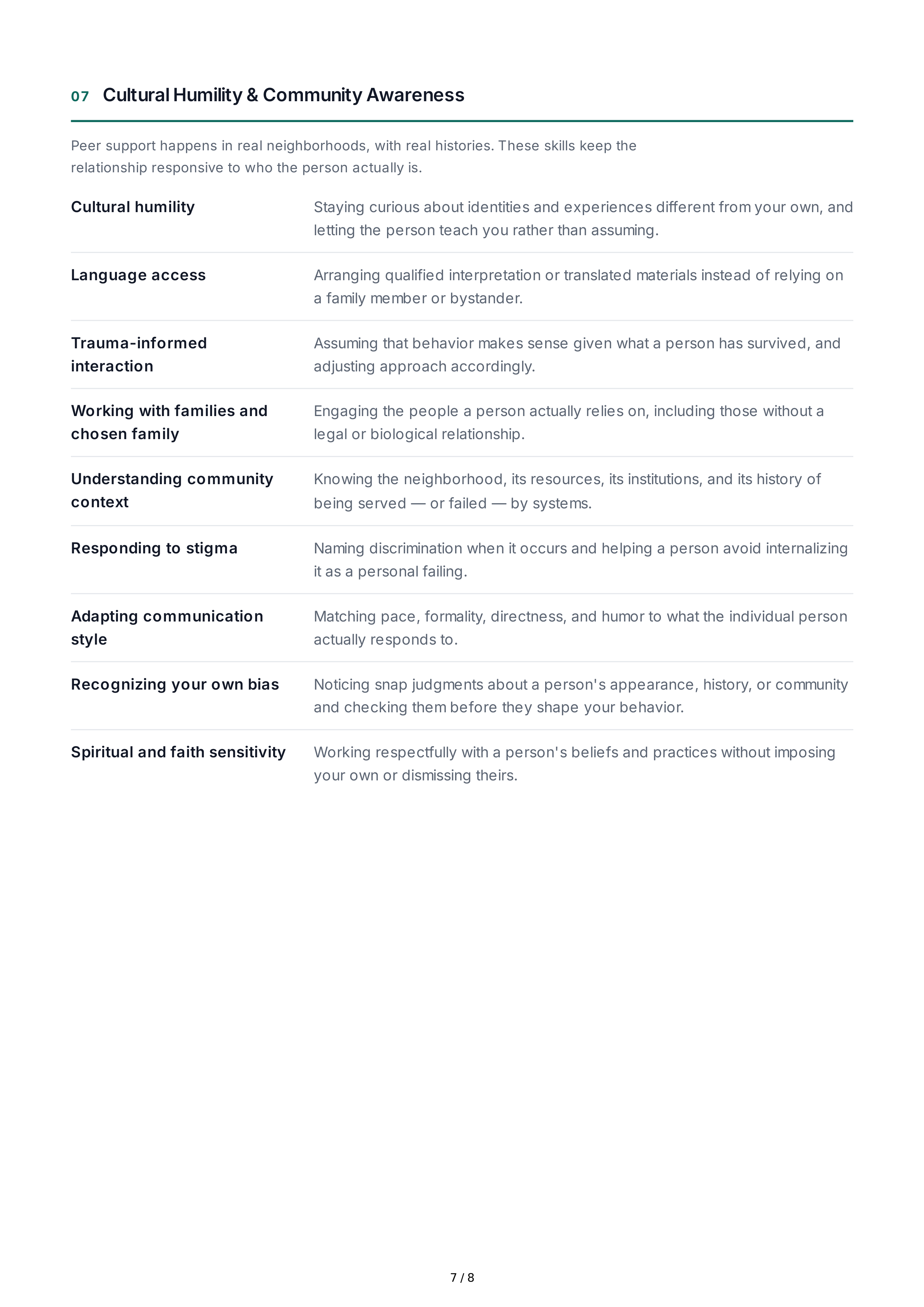
07
Cultural
Humility
&
Community
Awareness
Peer
support
happens
in
real
neighborhoods
,
with
real
histories
.
These
skills
keep
the
relationship
responsive
to
who
the
person
actually
is
.
Cultural
humility
Staying
curious
about
identities
and
experiences
different
from
your
own
,
and
letting
the
person
teach
you
rather
than
assuming
.
Language
access
Arranging
qualified
interpretation
or
translated
materials
instead
of
relying
on
a
family
member
or
bystander
.
Trauma
-
informed
interaction
Assuming
that
behavior
makes
sense
given
what
a
person
has
survived
,
and
adjusting
approach
accordingly
.
Working
with
families
and
chosen
family
Engaging
the
people
a
person
actually
relies
on
,
including
those
without
a
legal
or
biological
relationship
.
Understanding
community
context
Knowing
the
neighborhood
,
its
resources
,
its
institutions
,
and
its
history
of
being
served
—
or
failed
—
by
systems
.
Responding
to
stigma
Naming
discrimination
when
it
occurs
and
helping
a
person
avoid
internalizing
it
as
a
personal
failing
.
Adapting
communication
style
Matching
pace
,
formality
,
directness
,
and
humor
to
what
the
individual
person
actually
responds
to
.
Recognizing
your
own
bias
Noticing
snap
judgments
about
a
person
'
s
appearance
,
history
,
or
community
and
checking
them
before
they
shape
your
behavior
.
Spiritual
and
faith
sensitivity
Working
respectfully
with
a
person
'
s
beliefs
and
practices
without
imposing
your
own
or
dismissing
theirs
.
7 / 8
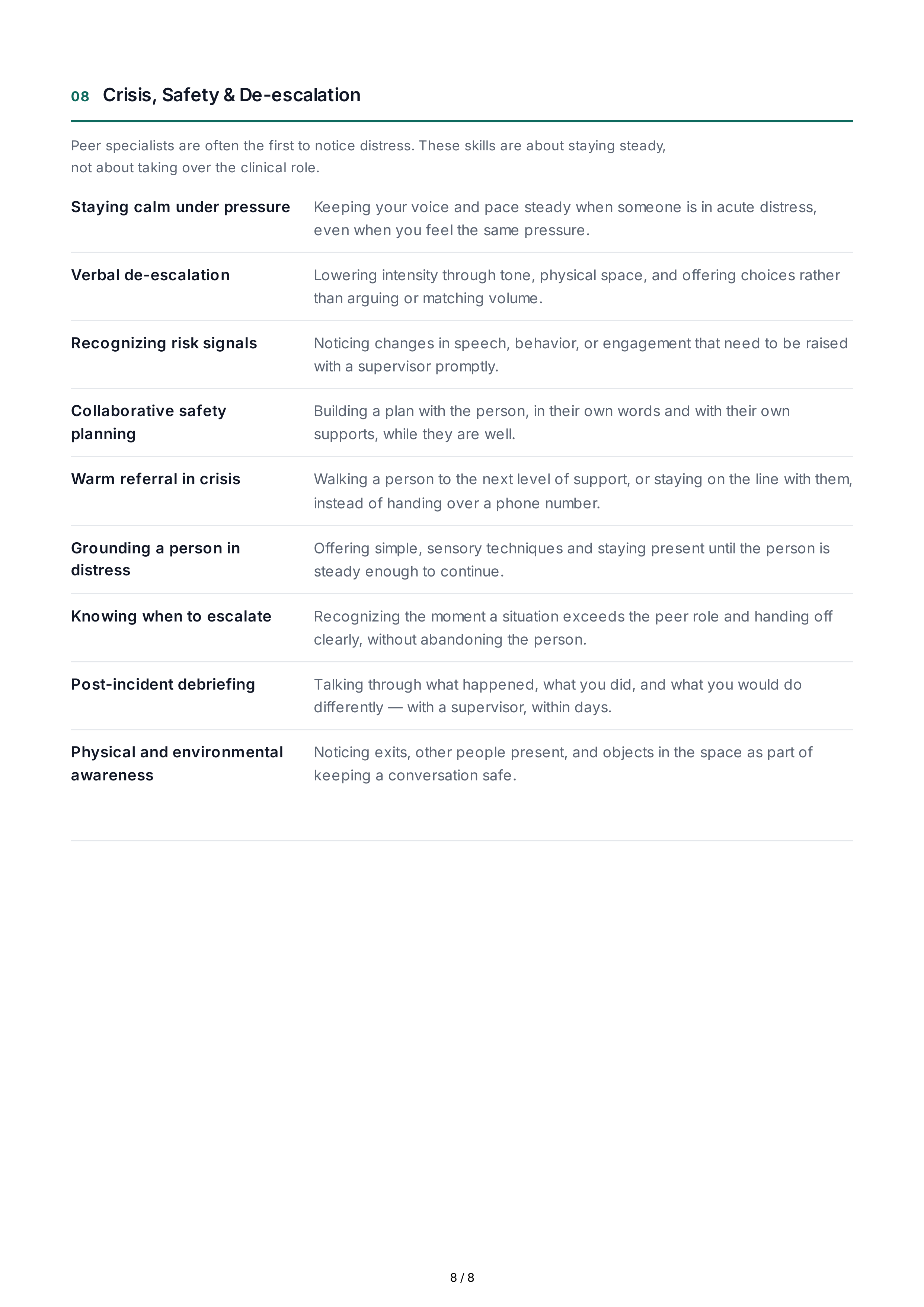
08
Crisis
,
Safety
&
De
-
escalation
Peer
specialists
are
often
the
first
to
notice
distress
.
These
skills
are
about
staying
steady
,
not
about
taking
over
the
clinical
role
.
Staying
calm
under
pressure
Keeping
your
voice
and
pace
steady
when
someone
is
in
acute
distress
,
even
when
you
feel
the
same
pressure
.
Verbal
de
-
escalation
Lowering
intensity
through
tone
,
physical
space
,
and
offering
choices
rather
than
arguing
or
matching
volume
.
Recognizing
risk
signals
Noticing
changes
in
speech
,
behavior
,
or
engagement
that
need
to
be
raised
with
a
supervisor
promptly
.
Collaborative
safety
planning
Building
a
plan
with
the
person
,
in
their
own
words
and
with
their
own
supports
,
while
they
are
well
.
Warm
referral
in
crisis
Walking
a
person
to
the
next
level
of
support
,
or
staying
on
the
line
with
them
,
instead
of
handing
over
a
phone
number
.
Grounding
a
person
in
distress
Offering
simple
,
sensory
techniques
and
staying
present
until
the
person
is
steady
enough
to
continue
.
Knowing
when
to
escalate
Recognizing
the
moment
a
situation
exceeds
the
peer
role
and
handing
off
clearly
,
without
abandoning
the
person
.
Post
-
incident
debriefing
Talking
through
what
happened
,
what
you
did
,
and
what
you
would
do
differently
—
with
a
supervisor
,
within
days
.
Physical
and
environmental
awareness
Noticing
exits
,
other
people
present
,
and
objects
in
the
space
as
part
of
keeping
a
conversation
safe
.
8 / 8