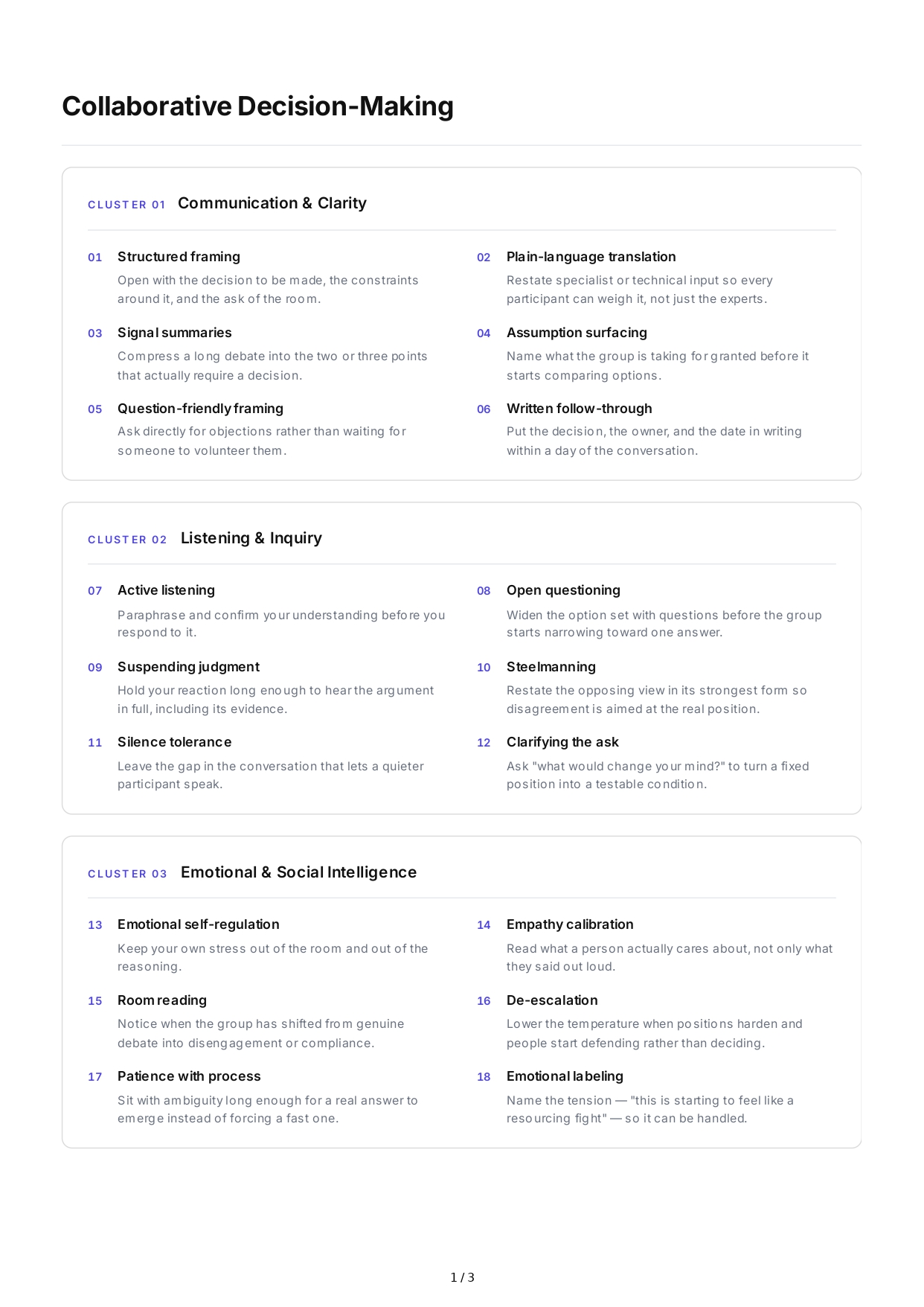
Empathy
Interpersonal
Skills
1 / 5
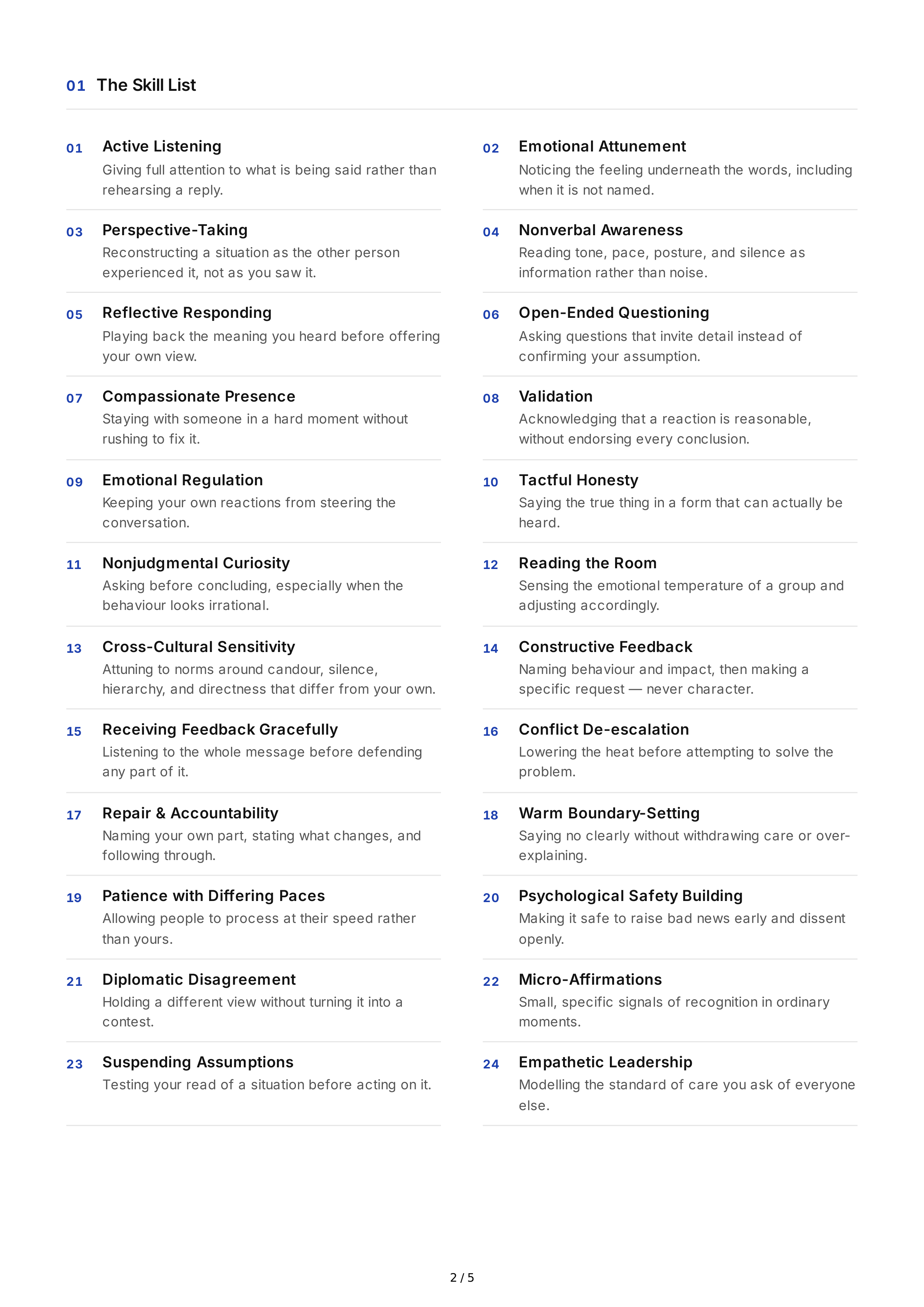
01
The
Skill
List
01
Active
Listening
Giving
full
attention
to
what
is
being
said
rather
than
rehearsing
a
reply
.
02
Emotional
Attunement
Noticing
the
feeling
underneath
the
words
,
including
when
it
is
not
named
.
03
Perspective
-
Taking
Reconstructing
a
situation
as
the
other
person
experienced
it
,
not
as
you
saw
it
.
04
Nonverbal
Awareness
Reading
tone
,
pace
,
posture
,
and
silence
as
information
rather
than
noise
.
05
Reflective
Responding
Playing
back
the
meaning
you
heard
before
offering
your
own
view
.
06
Open
-
Ended
Questioning
Asking
questions
that
invite
detail
instead
of
confirming
your
assumption
.
07
Compassionate
Presence
Staying
with
someone
in
a
hard
moment
without
rushing
to
fix
it
.
08
Validation
Acknowledging
that
a
reaction
is
reasonable
,
without
endorsing
every
conclusion
.
09
Emotional
Regulation
Keeping
your
own
reactions
from
steering
the
conversation
.
10
Tactful
Honesty
Saying
the
true
thing
in
a
form
that
can
actually
be
heard
.
11
Nonjudgmental
Curiosity
Asking
before
concluding
,
especially
when
the
behaviour
looks
irrational
.
12
Reading
the
Room
Sensing
the
emotional
temperature
of
a
group
and
adjusting
accordingly
.
13
Cross
-
Cultural
Sensitivity
Attuning
to
norms
around
candour
,
silence
,
hierarchy
,
and
directness
that
differ
from
your
own
.
14
Constructive
Feedback
Naming
behaviour
and
impact
,
then
making
a
specific
request
—
never
character
.
15
Receiving
Feedback
Gracefully
Listening
to
the
whole
message
before
defending
any
part
of
it
.
16
Conflict
De
-
escalation
Lowering
the
heat
before
attempting
to
solve
the
problem
.
17
Repair
&
Accountability
Naming
your
own
part
,
stating
what
changes
,
and
following
through
.
18
Warm
Boundary
-
Setting
Saying
no
clearly
without
withdrawing
care
or
over
-
explaining
.
19
Patience
with
Differing
Paces
Allowing
people
to
process
at
their
speed
rather
than
yours
.
20
Psychological
Safety
Building
Making
it
safe
to
raise
bad
news
early
and
dissent
openly
.
21
Diplomatic
Disagreement
Holding
a
different
view
without
turning
it
into
a
contest
.
22
Micro
-
Affirmations
Small
,
specific
signals
of
recognition
in
ordinary
moments
.
23
Suspending
Assumptions
Testing
your
read
of
a
situation
before
acting
on
it
.
24
Empathetic
Leadership
Modelling
the
standard
of
care
you
ask
of
everyone
else
.
2 / 5
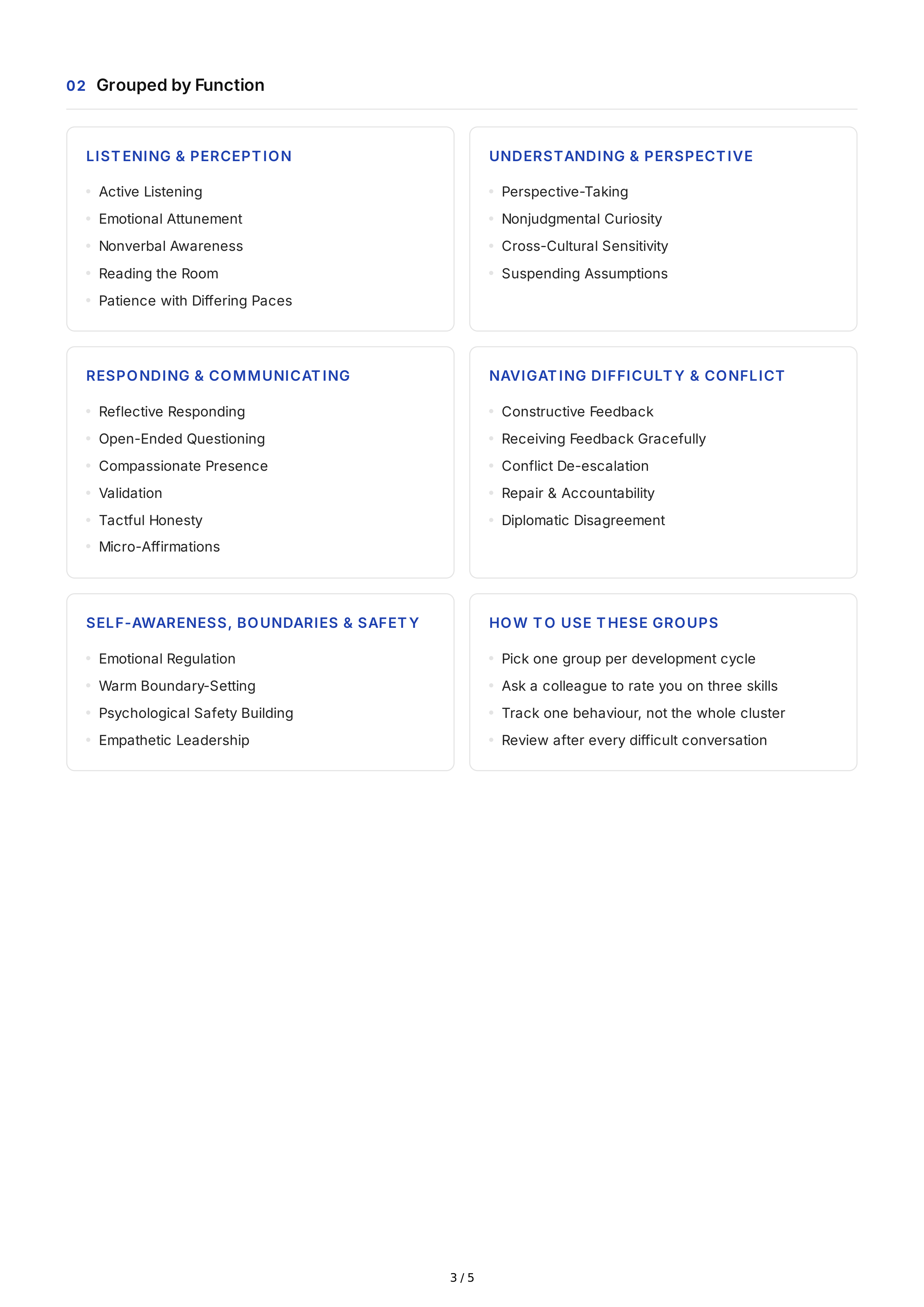
02
Grouped
by
Function
LISTENING
&
PERCEPTION
UNDERSTANDING
&
PERSPECTIVE
RESPONDING
&
COMMUNICATING
NAVIGATING
DIFFICULTY
&
CONFLICT
SELF
-
AWARENESS
,
BOUNDARIES
&
SAFETY
HOW
TO
USE
THESE
GROUPS
Active
Listening
Emotional
Attunement
Nonverbal
Awareness
Reading
the
Room
Patience
with
Differing
Paces
Perspective
-
Taking
Nonjudgmental
Curiosity
Cross
-
Cultural
Sensitivity
Suspending
Assumptions
Reflective
Responding
Open
-
Ended
Questioning
Compassionate
Presence
Validation
Tactful
Honesty
Micro
-
Affirmations
Constructive
Feedback
Receiving
Feedback
Gracefully
Conflict
De
-
escalation
Repair
&
Accountability
Diplomatic
Disagreement
Emotional
Regulation
Warm
Boundary
-
Setting
Psychological
Safety
Building
Empathetic
Leadership
Pick
one
group
per
development
cycle
Ask
a
colleague
to
rate
you
on
three
skills
Track
one
behaviour
,
not
the
whole
cluster
Review
after
every
difficult
conversation
3 / 5
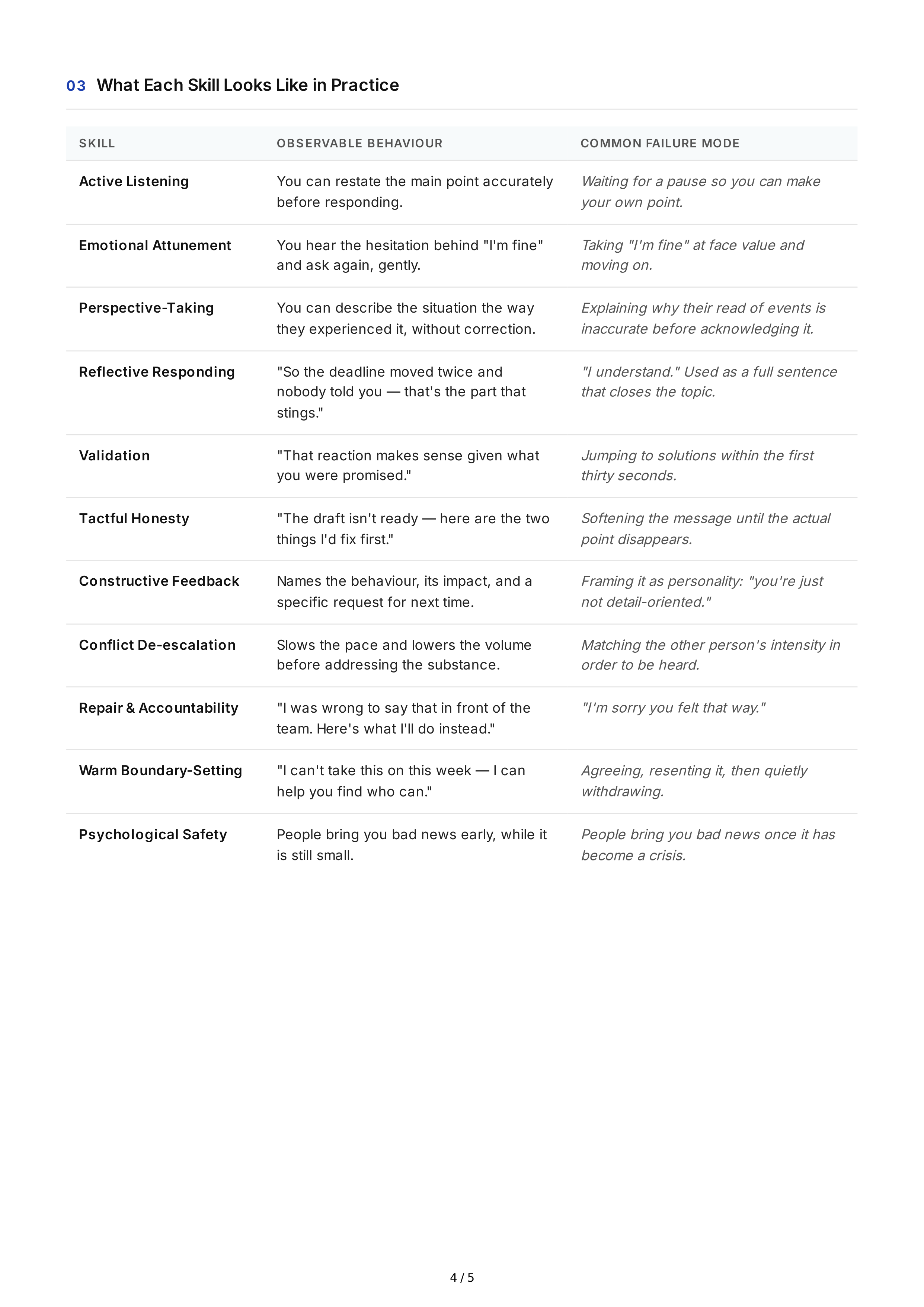
03
What
Each
Skill
Looks
Like
in
Practice
SKILL
OBSERVABLE
BEHAVIOUR
COMMON
FAILURE
MODE
Active
Listening
You
can
restate
the
main
point
accurately
before
responding
.
Waiting
for
a
pause
so
you
can
make
your
own
point
.
Emotional
Attunement
You
hear
the
hesitation
behind
"
I
'
m
fine
"
and
ask
again
,
gently
.
Taking
"
I
'
m
fine
"
at
face
value
and
moving
on
.
Perspective
-
Taking
You
can
describe
the
situation
the
way
they
experienced
it
,
without
correction
.
Explaining
why
their
read
of
events
is
inaccurate
before
acknowledging
it
.
Reflective
Responding
"
So
the
deadline
moved
twice
and
nobody
told
you
—
that
'
s
the
part
that
stings
."
"
I
understand
."
Used
as
a
full
sentence
that
closes
the
topic
.
Validation
"
That
reaction
makes
sense
given
what
you
were
promised
."
Jumping
to
solutions
within
the
first
thirty
seconds
.
Tactful
Honesty
"
The
draft
isn
'
t
ready
—
here
are
the
two
things
I
'
d
fix
first
."
Softening
the
message
until
the
actual
point
disappears
.
Constructive
Feedback
Names
the
behaviour
,
its
impact
,
and
a
specific
request
for
next
time
.
Framing
it
as
personality
: "
you
'
re
just
not
detail
-
oriented
."
Conflict
De
-
escalation
Slows
the
pace
and
lowers
the
volume
before
addressing
the
substance
.
Matching
the
other
person
'
s
intensity
in
order
to
be
heard
.
Repair
&
Accountability
"
I
was
wrong
to
say
that
in
front
of
the
team
.
Here
'
s
what
I
'
ll
do
instead
."
"
I
'
m
sorry
you
felt
that
way
."
Warm
Boundary
-
Setting
"
I
can
'
t
take
this
on
this
week
—
I
can
help
you
find
who
can
."
Agreeing
,
resenting
it
,
then
quietly
withdrawing
.
Psychological
Safety
People
bring
you
bad
news
early
,
while
it
is
still
small
.
People
bring
you
bad
news
once
it
has
become
a
crisis
.
4 / 5
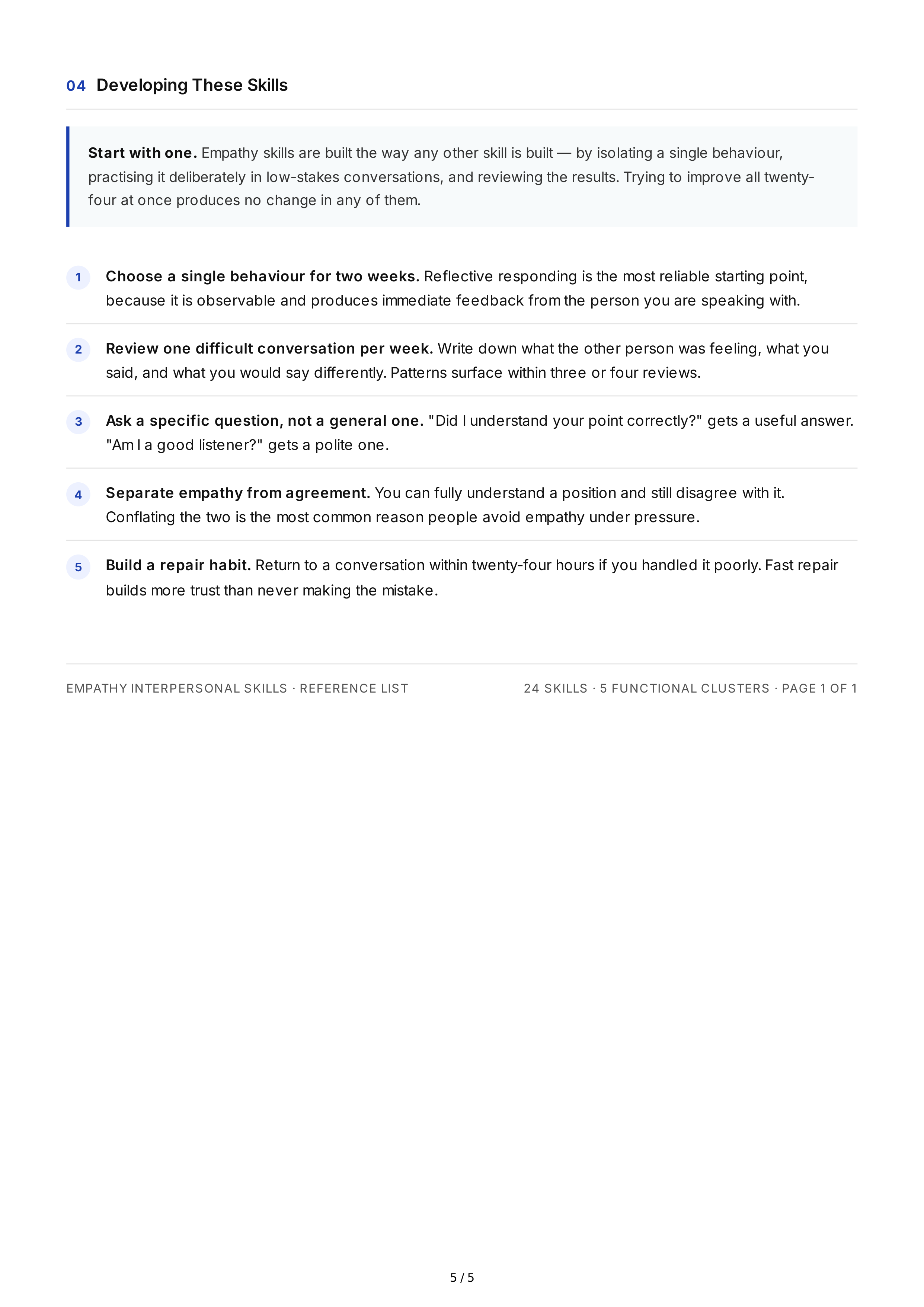
04
Developing
These
Skills
Start
with
one
.
Empathy
skills
are
built
the
way
any
other
skill
is
built
—
by
isolating
a
single
behaviour
,
practising
it
deliberately
in
low
-
stakes
conversations
,
and
reviewing
the
results
.
Trying
to
improve
all
twenty
-
four
at
once
produces
no
change
in
any
of
them
.
1
Choose
a
single
behaviour
for
two
weeks
.
Reflective
responding
is
the
most
reliable
starting
point
,
because
it
is
observable
and
produces
immediate
feedback
from
the
person
you
are
speaking
with
.
2
Review
one
difficult
conversation
per
week
.
Write
down
what
the
other
person
was
feeling
,
what
you
said
,
and
what
you
would
say
differently
.
Patterns
surface
within
three
or
four
reviews
.
3
Ask
a
specific
question
,
not
a
general
one
.
"
Did
I
understand
your
point
correctly
?"
gets
a
useful
answer
.
"
Am
I
a
good
listener
?"
gets
a
polite
one
.
4
Separate
empathy
from
agreement
.
You
can
fully
understand
a
position
and
still
disagree
with
it
.
Conflating
the
two
is
the
most
common
reason
people
avoid
empathy
under
pressure
.
5
Build
a
repair
habit
.
Return
to
a
conversation
within
twenty
-
four
hours
if
you
handled
it
poorly
.
Fast
repair
builds
more
trust
than
never
making
the
mistake
.
EMPATHY
INTERPERSONAL
SKILLS
·
REFERENCE
LIST
24
SKILLS
· 5
FUNCTIONAL
CLUSTERS
·
PAGE
1
OF
1
5 / 5