Boundary
Setting
Interpersonal
Skills
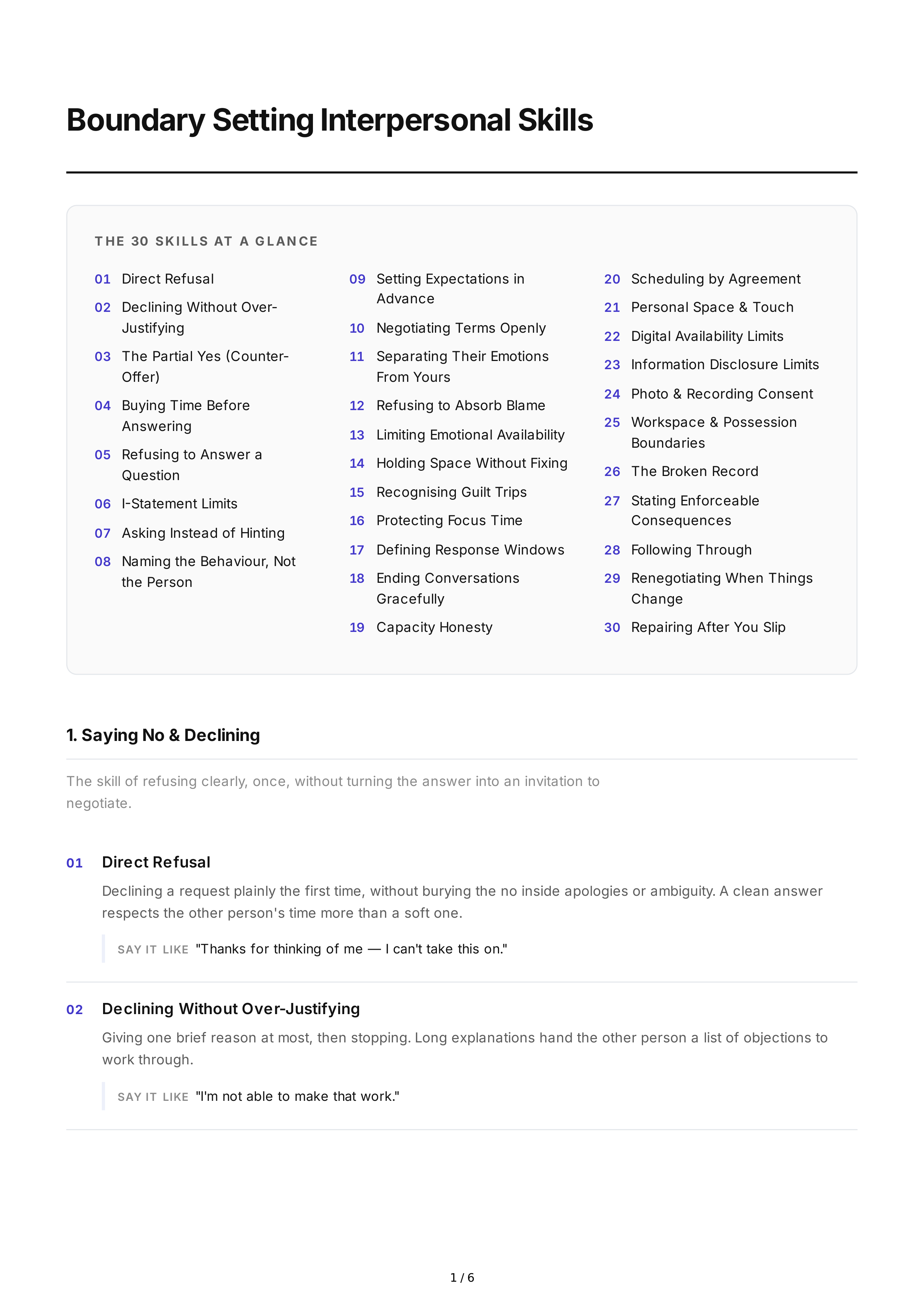
T HE
30
SK I LLS
AT
A
G LAN CE
01
Direct
Refusal
02
Declining
Without
Over
-
Justifying
03
The
Partial
Yes
(
Counter
-
Offer
)
04
Buying
Time
Before
Answering
05
Refusing
to
Answer
a
Question
06
I
-
Statement
Limits
07
Asking
Instead
of
Hinting
08
Naming
the
Behaviour
,
Not
the
Person
09
Setting
Expectations
in
Advance
10
Negotiating
Terms
Openly
11
Separating
Their
Emotions
From
Yours
12
Refusing
to
Absorb
Blame
13
Limiting
Emotional
Availability
14
Holding
Space
Without
Fixing
15
Recognising
Guilt
Trips
16
Protecting
Focus
Time
17
Defining
Response
Windows
18
Ending
Conversations
Gracefully
19
Capacity
Honesty
20
Scheduling
by
Agreement
21
Personal
Space
&
Touch
22
Digital
Availability
Limits
23
Information
Disclosure
Limits
24
Photo
&
Recording
Consent
25
Workspace
&
Possession
Boundaries
26
The
Broken
Record
27
Stating
Enforceable
Consequences
28
Following
Through
29
Renegotiating
When
Things
Change
30
Repairing
After
You
Slip
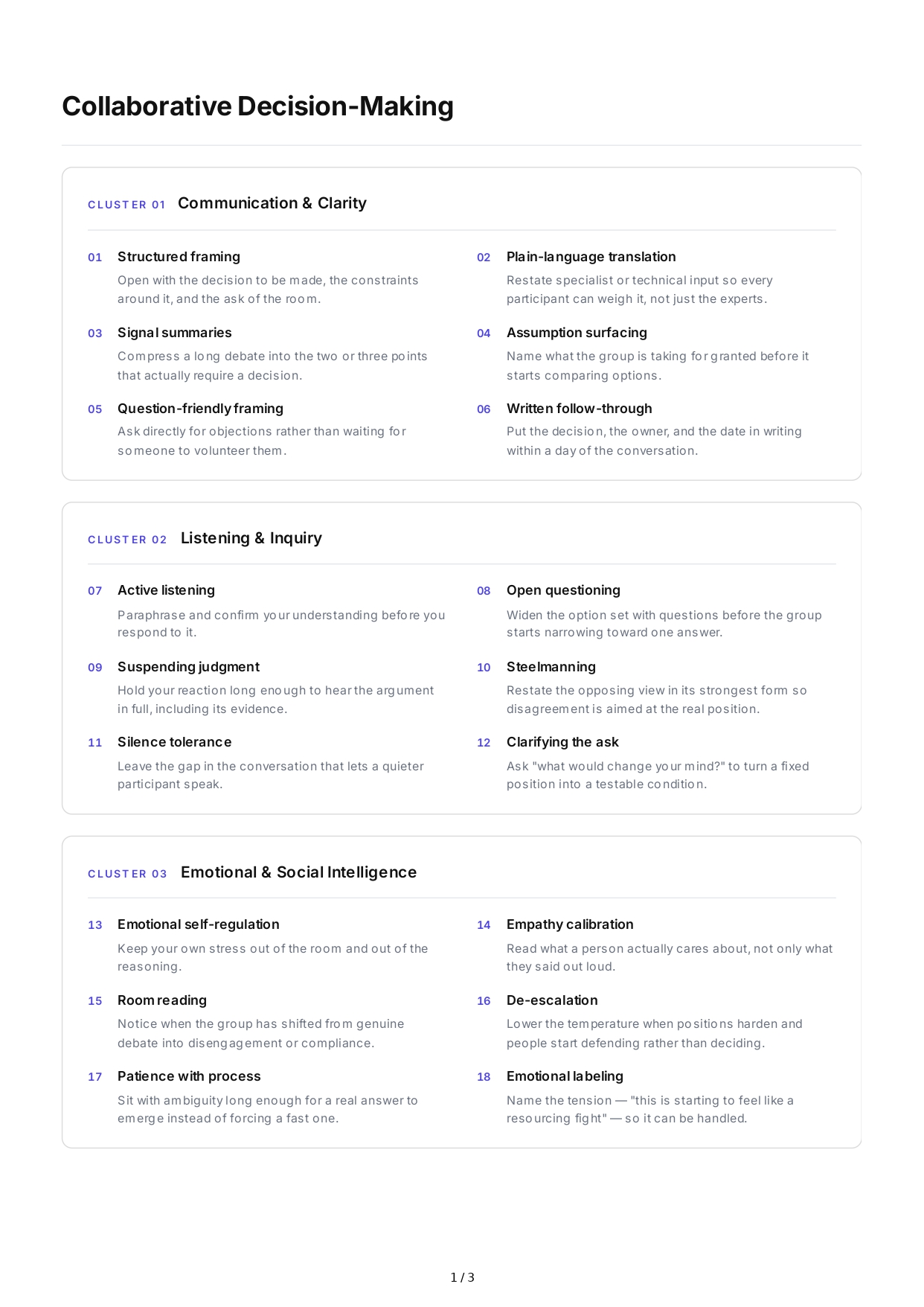
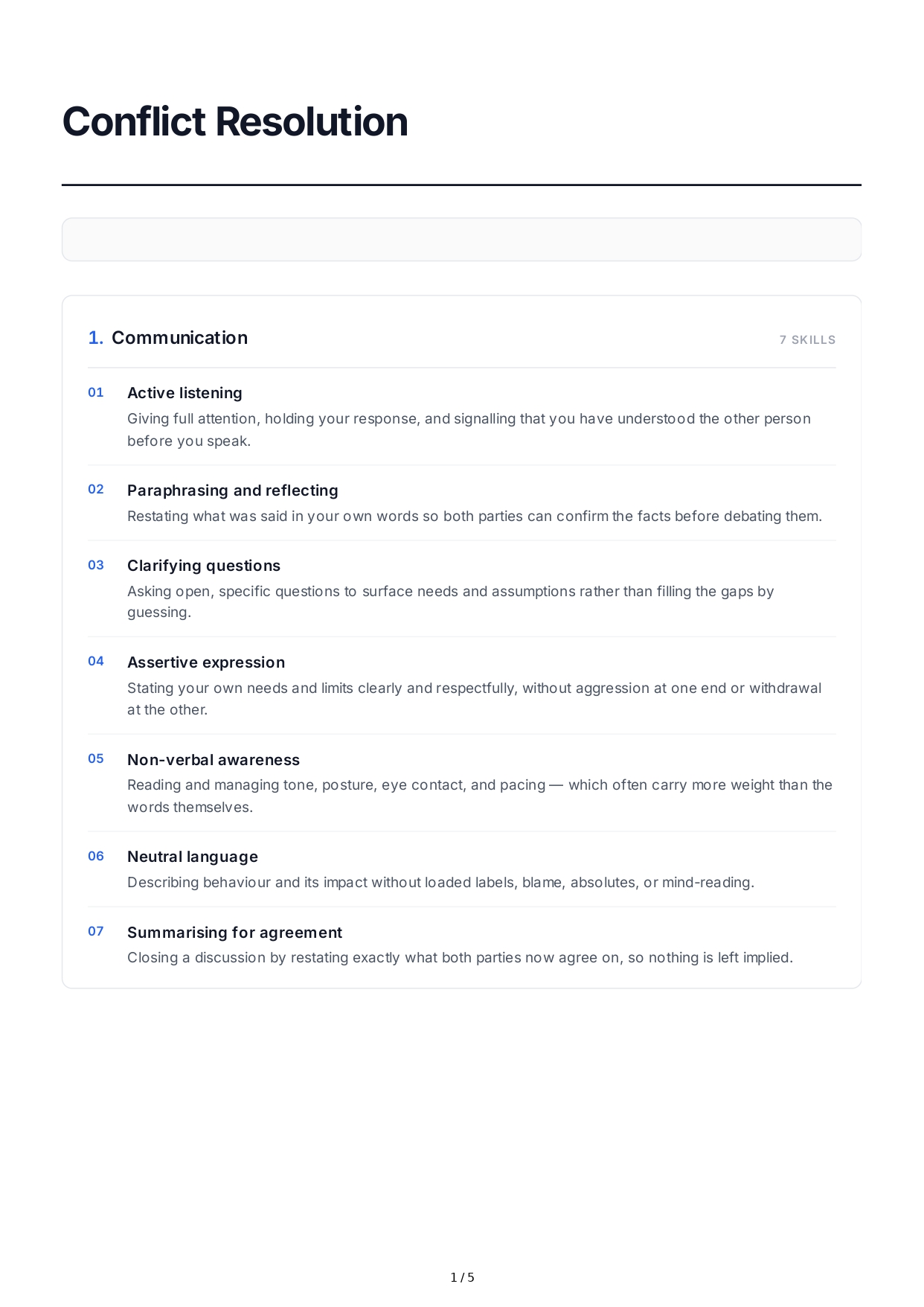
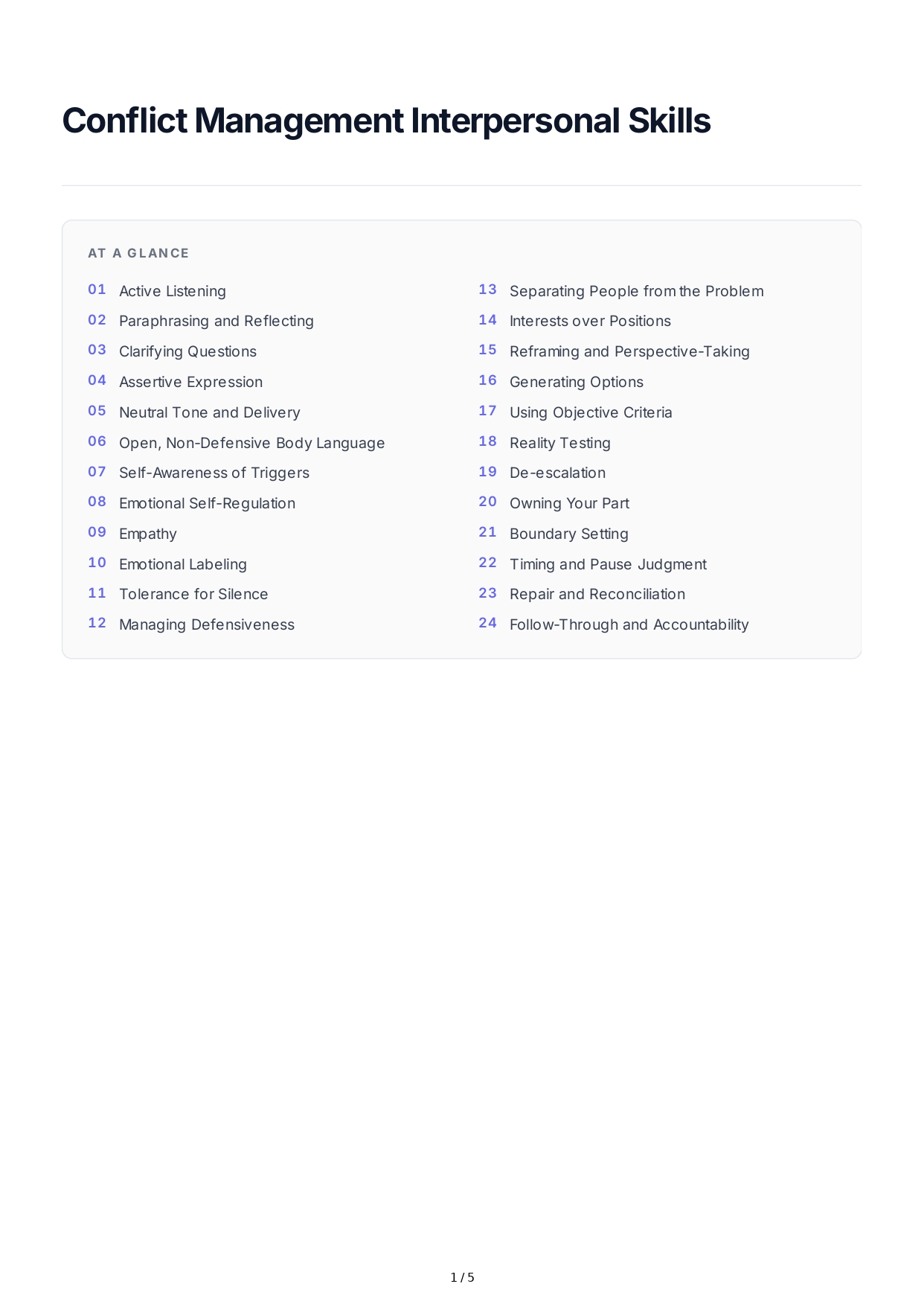
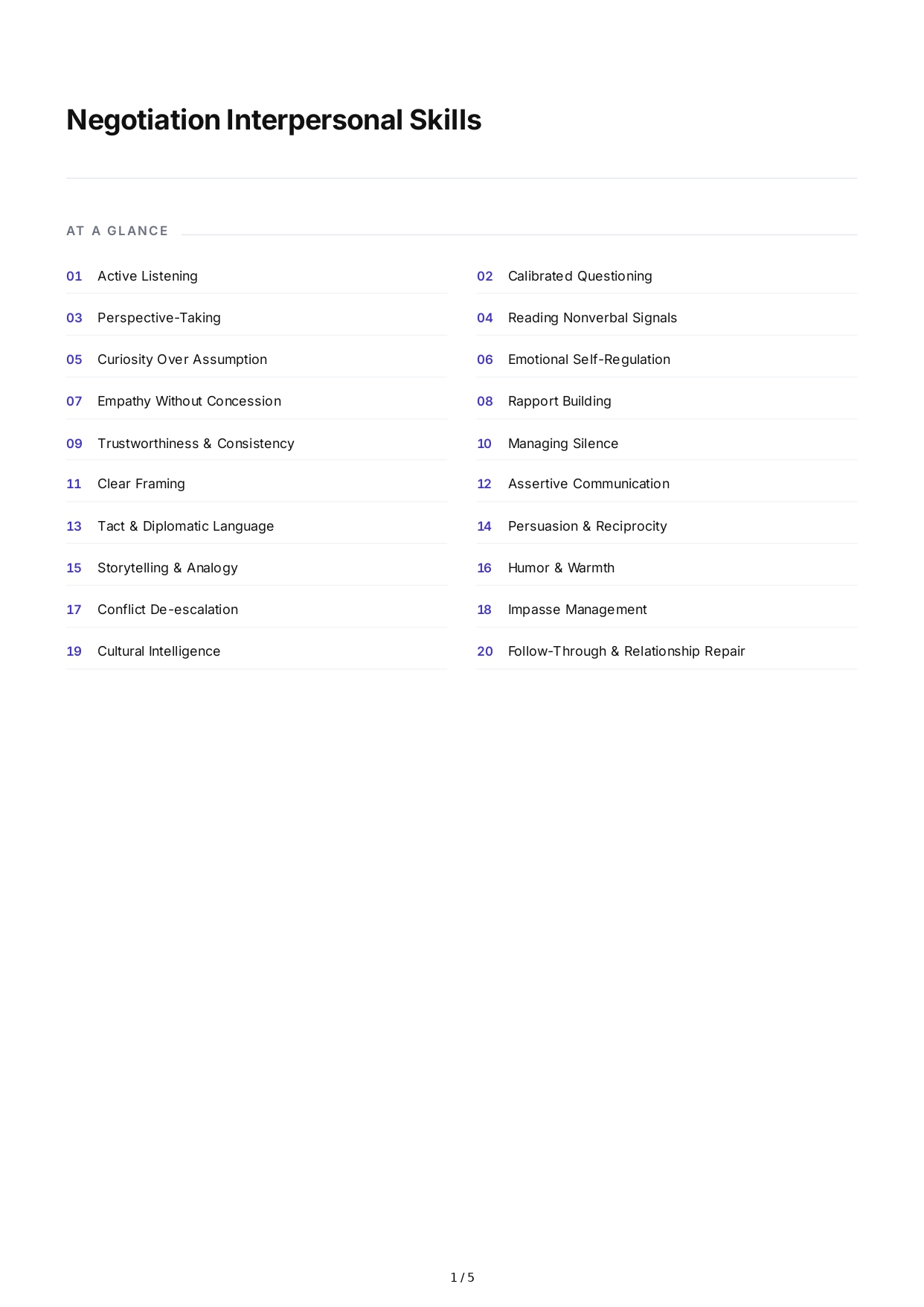
1.
Saying
No
&
Declining
The
skill
of
refusing
clearly
,
once
,
without
turning
the
answer
into
an
invitation
to
negotiate
.
01
Direct
Refusal
Declining
a
request
plainly
the
first
time
,
without
burying
the
no
inside
apologies
or
ambiguity
.
A
clean
answer
respects
the
other
person
'
s
time
more
than
a
soft
one
.
SAY
IT
LIKE
"
Thanks
for
thinking
of
me
—
I
can
'
t
take
this
on
."
02
Declining
Without
Over
-
Justifying
Giving
one
brief
reason
at
most
,
then
stopping
.
Long
explanations
hand
the
other
person
a
list
of
objections
to
work
through
.
SAY
IT
LIKE
"
I
'
m
not
able
to
make
that
work
."
1 / 6
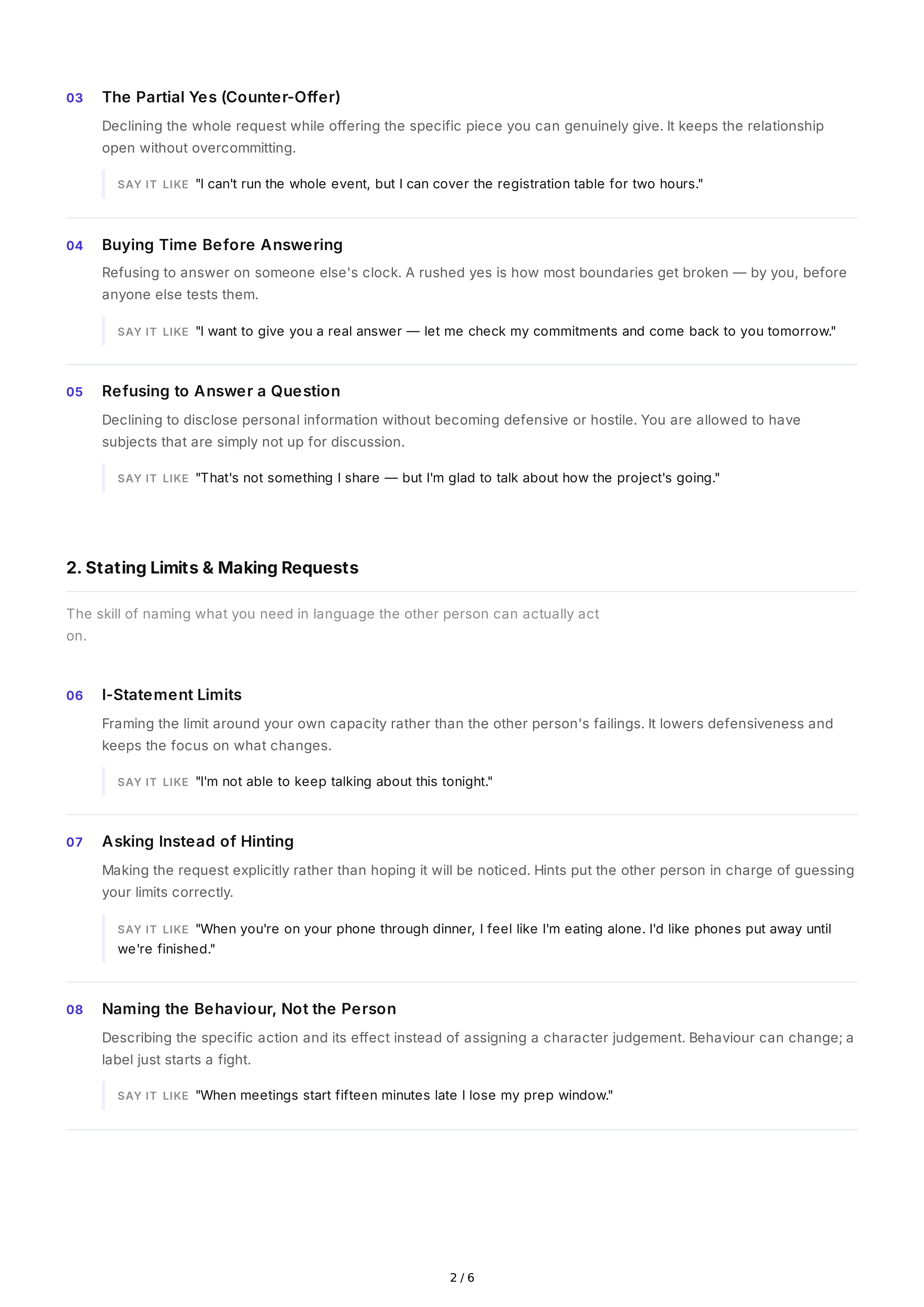
03
The
Partial
Yes
(
Counter
-
Offer
)
Declining
the
whole
request
while
offering
the
specific
piece
you
can
genuinely
give
.
It
keeps
the
relationship
open
without
overcommitting
.
SAY
IT
LIKE
"
I
can
'
t
run
the
whole
event
,
but
I
can
cover
the
registration
table
for
two
hours
."
04
Buying
Time
Before
Answering
Refusing
to
answer
on
someone
else
'
s
clock
.
A
rushed
yes
is
how
most
boundaries
get
broken
—
by
you
,
before
anyone
else
tests
them
.
SAY
IT
LIKE
"
I
want
to
give
you
a
real
answer
—
let
me
check
my
commitments
and
come
back
to
you
tomorrow
."
05
Refusing
to
Answer
a
Question
Declining
to
disclose
personal
information
without
becoming
defensive
or
hostile
.
You
are
allowed
to
have
subjects
that
are
simply
not
up
for
discussion
.
SAY
IT
LIKE
"
That
'
s
not
something
I
share
—
but
I
'
m
glad
to
talk
about
how
the
project
'
s
going
."
2.
Stating
Limits
&
Making
Requests
The
skill
of
naming
what
you
need
in
language
the
other
person
can
actually
act
on
.
06
I
-
Statement
Limits
Framing
the
limit
around
your
own
capacity
rather
than
the
other
person
'
s
failings
.
It
lowers
defensiveness
and
keeps
the
focus
on
what
changes
.
SAY
IT
LIKE
"
I
'
m
not
able
to
keep
talking
about
this
tonight
."
07
Asking
Instead
of
Hinting
Making
the
request
explicitly
rather
than
hoping
it
will
be
noticed
.
Hints
put
the
other
person
in
charge
of
guessing
your
limits
correctly
.
SAY
IT
LIKE
"
When
you
'
re
on
your
phone
through
dinner
,
I
feel
like
I
'
m
eating
alone
.
I
'
d
like
phones
put
away
until
we
'
re
finished
."
08
Naming
the
Behaviour
,
Not
the
Person
Describing
the
specific
action
and
its
effect
instead
of
assigning
a
character
judgement
.
Behaviour
can
change
;
a
label
just
starts
a
fight
.
SAY
IT
LIKE
"
When
meetings
start
fifteen
minutes
late
I
lose
my
prep
window
."
2 / 6
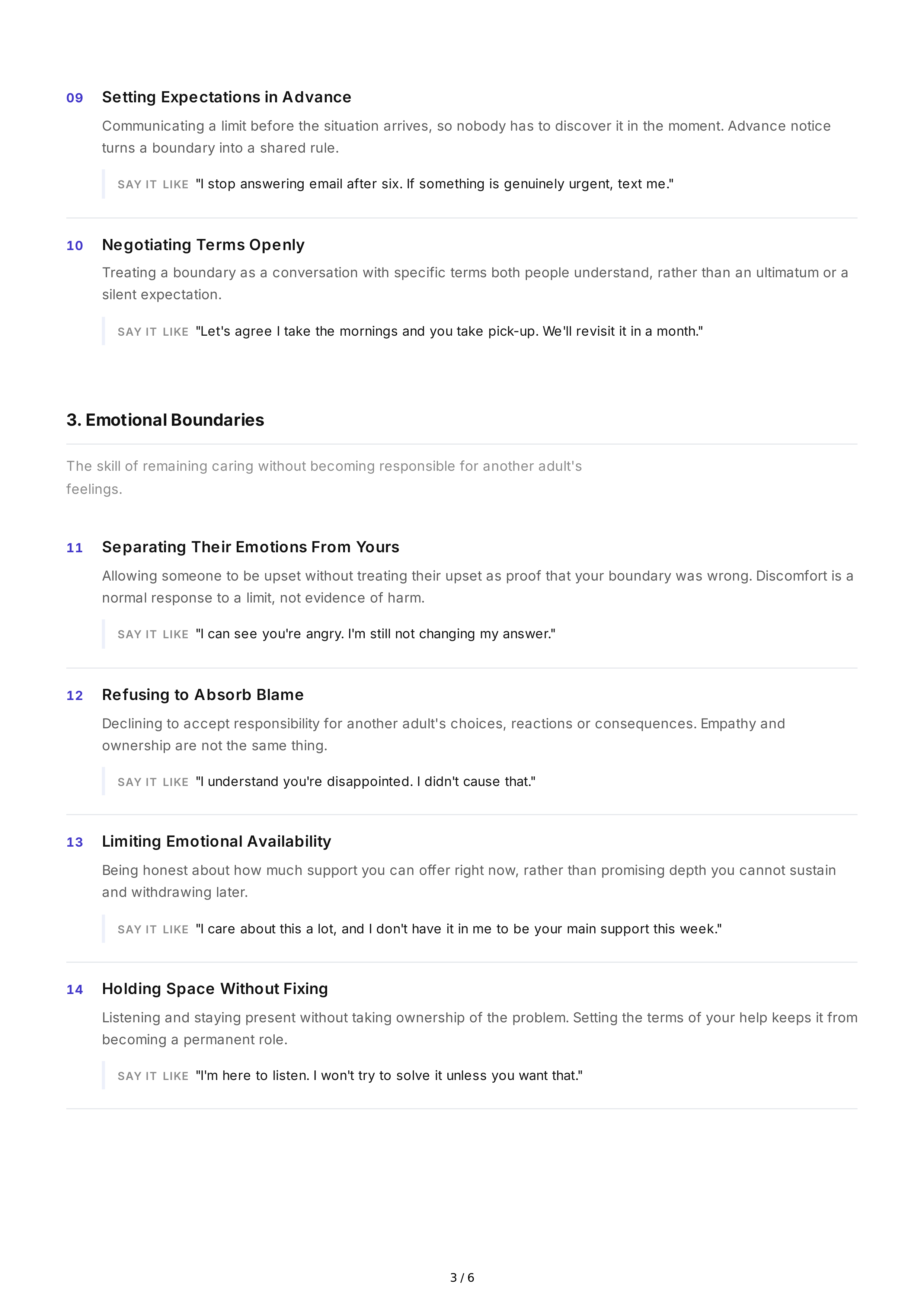
09
Setting
Expectations
in
Advance
Communicating
a
limit
before
the
situation
arrives
,
so
nobody
has
to
discover
it
in
the
moment
.
Advance
notice
turns
a
boundary
into
a
shared
rule
.
SAY
IT
LIKE
"
I
stop
answering
email
after
six
.
If
something
is
genuinely
urgent
,
text
me
."
10
Negotiating
Terms
Openly
Treating
a
boundary
as
a
conversation
with
specific
terms
both
people
understand
,
rather
than
an
ultimatum
or
a
silent
expectation
.
SAY
IT
LIKE
"
Let
'
s
agree
I
take
the
mornings
and
you
take
pick
-
up
.
We
'
ll
revisit
it
in
a
month
."
3.
Emotional
Boundaries
The
skill
of
remaining
caring
without
becoming
responsible
for
another
adult
'
s
feelings
.
11
Separating
Their
Emotions
From
Yours
Allowing
someone
to
be
upset
without
treating
their
upset
as
proof
that
your
boundary
was
wrong
.
Discomfort
is
a
normal
response
to
a
limit
,
not
evidence
of
harm
.
SAY
IT
LIKE
"
I
can
see
you
'
re
angry
.
I
'
m
still
not
changing
my
answer
."
12
Refusing
to
Absorb
Blame
Declining
to
accept
responsibility
for
another
adult
'
s
choices
,
reactions
or
consequences
.
Empathy
and
ownership
are
not
the
same
thing
.
SAY
IT
LIKE
"
I
understand
you
'
re
disappointed
.
I
didn
'
t
cause
that
."
13
Limiting
Emotional
Availability
Being
honest
about
how
much
support
you
can
offer
right
now
,
rather
than
promising
depth
you
cannot
sustain
and
withdrawing
later
.
SAY
IT
LIKE
"
I
care
about
this
a
lot
,
and
I
don
'
t
have
it
in
me
to
be
your
main
support
this
week
."
14
Holding
Space
Without
Fixing
Listening
and
staying
present
without
taking
ownership
of
the
problem
.
Setting
the
terms
of
your
help
keeps
it
from
becoming
a
permanent
role
.
SAY
IT
LIKE
"
I
'
m
here
to
listen
.
I
won
'
t
try
to
solve
it
unless
you
want
that
."
3 / 6
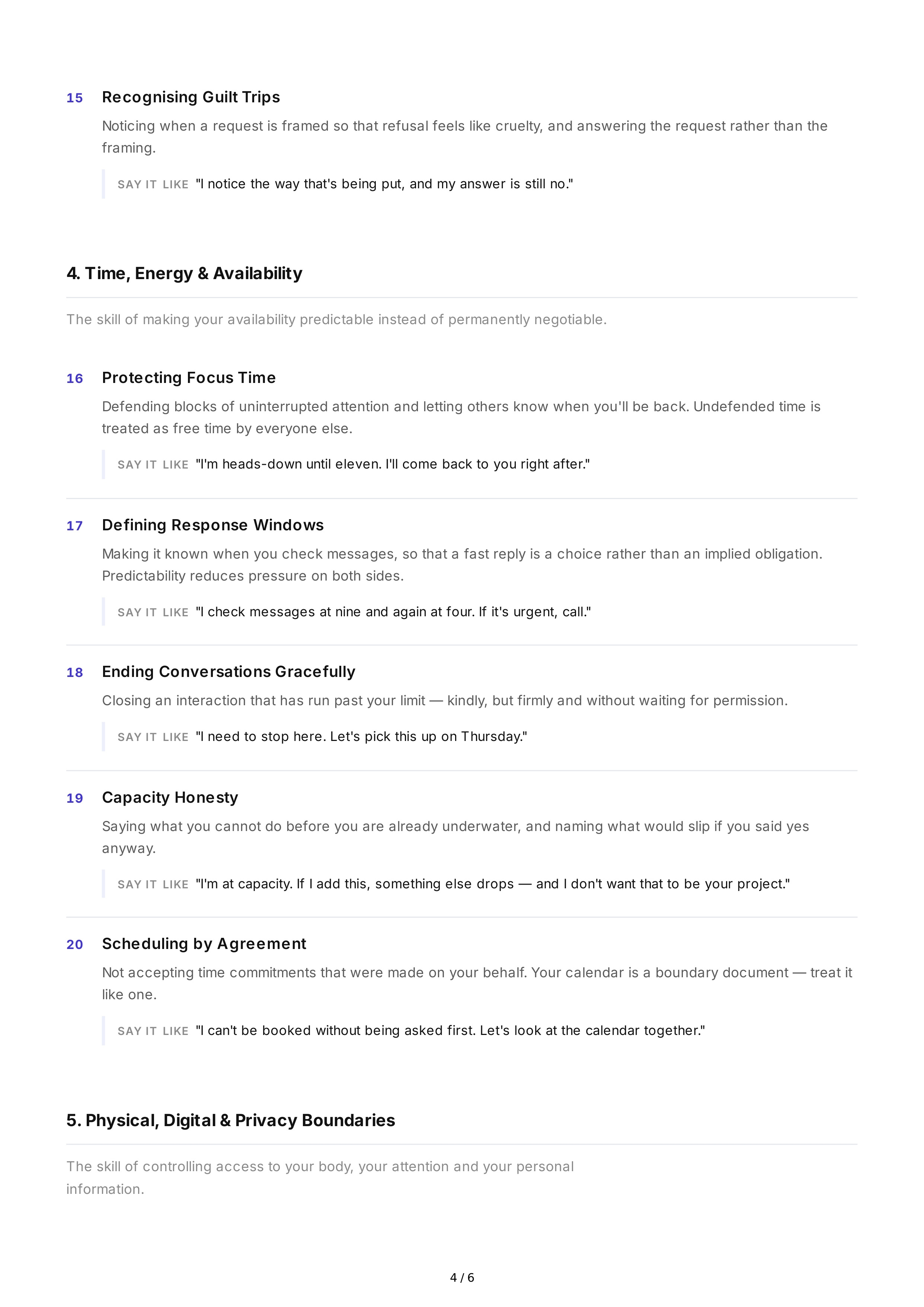
15
Recognising
Guilt
Trips
Noticing
when
a
request
is
framed
so
that
refusal
feels
like
cruelty
,
and
answering
the
request
rather
than
the
framing
.
SAY
IT
LIKE
"
I
notice
the
way
that
'
s
being
put
,
and
my
answer
is
still
no
."
4.
Time
,
Energy
&
Availability
The
skill
of
making
your
availability
predictable
instead
of
permanently
negotiable
.
16
Protecting
Focus
Time
Defending
blocks
of
uninterrupted
attention
and
letting
others
know
when
you
'
ll
be
back
.
Undefended
time
is
treated
as
free
time
by
everyone
else
.
SAY
IT
LIKE
"
I
'
m
heads
-
down
until
eleven
.
I
'
ll
come
back
to
you
right
after
."
17
Defining
Response
Windows
Making
it
known
when
you
check
messages
,
so
that
a
fast
reply
is
a
choice
rather
than
an
implied
obligation
.
Predictability
reduces
pressure
on
both
sides
.
SAY
IT
LIKE
"
I
check
messages
at
nine
and
again
at
four
.
If
it
'
s
urgent
,
call
."
18
Ending
Conversations
Gracefully
Closing
an
interaction
that
has
run
past
your
limit
—
kindly
,
but
firmly
and
without
waiting
for
permission
.
SAY
IT
LIKE
"
I
need
to
stop
here
.
Let
'
s
pick
this
up
on
Thursday
."
19
Capacity
Honesty
Saying
what
you
cannot
do
before
you
are
already
underwater
,
and
naming
what
would
slip
if
you
said
yes
anyway
.
SAY
IT
LIKE
"
I
'
m
at
capacity
.
If
I
add
this
,
something
else
drops
—
and
I
don
'
t
want
that
to
be
your
project
."
20
Scheduling
by
Agreement
Not
accepting
time
commitments
that
were
made
on
your
behalf
.
Your
calendar
is
a
boundary
document
—
treat
it
like
one
.
SAY
IT
LIKE
"
I
can
'
t
be
booked
without
being
asked
first
.
Let
'
s
look
at
the
calendar
together
."
5.
Physical
,
Digital
&
Privacy
Boundaries
The
skill
of
controlling
access
to
your
body
,
your
attention
and
your
personal
information
.
4 / 6
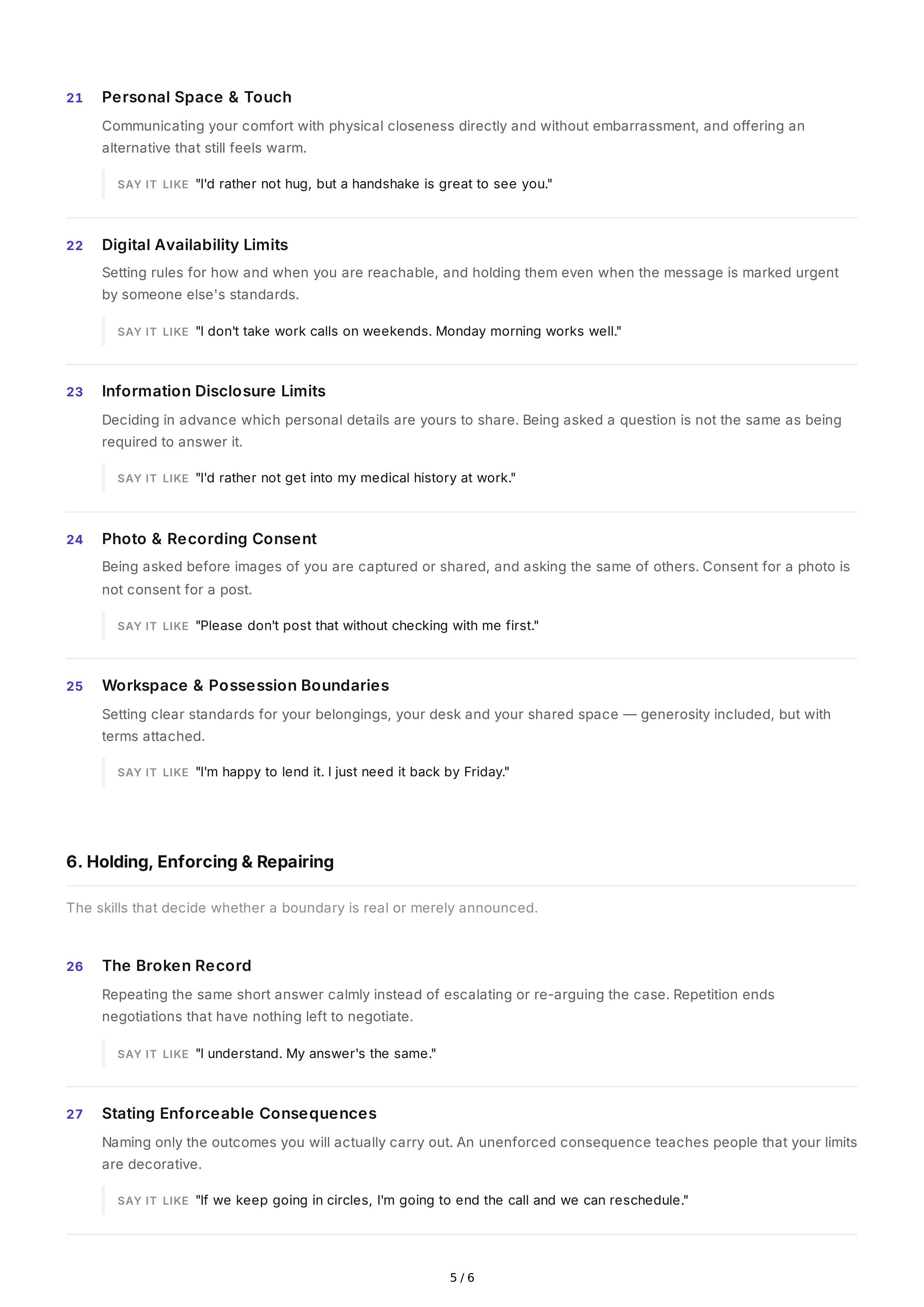
21
Personal
Space
&
Touch
Communicating
your
comfort
with
physical
closeness
directly
and
without
embarrassment
,
and
offering
an
alternative
that
still
feels
warm
.
SAY
IT
LIKE
"
I
'
d
rather
not
hug
,
but
a
handshake
is
great
to
see
you
."
22
Digital
Availability
Limits
Setting
rules
for
how
and
when
you
are
reachable
,
and
holding
them
even
when
the
message
is
marked
urgent
by
someone
else
'
s
standards
.
SAY
IT
LIKE
"
I
don
'
t
take
work
calls
on
weekends
.
Monday
morning
works
well
."
23
Information
Disclosure
Limits
Deciding
in
advance
which
personal
details
are
yours
to
share
.
Being
asked
a
question
is
not
the
same
as
being
required
to
answer
it
.
SAY
IT
LIKE
"
I
'
d
rather
not
get
into
my
medical
history
at
work
."
24
Photo
&
Recording
Consent
Being
asked
before
images
of
you
are
captured
or
shared
,
and
asking
the
same
of
others
.
Consent
for
a
photo
is
not
consent
for
a
post
.
SAY
IT
LIKE
"
Please
don
'
t
post
that
without
checking
with
me
first
."
25
Workspace
&
Possession
Boundaries
Setting
clear
standards
for
your
belongings
,
your
desk
and
your
shared
space
—
generosity
included
,
but
with
terms
attached
.
SAY
IT
LIKE
"
I
'
m
happy
to
lend
it
.
I
just
need
it
back
by
Friday
."
6.
Holding
,
Enforcing
&
Repairing
The
skills
that
decide
whether
a
boundary
is
real
or
merely
announced
.
26
The
Broken
Record
Repeating
the
same
short
answer
calmly
instead
of
escalating
or
re
-
arguing
the
case
.
Repetition
ends
negotiations
that
have
nothing
left
to
negotiate
.
SAY
IT
LIKE
"
I
understand
.
My
answer
'
s
the
same
."
27
Stating
Enforceable
Consequences
Naming
only
the
outcomes
you
will
actually
carry
out
.
An
unenforced
consequence
teaches
people
that
your
limits
are
decorative
.
SAY
IT
LIKE
"
If
we
keep
going
in
circles
,
I
'
m
going
to
end
the
call
and
we
can
reschedule
."
5 / 6
28
Following
Through
Doing
exactly
what
you
said
you
would
do
after
a
limit
is
crossed
—
without
anger
,
renegotiation
or
a
fresh
warning
.
SAY
IT
LIKE
"
I
said
I
'
d
leave
if
the
shouting
continued
,
so
I
'
m
going
to
go
now
."
29
Renegotiating
When
Things
Change
Revisiting
a
boundary
when
circumstances
genuinely
shift
,
rather
than
quietly
letting
it
erode
or
holding
it
out
of
stubbornness
.
SAY
IT
LIKE
"
That
worked
when
I
was
remote
.
Now
that
I
'
m
back
in
the
office
,
let
'
s
redo
the
schedule
."
30
Repairing
After
You
Slip
Acknowledging
it
when
you
over
-
promised
or
gave
in
,
and
resetting
the
limit
out
loud
.
Repair
is
what
keeps
a
boundary
credible
after
it
breaks
.
SAY
IT
LIKE
"
I
said
yes
when
I
should
have
said
no
.
Let
me
correct
that
—
I
can
'
t
do
it
."
6 / 6