Compassion
Interpersonal
Skills
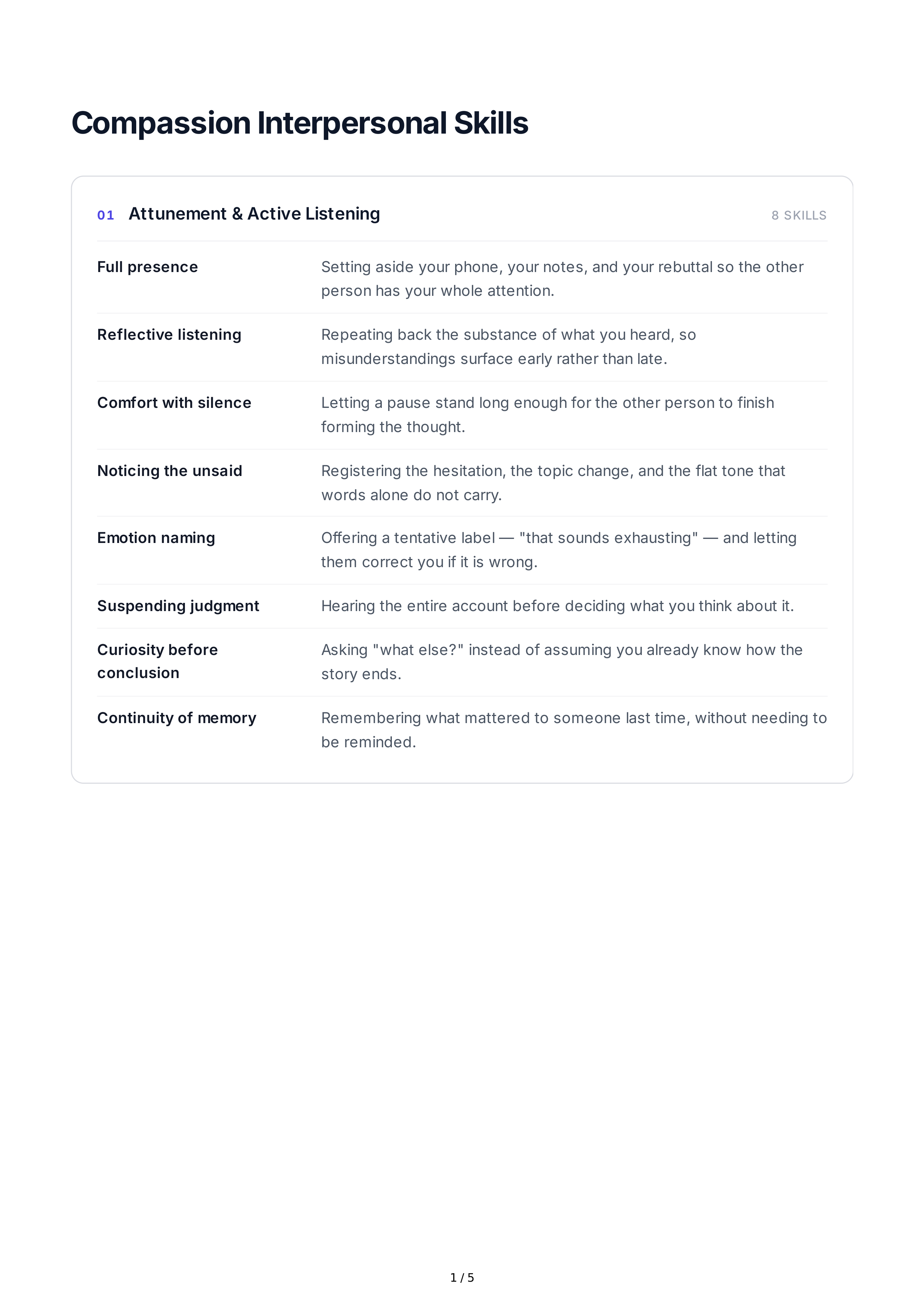
01
Attunement
&
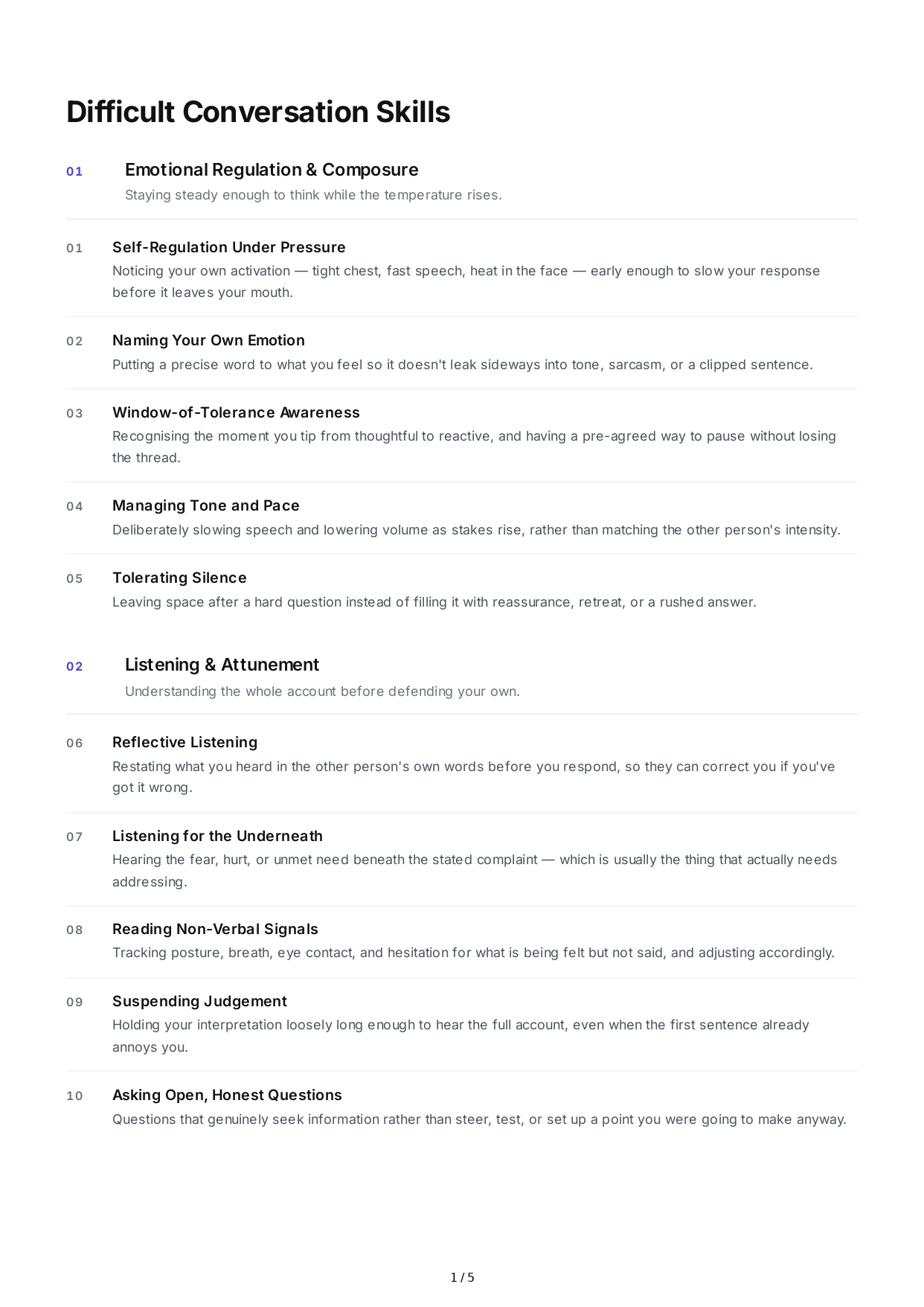
Active
Listening
8
SKILLS
Full
presence
Setting
aside
your
phone
,
your
notes
,
and
your
rebuttal
so
the
other
person
has
your
whole
attention
.
Reflective
listening
Repeating
back
the
substance
of
what
you
heard
,
so
misunderstandings
surface
early
rather
than
late
.
Comfort
with
silence
Letting
a
pause
stand
long
enough
for
the
other
person
to
finish
forming
the
thought
.
Noticing
the
unsaid
Registering
the
hesitation
,
the
topic
change
,
and
the
flat
tone
that
words
alone
do
not
carry
.
Emotion
naming
Offering
a
tentative
label
— "
that
sounds
exhausting
" —
and
letting
them
correct
you
if
it
is
wrong
.
Suspending
judgment
Hearing
the
entire
account
before
deciding
what
you
think
about
it
.
Curiosity
before
conclusion
Asking
"
what
else
?"
instead
of
assuming
you
already
know
how
the
story
ends
.
Continuity
of
memory
Remembering
what
mattered
to
someone
last
time
,
without
needing
to
be
reminded
.
1 / 5
02
Empathy
&
Emotional
Attunement
8
SKILLS
Perspective
-
taking
Reconstructing
the
situation
from
inside
their
constraints
rather
than
your
own
.
Validation
Treating
a
feeling
as
legitimate
without
automatically
endorsing
the
behavior
that
followed
it
.
Empathic
accuracy
Reading
what
someone
actually
feels
rather
than
projecting
your
own
reaction
onto
them
.
Resonant
warmth
Communicating
care
through
tone
,
pace
,
and
attention
—
not
only
through
word
choice
.
Steadiness
under
distress
Staying
regulated
when
someone
else
'
s
emotions
are
running
hot
.
Non
-
anxious
presence
Resisting
the
urge
to
fix
things
mainly
to
relieve
your
own
discomfort
.
Distress
tolerance
Remaining
in
the
conversation
instead
of
deflecting
with
humor
,
advice
,
or
a
subject
change
.
Proportionate
response
Matching
the
size
of
your
reaction
to
the
size
of
what
actually
happened
.
2 / 5
03
Nonjudgmental
Communication
8
SKILLS
Description
over
evaluation
Reporting
what
you
observed
instead
of
assigning
motives
to
it
.
"
I
"
statements
Framing
impact
from
your
side
— "
I
felt
sidelined
" —
rather
than
as
a
verdict
on
their
character
.
Tentative
framing
Saying
"
I
might
be
reading
this
wrong
"
to
keep
the
door
open
for
correction
.
Open
questions
Asking
questions
that
cannot
be
answered
with
a
simple
yes
or
no
.
Asking
before
advising
Checking
whether
someone
wants
ideas
right
now
or
only
wants
to
be
heard
.
Assumption
checks
Naming
your
interpretation
out
loud
and
asking
whether
it
is
accurate
.
Plain
language
Dropping
jargon
and
diagnosis
-
speak
that
put
distance
between
you
and
the
person
in
front
of
you
.
Constructive
honesty
Telling
the
difficult
truth
in
a
way
that
leaves
the
other
person
'
s
dignity
intact
.
3 / 5
04
Respect
,
Dignity
&
Inclusion
8
SKILLS
Cultural
humility
Treating
your
own
norms
as
one
framework
among
many
,
not
the
default
setting
.
Name
and
pronoun
respect
Using
the
language
people
use
for
themselves
,
consistently
and
without
commentary
.
Accessibility
awareness
Adapting
pace
,
format
,
and
setting
to
how
someone
can
best
take
part
.
Power
awareness
Noticing
how
rank
,
money
,
or
seniority
shape
who
feels
free
to
disagree
.
Language
that
includes
Avoiding
labels
that
turn
a
person
into
a
category
.
Trauma
-
informed
phrasing
Steering
clear
of
framing
that
implies
blame
or
pathology
.
Discretion
Holding
sensitive
information
carefully
—
including
in
casual
conversation
.
Consent
in
disclosure
Asking
before
sharing
someone
'
s
story
,
even
the
flattering
version
of
it
.
05
Boundaries
,
Repair
&
Self
-
Compassion
8
SKILLS
Compassionate
limits
Caring
about
someone
'
s
difficulty
without
taking
ownership
of
it
.
Warm
refusal
Saying
no
clearly
and
kindly
,
without
attaching
a
long
justification
.
Fatigue
awareness
Recognizing
depletion
in
yourself
before
it
curdles
into
resentment
.
Self
-
compassion
Extending
to
your
own
mistakes
the
patience
you
would
offer
a
colleague
.
Accountability
Owning
impact
plainly
,
without
attaching
a
defense
to
the
apology
.
Specific
repair
Changing
the
behavior
that
caused
harm
rather
than
only
regretting
it
.
Realistic
hope
Holding
optimism
that
does
not
require
pretending
the
difficulty
is
not
real
.
Referral
judgment
Recognizing
when
someone
needs
a
professional
you
are
not
.
4 / 5
06
Supportive
Action
8
SKILLS
Useful
help
Asking
"
what
would
actually
be
helpful
right
now
?"
rather
than
guessing
.
Follow
-
through
Doing
the
small
thing
you
promised
,
on
the
day
you
said
you
would
do
it
.
Advocacy
Spending
your
own
voice
on
someone
who
keeps
getting
talked
over
.
Accompaniment
Staying
alongside
a
person
without
needing
to
lead
or
be
credited
.
Ordinary
warmth
Using
names
,
greeting
people
,
and
keeping
small
courtesies
intact
under
pressure
.
Timely
check
-
ins
Following
up
the
week
it
happened
,
not
a
month
later
.
Resource
navigation
Knowing
where
real
help
lives
and
how
to
get
someone
to
it
.
Shared
celebration
Treating
someone
else
'
s
good
news
as
genuinely
,
ungrudgingly
good
.
5 / 5