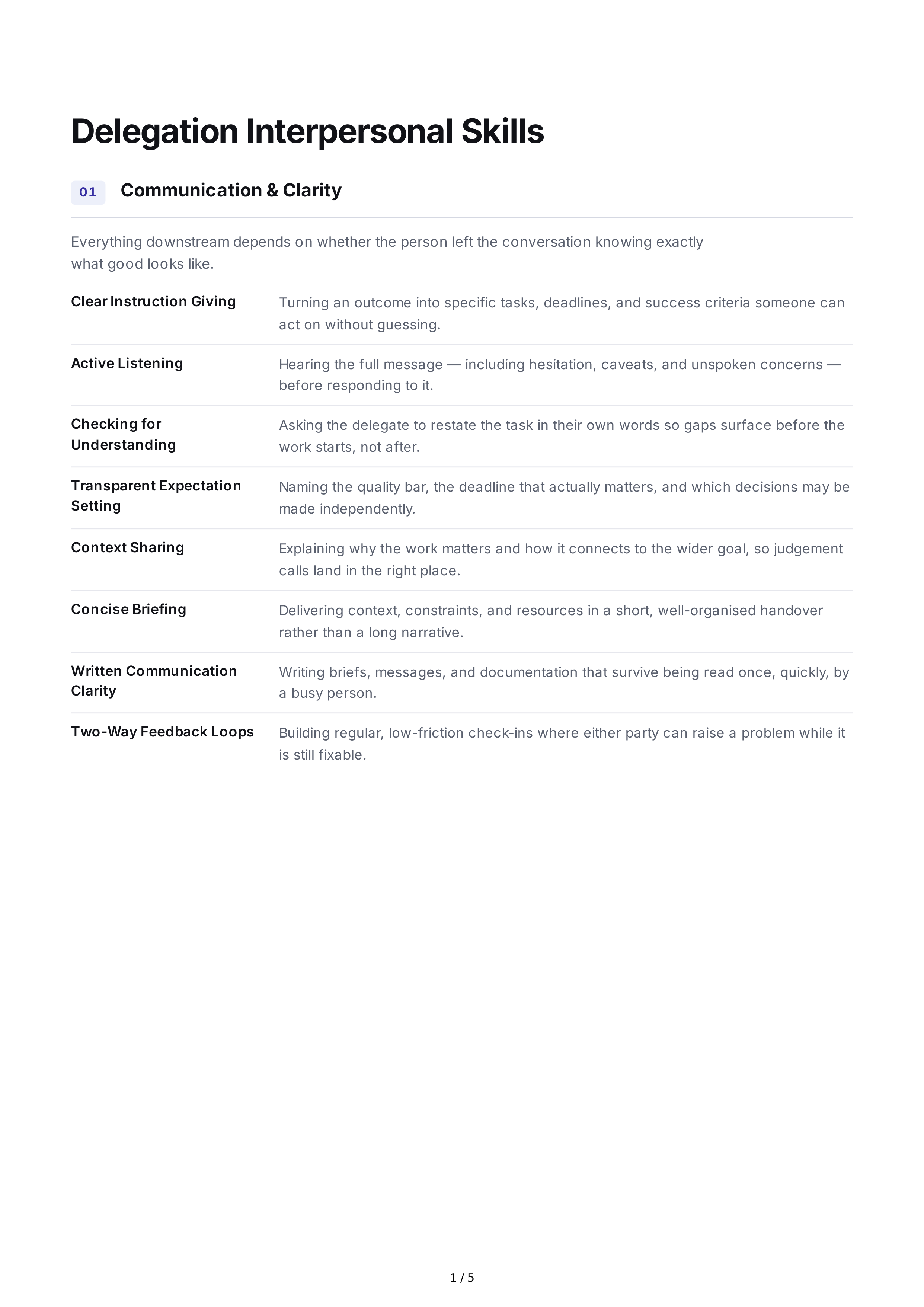
Delegation
Interpersonal
Skills
01
Communication
&
Clarity
Everything
downstream
depends
on
whether
the
person
left
the
conversation
knowing
exactly
what
good
looks
like
.
Clear
Instruction
Giving
Turning
an
outcome
into
specific
tasks
,
deadlines
,
and
success
criteria
someone
can
act
on
without
guessing
.
Active
Listening
Hearing
the
full
message
—
including
hesitation
,
caveats
,
and
unspoken
concerns
—
before
responding
to
it
.
Checking
for
Understanding
Asking
the
delegate
to
restate
the
task
in
their
own
words
so
gaps
surface
before
the
work
starts
,
not
after
.
Transparent
Expectation
Setting
Naming
the
quality
bar
,
the
deadline
that
actually
matters
,
and
which
decisions
may
be
made
independently
.
Context
Sharing
Explaining
why
the
work
matters
and
how
it
connects
to
the
wider
goal
,
so
judgement
calls
land
in
the
right
place
.
Concise
Briefing
Delivering
context
,
constraints
,
and
resources
in
a
short
,
well
-
organised
handover
rather
than
a
long
narrative
.
Written
Communication
Clarity
Writing
briefs
,
messages
,
and
documentation
that
survive
being
read
once
,
quickly
,
by
a
busy
person
.
Two
-
Way
Feedback
Loops
Building
regular
,
low
-
friction
check
-
ins
where
either
party
can
raise
a
problem
while
it
is
still
fixable
.
1 / 5
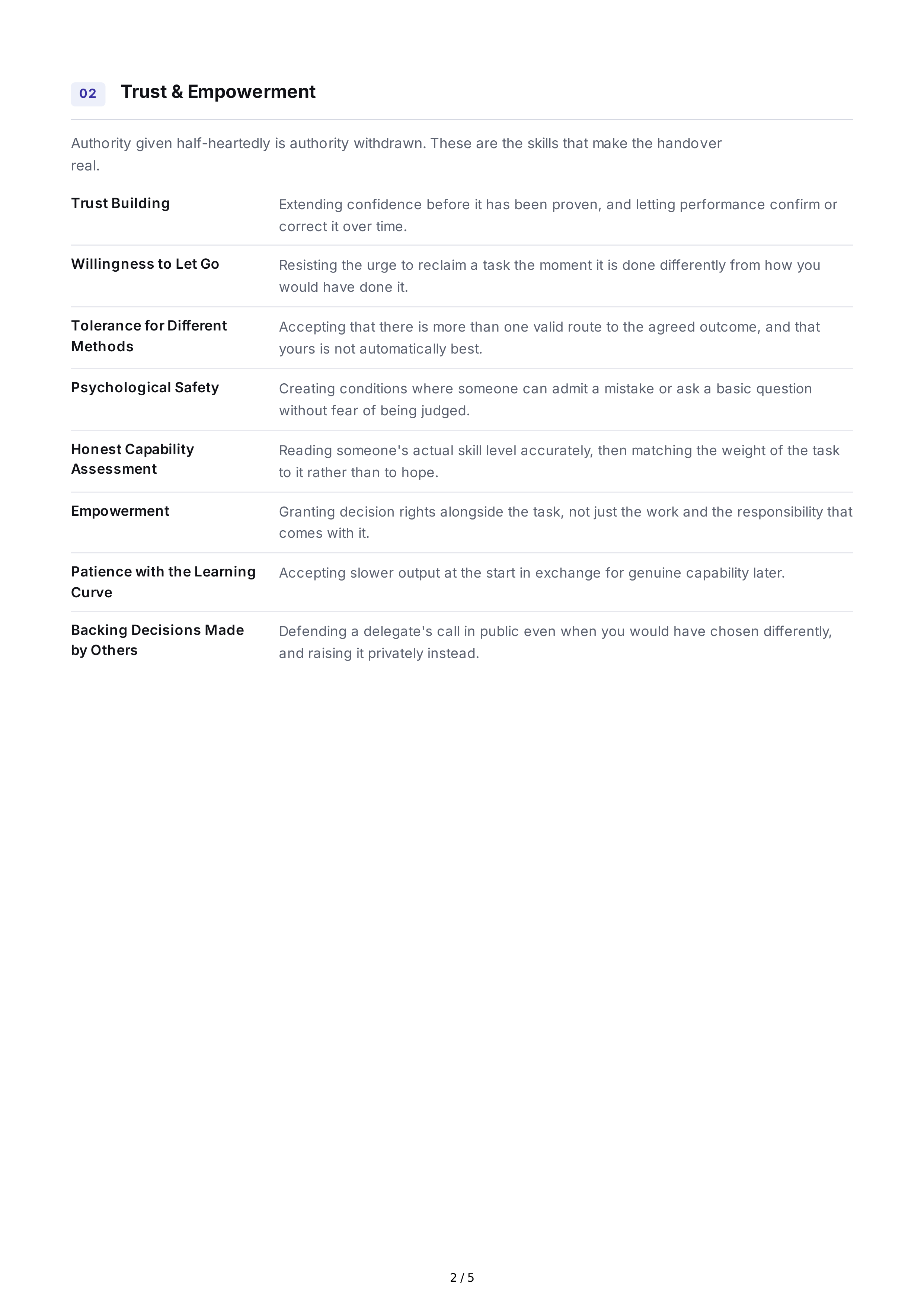
02
Trust
&
Empowerment
Authority
given
half
-
heartedly
is
authority
withdrawn
.
These
are
the
skills
that
make
the
handover
real
.
Trust
Building
Extending
confidence
before
it
has
been
proven
,
and
letting
performance
confirm
or
correct
it
over
time
.
Willingness
to
Let
Go
Resisting
the
urge
to
reclaim
a
task
the
moment
it
is
done
differently
from
how
you
would
have
done
it
.
Tolerance
for
Different
Methods
Accepting
that
there
is
more
than
one
valid
route
to
the
agreed
outcome
,
and
that
yours
is
not
automatically
best
.
Psychological
Safety
Creating
conditions
where
someone
can
admit
a
mistake
or
ask
a
basic
question
without
fear
of
being
judged
.
Honest
Capability
Assessment
Reading
someone
'
s
actual
skill
level
accurately
,
then
matching
the
weight
of
the
task
to
it
rather
than
to
hope
.
Empowerment
Granting
decision
rights
alongside
the
task
,
not
just
the
work
and
the
responsibility
that
comes
with
it
.
Patience
with
the
Learning
Curve
Accepting
slower
output
at
the
start
in
exchange
for
genuine
capability
later
.
Backing
Decisions
Made
by
Others
Defending
a
delegate
'
s
call
in
public
even
when
you
would
have
chosen
differently
,
and
raising
it
privately
instead
.
2 / 5
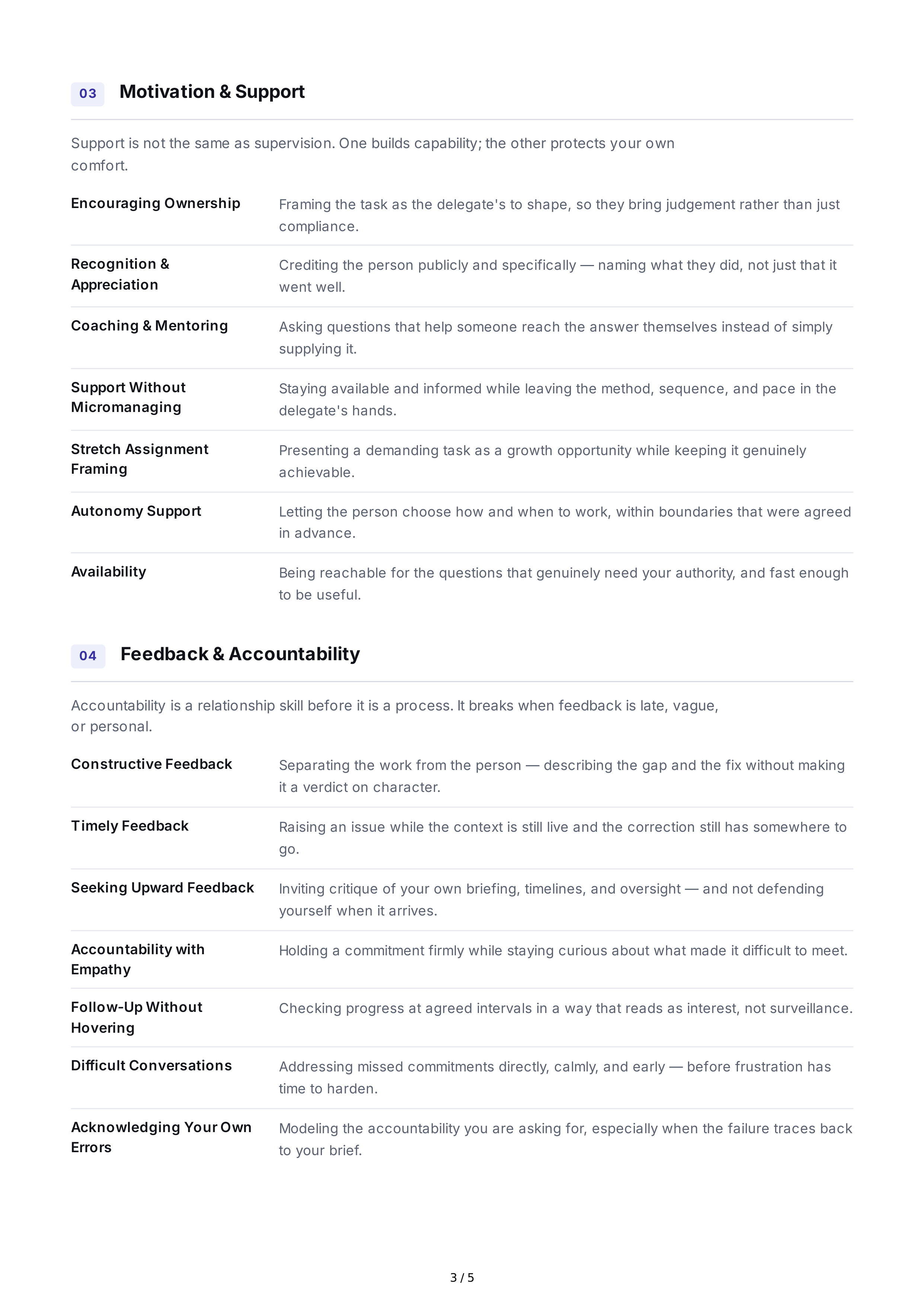
03
Motivation
&
Support
Support
is
not
the
same
as
supervision
.
One
builds
capability
;
the
other
protects
your
own
comfort
.
Encouraging
Ownership
Framing
the
task
as
the
delegate
'
s
to
shape
,
so
they
bring
judgement
rather
than
just
compliance
.
Recognition
&
Appreciation
Crediting
the
person
publicly
and
specifically
—
naming
what
they
did
,
not
just
that
it
went
well
.
Coaching
&
Mentoring
Asking
questions
that
help
someone
reach
the
answer
themselves
instead
of
simply
supplying
it
.
Support
Without
Micromanaging
Staying
available
and
informed
while
leaving
the
method
,
sequence
,
and
pace
in
the
delegate
'
s
hands
.
Stretch
Assignment
Framing
Presenting
a
demanding
task
as
a
growth
opportunity
while
keeping
it
genuinely
achievable
.
Autonomy
Support
Letting
the
person
choose
how
and
when
to
work
,
within
boundaries
that
were
agreed
in
advance
.
Availability
Being
reachable
for
the
questions
that
genuinely
need
your
authority
,
and
fast
enough
to
be
useful
.
04
Feedback
&
Accountability
Accountability
is
a
relationship
skill
before
it
is
a
process
.
It
breaks
when
feedback
is
late
,
vague
,
or
personal
.
Constructive
Feedback
Separating
the
work
from
the
person
—
describing
the
gap
and
the
fix
without
making
it
a
verdict
on
character
.
Timely
Feedback
Raising
an
issue
while
the
context
is
still
live
and
the
correction
still
has
somewhere
to
go
.
Seeking
Upward
Feedback
Inviting
critique
of
your
own
briefing
,
timelines
,
and
oversight
—
and
not
defending
yourself
when
it
arrives
.
Accountability
with
Empathy
Holding
a
commitment
firmly
while
staying
curious
about
what
made
it
difficult
to
meet
.
Follow
-
Up
Without
Hovering
Checking
progress
at
agreed
intervals
in
a
way
that
reads
as
interest
,
not
surveillance
.
Difficult
Conversations
Addressing
missed
commitments
directly
,
calmly
,
and
early
—
before
frustration
has
time
to
harden
.
Acknowledging
Your
Own
Errors
Modeling
the
accountability
you
are
asking
for
,
especially
when
the
failure
traces
back
to
your
brief
.
3 / 5
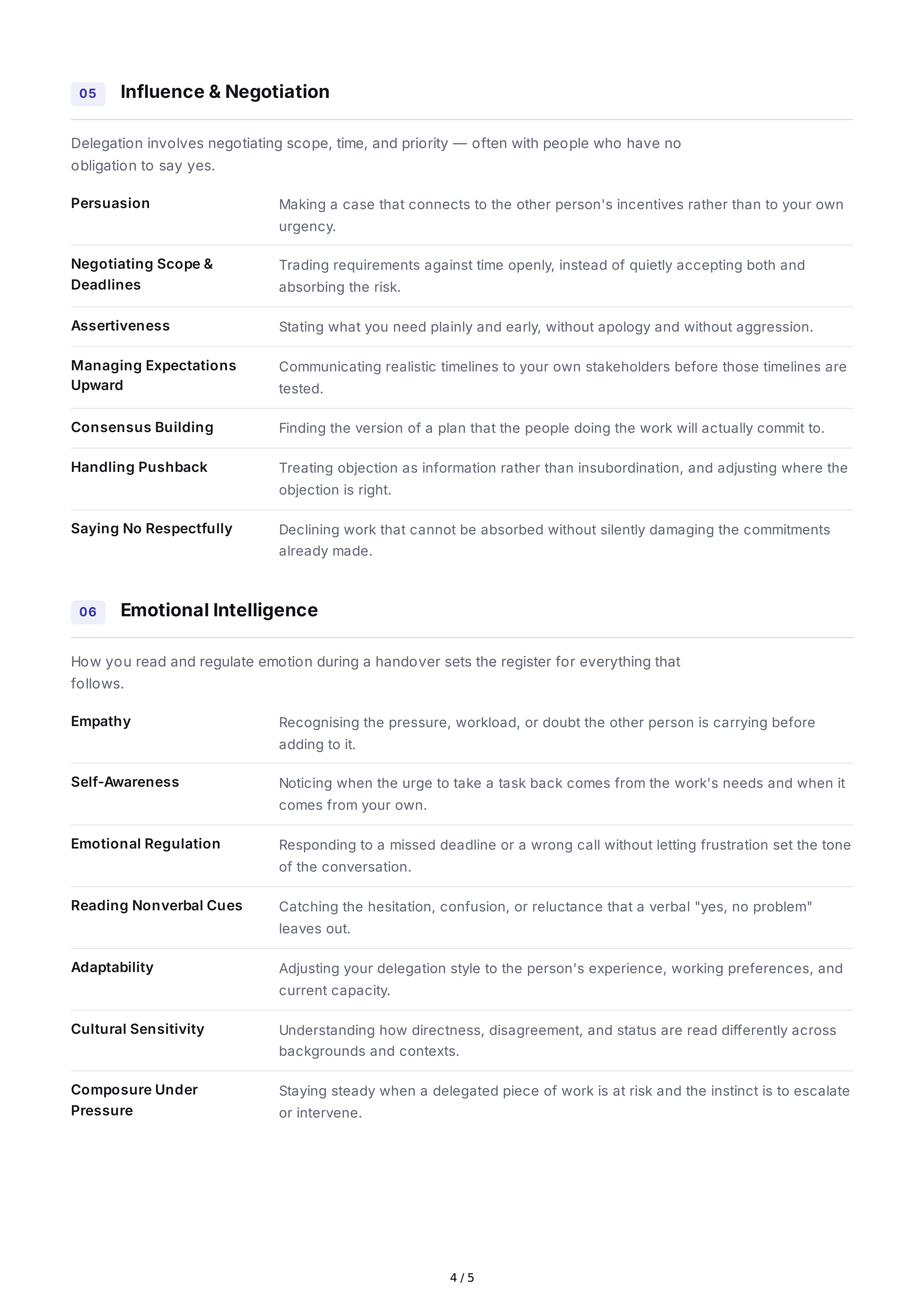
05
Influence
&
Negotiation
Delegation
involves
negotiating
scope
,
time
,
and
priority
—
often
with
people
who
have
no
obligation
to
say
yes
.
Persuasion
Making
a
case
that
connects
to
the
other
person
'
s
incentives
rather
than
to
your
own
urgency
.
Negotiating
Scope
&
Deadlines
Trading
requirements
against
time
openly
,
instead
of
quietly
accepting
both
and
absorbing
the
risk
.
Assertiveness
Stating
what
you
need
plainly
and
early
,
without
apology
and
without
aggression
.
Managing
Expectations
Upward
Communicating
realistic
timelines
to
your
own
stakeholders
before
those
timelines
are
tested
.
Consensus
Building
Finding
the
version
of
a
plan
that
the
people
doing
the
work
will
actually
commit
to
.
Handling
Pushback
Treating
objection
as
information
rather
than
insubordination
,
and
adjusting
where
the
objection
is
right
.
Saying
No
Respectfully
Declining
work
that
cannot
be
absorbed
without
silently
damaging
the
commitments
already
made
.
06
Emotional
Intelligence
How
you
read
and
regulate
emotion
during
a
handover
sets
the
register
for
everything
that
follows
.
Empathy
Recognising
the
pressure
,
workload
,
or
doubt
the
other
person
is
carrying
before
adding
to
it
.
Self
-
Awareness
Noticing
when
the
urge
to
take
a
task
back
comes
from
the
work
'
s
needs
and
when
it
comes
from
your
own
.
Emotional
Regulation
Responding
to
a
missed
deadline
or
a
wrong
call
without
letting
frustration
set
the
tone
of
the
conversation
.
Reading
Nonverbal
Cues
Catching
the
hesitation
,
confusion
,
or
reluctance
that
a
verbal
"
yes
,
no
problem
"
leaves
out
.
Adaptability
Adjusting
your
delegation
style
to
the
person
'
s
experience
,
working
preferences
,
and
current
capacity
.
Cultural
Sensitivity
Understanding
how
directness
,
disagreement
,
and
status
are
read
differently
across
backgrounds
and
contexts
.
Composure
Under
Pressure
Staying
steady
when
a
delegated
piece
of
work
is
at
risk
and
the
instinct
is
to
escalate
or
intervene
.
4 / 5
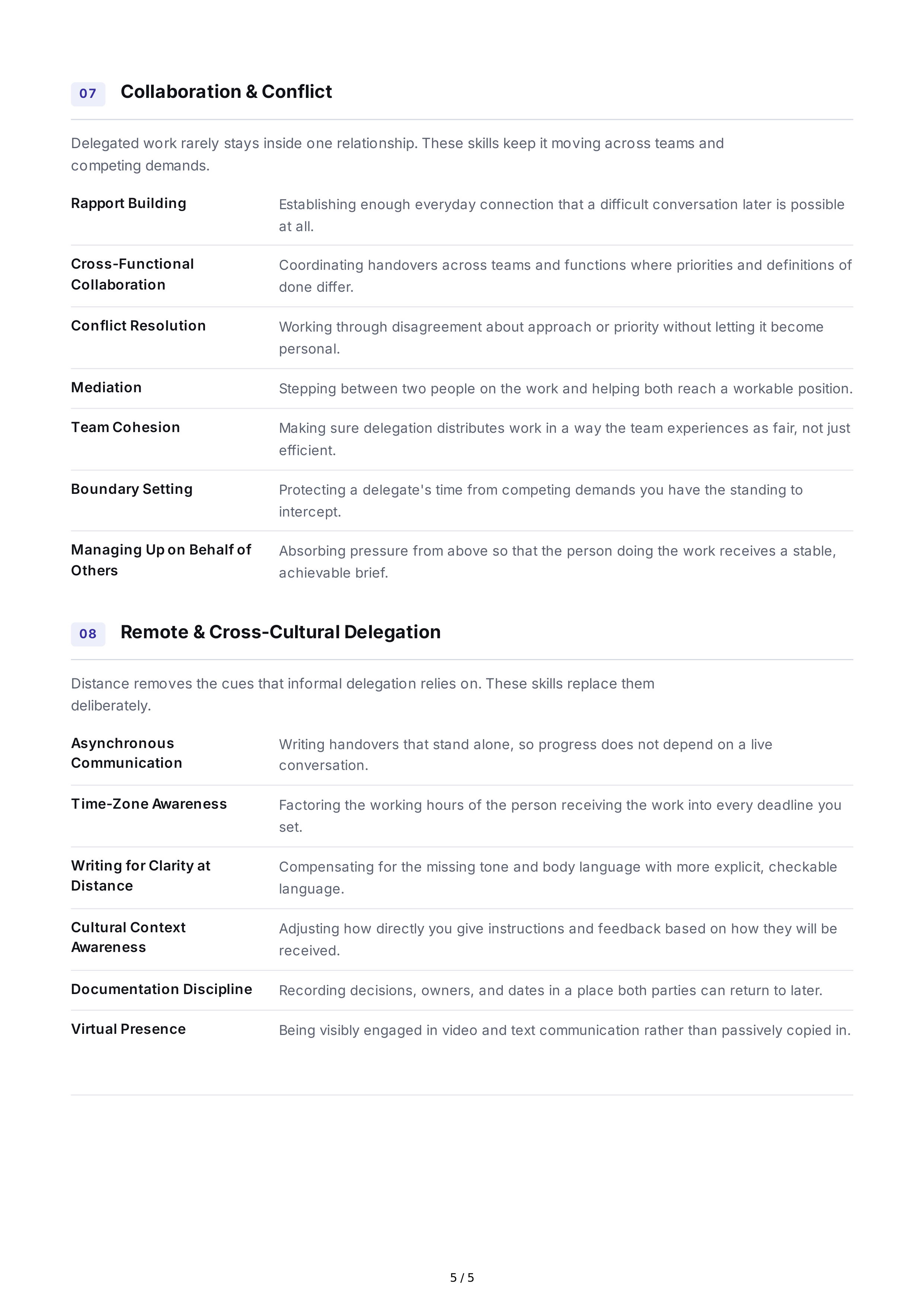
07
Collaboration
&
Conflict
Delegated
work
rarely
stays
inside
one
relationship
.
These
skills
keep
it
moving
across
teams
and
competing
demands
.
Rapport
Building
Establishing
enough
everyday
connection
that
a
difficult
conversation
later
is
possible
at
all
.
Cross
-
Functional
Collaboration
Coordinating
handovers
across
teams
and
functions
where
priorities
and
definitions
of
done
differ
.
Conflict
Resolution
Working
through
disagreement
about
approach
or
priority
without
letting
it
become
personal
.
Mediation
Stepping
between
two
people
on
the
work
and
helping
both
reach
a
workable
position
.
Team
Cohesion
Making
sure
delegation
distributes
work
in
a
way
the
team
experiences
as
fair
,
not
just
efficient
.
Boundary
Setting
Protecting
a
delegate
'
s
time
from
competing
demands
you
have
the
standing
to
intercept
.
Managing
Up
on
Behalf
of
Others
Absorbing
pressure
from
above
so
that
the
person
doing
the
work
receives
a
stable
,
achievable
brief
.
08
Remote
&
Cross
-
Cultural
Delegation
Distance
removes
the
cues
that
informal
delegation
relies
on
.
These
skills
replace
them
deliberately
.
Asynchronous
Communication
Writing
handovers
that
stand
alone
,
so
progress
does
not
depend
on
a
live
conversation
.
Time
-
Zone
Awareness
Factoring
the
working
hours
of
the
person
receiving
the
work
into
every
deadline
you
set
.
Writing
for
Clarity
at
Distance
Compensating
for
the
missing
tone
and
body
language
with
more
explicit
,
checkable
language
.
Cultural
Context
Awareness
Adjusting
how
directly
you
give
instructions
and
feedback
based
on
how
they
will
be
received
.
Documentation
Discipline
Recording
decisions
,
owners
,
and
dates
in
a
place
both
parties
can
return
to
later
.
Virtual
Presence
Being
visibly
engaged
in
video
and
text
communication
rather
than
passively
copied
in
.
5 / 5